
On Dec. 13 last year, a stranger in a Brown University bathroom noticed a man dressed head to toe in black, wrong for the weather, mere hours before that same man opened fire on Brown University’s campus, killing two and wounding eight before vanishing. Investigators had almost nothing: no name, no plate, just a tip describing a gray Nissan with Florida plates. But that was enough: Providence police ran it through a network of more than 70 Flock Safety cameras, which reached back through 30 days of history, and found the car had passed 14 times since Dec. 1. “We were able to find the vehicle on Flocks, actually get the actual plate, learn that it was a car rental,” said the Providence police chief. Police tracked the car thanks to Flock and traced him to a storage unit in New Hampshire less than a week after the shooting.
Somewhere in Florida, at almost the same time, a different man was looking into Flock-collected data, but for an entirely different reason. Officer Christopher Goodson wasn’t hunting a stranger but was watching for his estranged wife. Using his department’s access to Flock, he logged more than 700 unauthorized inquiries into her vehicle between September 2024 and June 2026, and was arrested just last week.
Flock Safety has spent nine years promising to solve crime. At the same time it may have built the most pervasive surveillance network in American history—one that is increasingly drawing loud pushback from advocates worried about what’s been collected and who has access to the data.
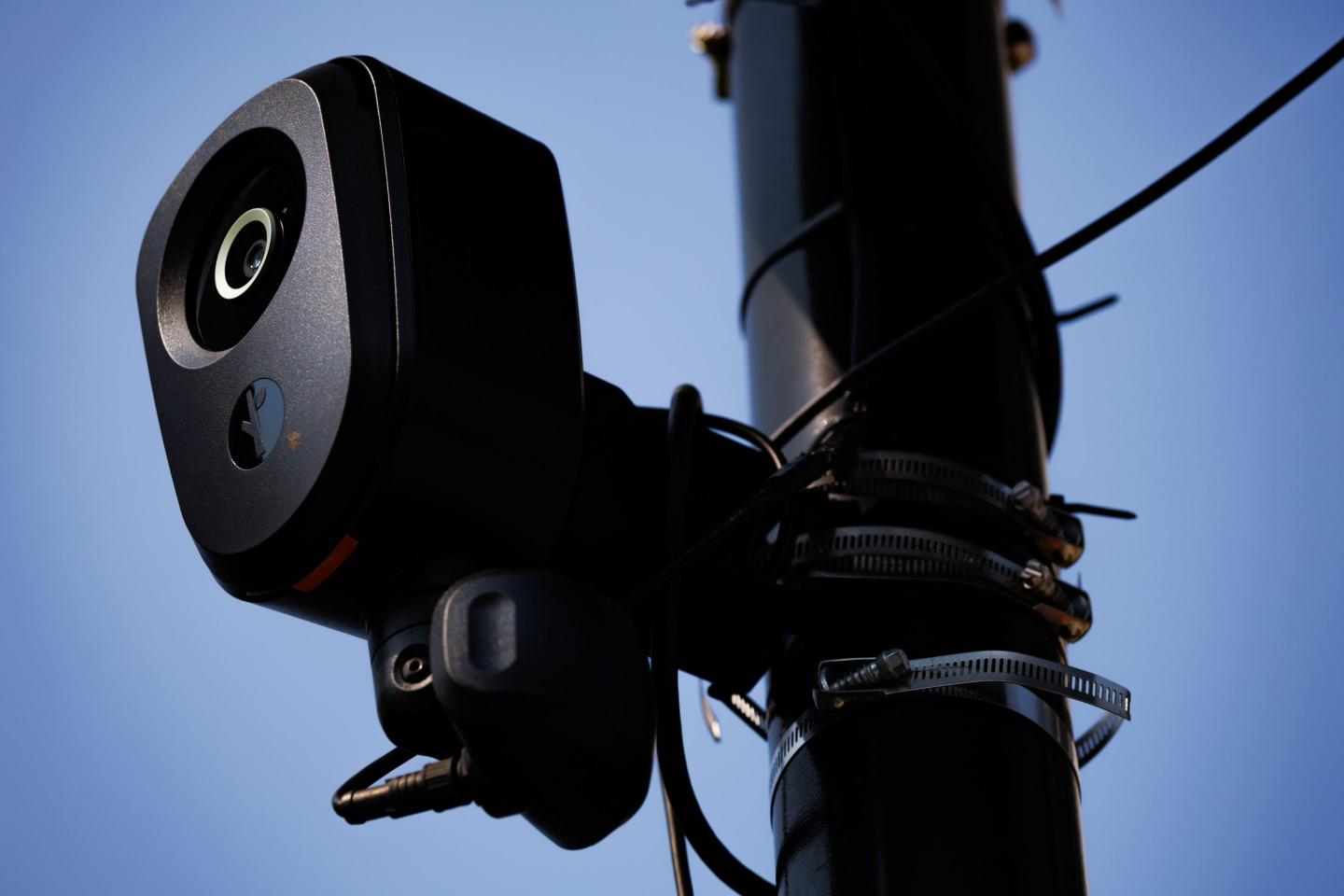
Flock’s network of solar-powered cameras don’t just record license plates, they log the make, model, color, and identifying details of every vehicle that passes in more than 5,000 communities across 49 states. Then law-enforcement officers can search that data using natural-language descriptions (for example, car color or a bumper sticker) across thousands of jurisdictions simultaneously. Theoretically any police department with a Flock contract can reconstruct where you drove, when, and how often. The company says data belongs to its customers and is typically deleted in 30 days. But Fortune found the LAPD’s own inspector general discovered that at least one Flock contract lets the company retain data for five years and use it for “any purpose in Flock’s sole discretion.”
The backlash is intense and keeps growing: Residents in 36 states have vandalized or destroyed automated license plate recognition (ALPR) cameras; 82 contracts have been terminated since 2021; and city council chambers from Boston to Santa Clara have become battlegrounds over a technology most residents didn’t know was watching them. Says Anne Toomey McKenna, a privacy attorney and visiting law professor at the University of Richmond: “Our Fourth Amendment was not designed for the persistent and pervasive surveillance environment which we live [in].” She called it a catch-22: The Supreme Court has ruled that accessing someone’s location data is a search requiring a warrant, “but then we step into this gray area” once police simply buy the data instead of compelling it.
When reached for comment regarding the controversy, Flock CEO Garrett Langley told Fortune that the company was started to solve crimes. “Every day, Flock helps solve crimes that would otherwise go unsolved. From finding missing children, to solving murders, violent crime, and recovering stolen vehicles, Flock gives investigators leads they didn’t have before,” Langley said. “That impact is why we started Flock, and it drives every decision we make about how this technology should be built and governed.”
It has been a very lucrative enterprise thus far. Flock is backed by blue-chip VC investors including a16z and Tiger Global. The nine-year-old startup told Fortune in April it had raised $500 million at an $8.3 billion valuation, has taken in $1.2 billion total, and crossed $500 million in annual recurring revenue in the first half of 2026. The company has now expanded into video, gunshot detection, drones, and AI-powered search software. The company confirmed to Fortune that over half of new revenue is non-license-plate readers.
“We are setting a baseline that we believe the industry should follow with our recent privacy enhancements and measures to proactively address officer abuse,” Langley continued. “Local communities, not Flock, decide their sharing rules, offense filters, and retention windows,” he continued. “Our job is to give them better tools that reflect their needs and values of their communities and to help hold individuals accountable when someone misuses the system.”
But one thing is clear: The technology that made Flock a billion-dollar business is turning it into what some see as a villain.
A significant funding background
Langley was an electrical engineer in metro Atlanta, hit by a string of break-ins, when he started asking why local police had so little to work with. “Due to a lack of investigative evidence, over 80% of property crime is never solved,” he later wrote in a company profile posted on Y Combinator’s site. “There was a clear gap in the market, left unfilled by ineffectual alarm systems and expensive, outdated traditional security cameras,” he wrote. “With the right team, technology, and policies, we could actually not only solve, but eliminate crime.”
Langley recruited two former colleagues—Matt Feury and Paige Todd. According to a16z’s announcement of Flock’s Series D (which the VC firm led in 2021), the three built their first prototype at Langley’s kitchen table in three weeks. Homeowners associations were the earliest customers, making up more than 40% of Flock’s business four years in before law-enforcement contracts came to dominate. At the time of the funding, a16z general partners David Ulevitch and David George called the company an “n of 1” startup, noting it was “effectively the only game in town.” Tiger Global led the Series E in February 2022, a $150 million round at a $3.5 billion valuation, joined by new investors 776 and Spark Capital alongside returning backers a16z, Bedrock, Matrix, Meritech, and Initialized. By March 2025, Flock raised another $275 million at a $7.5 billion valuation in a round led again by a16z, with participation from Greenoaks, Sands Capital, Founders Fund, Kleiner Perkins, Tiger Global, and Y Combinator. Neither a16z nor Tiger responded to Fortune’s requests for comment.
Investors have no doubt been thrilled with the growth, but some residents in Flock-patrolled areas are rebelling. In July, angry citizens cut down Flock cameras with an electric saw in upstate New York. They threw paint on them in Oakland, Calif., and rammed a truck into one in Idaho. One man in Florida has taken to sitting in a lawn chair holding a piece of cardboard on a pole to block a camera’s view. Just this week, a man dressed up as Darth Vader showed up at a San Diego meeting to “praise” the city’s use of Flock cameras. Flock cameras have now been vandalized in at least 36 states, according to NPR. Asked about the vandalism, Langley said that people engaging in it likely aren’t being told they may be committing a felony, and said residents with concerns about the technology should raise them with their city council rather than the cameras themselves.
Furthermore, a Washington Post investigation found nearly 50 cases of officers charged with or accused of misusing the cameras, many involving tracking current or former romantic partners. The Institute for Justice keeps a public database of more than 150 documented cases nationwide, sorted into four types—stalking, non-law-enforcement use, misread errors, and other misuse—drawn from media reports and public records. IJ says this is likely an undercount, since officers rarely have to give a specific reason for a search.
In March, Boston, Flagstaff, and Santa Clara all suspended or ended their Flock contracts after Amazon’s Ring pulled its Flock integration in the wake of backlash to a Super Bowl ad. Reporting by the San Francisco Standard found 82 Flock contracts terminated across 28 states between August 2021 and May 2026, with 39 of them in just the first five months of this year alone. Still, Langley told Fortune these were not affecting business. “Flock continues to bring on significantly more customers than are leaving. We are growing our customer base at 10 times the rate of customer churn, and agencies are turning more to Flock every day to help deter crime and make their communities safer.”
Not every city ends up on the cancellation list, even after loud public pressure. Peter K. Jackson, counsel at Greenberg Glusker, pointed to West Hollywood, which he said renewed its Flock contract without amendment “despite a tremendous public rancor at various city council meetings.” Jackson told Fortune that outcome is partly due to a structural quirk: West Hollywood doesn’t run its own police department, relying instead on the Los Angeles County Sheriff’s Department for policing, meaning the city council isn’t the only party with a say in whether the cameras stay. Jackson suggested that may have given council members reason to hesitate before cutting a tool the county sheriff’s office had come to rely on, even as residents packed meetings to object.
Many of the cities that are, however, canceling contracts have city council meetings that sometimes share similar themes: a growing resentment against surveillance technology and data collection.
Privacy advocates are particularly worried about long or lax retention periods that mean data is searchable for months or even years. “Flock’s standard retention period is thirty (30) calendar days from the date of capture. This standard retention period applies to all customer data, unless otherwise specified in the individual customer’s agreement,” read Flock’s Evidence Policy. Then last week, Flock recommended a default to seven days, and introduced “Evidence Mode,” letting detectives preserve specific data past that window for active cases. Langley wrote that Flock’s own analysis found “over 90% of searches without a full plate are done within a week,” and that “every community will continue to choose the retention period that fits its public safety strategy.” But Tom Bowman, policy counsel at the Center for Democracy and Technology’s Security & Surveillance Project, told Fortune that the policy changes still leave it up to the customer. “This is just a recommendation,” he said. “This is not legally binding.” The real retention period for that city is whatever its own contract says.
That’s something confirmed by a government audit of one of Flock’s largest customers. In July, the Los Angeles Police Department was renegotiating its own Flock agreement over data-ownership concerns. Around the same time, the department’s own inspector general audited its Flock contracts and published the findings. One of its agreements lets Flock “retain the right to use the foregoing for any purpose in Flock’s sole discretion,” while a separate agreement grants the company rights to use anonymized footage for “training of machine learning algorithms.” The report continued quoting the agreement: “Flock shall retain all data collected for five years at no charge to the Department or City”—60 times longer than Flock’s “standard” 30-day policy, and more than 260 times longer than the seven-day figure the company spent last week promoting publicly.
Privacy advocates say this is the real danger: A simple surveillance camera tracks your passing of a certain location at that point in time. This, on the other hand, can potentially follow your every move. “ALPR systems have become so ubiquitous that they are not just tracking your location at a single point in time, but they are tracking your pattern of movements,” Bowman explained. “They can essentially reconstruct your entire daily life: where you go to sleep, where you go to work, where you go to service, so on and so forth.”
In response to the LAPD’s ongoing renegotiation, Langley told ABC7 that “the technology is really simple.” He explained: “A car drives by, we take a picture. It’s a static picture of a car, and then we read the license plate. That’s what the technology is. It’s actually not that complicated, it’s pretty simple.”
Both Jackson and McKenna say Flock’s language of “customers own the data” can be true, but that also doesn’t mean Flock also can’t retain the data and use it to train its technology. Currently, LAPD responded to its audit by drafting new contract language that would explicitly bar any vendor from using city data “to train, fine-tune, or improve any algorithm or artificial-intelligence system” going forward.
Michael De Dora, U.S. advocacy lead at Access Now, told Fortune a larger issue is what happens when that data crosses jurisdictions. Once police departments have a contract with Flock, he said, they “can then go to other police departments and agencies and say, ‘Hey, let’s pull all this Flock information together,’” creating what he called “a searchable, shareable historical database of the whereabouts of Americans” that is, in his words, “a totally unregulated space right now.” A retention limit set by one city’s contract, in other words, doesn’t necessarily bind what happens to that same data once another agency has pulled a copy of it.
The question of cross-jurisdictional data sharing is already playing out. IJ’s database documented a Johnson County, Texas, sheriff’s deputy who ran a nationwide Flock search for a woman suspected of having had an abortion, in May 2025. Another case stems from Wisconsin in which officers, in released court records under probable cause, searched for a man because his “vehicle travels to Michigan frequently which is a known source state for marijuana as it is legal there” and searched his car for marijuana.
Is this backlash or is there a legal argument to be made?
Both McKenna and Bowman connect the contract fight to a bigger, unresolved legal one. Courts have long held that a driver on a public road has no reasonable expectation of privacy, but McKenna argues that no longer holds up cleanly.
Bowman pointed to Chatrie v. United States, decided this year, which held that police accessing precise location history is a search requiring a warrant regardless of scope, precedent he argues could extend to ALPR networks that, at scale, can rebuild someone’s entire daily movement rather than capturing one plate at one intersection.
“Law enforcement can circumvent the Fourth Amendment simply by pulling out their wallet and buying that data,” he said, a gap privacy advocates have been trying to close for years. “The Fourth Amendment’s Not For Sale Act is a bill that has been introduced in multiple Congresses that continuously receive support and then gets blocked at the last minute,” Bowman said. If it ever passed, he argues, it would functionally require a warrant before police could buy the kind of location data ALPR networks generate, which is why he doesn’t expect Flock to support it.
Flock cameras are helping police catch criminals and potentially act as deterrents before a crime is even committed. But citizens and courts are now deciding what price to put on Americans’ freedom to move without being watched.