
Good morning. On Fortune’s radar today:
- Bessent’s bond buyback plan is like ‘rearranging deckchairs on the Titanic.’
- Markets: Chill.
- Venezuela wants your money and your drilling equipment.
- Trump calls for “Economic D-Day” against Iran.
- More ships are getting through the Hormuz than we thought.
- Poll: Most Russians want the war with Ukraine to end.
- AI is causing dislocation in the job market.
- It’s a golden era for train robberies, thanks to Covid.
➡️ Did someone forward you this email? If you would like to receive this information directly, every morning before the markets open in New York, sign up here.
BESSENT’S BOND DRAMA
Bessent’s $4 billion bond buyback plan is like ‘rearranging deckchairs on the Titanic given the U.S. national debt of $40 trillion,’ ING says
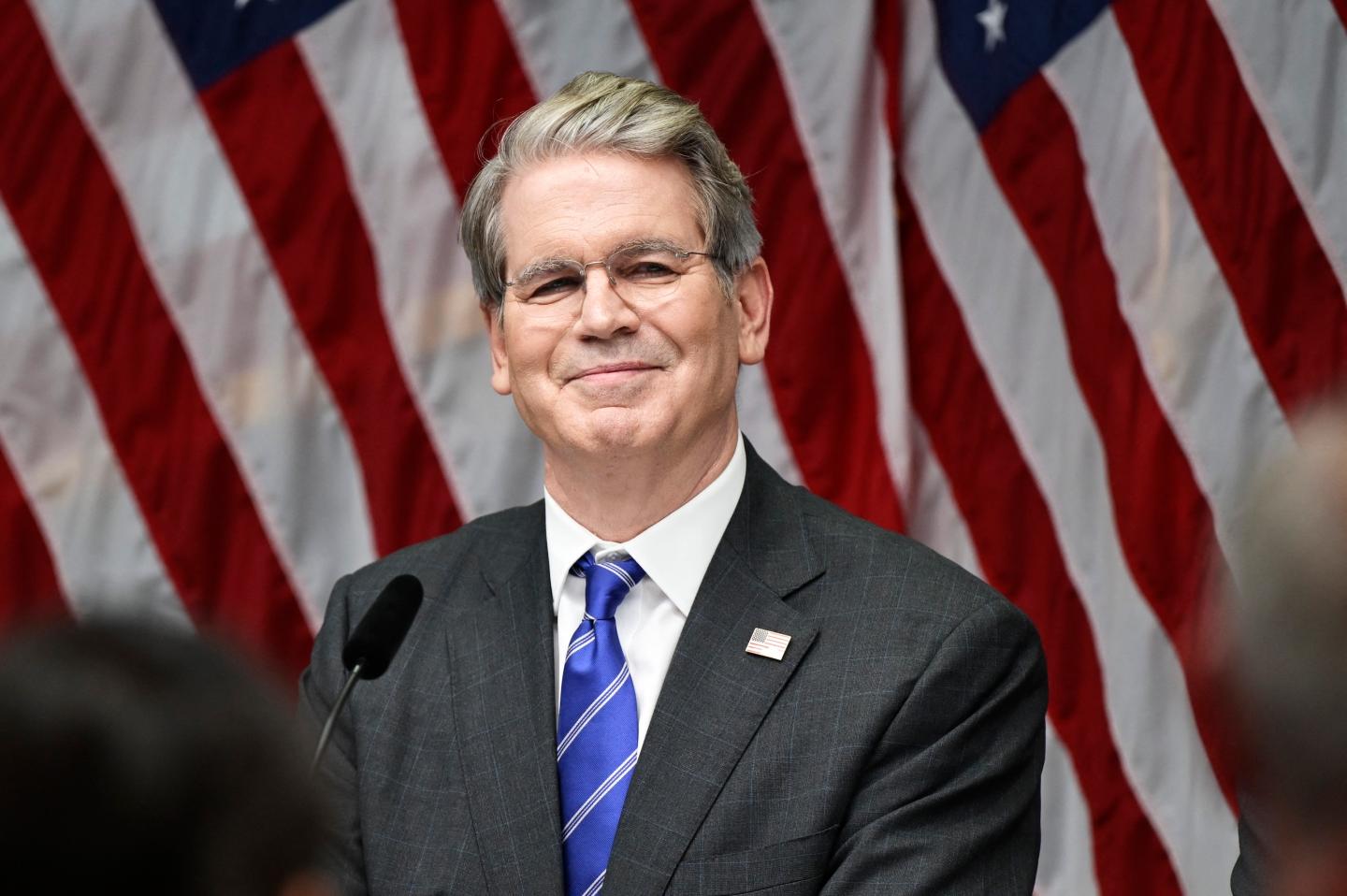
U.S. Treasury Secretary Scott Bessent made a surprise intervention into the bond market yesterday, promising to “at least double” its buybacks of long-dated bonds, such as the 10-, 20-, and 30-year Treasuries. “The current maximum size of $2 billion per operation will be at least $4 billion per operation.” The buying will start on September 9. A total of up to $128 billion could be spent over the course of a year, The Wall Street Journal estimated.
The intent of the operation is to raise the price of the bonds and thus lower the interest yield on them. Long-dated bonds are used to set interest rates on a wide range of credit products, such as mortgages, car loans and commercial loans. If rates fall, that credit should become cheaper to obtain.
The intervention worked: The yield on the 30-year Treasury fell from over 5.3% to 5.19%, before ticking up a little to 5.218% this morning. (That’s a big single-day decline in bondland.)
Wall Street reacted with … skepticism.
“While increasing liquidity buy-back operations by $2 billion might seem like rearranging deckchairs on the Titanic given the U.S. national debt of $40 trillion, yesterday's intervention by the U.S. Treasury has been warmly greeted by investors around the world,” ING’s Chris Turner told clients this morning.
Guneet Dhingra and his team at BNP Paribas said: “Despite a series of efforts to thwart bond vigilantes, we believe these measures will struggle to offset either declining Fed credibility or rising rate expectations. … bond vigilantes continue to have the upper hand. The boost to buybacks is also happening in a world of challenged Fed credibility. We do not believe buybacks will be enough to offset a continued loss in Fed credibility.”
“Admittedly, the increase in buybacks isn’t a particularly big amount relative to the number of outstanding Treasuries. But it offers a signal that officials are willing to support the long end,” Deutsche Bank’s Henry Allen et al said in an email.
Ed Yardeni, who invented the phrase “bond vigilantes,” said “Bessent is signaling that he will do whatever it takes to keep a lid on bond yields. His message to the Bond Vigilantes: ‘You folks aren't the only players in the bond market.’”
THE MARKETS
U.S. and Asian markets step up despite increased price of oil
Traders in America and Asia appeared to welcome Bessent’s promised injection of new money into the bond markets. The S&P 500 rose yesterday, and futures were in a holding pattern this morning before the opening bell. The index remains near its all-time high in part because retail traders net bought $6.9 billion in stocks in the most recent week monitored by Arun Jain and his team at J.P. Morgan.
Asian markets rose strongly today, despite President Trump’s threats to impose more harsh economic measures against Iran, which produced an immediate increase in the price of oil this morning.
- S&P 500 futures were flat this morning. The index rose 0.21% yesterday.
- In Europe, the Stoxx 600 was down 0.08% in early trading and the U.K.’s FTSE 100 was up 0.19% before lunch.
- Asia: South Korea’s KOSPI was up 5.89%. Japan’s Nikkei 225 was up 1.36%. India’s Nifty 50 was up 0.64%. China’s CSI 300 was up 0.09%.
- Brent crude was $94 per barrel this morning, up from $91 yesterday.
- Bitcoin rose to $71.6K.
MORE FROM FORTUNE
In this economy, millennials and Gen Z would rather break up than date someone in debt: ‘There’s a pretty big divide’ - Catherina Gioino
Companies are spending trillions on AI. The C-suite doesn’t know who is in charge of it - Amanda Gerut
The Real Cost of OpenAI’s Security Breaches - Fortune Daily
‘Buyers aren’t yet opening their wallets’: AI-generated assets are flooding marketplaces, but consumers are snubbing them for human-made products - Sasha Rogelberg
Teachers in one of San Francisco’s richest suburbs are so underpaid that a philanthropist just gave each of them $9,161 - Sydney Lake
Meta faces a $1.4 trillion threat that could mean ‘turning in the keys and walking away’—but the stakes of the case reach across tech - Tatiana Sataua
OIL
Venezuela: Please come and exploit our resources!
Venezuela’s new petroleum minister sees her South American home not as a dilapidated former oil giant, but as an emerging energy economy ripe for U.S. and foreign investments.
Paula Henao, who took over as the hydrocarbons minister in March after the forced U.S. removal of former leader Nicolás Maduro, told an overflowing Houston energy audience on Wednesday that Venezuela is much more than just its famed heavy-grade crude oil, Fortune’s Jordan Blum reports. There are more than 916 exploration opportunities awaiting foreign investment, she said, including natural gas and other untapped oil basins.
“It’s an entire world waiting to be discovered, just waiting for us to reach these agreements so we can develop these new areas,” she told the crowd at the posh Post Oak Hotel in Houston.
ONE BIG THING
Trump announces global trade war against Iran
President Trump announced he will impose “an ECONOMIC D-DAY” on Iran involving sanctions on any country that deals with the Islamic Republic. “This will be Economic Warfare and Isolation on an unprecedented scale,” he said on Truth Social. “ANY country that allows its financial institutions, businesses, airports, or government entities to provide any type of lifeline to Iran will itself face TREMENDOUS Economic Consequences. Oil smuggling, swap lines, cash transfers, exchange houses, ship registries, front companies — It all needs to stop NOW.”
Iran said, “The so-called 'Economic D-Day' is a diversion from America's own crisis: unprecedented debt & surging interest costs,” per Seyed Abbas Araghchi, Iran’s foreign minister.
The threat came a day after the UAE announced it would stop all trade with Iran in retaliation for being struck by Iranian missiles. That move could deepen the Iranian recession to 5% this year. New sanctions will hurt Iran for sure, but don’t expect this to be the final straw, Mehrdad Sepahvand, a former economic adviser to the Central Bank of Iran, told CNBC. “We should be a little bit cautious about the view that the Iranian economy is simply on the verge of collapse.”
- Open question: It will be interesting to see if Trump is willing to impose his sanctions on Russia and China, who are among Iran’s largest trade partners.
The U.S. is getting more ships through the Strait of Hormuz than we thought
Between 15 and 20 tankers are transiting the Strait of Hormuz each night as part of a U.S. operation to smuggle vessels, with their transponders switched off, through the seaway and protect them from Iranian attacks, Axios reports. The news is a surprise because previously it was thought that only half a dozen ships per day were making the run. The operation has been going on for several weeks via the southern channels close to the coast of Oman. Axios says about 10 million barrels of oil a day are making it through.
The New York Times has different numbers: 5 million barrels per day made it through in July, the paper said. Centcom said 1,000 ships have made the journey, protected by naval ships, helicopters, planes, and missile interceptors.
Nonetheless, at least 15 ships have been hit by Iranian fire during the war.
PUT OUT OVER PUTIN
Large majority of Russians want the war with Ukraine to end
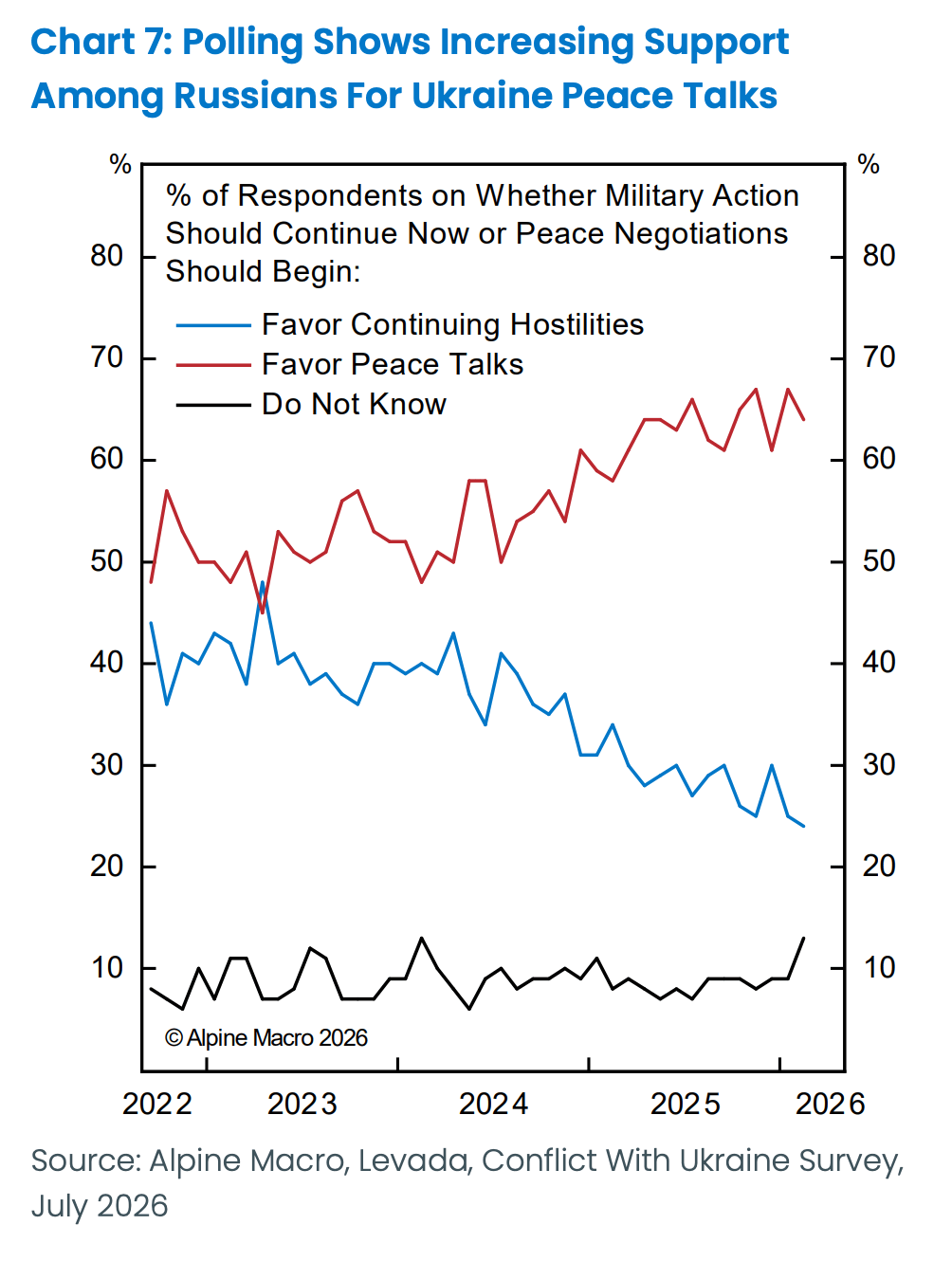
In Russia, Putin’s war with Ukraine is increasingly unpopular, according to this polling data from Alpine Macro. 65% now favor peace talks. That’s not surprising. Russia has suffered roughly 1.4 million casualties since the war began, of which perhaps 450,000 were fatalities.
And there will be more to come, according to Alpine’s Chief Geopolitical Strategist Dan Alamariu. “The Kremlin may be preparing a large-scale upcoming offensive. It has stepped up missile and drone strikes as Ukrainian interceptor stocks run dry," he said in a note seen by Fortune.
Ukrainian intelligence expects Putin to order a call-up of 300,000 to 500,000 men after the September elections.
AI
More evidence that AI is causing dislocation in the job market
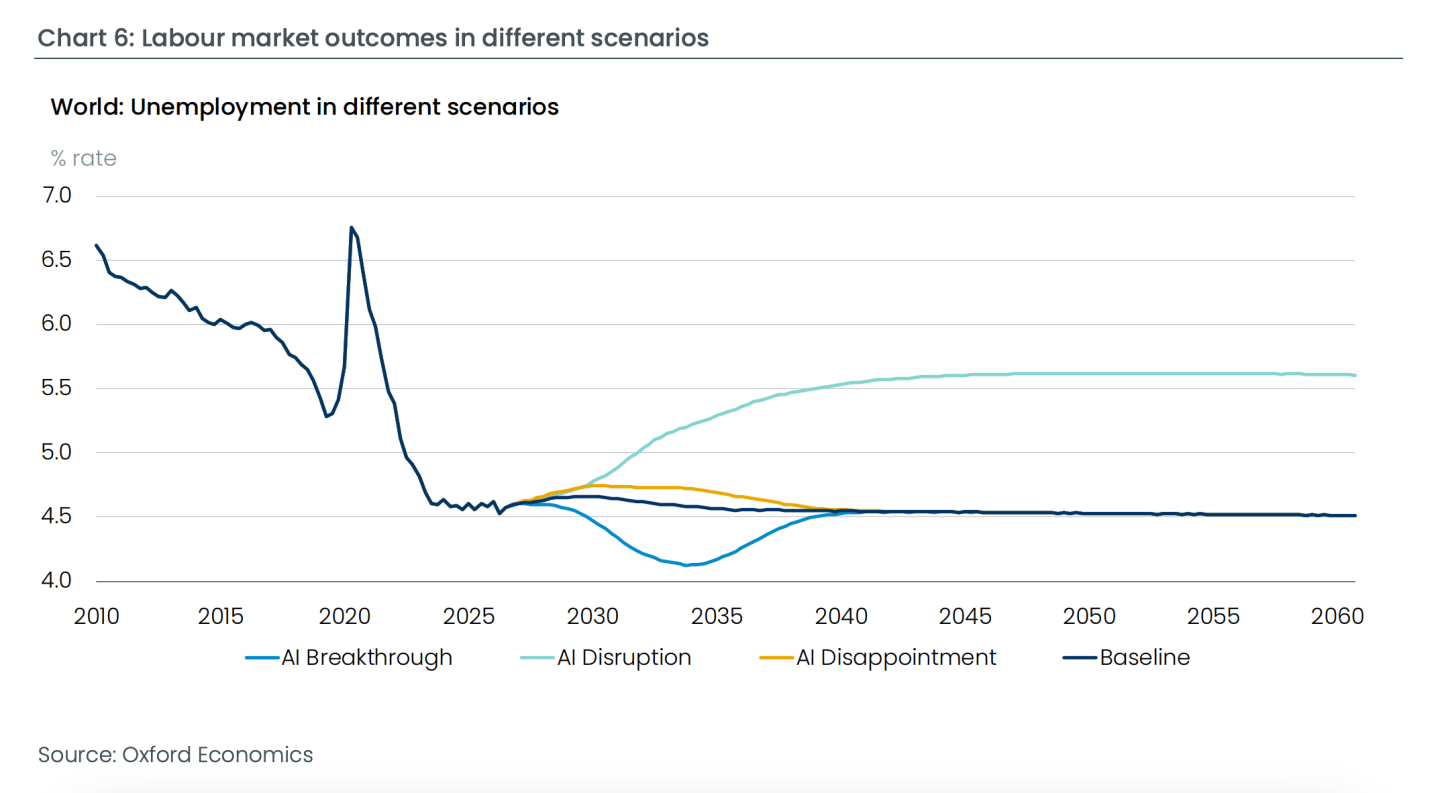
If AI is “disruptive” to the job market it could permanently raise unemployment in the U.S. a full percentage point, to above 5%, according to a forecast from Adam Slater and Daniel Moseley of Oxford Economics. That’s just one scenario, the pair said in a recent note. There are three possible scenarios: “An AI Breakthrough scenario with large productivity gains and positive labour market outcomes, an AI Disruption scenario with fast productivity rises but serious dislocation of labour markets, and an AI Disappointment scenario with weaker productivity gains and moderately worse labour market outcomes,” they said. It might look like this:
OK, so that’s the forecast. But how is it panning out in real life? Analysts are still reading the tea leaves on whether AI has started destroying or creating jobs. But there is a steady drip of research showing that AI is job-destructive at the edges. Sarah Dong and Joseph Briggs of Goldman Sachs looked at industries with high exposure to AI and then counted job openings in those industries listed on Indeed. Companies that use AI a lot have reduced the pace of their hiring, they said in a note this week: “Industries with greater exposure to AI automation are associated with slower job openings growth since the second half of 2022, with a more negative relationship in Germany, Australia, and the U.S.” It looks like this:
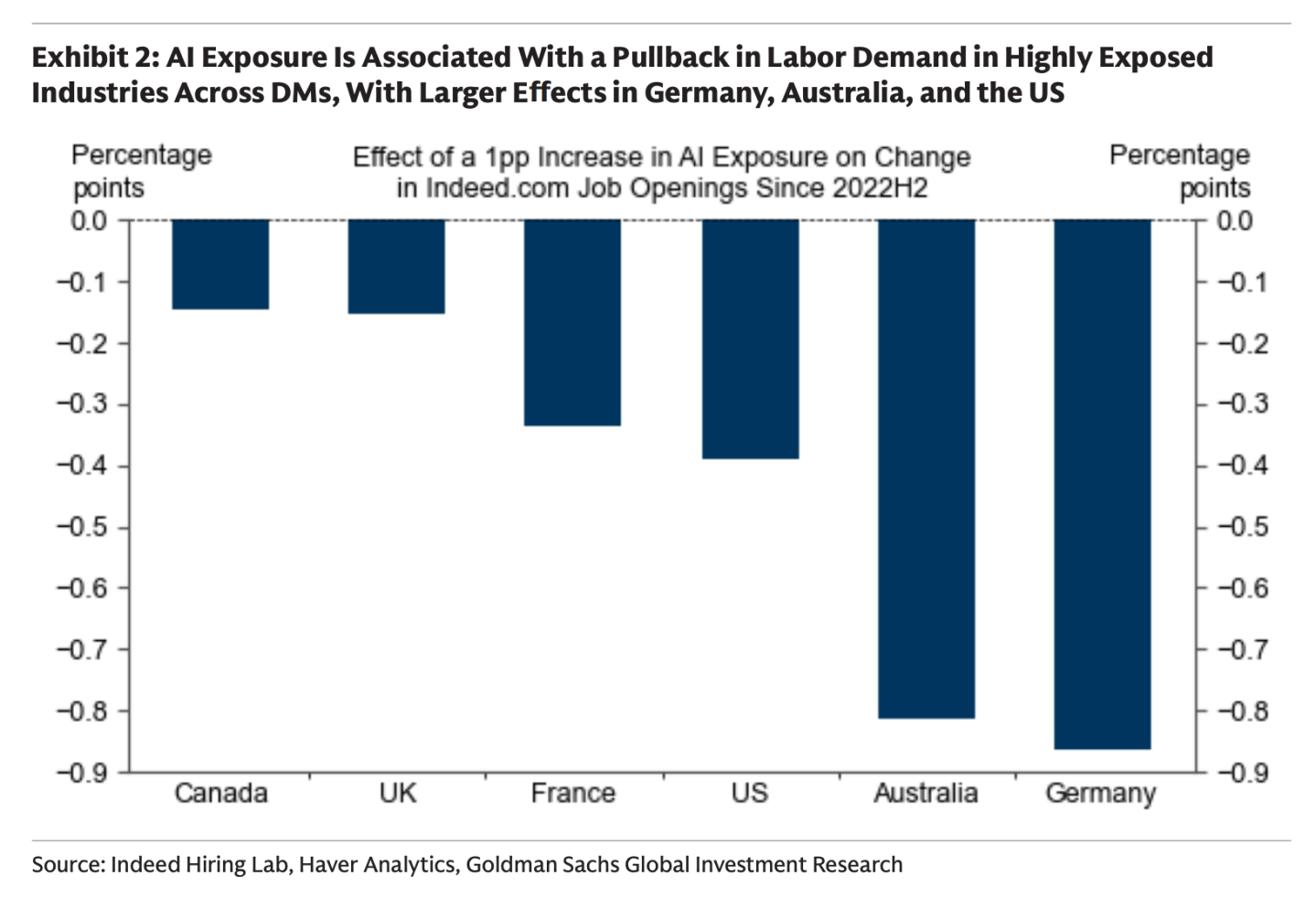
CHART OF THE DAY
AI remains a hot topic on earnings calls—even if the effect on profits remains elusive
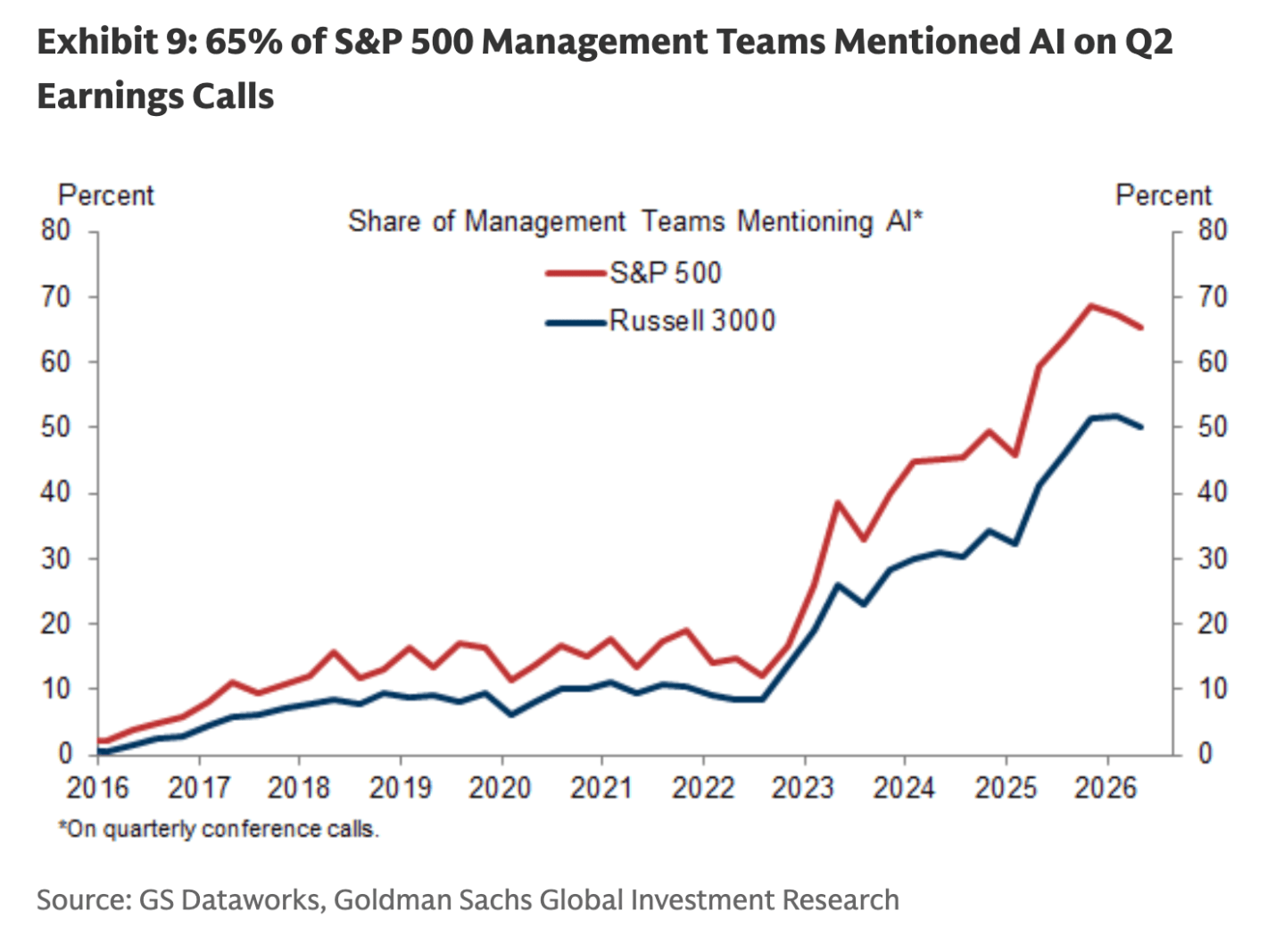
Sixty-five percent of S&P 500 companies discussed AI on their most recent earnings calls, according to a survey by Ronnie Walker at Goldman Sachs. That’s down a little bit from the peak. Interestingly, chief executives have stopped talking about “generative AI” in favor of “AI-enabled” processes. Specifics, as ever, remain elusive: “Only a small share of management teams have quantified the impact of AI on specific use cases (11%) or earnings (2%),” he said in a recent note.
NUMBER OF THE DAY: Bond crisis believers
50%
The percentage of bond investors, voters, and economics or finance graduates who believe there will be a U.S. debt crisis within the next 10 years, according to a new paper from NBER. The 50% level was consistent across all three groups. The survey included 2,233 people.
THE FRONT PAGES TODAY
Top US law firms hit by backlash over ‘crazy’ hiring of first-year students - FT
Bitcoin, ether surge as Trump urges Congress to pass crypto Clarity Act - CNBC
Women at L3Harris Shared Concerns About CEO’s Behavior Years Before Ouster - WSJ
Prince Harry and Meghan moving back to UK later this month - BBC
China Sentences Evergrande Founder to Life in Prison - NYT
US debt crosses $40T after doubling under Trump, Biden — sparking new warnings of fiscal crisis - NY Post
ONE MORE THING
Making train robberies great again
Train robberies are a trope of cowboy Westerns, associated with 19th-century outlaws like Jesse James, Butch Cassidy and the Reno Gang. But the modern incarnation is largely a product of the pandemic, with theft quadrupling from levels seen before 2020. Once lockdowns began, criminal gangs that had relied on the drug trade saw their supply chains disrupted just as stay-at-home requirements boosted demand for physical goods. So the gangs pivoted to theft, focused on the rail hubs located in urban bottlenecks including Chicago, Los Angeles and Memphis, according to Bloomberg.
Criminals nabbed more than $200 million of goods from 75,000 thefts on U.S. freight rail networks in 2025, according to an industry group that represents CSX, BNSF Railway Co. and Union Pacific Corp., among others. In January last year, a BNSF train was robbed of about 1,985 pairs of unreleased Nikes worth more than $440,000, according to a filing in U.S. District Court in Phoenix. A CSX spokesperson said more than $900,000 of tires alone have been stolen from trains across its network since the start of 2023.
- Would you like to sponsor this newsletter? Contact Polly Raven (polly.raven@fortune.com) for details.