
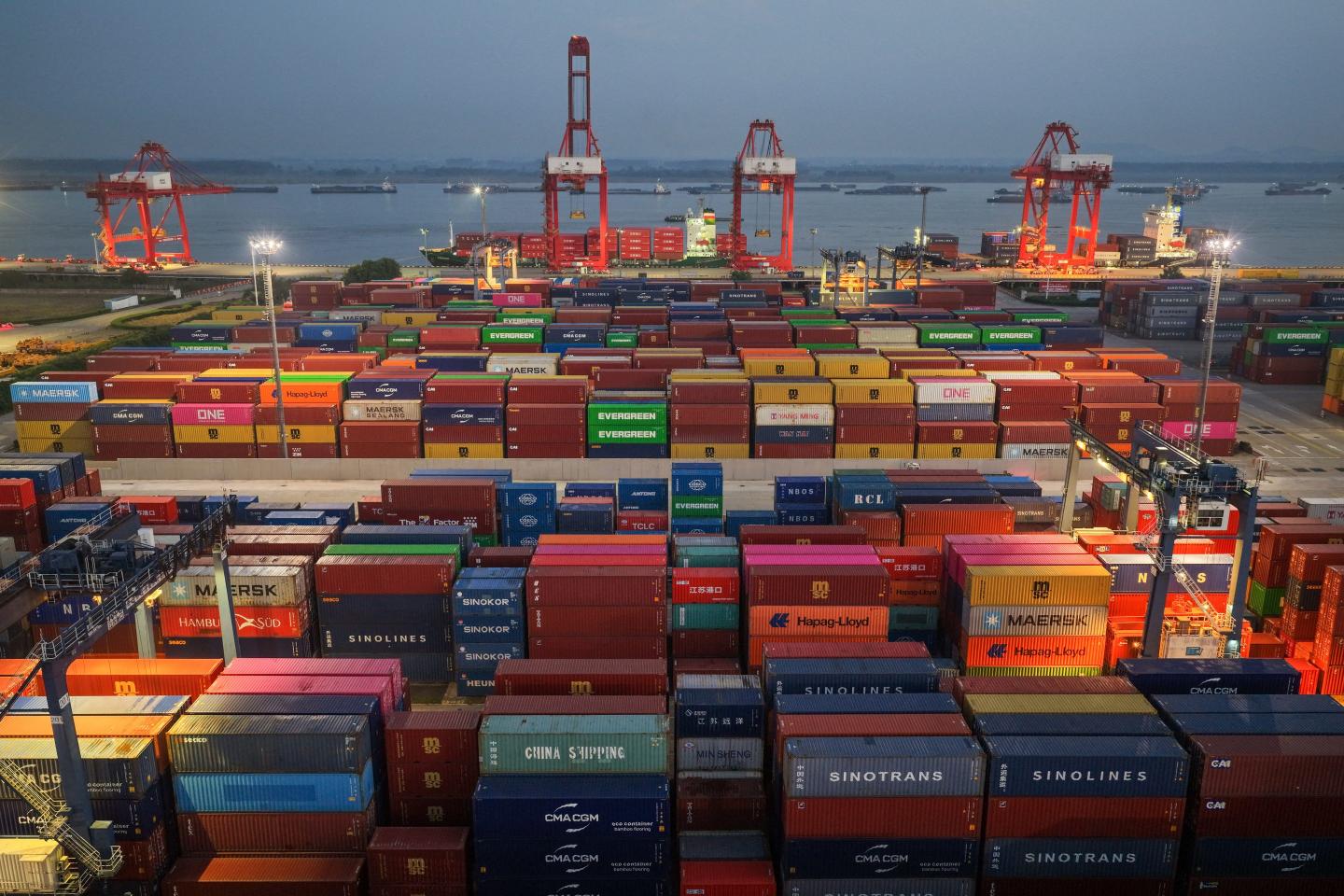
Beijing is pushing back against U.S. accusations that several other economies, including several in Southeast Asia, are part of a “shadow transshipment network” that funnels Chinese-made goods to the U.S. while obscuring their country of origin.
On Thursday, the White House’s Office of Trade and Manufacturing Policy released a report titled “The Great Transshipment Scam,” which claimed that rerouting Chinese-made goods through a network of 40 different jurisdictions cost the U.S. as much as $303 billion.
A Chinese embassy spokesperson in Washington D.C. said the country “firmly opposes” the over-stretching of national security justifications to suppress Chinese enterprises, and warned that it would take the steps necessary to safeguard its own interests.
Other governments named in the report, including the European Union and the Southeast Asian nation of Singapore, are also pushing back. Arianna Podesta, the spokesperson of the European Commission, said that while the EU continues to engage with the U.S. on both tariff and non-tariff issues, its rules framework and regulatory autonomy are not “up for negotiation”.
On Aug. 15, Singapore’s Ministry of Trade and Industry (MTI) also reiterated that it “takes trade compliance seriously”. In response to queries from The Straits Times, MTI emphasised Singapore’s commitment to upholding its reputation as a trusted international business hub, adding that it “does not condone businesses using their association with Singapore and using fraudulent and dishonest means to circumvent or violate the laws and regulations of other countries”.
What is transshipment?
According to the Center for Strategic and International Studies (CSIS), a Washington-based think tank, transshipment is the movement of items from country A to country C, with an intermediate stop in country B. This changes a good’s country of origin, which may have implications on how it is treated once it reaches its final destination.
Customs officials are generally only concerned with transshipment if there was little-to-no value added in the intermediate stop, essentially slapping a new label on a finished good. The White House’s report complains that this illegal transshipment could involve “relabeling, repackaging, re-invoicing, minor processing, false country-of-origin claims, or other actions intended to secure tariff treatment that would not apply if the goods’ true economic origin were declared.”
However, since the first Trump administration slapped tariffs on Chinese imports in 2018, many companies now route their supply chains through third countries like Vietnam and Mexico, using them for final assembly of goods made with Chinese components. As these activities involve some amount of value-added, and so customs enforcement consider the final good to be a product of that third country, and not of China.
According to the White House Council of Economic Advisers, potential illegal transshipment currently takes place in the range of $34.2 billion to $89.6 billion. The White House claims that 450,000 jobs have been displaced, annual GDP has been slashed by $113 billion to $150 billion, and federal revenue losses range between $19 billion and $26 billion, due to what it deems “illegal transshipment.”
Who’s named in the White House report?
The White House’s report names 40 economies allegedly involved in China’s “shadow transshipment network”.
This includes eight regions under Tier 1, which the U.S. has labeled as “diversified scale leaders”, or nations which see large absolute volumes of China-linked goods, where “illegal transshipment risk may be embedded within broad legitimate trade flows”. They include several long-time U.S. allies, including Canada, Japan, South Korea, Taiwan, Israel and Europe. (The other territories listed under this tier are Mexico and India.)
Six economies are listed under Tier 2, which the U.S. pegs as “scale leaders with significant economic integration with China”, through input sourcing, logistics systems and regional rerouting channels. They include Brazil, Malaysia, Indonesia, Thailand, Turkey and Vietnam.
The bulk of the 40 nations are classified under Tier 3, or what the U.S. labels as “small, opportunistic Chinese targets”, which see lower absolute transshipment volumes but have “specific weak-link advantages” like low-cost labor and free zones. This tier includes Southeast Asian countries like Singapore, Myanmar and the Philippines, Central Asian nations like Uzbekistan and Kazakhstan, and South American nations like Argentina, Chile and Colombia.
What’s next?
Despite a long list of accusations, the White House’s report did not specify any action to be taken against China and the 40 other economies. It did, however, highlight the U.S.’ plans to develop an “AI-enabled detective border”, which will ingest and analyze global trade data to identify illicit transshipment activities.
Globally, analysts including Song Seng Wun, an economic adviser at Singapore-based fintech company SDAX, also say that simply being named to the list is a form of pressure, even if the U.S. does not take further regulatory or enforcement actions.
“By naming Singapore, the U.S. is putting compliance pressure on the region’s largest gateway and signaling that scrutiny will extend to major transshipment hubs, not only manufacturing centers,” Song told The Business Times.