
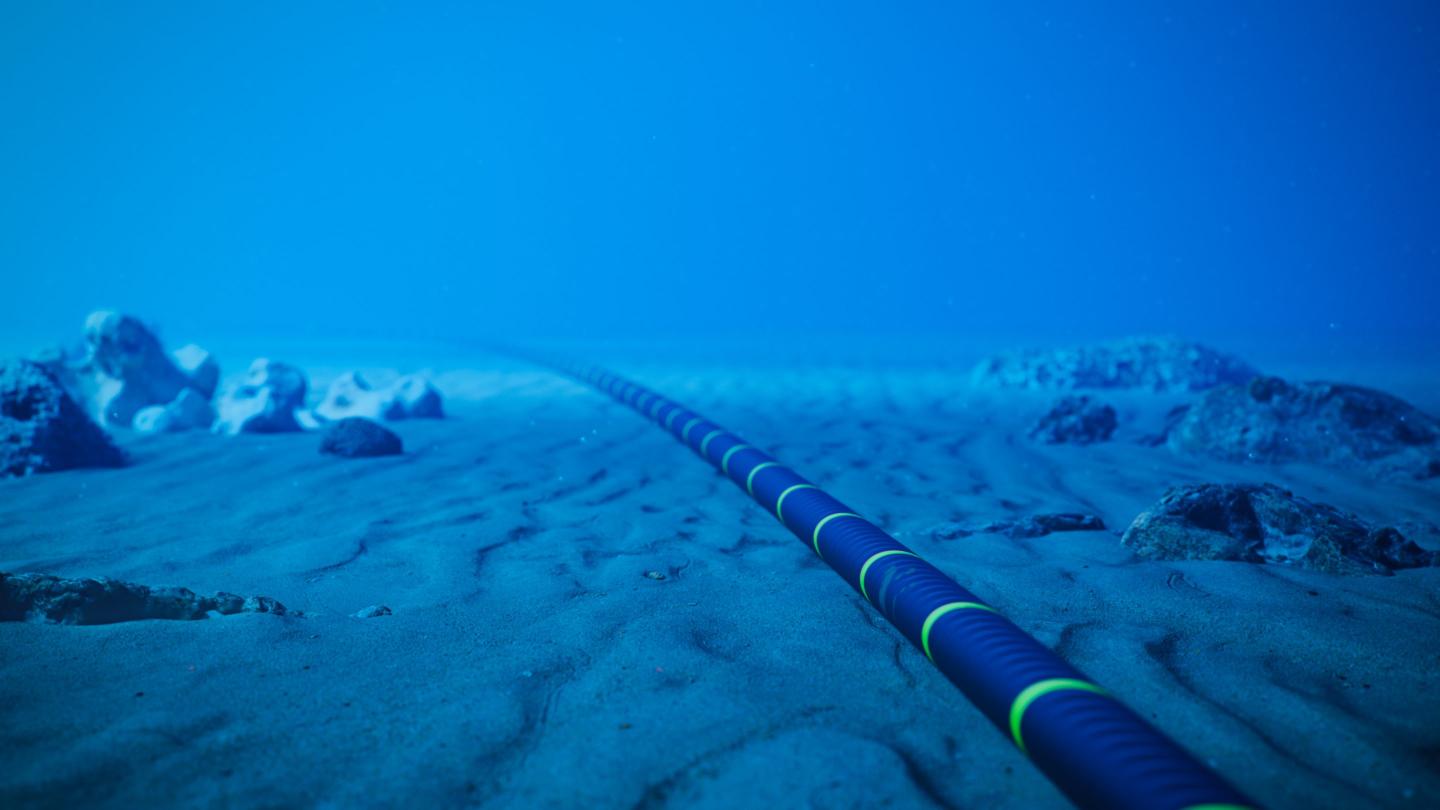
As tech behemoths Meta and Google delay subsea cable projects through the Red Sea amid rising security risks, many of the Gulf’s tech players are ramping up investment in the data highways needed to support the region’s rapidly expanding AI and cloud ambitions.
While geopolitical tensions are making traditional Europe—Asia routes through the Red Sea increasingly difficult to build and maintain, countries including Saudi Arabia, the UAE and Qatar are pouring billions into alternative subsea and terrestrial fiber routes in a bid to ensure that their ambitious plans to become AI powerhouses are not derailed.
Playing a key role in that push is Qatar’s Ooredoo Group, which has been steadily transforming itself from a traditional telco into a digital infrastructure provider over the last three years.
Its Fibre in the Gulf (FIG) subsea cable system, scheduled for completion in late 2027, will be the largest ever built in the GCC.
The system, in which Ooredoo is investing over $500 million, will span almost 2,000 kilometres and deliver planned capacity of up to 720 terabits per second—enough to move millions of gigabits of data every single second.
But FIG’s significance is not simply its scale.
“FIG will be the first cable connecting Asia to Europe, but completely circumventing both the Suez Canal and the Bab-el-Mandeb strait and running from Oman through Iraq and Turkey into Europe,” Aziz Aluthman Fakhroo, CEO of Ooredoo Group told Fortune.
“When we launched this project 18 months ago, the Iran conflict we’re facing today wasn’t on the horizon. But even then, we were already seeing very strong demand for FIG. I think that the current events have reinforced that proposition.”
Houthi attacks have effectively halted subsea cable construction in the Red Sea since 2024, including from tech heavyweights Google and Meta.
Dubbed “the information highway”, the Middle East is a crucial conduit of data connectivity. However, the flow of data is highly concentrated; over 90% of Europe–Asia data and telecommunications traffic flows through Egypt and the subsea cable corridors converging at the Red Sea and Suez Canal region, research by the Center for Strategic and International Studies (CSIS) shows.
“Creating these alternative routes in terms of connectivity is extremely important given that the vast majority of data flows through the Suez Canal,” said Fakhroo.
“There hasn’t been any new capacity built in the last five to seven years due to a number of reasons, including geopolitical events. And yet, every year, these data flows increase by about 30%, so we’re seeing extremely strong growth in connectivity.”
Fakhroo acknowledged, however, that the U.S.-Iran war has disrupted Ooredoo’s rollout of FIG, especially given that it is conceived to pass through the Strait of Hormuz.
“The war has added complications in terms of logistics and supply chains,” he said.
“Certain markets, such as Iraq, have been somewhat put on hold or delayed, but these markets are not the main drivers of our growth strategy over the next two to three years.”
Fakhroo said that Ooredoo is currently focused on accelerating investment in land-based infrastructure and purchasing cables, allowing it to keep FIG moving forward while access to parts of the network remains constrained by the situation in the Strait of Hormuz.
“So, we currently can’t get the ship-laying cables inside Hormuz, but we’re still continuing with the ground seabed surveys in other areas, and we’re building out the land-based routes,” he said.
Indeed, Ooredoo’s ambitions go beyond simply building the digital highways—it wants to own and control them, too. That means investing not just in subsea cables, but also in the infrastructure that brings them ashore and carries data onward, from landing stations to terrestrial fibre networks.
In May this year, Ooredoo announced a partnership with du to land the FIG system in the UAE and also advanced the construction of landing infrastructure and new cable landing stations in both Qatar and Iraq.
Ooredoo is also working with Saudi Telecom Company (STC) on building a terrestrial fiber-optic network called the Saudi Oman Network Infrastructure Corridor (Sonic) which spans 1,931 kilometers through some of the world’s most challenging desert terrain.
Announced in February last year, the project is scheduled for completion within 24 months. It runs from cable landing stations in Jeddah through the primary data center clusters in Riyadh and Muscat and extends toward the southeastern border with Oman.
In doing so, it aims to create a “Digital Bridge” across the Arabian Peninsula, bypassing the chokepoints of the Red Sea and the Strait of Hormuz.
In February this year, Ooredoo doubled down on fiber as a growth engine, setting up Ooredoo Fibre Networks (OFN) as a dedicated entity to scale its investments in subsea cables and fiber infrastructure—a clear signal that it sees the business as a growth opportunity in its own right.
Fakhroo remains upbeat about the outlook for data center growth in the region, despite the ongoing volatility and the recent high-profile attacks on data centers in both the UAE and Bahrain.
“As economies across the region become increasingly digital, there’s a growing focus on sovereignty—sovereign cloud, sovereign AI, and sovereign data residency,” he said.
“And such solutions require a presence in the country where they’re being sold, because the data they host cannot leave that country’s borders. So, despite all the events we’ve seen, local demand remains very strong and is more than sufficient to drive significant growth.”
In July, Qatari data center developer Meeza announced the completion of a 4MW expansion project for an unnamed “leading global hyperscaler”, delivering the facility nine months ahead of schedule.
For its part, Ooredoo’s data center company, Syntys, is targeting installed capacity of 120MW by 2030.
“We set that target back in 2024 but we’ll be way ahead of that by then,” said Fakhroo.
The UAE, Saudi Arabia and Qatar are collectively targeting 8–10 GW of AI compute capacity across announced projects and national ambitions. That includes the UAE’s planned 5-GW campus and Saudi Arabia’s HUMAIN, which is targeting 1.9 GW of compute capacity by 2030, with further expansion planned beyond that.
Both the UAE and Saudi Arabia are now also racing to build new data highways to Europe.
STC, majority-owned by the Saudi Public Investment Fund (PIF), is investing $800 million in SilkLink.
The project encompasses building a fiber optic cable network spanning 4,500 kilometers (2,800 miles) across Syria to a submarine cable landing station at Tartus on the Mediterranean, with connections to Jordan, Lebanon, and Turkey. Announced in February this year, the first phase is expected to start within 18 to 24 months.
A week later, an Iraqi-UAE private consortium announced plans to build WorldLink, a $700 million hybrid subsea and terrestrial fiber-optic cable network, that would run from the UAE to Iraq’s Al-Faw Peninsula, and overland through Iraq and Kurdistan to Turkey.
Due to be rolled out in phases over the next five years, the consortium has said the cable would target hyperscalers, international carriers, and AI applications. It also aims to ease congestion and reduce transit times versus the traditional paths that run through the Suez Canal.