
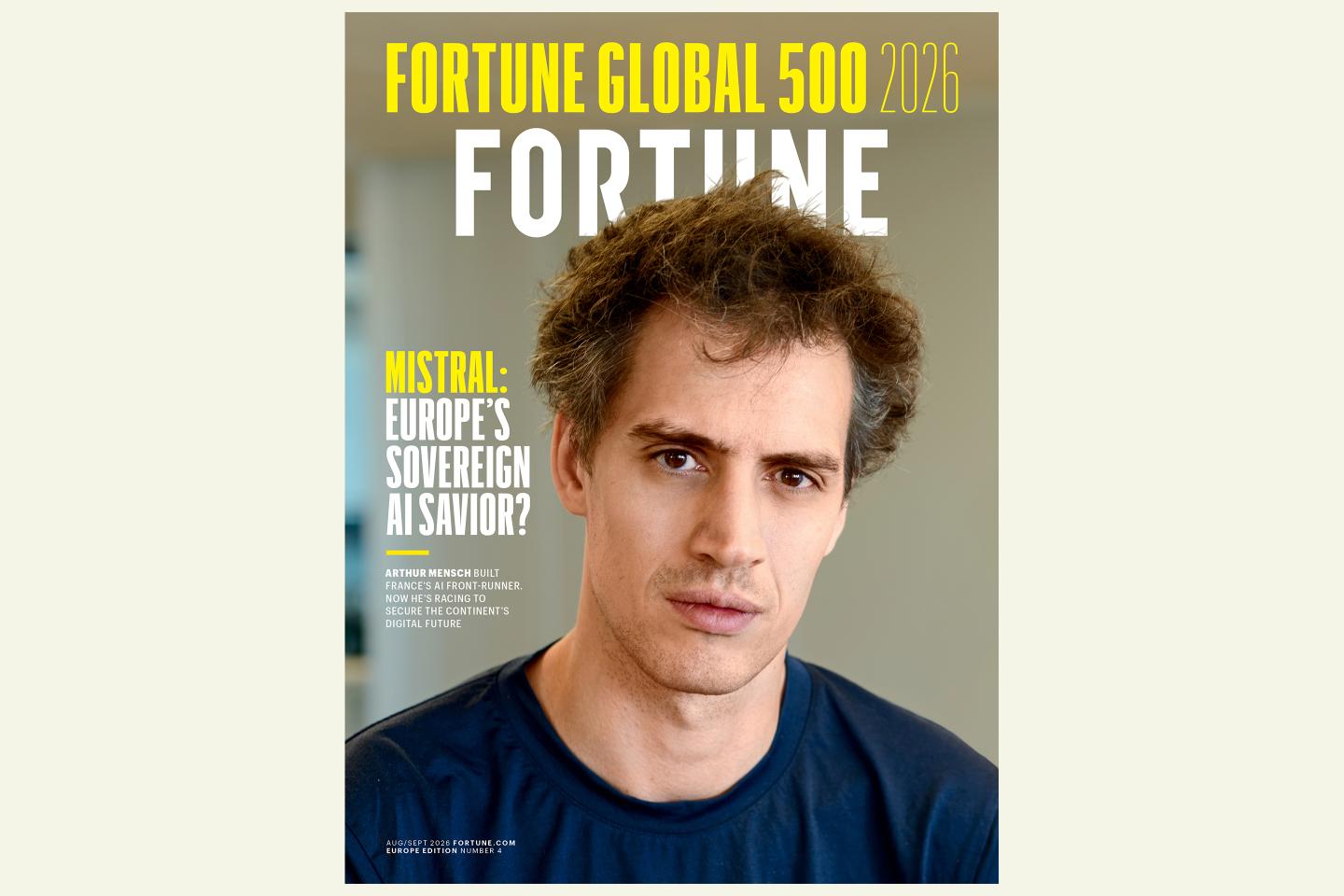
Europe Is running out of time. In June, a group of AI governance experts published a chilling doomsday scenario: Unless Europe accelerates AI investment by 2031, it risks economic marginalization—outcompeted by the U.S. and China and vulnerable to sophisticated cyberattacks.
The warning echoes that of Arthur Mensch, CEO of Paris-based AI company Mistral, and this issue’s cover star. Without building its own AI infrastructure, he says, Europe risks becoming a “vassal state,” permanently dependent on U.S. technology.
These fears were briefly realized when the U.S. government ordered Anthropic to cut foreign access to its most advanced AI models. Since then, AI sovereignty has rapidly risen up the agenda of European policymakers. Mistral is Europe’s AI front-runner, and there are hopes it could be the answer to the continent’s AI sovereignty question. Mensch, however, has no interest in limiting the company’s ambition. As he tells our tech reporter Beatrice Nolan in “Europe’s AI sovereignty is under threat. Could Mistral be the answer?“, he wants Mistral to become a genuine global contender.
An AI reckoning is not the only threat facing Europe. A series of record heat waves have caused large areas of Western Europe to swelter this summer—as my London-based Fortune colleagues and I can attest to (temperatures topped 36°C in the city this June). The soaring heat poses risks to both businesses and workers. In “Europe’s employers face a new challenge—keeping workers safe during heatwaves,” Oliver Balch speaks to the companies scrambling to retrofit workplaces, create cooler environments, and provide protective equipment, in an effort to preserve productivity.
Europe’s summer has not been defined solely by disruption; there have also been moments of collective celebration. Italian tennis star Jannik Sinner claimed victory at the Wimbledon Championships; Glasgow played host to the Commonwealth Games; and Spain lifted the FIFA World Cup trophy in New York/New Jersey.
As the summer of sport comes to a close, Fortune features writer Sam Birchall speaks with NFL CMO Tim Ellis about his ambitions for American football to finally break into the European market (“The NFL’s previous push into Europe lost $400 million—so why is it trying again?“). After multiple failed attempts, he hopes that upcoming matches in London, Paris, and Madrid can help the sport grow its audience on this side of the Atlantic—in the same way that FIFA courted a new soccer fan base in the U.S.
The question of global competitiveness runs throughout this issue—and nowhere is this more visible than in the Fortune Global 500 list, our annual rundown of the biggest companies in the world. The businesses listed boast combined revenues of more than $43 trillion. And we’ll be welcoming some of the leaders of these companies to the Fortune CEO Forum, in London, on Sept. 16.
Amazon tops this year’s ranking, after generating $716.9 billion in revenue. Its rise to the No. 1 position came as little surprise to founder Jeff Bezos, who sat down with Fortune editorial director Kristin Stoller. She charts the company’s journey from garage startup to AI empire in “No. 1 on the Fortune Global 500: Amazon’s Jeff Bezos on how his garage startup became the largest company in the world by revenue.”
Amazon’s trajectory is one Arthur Mensch may hope Mistral can one day emulate. For now, though, Europe’s AI hopeful remains some distance from joining the Fortune Global 500 ranks. I hope you enjoy the issue!
This article appears in the August/September 2026: Europe issue of Fortune with the headline “The countdown is on.”