
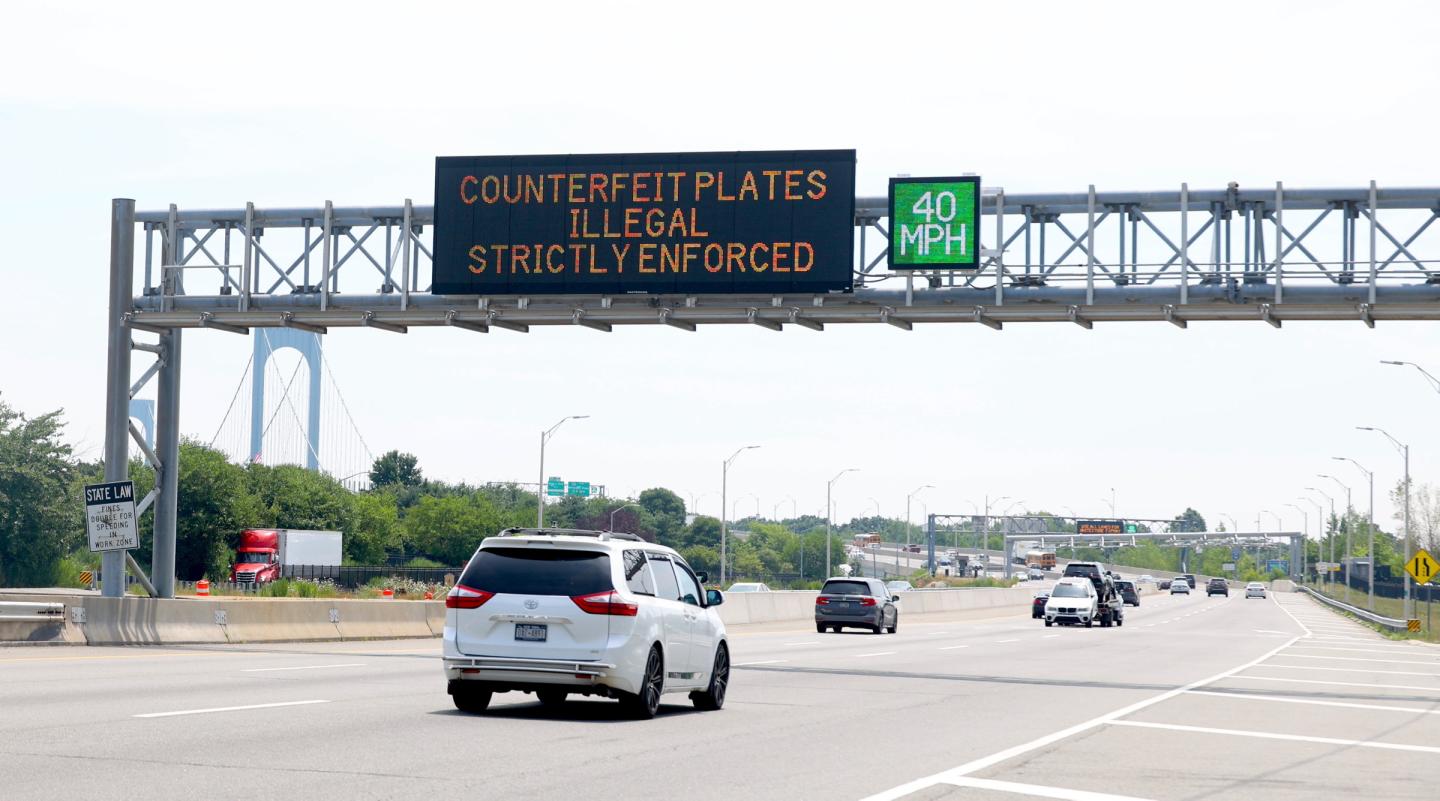
It’s not an uncommon sight to see out-of-state plates in New York. For one, it is the self-described greatest city in the world, so of course people embark on road trips to see all the sights of the five boroughs. But on the other hand, plenty of those plates are New Yorkers who register their cars in New Jersey, Pennsylvania, or elsewhere specifically to dodge New York’s high insurance premiums, while actually living in and driving around the Big Apple.
In New York City specifically, a Streetsblog analysis of city violation data found nearly 21,000 vehicles registered outside the tri-state area (plus Pennsylvania) that picked up at least one violation in the city in every single quarter of the year: a pattern strongly suggesting these cars are actually garaged and driven in New York full-time, with owners registering elsewhere purely to dodge the state’s high insurance rates.
The City Council’s Oversight and Investigations Division surveyed more than 3,500 parked vehicles last year across precincts chosen for high volumes of out-of-state-plate summonses. Of 768 non–New York-plated vehicles found, one in five had mismatched, temporary, or fraudulent “no-hit” plates that don’t trace back to any valid registration. Those vehicles owed nearly two-and-a-half times more in outstanding fines than properly registered cars, and paid only 16% of what they owed, versus 63% for validly plated ones.
But Mayor Zohran Mamdani’s pied-à-terre tax—a surcharge for anyone who owns a second home in New York valued at over a certain limit—is effectively acting as an extra tax auditor. The question is simple: Are you a New York City resident? Then present your driver’s license or income taxes. Did you happen to file out of state though you lay your head in the five boroughs? Technically, that makes you a nonresident—and someone defrauding the city, per the Department of Finance (DOF).
The DOF has quietly audited residency status for years through the STAR exemption and the Senior Citizen Homeowners’ Exemption, both of which require a property to be the owner’s actual primary residence, and both of which have turned up real fraud when checked. One comptroller’s audit alone found the DOF had improperly granted the senior exemption to properties whose owners had died and to corporations that were never eligible, a loss of at least $59.2 million over five years. The pied-à-terre tax flips that same question around: Instead of catching people wrongly claiming a primary-residence break, it catches properties wrongly claimed as primary, to avoid the surcharge.
What we’re describing here is rate evasion, or “garage fraud,” a recognized form of insurance fraud nationally, not just a New York quirk. Insurers price premiums based on a car’s garaging ZIP code, since accident and theft risk vary sharply by density, creating a built-in incentive to register a car at a cheaper address than where it’s actually kept. A 2011 New York State Independent Democratic Conference paper on the practice found it goes well beyond individual drivers fudging an address: It documented organized rings registering dozens of vehicles at a single out-of-state address, then buying and reselling cheap out-of-state policies in bulk.
If someone genuinely lives in New York full-time, proving it is simple: A tax return with the address on it settles the question. The letters only become a real problem for someone who filed as a non–New York resident while actually living in the city, exactly the asymmetry being exposed by the Mamdani tax.
Domestically, it’s not just New York
New York’s own state government has escalated its response accordingly. Governor Kathy Hochul made ghost plates and out-of-state registration fraud a centerpiece of her 2026 State of the State address, citing an estimated $300-a-year cost to every law-abiding New York driver, and has since run multiagency crackdowns—state police, DMV, and the Thruway Authority working with local departments—that pulled more than 200 vehicles off the road in a single recent sweep.
California is chasing a parallel scheme aimed at taxes rather than insurance. Prosecutors charged 14 people with felony tax evasion in March 2026 over the “Montana LLC” loophole, in which owners register expensive vehicles through Montana shell companies to dodge sales tax and registration fees. Philadelphia, meanwhile, launched a public reporting tool for so-called ghost cars and towed more than 50 within two weeks, with officials explicitly framing the issue as a quality-of-life problem that bleeds into public safety.
In Europe, it’s Italy and France
The Neapolitan word furbo directly translates to being sly, but in reality, it’s so much more. It’s finding a way to get home after curfew without getting in trouble; of avoiding detention in school; of finding a loophole around a law.
So that’s why it’s not surprising this whole issue is dubbed in Polish the przekręt neapolski, or the “Neapolitan scam.” This week, Polish authorities admitted they’re cracking down on a scheme in which Neapolitan car owners deregister their vehicles from Italy’s public motor registry, have it “exported” to Poland and reregistered under Polish plates through a long-term rental agreement, then get them back, often without the cars ever physically leaving Italy.
Mandatory liability insurance in Naples, among Italy’s most expensive, can run €600 to over €2,000 a year; the Polish-plate workaround drops that to roughly €350 a year after the first year. It’s been illegal since 2022, when Italy banned residents from driving foreign-plated cars not also registered domestically. But in 2025 alone, Naples province registered 14,066 foreign vehicles, almost all Polish-plated. And nationally, Italy has 68,228 Polish-plated vehicles on the road, concentrated overwhelmingly around Naples.
Payouts tied to uninsured Polish-plated cars in Italy jumped from €1.5 million in 2024 to more than €4.2 million in 2025. Poland’s Infrastructure Ministry is now drafting a reform requiring photographic proof during inspections that a car is actually sitting in a Polish garage.
The Naples scheme is a story about individual drivers gaming an insurance market. France’s version shows how the same address-arbitrage logic scales into organized crime: The state auditor Cour des Comptes found roughly 1 million illegally registered vehicles currently on French roads, enabled by fraudulent “ghost dealerships” manipulating the national vehicle registry for a fee. The report put losses at €550 million in unpaid fees and fines just between 2022 and 2024 alone, and found the same registry fraud used to dodge luxury-car environmental taxes, disguise stolen vehicles, and support drug-trafficking logistics. In New York, with a driver simply registering a Honda in New Jersey, they’re part of a greater tax and insurance fraud scheme.