
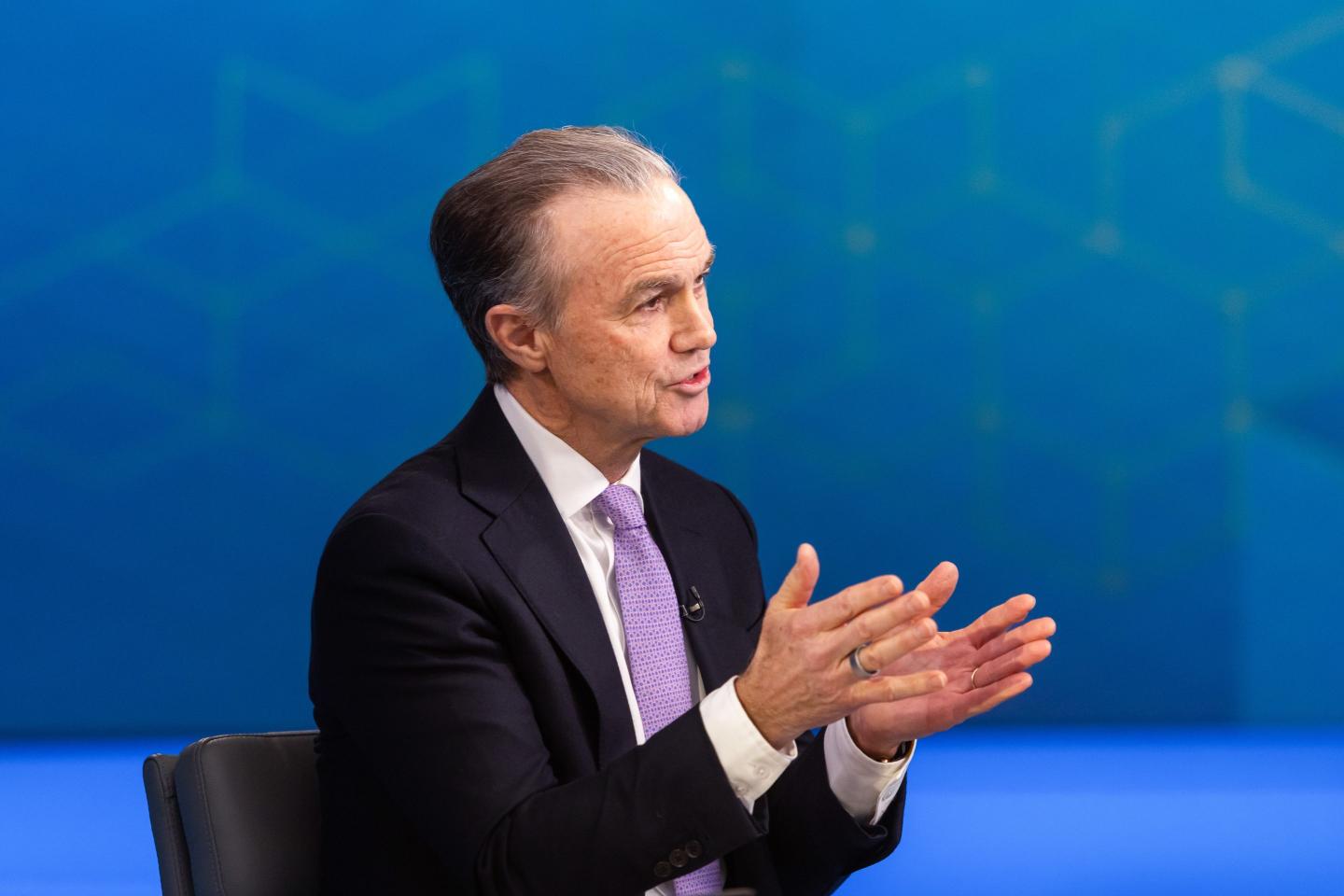
Greg Fleming has navigated Wall Street’s biggest crises over nearly four decades, from negotiating Merrill Lynch’s 2008 fire sale to building Rockefeller Capital Management into a $200 billion wealth empire.
But in a wide-ranging Bloomberg Wealth interview with David Rubenstein, it wasn’t markets, AI, or even inflation that left the Rockefeller Capital Management CEO sounding genuinely stunned.
“It’s a fantastic amount of money to have borrowed, even for an economy this robust and this big,” Fleming said, describing a national debt now approaching $40 trillion.
Fleming, who oversees more than $200 billion in client assets for some of America’s wealthiest families through the storied firm he built from John D. Rockefeller’s original 1882 family office didn’t mince words when Rubenstein pressed him on his biggest worry for the U.S. economy.
“I’m most focused on the fiscal situation in this country,” he said. “We’re still at relatively full employment…We have been in a good time. We run these 5, 6, 7% of GDP deficits annually, and there seems to be no impetus to change that.” He added a detail that has become a rallying point for fiscal hawks: The federal government now spends more on interest payments than on national defense.
Just how big is $40 trillion?
Fleming’s reaction isn’t hyperbole—it tracks with a running tally of grim milestones.
The debt crossed $39 trillion in mid-March, with net interest payments projected to exceed $1 trillion in fiscal year 2026, nearly triple the $345 billion in interest the government paid during the onset of the pandemic, in 2020.
By April, debt held by the public had crossed 100% of GDP for the first time since World War II, meaning the government’s obligations exceeded the size of the entire U.S. economy. Brookings economist Jessica Riedl calculated the ratio could climb to 137% within a decade, a trajectory that would surpass the debt’s postwar peak and stay there indefinitely, unlike the temporary wartime spike that preceded it.
Fleming told Rubenstein that the debt picture makes life especially difficult for new Fed Chair Kevin Warsh, who has inherited a genuinely tangled set of crosscurrents. Artificial intelligence adoption is “moving faster than even I thought,” Fleming said, and could have a disinflationary effect as companies embed AI agents to boost productivity. It’s a “very complicated picture,” with questions about productivity combining with an energy shock and a fiscal deficit that “clearly could put pressure on rates, particularly on the long end.”
On a podcast in late 2025, Fleming had floated the possibility that AI might help the U.S. grow its way out from under the debt even as deficits climbed. But by the time he spoke with Rubenstein, that optimism had visibly narrowed into acknowledgment that AI is, at best, one variable among several—competing against an energy shock and unchecked deficit spending, not a silver bullet.
Recent research lends credence to that hedged view, as the St. Louis Fed analyzed nearly 490,000 corporate earnings calls to show a spike in mentions of AI-related productivity but almost no appearance in macroeconomic data.
A consistent warning, growing louder
Fleming’s alarm is not a sudden conversion; he has voiced nearly identical warnings for years, suggesting the debt has moved from background concern to central preoccupation.
As far back as October 2023, Fleming told Bloomberg’s David Westin that the “U.S. debt situation is definitely a concern,” predicting interest payments would exceed military spending by 2027. That threshold arrived even earlier than he forecast, becoming a “permanent” fixture of the federal budget by 2024. At the time, he flagged deficits running at roughly 8% of GDP with no recession in sight as historically unusual.
Fleming’s alarm reflects a broader shift across his industry, where advisors are unusually attuned to fiscal risk given their role stewarding multigenerational family wealth. A 2024 industry survey found that 48% of financial advisors ranked the national debt as America’s “most urgent” policy problem, placing it above immigration, tax policy, and geopolitical conflict.
“If one of our clients had the balance of income and expenses that the U.S. government has, they would be broke,” one advisor said.
That cuts to the heart of why Fleming’s comments resonate. He spends his days counseling ultrawealthy families on preserving fortunes across generations by living within their means and avoiding excessive leverage. Applying that same discipline to Washington, he suggested to Rubenstein, produces an uncomfortable verdict.
Fleming stopped short of predicting a crisis, and said he remained bullish on long-term U.S. wealth creation, noting in the same interview that new “growth cities” continue to generate staggering fortunes for families his firm serves.
But his framing suggested he views the debt trajectory as a structural risk that could reshape interest rates and inflation dynamics for years, one that even AI’s productivity gains may only partially offset.
Rockefeller Capital Management did not respond to a request for comment.