
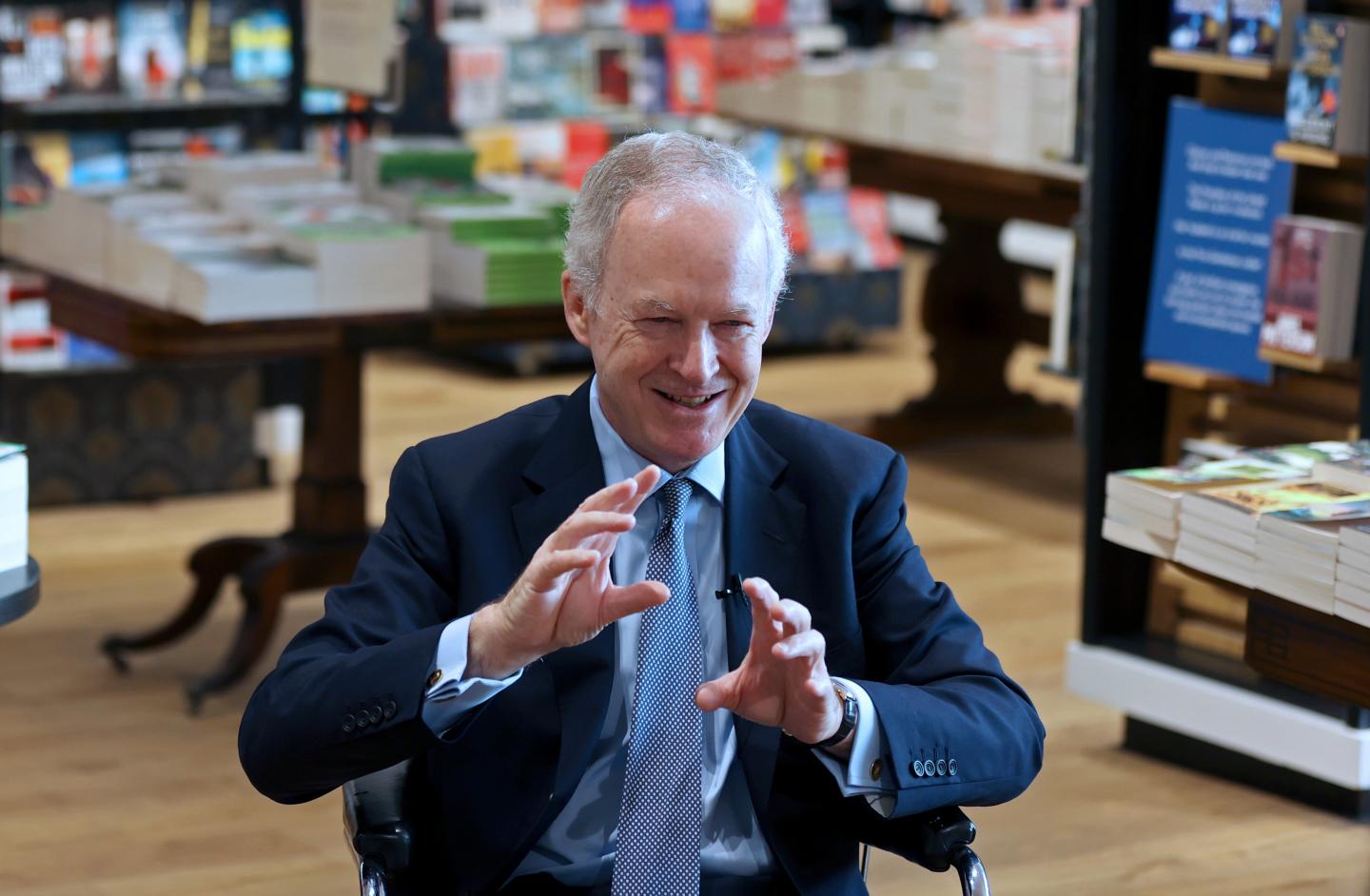
When James Daunt was named CEO of Barnes & Noble in 2019, he quickly began making the big-box store more like local indie bookstores.
Barnes & Noble had just been taken private by Elliott Advisors for $683 million after sales declines driven by formulaic stores that had lost their charm. The hedge fund installed Daunt, a Brit, as CEO, based on his track record reviving Elliott-owned Waterstones, a large British bookseller, and his experience as owner of the beloved 10-store Daunt Books in London.
His plan to turn around Barnes & Noble hinged on infusing the retailer’s more than 700 stores with some of the aura of his namesake chain, whose locations are treated as hallowed ground by many book lovers for their browsing‑friendly displays and oak‑paneled galleries.
“There are universal factors that make a great bookstore, and it doesn’t matter whether it’s a huge chain store or a small independent,” Daunt told Fortune on a new episode of the Behind the Business series.
Core to any great bookstore is a welcoming environment for readers with appealing displays, an interesting—even quirky—array of books, and enthusiastic, knowledgeable workers who are eager to talk titles with customers. Early on, Daunt flagged that Barnes & Noble—like Waterstones before it—suffered from uniformity that bored customers. In his view, stores needed far more independence to decide what inventory to carry and how to display it.
Standing in the way was a well-established business practice in the bookselling industry. For years, publishers would give Barnes & Noble a discount on books if it agreed to sell them—and give them prime real estate—at every store. The practice, called “co-op advertising,” is one of the first things Daunt eliminated.
The approach had provided some certainty in revenue, but managing co-op advertising occupied a lot of booksellers’ time, Daunt says; it made their jobs dull and pulled them away from customers at a time when hands-on service was supposed to distinguish Barnes & Noble from buying books on Amazon.
“It created these really dispiriting, anodyne stores because they were all the same, selling the same old books, the same authors, the same bestsellers,” Daunt recalls. “We just said, ‘No more of that.’ We’re going to choose what we sell.”
“We,” in this case, didn’t mean Barnes & Noble’s New York headquarters as it had in the past. Rather, the retailer gave small regional clusters of outlets wide discretion over what to stock on store shelves.
“We abandoned [co-op advertising] 100% so now each store curates its own assortment, reorders books according to what its customers are actually interested in, and does their own thing,” he says. Readers on the Upper East Side of Manhattan and those in, say, Flint, Mich., don’t read the exact same books, the CEO says.
In another key move, Daunt started placing smaller initial orders of books—even if the retailer expected the titles to sell well—but ordered more titles overall with the goal of carrying a wider selection. It created a sense among customers that a Barnes & Noble store is a place of discovery. For employees, it made the stores a more fun place to work.
As a private company, Barnes & Noble does not disclose financial information. But reports of a possible IPO and store growth indicate it’s on firmer financial footing compared with the 2010s when it seemed doomed to meet the same fate as the now-defunct Borders chain. In that era, Barnes & Noble saw massive sales declines, closed more than 100 stores, went through six chief executives, and lost $1 billion on its Nook e-reader, a device it had hoped would compete with Amazon’s Kindle. The missteps left stores understaffed and drained the company of the financial firepower needed to invest in upgrading them.
Now, Daunt’s strategies have given Elliott the confidence to open dozens of new Barnes & Noble stores annually for the past three years, including 50 this past year, with more to come. (Its store count is approaching its all-time high of nearly 800 in the mid 2000s, though many of the new locations are much smaller than the big boxes it shuttered last decade.) Barnes & Noble has also remodeled many of its locations, installing modular shelving, improving lighting, and reorganizing how books are presented. Multiple media outlets reported this spring that Elliott was eyeing an initial public offering for the combined company holding Barnes & Noble and Waterstones that would value it at $4 billion. Daunt declined to discuss a potential listing.
Barnes & Noble has been through expansion cycles before, notably in the boom-time years of the 1990s and 2000s. What’s different this time is that Barnes & Noble’s store openings coincide with a revival of independent bookstores. For decades, Barnes & Noble was accused of killing mom-and-pop bookstores across the U.S. Not anymore: According to the American Booksellers Association, some 605 new independent bookstores opened in the U.S. in 2025, up 87% from the year before. Book sales, meanwhile, aren’t growing nearly as fast. Revenues for the industry hit $14.6 billion in 2025, up 1.1% from 2024, according to the Association of American Publishers.
Daunt thinks the narrative of the big-box store spelling the end of indies is a trope (to be expected, given his stakes in both kinds of outlets), and he says he’s not surprised that independent stores are flourishing as Barnes & Noble stages a comeback.
“The better our bookstores, the more books are sold, the more the market expands,” he says. “It’s not a zero-sum game.”
Still, the former investment banker who works for a private-equity owned company is capable of taking harsh steps when he sees fit. The Wall Street Journal reported in May that at one point, he made his entire corporate staff reapply for their jobs and let a few dozen employees go.
Another big plank of Daunt’s strategy is to continue improving stores and to open stores in markets Barnes & Noble abandoned during its 2010s-era implosion. As he walks the aisles of the chain’s mammoth Union Square store, which he calls “dated” (it opened in 1995) and a “work in progress,” he points out small details that enhance the browsing experience. Some displays feature a little note from the staff about why a book is a good read, a human touch reminiscent of an indie store. A table at the entrance features dozens of books arranged by theme: current affairs and income inequality, for instance. They were handpicked by the store staff, not imposed by HQ.
Daunt sees promise in the Union Square store. “It takes time, it takes intelligence,” he says of grouping books to encourage buying more. “These are great books. You’ll walk away with two, three, four, five books, not just one book or no books.”