Thirty years ago, my business partners and I were handed the prototype for a toy plane called the Sky Shark. It ran on compressed air. You pumped it up, let it fly, and it just…took off. Like magic.
At the time, we were barely in our mid-20s, and had started our own toy company, Spin Master, a few years before. We’d enjoyed some modest success, but we were looking for a new signature product, and the Sky Shark was the coolest thing we’d ever seen. Going purely on gut instinct, we bought it on the spot.
In that moment, we thought the Sky Shark was a new idea that we were lucky to snag before anyone else, which in itself is proof of how naive we were about the industry we’d just entered. The reality was that the prototype had already been shown it to every toy company in the world, and they’d all turned it down. Hasbro, Mattel, and all the others had passed because they had the experience to see all the risks and setbacks and headaches that lay in waiting. What goes up must come down, and when it does there’s a good chance it’ll break—or hit a kid in the face. And building a product that can actually fly is an engineering nightmare. All the established players had passed for one simple reason: they knew it couldn’t be done. But Ben, Anton and I, not knowing what couldn’t be done, decided that three guys in their mid-twenties with no engineering background to speak of would be the ones to get this thing off the ground.
What followed was two-years of seemingly insurmountable logistical and technical hurdles that consumed almost all my time and virtually every penny we’d made in the business to date, hundreds and hundreds of thousands of dollars. First we had to take the prototype and transform it into something that could be manufactured on an assembly line. I spent the next year flying in and out of Chicago to work with a prototyping shop. Every few weeks, I would take the latest iteration and head out to Washington Park to see it fly. Or not fly. It was always a two-steps-forward, one-step-back type of process. Sometimes it would soar. Other times it would crash and break apart.
Then, once we had a workable prototype, the headaches really set in. When you mass manufacture something, making parts with an injection mold machine as we were, even the tiniest problem can throw everything else off, which means you have to do what’s called a debug to make sure that the process is 100 percent perfect. So, at twenty-five years old, I was off to spend the next few months in Chaoyang, a poor, remote city deep in mainland China where our manufacturer was located; I used to go to the only McDonald’s in town because it was the one place that reminded me of home.
With the Sky Shark, we had a lot to work out with the wings, which had to be stiff enough to keep their shape but flexible enough to handle the impact of a crash landing without snapping apart. Debugging the motor was an enormous challenge as well, because the tolerances there had to be exact. Every fix took days, revising the CAD work and making new molds, and fixing one bug inevitably revealed the next bug, and another delay.
Some people might have looked at me then and seen a young kid who was several hundred thousand dollars in over his head. But I handled it. How? Because I had to. Because the product, incomplete and untested as it was, had already been sold through. If we’d waited until the plane was perfected to start selling it, we never would have recouped all the money that went into it. Retailers had already allocated shelf space, advertising dollars had already been spent, and I had a hard on-sale date hanging over my head through every setback. And once we did hit stores—barely making our production deadline—there were still more unforeseen problems to follow: customer service complaints, product returns, design tweaks, all of which had to be handled on the fly.
But it was worth it. We launched the Sky Shark as the first in a new line of flying toys called Air Hogs, and from the moment we hit stores the demand was insane. Spin Master went from $7 million in sales to $35 million in the first nine months alone. The following year, our total annual revenue shot up to $100 million. We even ended up on the cover of Popular Science with one of the top innovative products of the year. The magic was that we’d built a new category from the ground up. We kept producing more planes: the V-Wing Avenger, the Storm Launcher, the Stinger. It wasn’t a trend, and it wasn’t a novelty. We had carved out and anchored our position in the industry, building the foundation that would lead to the billion-dollar worldwide success of properties like Bakugan and PAW Patrol in the years ahead.
What every young person entering an established market needs to know is this: our success didn’t happen despite our inexperience. It happened because of it. When we started Spin Master, we didn’t know what we didn’t know, and that served us well. It meant our minds were open to any possibility, what I call “seeing the white space,” which is the ability to identify an opportunity in the marketplace that’s not being filled and then fill it.
When we were offered the idea for the Sky Shark, if we had known all the risks and complexities and problems and expenses involved, we would have passed on it like Hasbro and Mattel did, because the whole process would have seemed too daunting. Knowledge and experience can actually cloud your vision, because when you can see all the potential downsides of something, it’s easy to talk yourself into saying “No.”
When you’re in your twenties, the marketplace isn’t the only thing you don’t know about. You also don’t know who you are. You think you do, but from middle age you’ll likely look back and realize that you didn’t. You didn’t know your limitations, nor did you understand your real potential.
During the two-year process of developing the Sky Shark, we encountered countless logistical and technical difficulties. But on the human side of the equation, in terms of managing egos and office politics and keeping everyone working together, we didn’t hit a single snag—and that was because of me. That, I learned, was my superpower. I was able to keep everyone happy and humming along while working in a quiet, humble fashion. The crucible of creating the Sky Shark showed me I possessed a strength that I never knew about before, and it was only in setting myself an impossible task that I learned it was possible after all. It’s also how I learned that I thrived on the creative process of willing things into being and all the magic that comes with it.
For young entrepreneurs and creators today, the world is no different. Everything is changing all the time, which means new opportunities are always available. The proof is right in front of us. Just last month, Hollywood’s legacy studios were putting out retreads of old IP-driven stories like Supergirl, Masters of the Universe, and The Mandalorian and Grogu. They bombed. Meanwhile the top movies at the box office were two low-budget indie horror flicks, Obsession and Backrooms. Curry Barker, the director of Obsession, is twenty-six years old. Kane Parsons, the director of Backrooms, is just twenty.
With the onset of AI, more industries are up for grabs than ever before. Just in the past year, I’ve seen so many examples of the power of applications like Claude Code and Base 44 and Loveable. Outside of truly capital-intensive industries, the cost of entry for starting just about any new endeavor has dropped dramatically. Anyone with a good idea now has the ability to get their proof of concept built and out in the world in very little time. The next generation is going to use these powerful tools to serve customers in a way that’s more dynamic, more effective, and more user friendly—and they’re going to succeed because they’re too young to know what they can’t do.
Looking back on the day when we first flew the prototype for the Sky Shark nearly thirty years ago, it’s staggering to compare how much I know about the toy business now versus what I didn’t know then. But the not knowing was what made the magic happen. Without the slightest clue what we were getting ourselves into, like we did with the plane itself, we took our company, pumped it up, flicked the propeller, and the damn thing took off. Suddenly, amazingly, we were flying at a totally different altitude than we’d ever experienced before.
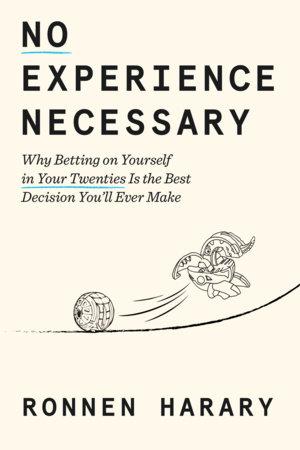
Excerpted from No Experience Necessary: Why Betting on Yourself in Your Twenties Is the Best Decision You’ll Ever Make by Ronnen Harary, published on 7/14/2026 by Crown Currency, an imprint of The Crown Publishing Group, a division of Penguin Random House, LLC. Copyright © 2026 by Ronnen Harary.