
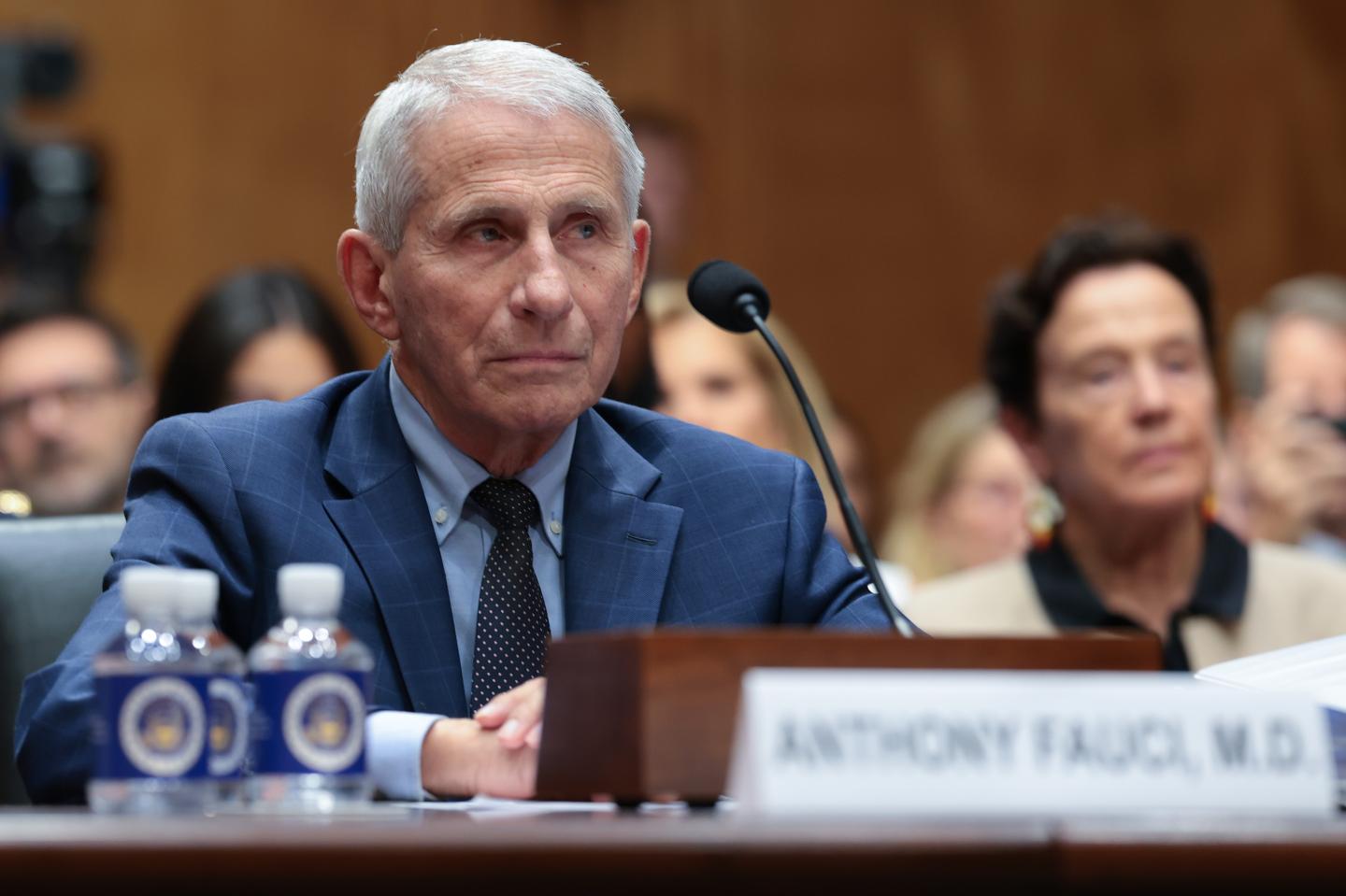
Last week, Senator Rand Paul released Dr. Anthony Fauci’s unflattering diary. This morning, Dr. Fauci, the COVID czar, was on the hot seat when he appeared before the U.S. Senate’s Homeland Security and Government Affairs Committee. These hearings were a nothing-burger. Dr. Fauci took the Fifth, 111 times.
Remember Dr. Fauci? He led the charge, along with others in the government-sponsored public health industrial complex that imposed COVID lockdowns on us and shut down the country in 2020.
Contrary to his radio silence at today’s hearings, one thing that screams with clarity is Fauci’s diary. It’s an open book. Dr. Fauci comes across as a “kiss-up, kick-down” kind of guy.
As a critic of lockdowns, I know firsthand how Dr. Fauci and the government-sponsored public health industrial complex operate. If you so much as question them, these Big Players can be ruthless.
Shortly after the onset of COVID, I, along with Jonas Herby in Denmark and Lars Jonung in Sweden, engaged in a comprehensive scientific literature review and meta-analysis to determine whether lockdowns were, in fact, effective in reducing COVID-19 mortality. This was a heavy lift. We identified 19,646 potential studies. But, in the end, only 22 could be converted into standardized estimates suitable for a high-quality, rigorous meta-analysis.
Contrary to the assertions by Dr. Fauci and proponents of lockdowns, our meta-analysis reached the conclusion that lockdowns had a tiny impact on COVID mortality. In addition to having a tiny impact on mortality, the lockdowns were accompanied by huge economic and social costs. Our meta-analysis estimated that lockdowns only saved between 6,000 and 23,000 lives in Europe and between 4,000 and 16,000 lives in the United States. When compared to a typical flu season, lockdowns prevented relatively few deaths. Indeed, in Europe, 72,000 flu deaths occur in a typical flu season, and in the United States, 38,000 flu deaths occur during a typical flu season. Based on the hard evidence contained in our meta-analysis, we concluded that COVID lockdowns were a major public policy blunder.
Our findings were eventually published in two peer-reviewed publications: a book, DID LOCKDOWNS WORK? The verdict on Covid restrictions, which was published by the Institute of Economic Affairs in London, and a journal article, which appeared in Public Choice. Never mind. Our research ignited the ire of the Big Players in the government-sponsored public health industrial complex.
To counter the facts contained in our meta-analysis, the Big Players in officialdom and allied factions followed their standard operating procedure. In addition to outright censorship, which we repeatedly encountered at the Social Science Research Network (SSRN), an enormous academic platform operated by the Netherlands-based publishing house Elsevier, the “fact-checkers” piled on. These are the folks who produce unfounded, irrelevant verbiage that lacks a critical sense or analytical insight. Next came hit pieces that echoed the claims of the so-called fact-checkers. The perpetrators hoped that a cone of silence would descend on their targets.
Where does this lead? It leads to what Nobelist Friedrich Hayek analyzes in Chapter XI of his classic, The Road to Serfdom. That Chapter is aptly titled “The End of Truth.”
The opinions expressed in Fortune.com commentary pieces are solely the views of their authors and do not necessarily reflect the opinions and beliefs of Fortune.
Steve Hanke is a Senior Contributing Columnist at Fortune and a Professor of Applied Economics at Johns Hopkins University. He is a co-author of DID LOCKDOWNS WORK? The verdict on Covid restrictions.