
Good morning and lock in: Our latest Fortune Global 500 is out.
The 37th running of our annual list features a new king: Amazon. As it did in this year’s Fortune 500 list, which is U.S.-focused, Amazon displaced rival Walmart for the first time in a decade. (Read this great story about it by colleague Kristin Stoller.)
That’s not the only tech tale in this year’s list. Alphabet became the most profitable company in the world, besting a four-year run by Saudi Aramco. Alibaba rose seven spots in just a year’s time; Tesla slid 10 spots in the same span. Tencent and TSMC both cracked the top 100 for the first time. And Nvidia cracked the top 50 for the first time—remarkable since it only made its list debut in 2024 at No. 222.
Who else is up and who else is down? You’ll just have to check out the full list. (Subscribers get early access, btw.)
More tech news follows. Have a productive day. —Andrew Nusca
Want to send thoughts or suggestions to Fortune Tech? Drop a line here.
A Chinese firm has begun manufacturing chipmaking machines
The AI arms race, in the words of chef Emeril Lagasse, has officially kicked up a notch.
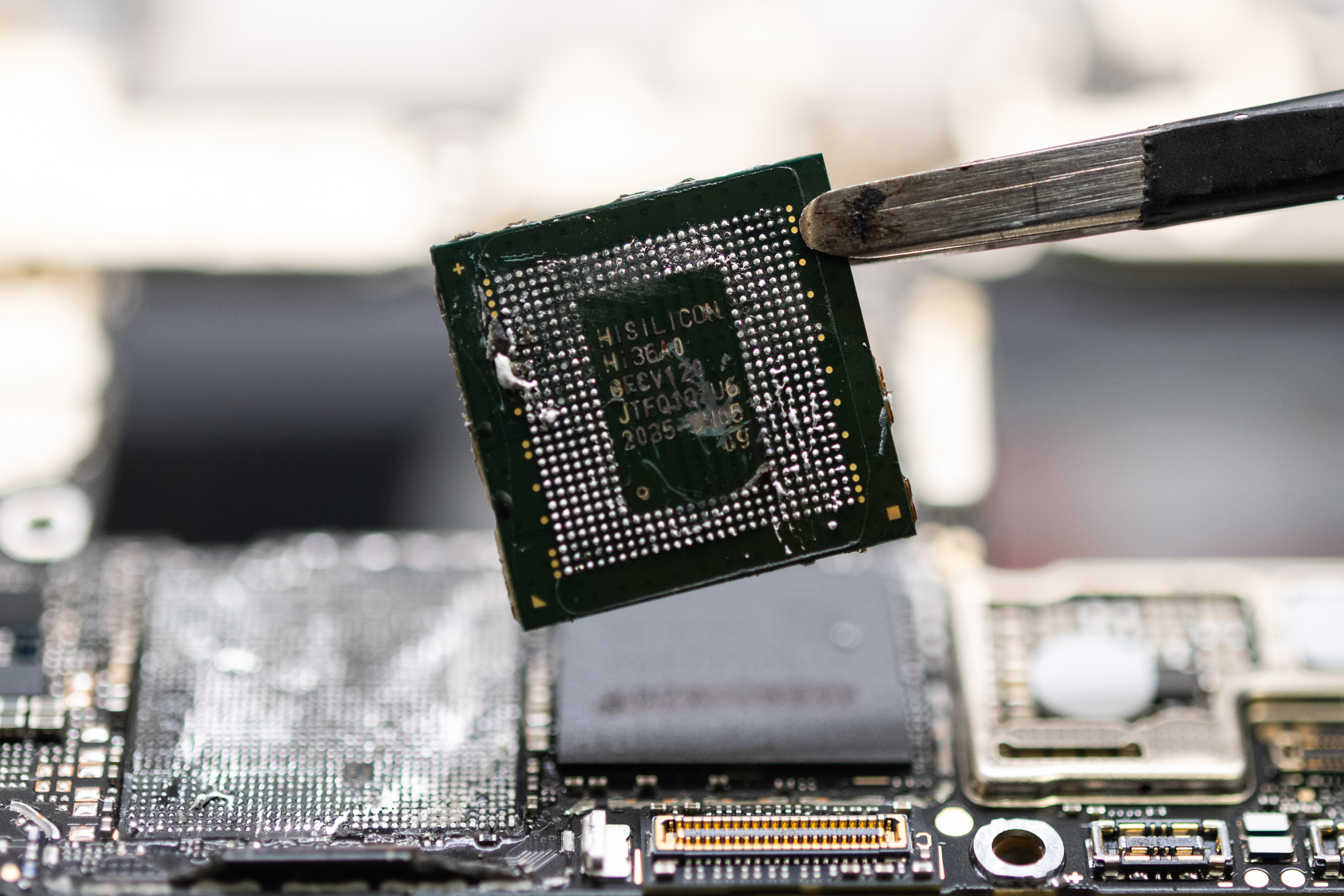
Not content with creating globally competitive AI models (to rival Anthropic and OpenAI) or even AI chips (to take on Nvidia, AMD, and Broadcom), China has reportedly begun manufacturing the astonishingly expensive machines that make the chips (R.I.P. ASML).
A new report in The Information says that an unnamed state-backed company has achieved a breakthrough by making the kind of immersion deep ultraviolet lithography machines, or DUVs, used by chipmakers including TSMC.
When I say this is heavy industry, believe it. A DUV lithography machine is about the size of a large truck, weighs upwards of 18 tons, and can cost up to $90 million.
(DUV machines, by the way, aren’t to be confused with EUV machines—the “E” is for “extreme”—which are much more expensive, far more precise, and way heavier, weighing as much as two narrow-body airliners. Cool.)
It was only nine months ago that the editor of an American international relations magazine wrote on social media about a Chinese firm reverse-engineering an ASML chipmaking machine in an attempt to better learn how they worked and evade U.S. sanctions. (Going so far as to boldly call ASML for technical support, apparently, but I digress.)
That post is now looking more serious by the week, given the precision engineering, parts, and assembly lines necessary to seriously pursue such a project.
No wonder shares of ASML fell 7% in the wake of the new report. For two decades, the Dutch company has controlled the lion’s share of the global DUV market, and now drives about 20% of its total revenue from China. —AN
Nvidia makes ‘substantial’ investment in Safe Superintelligence
While former OpenAI CTO Mira Murati makes headlines with the release of her Thinking Machines Lab’s first AI model, it’s been rather quiet elsewhere in the OpenAI diaspora—namely for former chief scientist Ilya Sutskever’s Safe Superintelligence.
No more. On Monday the two-year-old startup announced that it had “entered into a strategic partnership with Nvidia that will allow us to scale our compute by 10x.”
The world’s leading AI chipmaker will make a “substantial” investment—reportedly $5 billion—in SSI, as it’s known. It will also supply the secretive startup with “large amounts” of Nvidia hardware that will presumably dwarf the cache of Google TPUs it had previously been using.
SSI was last valued at $32 billion and is backed by Andreessen Horowitz, Sequoia Capital, DST Global, and Greenoaks Capital, among others.
And in case you were wondering, yes, Nvidia also struck a similar deal with Thinking Machines Lab in March.
What SSI is up to is not known in great detail. In a statement, Sutskever said his company’s research is “focused on overlooked aspects of how the human brain functions.” The company itself has declared that safe superintelligence—a smarter-than-humans computer system that won’t imperil humanity—“is our mission, our name, and our entire product roadmap.” —AN
Amazon hopes to deploy a 5,000-satellite constellation
The number-one company on the Fortune 500 and Fortune Global 500 lists wants to put 5,105 satellites in space.
Amazon Leo (as in “low Earth orbit,” not “DiCaprio” or “Messi” or “XIV”) has filed an application with the Federal Communications Commission for a proposed satellite network that would provide direct-to-device voice and data connectivity.
The idea is to deliver cellular services—voice, messaging, data, emergency—directly to mobile devices that are beyond the reach of conventional (that is, terrestrial) cellular networks.
Amazon would partner with mobile network operators all over the planet to facilitate it. It would also conveniently tap into the mobile satellite spectrum of Globalstar, which Amazon agreed to acquire in April for $11.6 billion.
If you’re thinking, boy, this sounds a lot like SpaceX’s Starlink—you’re right.
Still, the Amazon initiative formerly known as Project Kuiper will need a lot more than 5,105 satellites to catch up to Elon Musk’s newly public company.
With some 10,788 satellites in low Earth orbit, 12 million customers, and $11.4 billion in sales, Starlink has amassed a considerable lead in the category—nevermind its January FCC proposal to launch a low Earth orbit constellation of 1 million satellites. —AN
More tech
—Moonshot releases weights for its newest AI model, Kimi K3.
—Microsoft debuts Perception, an agentic security system to patch software flaws.
—27 years after Elon Musk co-founded the fintech firm X.com, his social media company of the same name rolls out a banking service called X Money.
—NBCUniversal and YouTube do a deal to make all Peacock content available via YouTube Premium in the U.S. next year.
—China will take “all necessary measures” if the U.S. sanctions Chinese companies for allegedly distilling their AI models.
—Minnesota is temporarily blocked from enforcing a new law banning prediction markets such as Kalshi and Polymarket.
—Microsoft’s Xbox suffers a “major outage” that makes it difficult for players to sign in or see game libraries.