
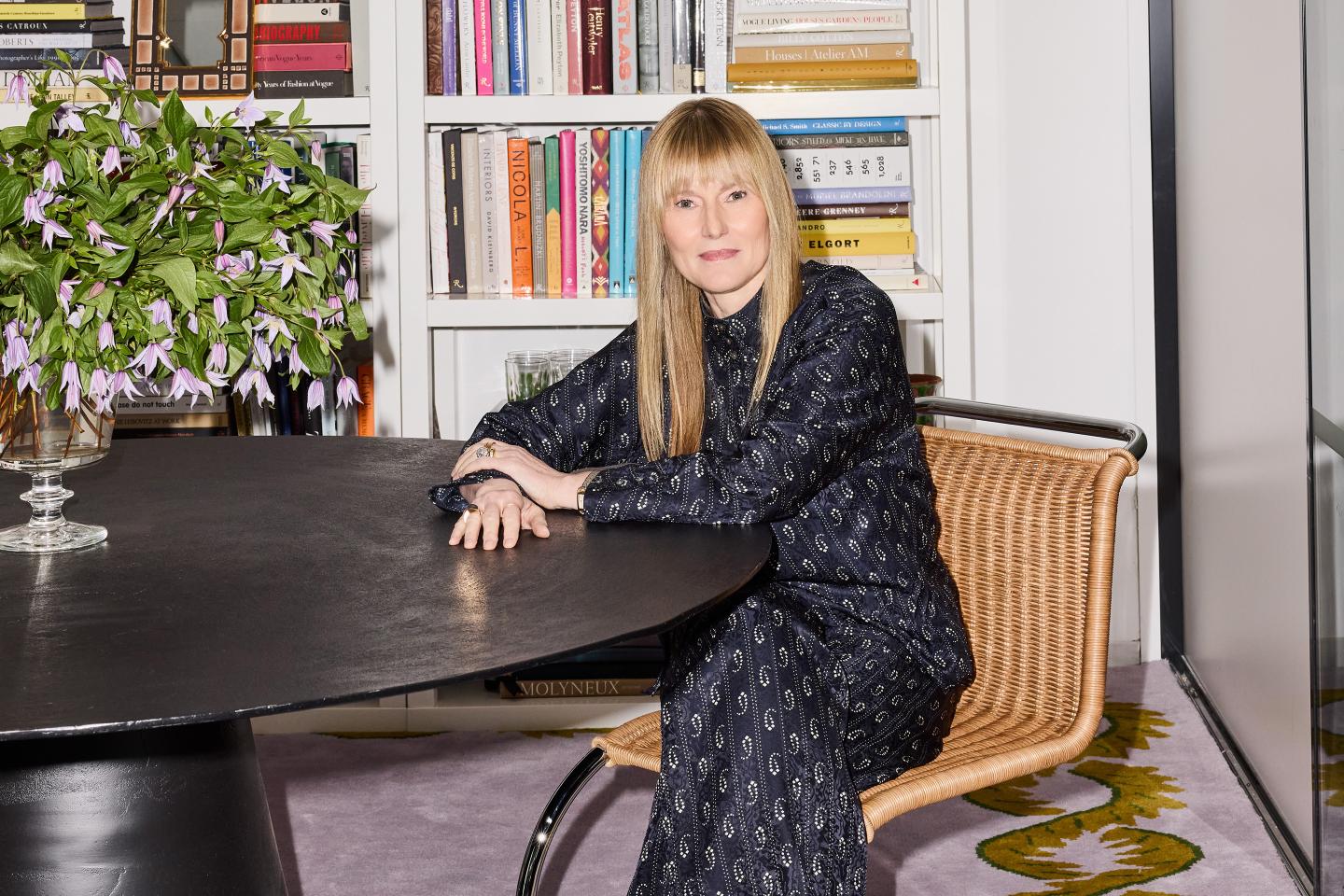
If you think about Architectural Digest, you might imagine that its editor-in-chief would be an expert in style, decor, magazines, and more. But over her 10 years at the helm, Amy Astley has become an authority in not just interior design, but nearly every issue that intersects with our homes and how we live today.
Astley doesn’t do many interviews, but we recently caught up at Condé Nast’s offices in honor of her upcoming 10-year anniversary as AD‘s EIC with this year’s September issue. Astley came to AD after 13 years as the founding editor of Teen Vogue. She was at the center of the Condé Nast universe, mentored by Anna Wintour and bouncing between Vogue and House & Garden before creating Teen Vogue during a time when teens and teen media were a dominant force in culture.
When she got to AD, the magazine was what she called a “sleeping beauty.” “It’s just waiting to be revived,” she told people at the time. The magazine launched in California in 1920 as a trade quarterly. It had become a little dusty—and home decor and interiors were not a prominent part of pop culture. “People thought interior design was sleepy and boring, and I know that it’s not. To me it’s something very personal,” she says.
Astley quickly prioritized Instagram and YouTube. At Teen Vogue, she’d been early to social media compared to the rest of Condé (Teenagers are far ahead of adults in every way, she explains. “They adopt technologies sooner—and they discard them sooner.”) But AD‘s Instagram had under 1 million followers, which “horrified” her. (Today it’s at 11.2 million.) She launched the YouTube series Open Door, where celebrities give tours of their homes. What seemed like a 21st-century innovation actually drew on the magazine’s origins; its earliest pages featured Old Hollywood stars like Mary Pickford and Douglas Fairbanks.
A decade later, her greatest achievement is probably AD‘s relevance at the center of culture. Take Dakota Johnson’s house tour, where, surprised by a styled bowl of limes, she said, “I love limes” and then admitted she lied and actually hates limes; that went viral enough for her to talk about it with Jimmy Fallon. David Harbour and Lily Allen’s home tour and unusual decor choices resurfaced amid news of their divorce and Allen’s album West End Girl (“You found us a brownstone / said ‘you want it? It’s yours.'”). There are satires of AD home tours—and a host of new competitors, from new media to independent creators.
After successfully reviving a legacy brand, Astley is now tasked with keeping it relevant through fast-changing social norms and expectations. She can tell where culture is headed from the comments section. “The audience can be quite harsh online—they’re not afraid of saying what they think. They want to see thoughtfulness about the environment,” she says. “People have had it with boring and beige, quiet luxury houses, tech bro bunkers. These things are played out—things that feel cold, impersonal, that look like a hotel.” Astley’s personal pet peeve is houses without any books.
She must reckon with questions like: As the wealth gap grows and housing becomes less affordable for millions of people, what is the general public’s appetite to see ultra-luxe real estate?
She’s settled on this view: “You can show something very luxurious and very beautiful if it’s very obvious that that homeowner is passionately involved with that house, is a real collector, and cares about the items in the house—it’ll fly. If there’s a feeling that it’s cold, that they aren’t involved, they don’t know what’s in there, that a designer or art consultants just put the stuff up on the wall, and the person’s not attached and doesn’t care—it won’t fly.”
She’s addressing these shifting attitudes with new kinds of content. A recent hit was Keke Palmer’s house tour, which has racked up 3.5 million views on YouTube. It’s a lived-in house, which Palmer shares with her sisters and their kids. She even showed off her Tupperware collection. Videos about regular people’s small spaces are another increasingly popular genre. There’s more awareness about the impact of our surroundings on our mental health. AD can’t fix the housing crisis. But Astley can ask: “How are people making it work? How are they making their life beautiful despite all the challenges?”
Like all media leaders, Astley is reckoning with the impact of AI on her business. With declining web traffic, digital ad revenue, and affiliate revenue from basic recommendations, she’s leaned into new lines of business like AD Pro and Directory, a roster of design talent that connects professionals with AD readers and possible clients. How AI can help more people thoughtfully design their homes is another area of interest. And the intimate nature of seeing inside someone’s home might help AD stand out from AI content too. “AI makes people crave something real from us, and we are real. We’ll never have an AI-generated home. We would never do that,” she says. “They always know that they can count on it to show it’s really Lenny [Kravitz], he’s really in his house, and we are not making it up.”
Her mantra, 10 years into exploring some of the most elaborate, artistic homes in the world, is: “Living creatively is more important than living large.”
Emma Hinchliffe
emma.hinchliffe@fortune.com
The Most Powerful Women Daily newsletter is Fortune’s daily briefing for and about the women leading the business world. Subscribe here.
ALSO IN THE HEADLINES
WHCD report. At the rescheduled White House Correspondents' Dinner, President Trump used his speech to go after CNN's Kaitlan Collins. He returned to a favorite topic—whether she smiles enough. "She’s a young, attractive woman. She never smiles,” the president said onstage. “I said, ‘Kaitlan, do you ever smile? Smile. You have a nice position, you’re at CNN fake news, you should be a happy person. So smile, Kaitlan, just smile.’"
An all-star weekend. At WNBA All-Star Weekend in Chicago, a few highlights: playing at the Obama Presidential Center. President Obama met Caitlin Clark and told her to focus on being a "hooper" and ignore the "nonsense." Disney doubled its ad revenue around the weekend for the second year in a row.
The Tate brothers' allies are quiet. With 38 new charges facing Tristan and Andrew Tate in the U.K., allies like Alina Habba (former Trump admin lawyer) are avoiding them. Karoline Leavitt said President Trump does not plan to intervene in the case.
Girls' volleyball is everywhere. It was the second-most popular team sport last school year, with 492,799 registered female athletes. That's behind track and field and above basketball or soccer.
ON MY RADAR
Emily Wilson thought she’d sell 1,000 copies of her Odyssey translation. She sold more than a million this year alone, thanks to Christopher Nolan Philadelphia Inquirer
Meet the woman who stands to inherit much of Jeffrey Epstein's fortune NYT
The manicure is a $25 billion habit Katia Beauchamp wants you to quit Fast Company
PARTING WORDS
"My music is for bringing people together, not celebrating warfare."
— Katy Perry, objecting to the White House's use of her song "Firework" on a TikTok of U.S. military strikes on Iran