• Home
  • Latest
  • Fortune 500
  • Finance
  • Tech
  • Leadership
  • Lifestyle
  • Rankings
  • Multimedia

Trendingnow

1

'The demographic dividend of the last 40 years is ending': J.P. Morgan says the world is running out of the two things that kept interest rates down

2

Jensen Huang made his $172 billion fortune on AI chips. His family's $75 million gift to Vanderbilt argues art decides what technology is for

3

The $39 trillion U.S. national debt isn’t as high as Japan’s and Singapore’s relative to economy size—and yet it's still worse somehow

1

'The demographic dividend of the last 40 years is ending': J.P. Morgan says the world is running out of the two things that kept interest rates down

2

Jensen Huang made his $172 billion fortune on AI chips. His family's $75 million gift to Vanderbilt argues art decides what technology is for

3

The $39 trillion U.S. national debt isn’t as high as Japan’s and Singapore’s relative to economy size—and yet it's still worse somehow
Commentarydisruption

The Messi Test and how the Spaniards messed with it: what the World Cup final taught me about the Jobs AI can’t touch

By
Bhaskar Chakravorti
Bhaskar Chakravorti
Down Arrow Button Icon
By
Bhaskar Chakravorti
Bhaskar Chakravorti
Down Arrow Button Icon
July 25, 2026, 7:00 AM ET
m
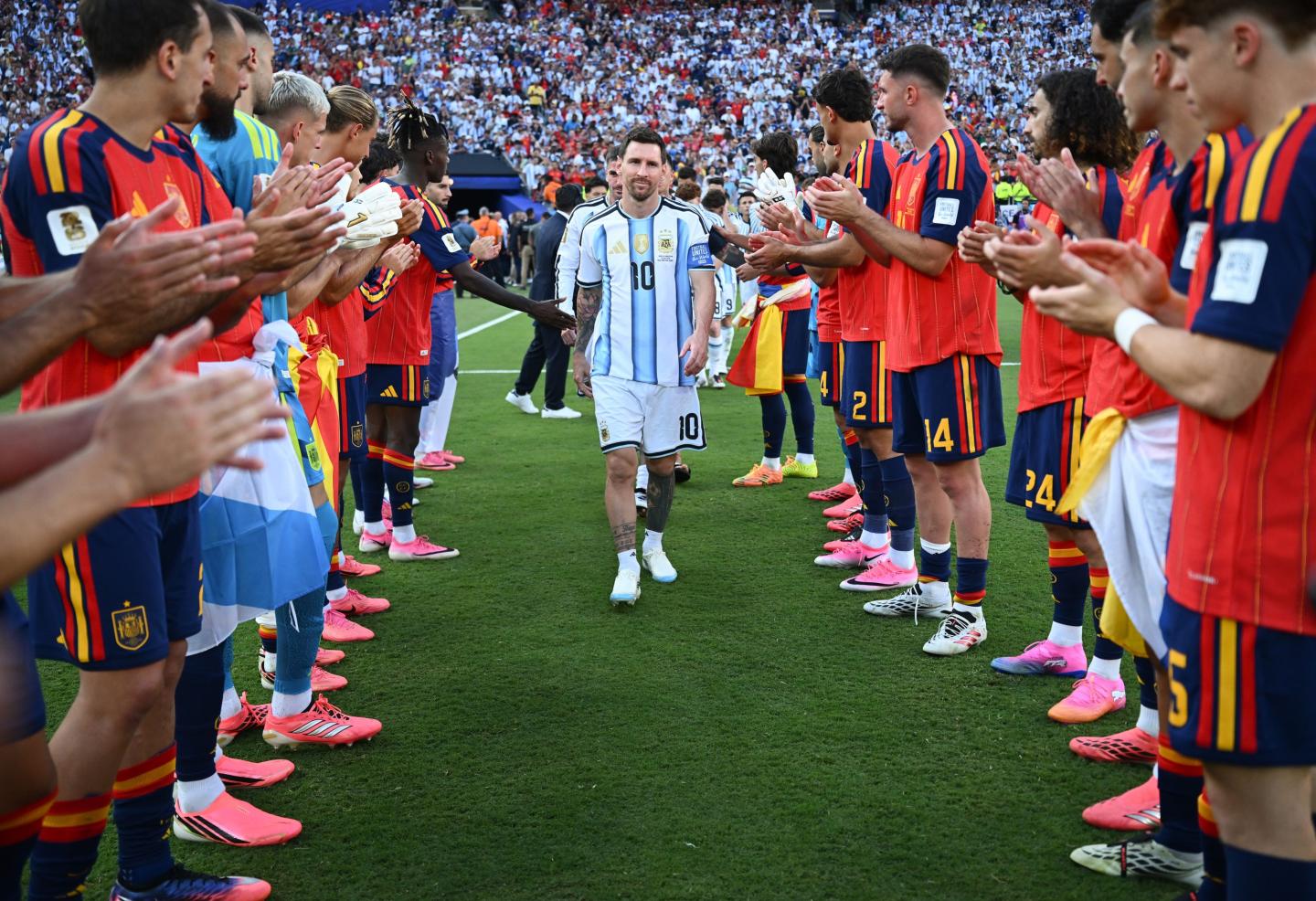
Lionel Messi #10 of Argentina is embraced by players of Spain at the ceremony following the FIFA World Cup 2026 Final match between Spain and Argentina at New York New Jersey Stadium on July 19, 2026 in East Rutherford, New Jersey. Hannah Peters - FIFA/FIFA via Getty Images
Add Fortune on Google for similar content.

On Sunday, July 19, a technologically saturated sporting spectacle came down to an old-fashioned denouement: 37 seconds into the second period of extra time of the 2026 World Cup Final, Spanish substitute Ferran Torres side-footed a loose ball past seemingly impenetrable goalkeeper Emiliano Martinez, giving Spain a 1-0 win over Lionel Messi’s Argentina.

Recommended Video

In the thrill of the game, you may be forgiven for overlooking how much of this tournament was run by tech. FIFA’s semi-automated offside system used dedicated tracking cameras mounted under stadium roofs to follow up to 29 points on every player’s body 50 times a second, fused with a sensor in the ball reporting its position 500 times a second; tickets were priced by algorithm; highlights were cut by AI; fans entered stadiums by biometric scan.

And yet, where it truly mattered, humans decided the game.

My team at Digital Planet at Tufts University’s Fletcher School and I spent this year mapping which American jobs AI could hollow out. Given the steady march of tech onto one of the planet’s most worshipped human endeavors, I watched the 2026 FIFA World Cup final through a particular lens to find the lines where man passes to machine and where the machine passes back. Let’s just call it the Messi Test.

To be clear: none of us will ever be Messi, or come close. But the human attributes he draws from live, in some measure, in all of us; strikingly, they even mark the boundary of what machines can take from us. Consider these four:

First, human work is safer when it rests on tacit knowledge. This is at the heart of what the philosopher Michael Polanyi meant by “we can know more than we can tell,” and an argument MIT’s David Autor makes to explain why judgment-heavy tasks resist codification. Messi created more chances for his team largely by walking, averaging around five kilometers a game. He found higher valued or “elite space” on the field while barely moving, reading patterns others can’t see by scanning the field. The very best scanners can get up to 0.8 scans a second. Translating the scans into positioning oneself cannot, as yet, be written into an algorithmic playbook.

Second, human work is safer when it calls for action and reaction in non-stationary, open-ended environments. Messi specializes in a game with adversarial settings with no single optimal play. He must improvise each time. AI can even conquer Go, a complex but closed game with fixed rules, but it is less capable in a game that’s open-ended in so many ways as soccer or a negotiation with an endless menu of pathways.

Third, human work is safer when human presence is key to the value. This might sound like a truism, but it is inescapable that extraordinary performers like Messi bring in the viewers. They command outsized markets, on the field, in corporate sponsorships and in inspiring new generations of players. Employers, consumers and other stakeholders want the real thing, not a machine trained on Messi’s past plays. Even OpenAI paid for Messi’s authentic face as its first global sports ambassador for a worldwide campaign promoting ChatGPT. 

Fourth, human work is safer when there is a trust gap. By its own admission, FIFA’s high-tech approach to catching offsides is only “semi-automated”. The system generates an alert, but a human must validate it before the referee acts. Both humans and algorithms can make mistakes, but society does not yet trust the algorithm with the final word. 

Prior to July 19, I thought I had the key attributes for a Messi Test; then Spain rewrote it. And they sharpened it. The greatest player the beautiful game may have ever produced was beaten not by a better player, but by a better system. Messi was choked by the Spanish team, finishing the final with zero touches in the opposition box and one blocked shot. This was the triumph of collective tacit knowledge over individual genius: a pressing structure, positional rotations, an unspoken sense of when to squeeze and when to hold. The task was distributed and the necessary skills were resident in no single head.

This brings me to the final attribute of the Messi Test: 

Fifth, human work is safest not when the machine tries to replicate the superstar; it’s when it tries to devise a system that can suffocate the superstar. Rodri, Spain’s midfield captain, who won the tournament’s Golden Ball, was the embodiment of leadership of such a system. He didn’t score a goal, but he completed 101 of 105 passes and won 80% of his duels and across the tournament completed more passes and covered more ground than any player, thereby anchoring the entire Spanish team. He helped make the system work.

To cap it off, the Messi Test also takes the air out of a prevailing myth, which is an oversimplification of a more nuanced reality. This is a narrative that says physical work is safest from AI; after all, no matter how much better they have become, robots trained by AI still can’t fold laundry. 

Consider this for a moment: Messi is among the least physical of the World Cup greats. He spends 63% to 64% of his match time walking, less than almost any other outfield player in modern soccer. What protects him are the attributes I noted earlier and not his ability to run, defy gravity or physically intimidate his opponent with his size. The implications cut both ways: not all deskwork is unsafe just as not all physical work is automatically safe ( think: warehouse sorting, farm harvesting, long-haul trucking). Our American AI Jobs Risk Index, covering 784 occupations across 530 metro areas, finds the safe/unsafe line runs through task attributes, not through the physical jobs versus cognitive jobs boundary alone.

The Messi Test should help those who are asking the question about what skills and occupations they should prepare for in an AI-saturated future. It should also help employers and executives navigate their own decisions and plan the composition of their workforce and avoid many of the traps they seem to be falling into. 

For example, while Messi may be today’s superstar, he was overcome by a coordinated system; so investing in the organization is critical. A critical member of that Spanish “organization” was a teenager, Lamine Yamal, who is the product of roughly a decade in Barcelona’s La Masia academy. This means that even though it might be expedient to replace a junior associate with AI and saving money on the junior hires, as many companies now seem to be doing, ask: where does the next Yamal of the org chart come from? 

Also, companies need to invest in the trust roles. This means training the humans who confirm the call and are the co-pilots. Much of the investment has gone into training AI – the pilot.  As AI generates more of the decisions, the most valuable job may be of the human who validates them. 

Companies must retire the reflexive “let’s re-skill the displaced workers” orthodoxy: most organizations don’t have a clear idea of what are the new jobs they will be preparing them for and the experience of re-skilling during an earlier era when automation was eating manufacturing jobs suggests that it doesn’t work particularly well. 

***

While FIFA’s machines tracked 29 points on every player’s body, what made the 2026 World Cup such a thrill was how an individual like Messi brought more than an athletic body to the game. What won the World Cup was the invisible connection between the bodies that ultimately beat him. No camera has been built that can track that. So far.

The opinions expressed in Fortune.com commentary pieces are solely the views of their authors and do not necessarily reflect the opinions and beliefs of Fortune.

About the Author
By Bhaskar Chakravorti
See full bioRight Arrow Button Icon
Add Fortune on Google for similar content.

Latest in Commentary

Finance
Lorem ipsum dolor sit amet, consectetur adipiscing elit, sed do eiusmod tempor incididunt ut labore et dolore magna aliqua. Ut enim ad minim veniam
By Fortune Editors
October 20, 2025
Finance
Lorem ipsum dolor sit amet, consectetur adipiscing elit, sed do eiusmod tempor incididunt ut labore et dolore magna aliqua. Ut enim ad minim veniam
By Fortune Editors
October 20, 2025
Finance
Lorem ipsum dolor sit amet, consectetur adipiscing elit, sed do eiusmod tempor incididunt ut labore et dolore magna aliqua. Ut enim ad minim veniam
By Fortune Editors
October 20, 2025
Finance
Lorem ipsum dolor sit amet, consectetur adipiscing elit, sed do eiusmod tempor incididunt ut labore et dolore magna aliqua. Ut enim ad minim veniam
By Fortune Editors
October 20, 2025
Finance
Lorem ipsum dolor sit amet, consectetur adipiscing elit, sed do eiusmod tempor incididunt ut labore et dolore magna aliqua. Ut enim ad minim veniam
By Fortune Editors
October 20, 2025
Finance
Lorem ipsum dolor sit amet, consectetur adipiscing elit, sed do eiusmod tempor incididunt ut labore et dolore magna aliqua. Ut enim ad minim veniam
By Fortune Editors
October 20, 2025

Most Popular

Finance
Lorem ipsum dolor sit amet, consectetur adipiscing elit, sed do eiusmod tempor incididunt ut labore et dolore magna aliqua. Ut enim ad minim veniam
By Fortune Editors
October 20, 2025
Finance
Lorem ipsum dolor sit amet, consectetur adipiscing elit, sed do eiusmod tempor incididunt ut labore et dolore magna aliqua. Ut enim ad minim veniam
By Fortune Editors
October 20, 2025
Finance
Lorem ipsum dolor sit amet, consectetur adipiscing elit, sed do eiusmod tempor incididunt ut labore et dolore magna aliqua. Ut enim ad minim veniam
By Fortune Editors
October 20, 2025
Finance
Lorem ipsum dolor sit amet, consectetur adipiscing elit, sed do eiusmod tempor incididunt ut labore et dolore magna aliqua. Ut enim ad minim veniam
By Fortune Editors
October 20, 2025
Finance
Lorem ipsum dolor sit amet, consectetur adipiscing elit, sed do eiusmod tempor incididunt ut labore et dolore magna aliqua. Ut enim ad minim veniam
By Fortune Editors
October 20, 2025
Finance
Lorem ipsum dolor sit amet, consectetur adipiscing elit, sed do eiusmod tempor incididunt ut labore et dolore magna aliqua. Ut enim ad minim veniam
By Fortune Editors
October 20, 2025
Fortune Secondary Logo
Rankings
  • 100 Best Companies
  • Fortune 500
  • Global 500
  • Fortune 500 Europe
  • Most Powerful Women
  • World's Most Admired Companies
  • See All Rankings
  • Lists Calendar
Sections
  • Finance
  • Fortune Crypto
  • Features
  • Leadership
  • Health
  • Commentary
  • Success
  • Retail
  • Mpw
  • Tech
  • Lifestyle
  • CEO Initiative
  • Asia
  • Politics
  • Conferences
  • Europe
  • Newsletters
  • Personal Finance
  • Environment
  • Magazine
  • Education
Customer Support
  • Frequently Asked Questions
  • Customer Service Portal
  • Privacy Policy
  • Terms Of Use
  • Single Issues For Purchase
  • International Print
Commercial Services
  • Advertising
  • Fortune Brand Studio
  • Fortune Analytics
  • Fortune Conferences
  • Business Development
  • Group Subscriptions
About Us
  • About Us
  • Press Center
  • Work At Fortune
  • Terms And Conditions
  • Site Map
  • About Us
  • Press Center
  • Work At Fortune
  • Terms And Conditions
  • Site Map
  • Facebook icon
  • Twitter icon
  • LinkedIn icon
  • Instagram icon
  • TikTok icon
  • YouTube icon
Bhaskar Chakravorti is Dean of Global Business at The Fletcher School at Tufts University and founding Chair of Digital Planet, which publishes the Digital Evolution Index.

Latest in Commentary

Roderick Wong, MD is Managing Partner and Chief Investment Officer of RTW Investments
Commentary250 Years of Innovation
When 10,000 doctors stood up and cheered for a cancer drug — America’s innovation machine made it possible
By Roderick WongJuly 25, 2026
28 minutes ago
t
CommentaryCommunity
Ronald Reagan center director: How to talk politics with family, friends and neighbors, without losing them
By Frederick J. Ryan, Jr.July 25, 2026
28 minutes ago
m
Commentarydisruption
The Messi Test and how the Spaniards messed with it: what the World Cup final taught me about the Jobs AI can’t touch
By Bhaskar ChakravortiJuly 25, 2026
58 minutes ago
alex
CommentaryEntrepreneurship
I sold my startup for millions without a single dollar in revenue. Here’s why that’s the point
By Alexander Kardos-NyheimJuly 25, 2026
5 hours ago
craig
CommentaryPharmaceutical Industry
Big pharma’s patent cliff meets a new biotech Cold War: We need to outrun China, not outlaw it
By Craig GarthwaiteJuly 24, 2026
1 day ago
tim
Commentarysmartphones and mobile devices
NYU Stern pricing expert: There’s a hidden ‘AI tax’ hitting Apple, Dell — and your next phone
By Srikanth JagabathulaJuly 24, 2026
1 day ago

Most Popular

'The demographic dividend of the last 40 years is ending': J.P. Morgan says the world is running out of the two things that kept interest rates down
Economy
'The demographic dividend of the last 40 years is ending': J.P. Morgan says the world is running out of the two things that kept interest rates down
By Eleanor PringleJuly 24, 2026
1 day ago
Jensen Huang made his $172 billion fortune on AI chips. His family's $75 million gift to Vanderbilt argues art decides what technology is for
Big Tech
Jensen Huang made his $172 billion fortune on AI chips. His family's $75 million gift to Vanderbilt argues art decides what technology is for
By Sydney LakeJuly 23, 2026
2 days ago
The $39 trillion U.S. national debt isn’t as high as Japan’s and Singapore’s relative to economy size—and yet it's still worse somehow
Economy
The $39 trillion U.S. national debt isn’t as high as Japan’s and Singapore’s relative to economy size—and yet it's still worse somehow
By Sasha RogelbergJuly 23, 2026
2 days ago
Current price of oil as of July 24, 2026
Personal Finance
Current price of oil as of July 24, 2026
By Joseph HostetlerJuly 24, 2026
1 day ago
The millennial generation has split, new Fed research shows: Those over 35 are edging toward boomer-style wealth, while everyone else falls behind
Real Estate
The millennial generation has split, new Fed research shows: Those over 35 are edging toward boomer-style wealth, while everyone else falls behind
By Nick LichtenbergJuly 22, 2026
3 days ago
Current price of silver as of Friday, July 24, 2025
Personal Finance
Current price of silver as of Friday, July 24, 2025
By Joseph HostetlerJuly 24, 2026
1 day ago

© 2026 Fortune Media IP Limited. All Rights Reserved. Use of this site constitutes acceptance of our Terms of Use and Privacy Policy | CA Notice at Collection and Privacy Notice | Do Not Sell/Share My Personal Information
FORTUNE is a trademark of Fortune Media IP Limited, registered in the U.S. and other countries. FORTUNE may receive compensation for some links to products and services on this website. Offers may be subject to change without notice.