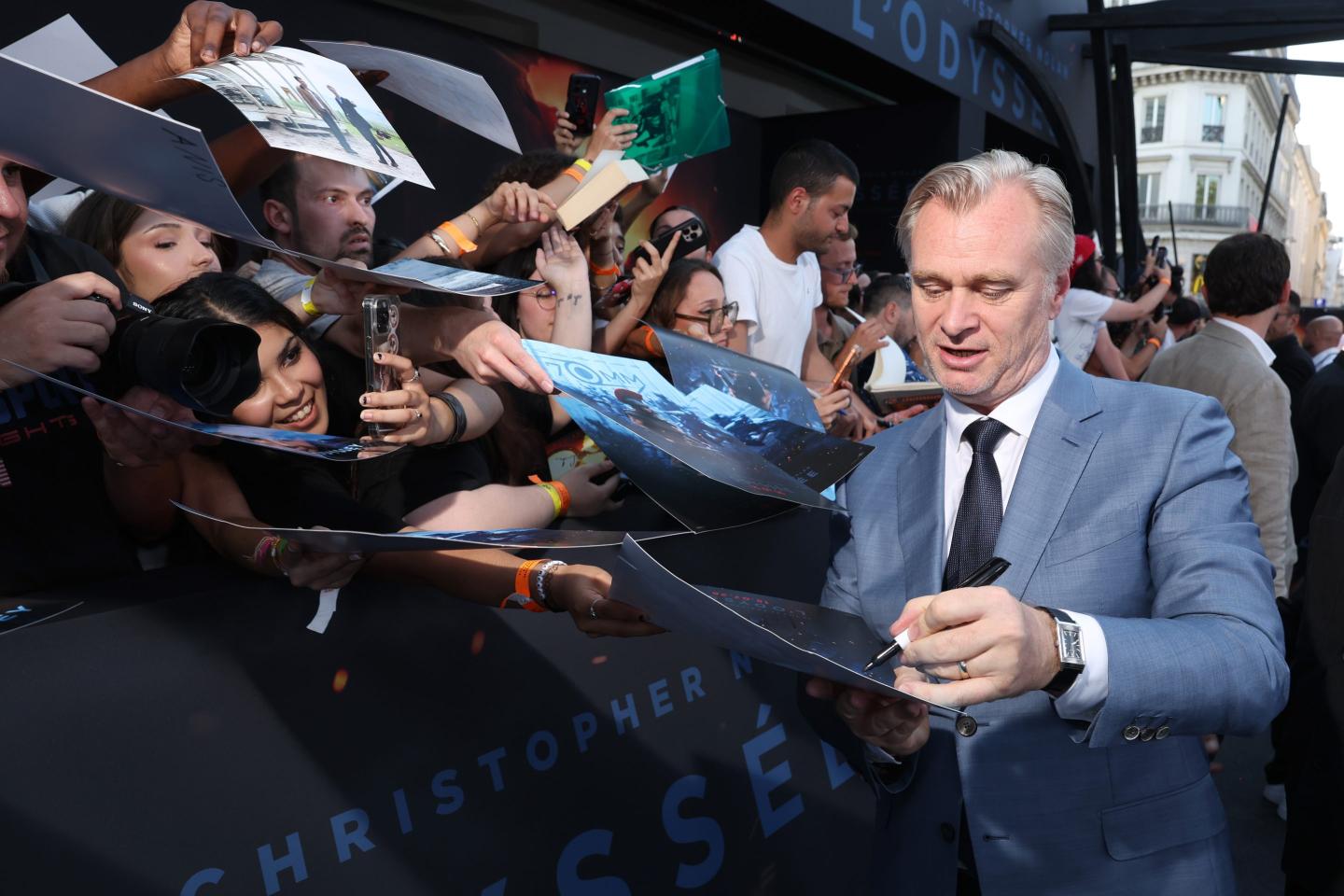
Christopher Nolan doesn’t need a superhero suit, a lightsaber, or a shared universe to sell out movie tickets. Instead, he appears to have enough brand equity to make a nearly three-hour, R-rated adaptation of Homer open bigger than any Batman movie he ever made.
The Odyssey—Nolan’s take on the classic Greek epic about a mythological hero’s boat ride home—raked in $264 million in its opening weekend, clearing its $250 million production budget and topping The Dark Knight Rises, The Dark Knight, and Oppenheimer to become the director’s biggest global debut.
This is a notable feat for an ancient war epic with no franchise scaffolding or superhero to lean on, making Nolan the closest thing Hollywood has to a “non-IP IP”—a filmmaker whose name functions like a franchise, according to Paul Dergarabedian, head of marketplace trends at Rentrak and one of the film industry’s most recognizable experts.
“It’s an automatic must-see cinematic event when Christopher Nolan’s name is on the movie,” Dergarabedian told Fortune.
He likens the director’s credit to the old Good Housekeeping Seal of Approval, a mark that creates “a mandate among moviegoers” to show up even when they don’t know what the film is about. In Comscore’s audience surveys, he noted, viewers rarely cite the director as their reason for buying a ticket, but Nolan is one of the few exceptions.
“What Christopher Nolan brings to the table is this sort of handcrafted, very human, analog art form,” Dergarabedian added.
The data backs the mystique. Across his filmography, Nolan’s movies have grossed more than $6 billion worldwide and roughly $2.4 billion domestically, according to Rentrak figures—a body of work built on dueling magicians, dream heists, and the birth of the atomic bomb.
“He never talks down to the audience, and I think audiences recognize that and respect it,” Dergarabedian said.
The ‘analog man in a digital AI world’
Nolan’s film appears to be a direct counterweight to the moment Hollywood is having with AI. Netflix has already spent up to $600 million acquiring Ben Affleck’s AI filmmaking startup and told shareholders AI touched roughly 300 titles in 2026, cutting visual-effects costs in half on some scenes. Amazon MGM’s head of AI Studios, Albert Cheng, has put the ambition even more bluntly: “We can actually fit five movies into what we would typically spend on one.”
But Nolan has built his identity on the opposite instinct. An outspoken skeptic of “AI slop,” his filmmaking—70mm film, practical effects, the studied refusal to take shortcuts—makes an argument for elaborate human authorship.
“He’s an analog man in a digital AI world, and I think that’s incredibly appealing,” Dergarabedian said. “AI is a fantastic tool, but it’s not a replacement for creativity.”
What separates Nolan’s work from a prompt-generated facsimile, Dergarabedian argued, is both technical polish and “heart and soul.” In an era when “a lot of people are punching in a prompt to create a movie,” the handcrafted alternative becomes “a very recognizable differentiator,” Dergarabedian told Fortune.
That differentiation also has a commercial shape: scarcity. The Odyssey is built around premium formats, including 70mm presentations available at only 41 theaters worldwide, and fans crossed oceans to be able to see it, reminiscent of how fans drove for hours to catch Oppenheimer, with one even braving 14 hours to see it.
Dergarabedian points to this dedication as proof audiences will pay a premium for provable human craft when a movie promises it. While it’s uncertain whether Nolan’s method will scale as studios race to cut costs with AI, the analyst is optimistic about Nolan inspiring a generation of filmmakers.
“His impact on cinema will be felt for decades to come,” he said.