
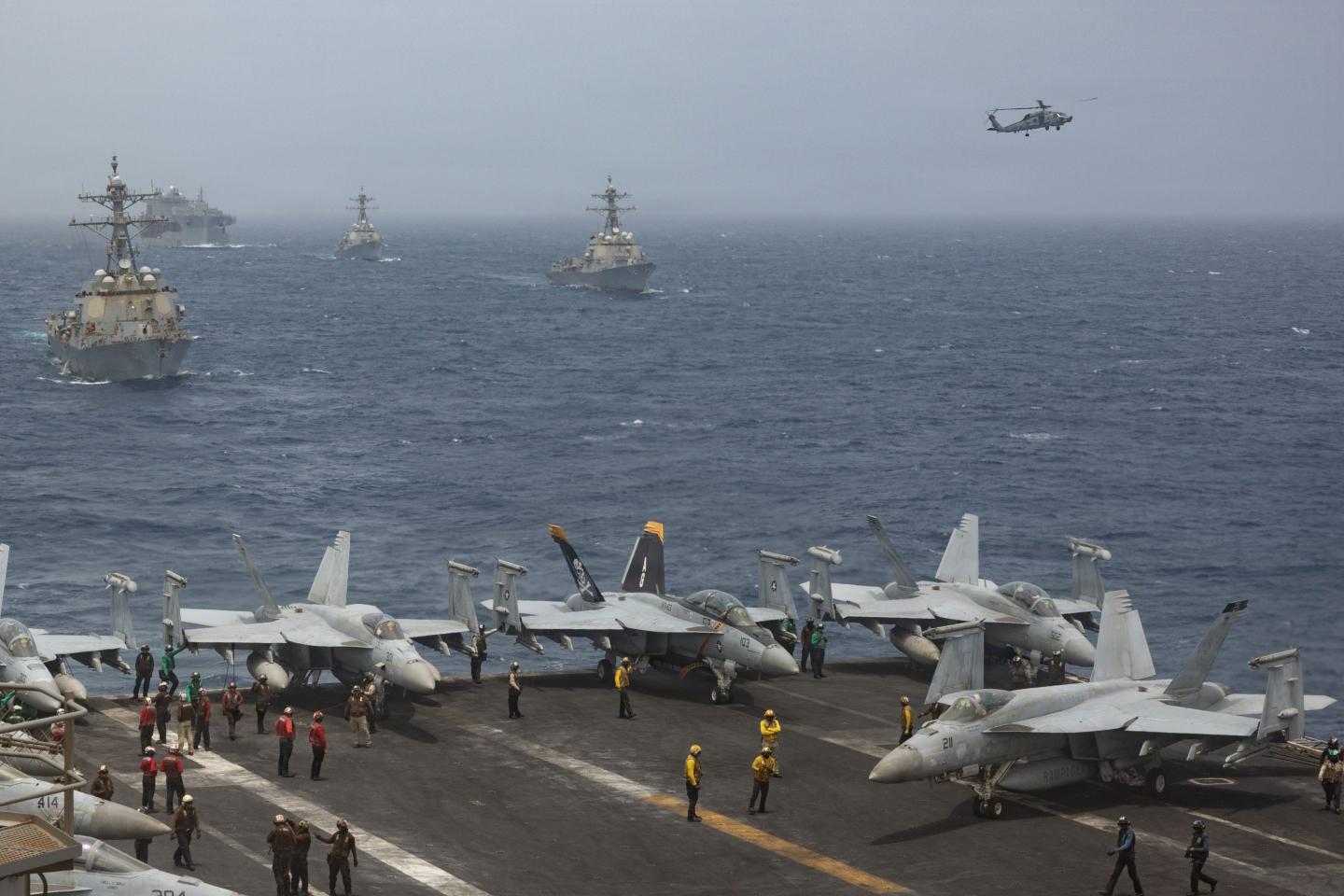
Despite the U.S.-Iran ceasefire agreement, the Persian Gulf has seen on-again, off-again fighting as both sides try to assert control over the Strait of Hormuz.
Iran insists that all traffic must receive its OK and has attacked ships attempting to cross the narrow waterway outside its approved route along the Iranian coast. On Saturday, it declared the strait closed again and claimed to hit a ship using an “unauthorized route.”
The U.S. has retaliated by bombing Iranian sites used for drone and missile strikes, doing so again on Saturday, while defending ships following an alternate route that hugs the Omani coast.
“Iran was provided yet another opportunity to demonstrate adherence to the Memorandum of Understanding after being held accountable for earlier attacks on commercial vessels but has again failed,” U.S. Central Command said on X. “In response, the United States is imposing a heavy cost by continuing to degrade Iran’s ability to attack civilian mariners and commercial ships freely transiting the strait.”
Top U.S. officials have demanded that Tehran make a public statement saying the strait is open and ships won’t be attacked. But the ability to close it off—and threaten the global economy with an oil shock—represents Iran’s main source of leverage.
Weeks of U.S. bombardment during the war failed to fully reopen the strait, though the Navy established the alternate channel by guiding ships through and offering protection from Iranian attacks.
The result has been a stalemate in recent weeks as the U.S. refuses to back down from trying to restore free navigation while Iran won’t budge on asserting its authority.
The solution could echo the famous Old Testament story where Solomon orders a baby claimed by two women to be cut in half.
Oman has drafted a proposal to manage traffic in the strait through two separately controlled routes, sources told CNN on Saturday.
The plan has yet to be finalized, but it calls for free navigation under prewar conditions in the southern corridor through Omani territorial waters.
The northern corridor through Iranian waters would require prior approval from Tehran, although no tolls would be imposed, the report said.
Oman’s foreign ministry didn’t immediately respond to a request for comment.
Iran’s foreign minister met with his Omani counterpart in Muscat on Saturday to discuss ways for ensuring safe passage in the strait.
Oman said it and Iran agreed to keep talking about the Strait of Hormuz “at the technical and political levels.”
Of course, no corridor can truly be open until shipping companies and their insurers deem it safe enough to transit, regardless of official pronouncements from the U.S. or Iran.
Defending the Omani route from Iran has been the U.S. military’s responsibility, giving it effective control over it, though some attacks have still gotten through.
But even if the U.S. is able to intercept all of Iran’s drones and missiles, enough ships still have to get in and out to both load and deliver the Persian Gulf’s oil supplies. Until then, oil markets will remain under pressure, forcing consuming countries to keep draining their reserves.
The current status quo under the fragile ceasefire may be unsustainable. The U.S. and Iran have signaled reluctance to return to all-out war, but more skirmishes are possible.
Dan Alamariu, chief geopolitical strategist at Alpine Macro, said in a note on Wednesday that the U.S. could try to pry open the strait by military force, adding that current military operations suggest the U.S. may be positioning for this option.
Another course of action is to “grind Iran down economically” by reimposing a naval blockade, which he called the “path of least resistance” unless the memorandum of understanding that was signed last month is reaffirmed.
Alamariu predicted a new deal may be needed. But along the way, more fighting, a blockade, or both are possible.
“Ultimately, both sides need a deal soon given domestic vulnerabilities: looming U.S. midterms, Iran’s economic and political fragilities,” he explained. “Some new deal is therefore quite possible, even likely within 1-2 months (or sooner), though timing and escalatory paths remain very uncertain. The current strikes and counter-strikes are a way to bargain, as both the U.S. and Iran are trying to establish greater leverage.”