
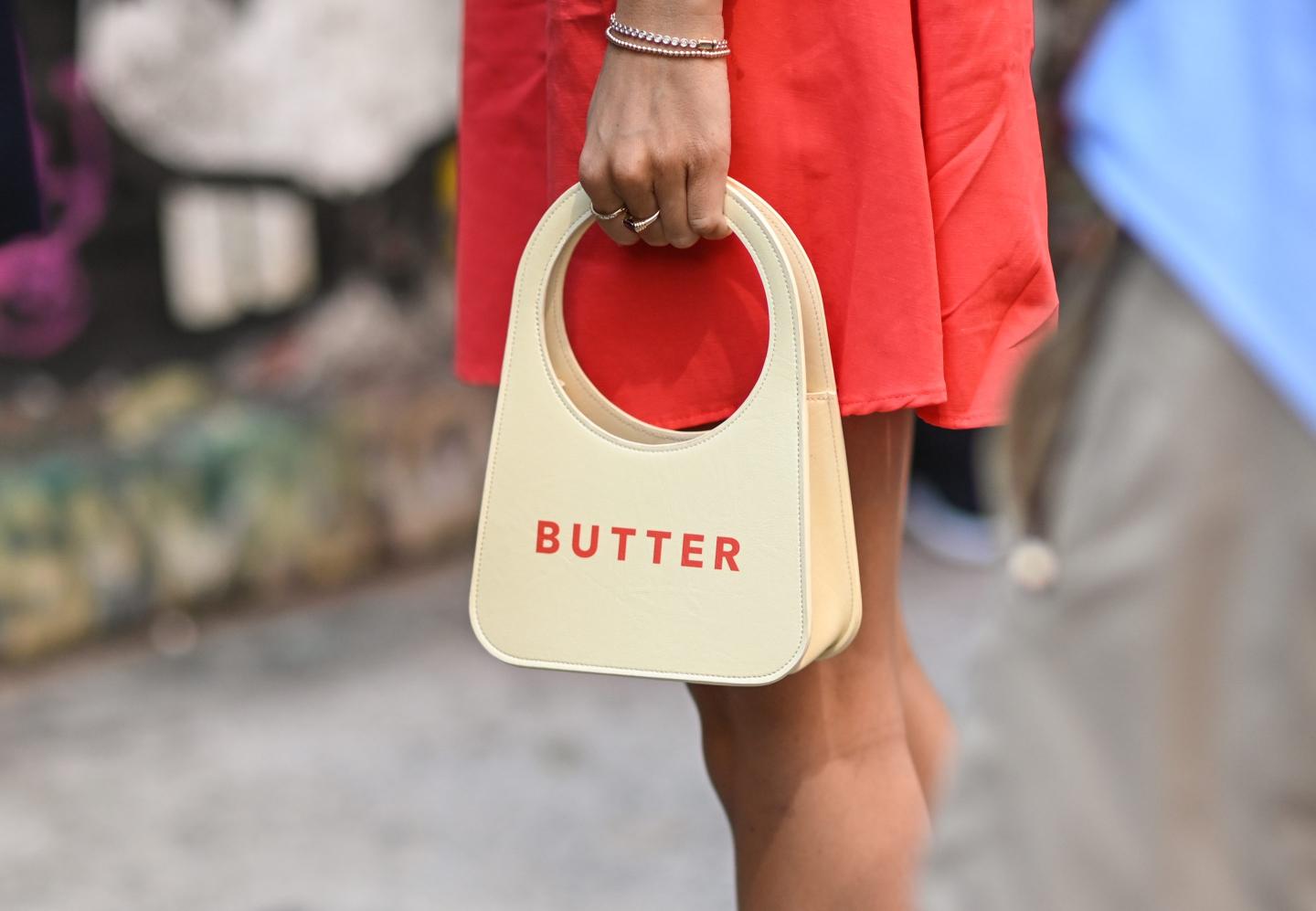
Why did America collectively decide this summer that it wanted to paints its nails, wear sun dresses and polo shirts, even stream old movies, featuring a queasy shade of yellow that looks like nothing more than a stick of butter on the top shelf of the fridge?
“Butter yellow” isn’t just a real shade, it is emerging as the shade of the off-kilter year of 2026. Search interest in “butter yellow dress” and “butter yellow nails” both hit all-time highs this June—the third consecutive June “butter yellow nails” peaked at a high point. “Butter summer” as a search term more than doubled in a single week.
The aesthetic has moved well beyond Pinterest boards: Butter yellow was spotted across runway collections from Chanel to Valentino this spring, Amazon has stocked up with clothing, shoes, and accessories in the shade, and beauty publications from Elle to The Zoe Report have declared it the dominant nail color of summer 2026. Simultaneously, Americans are rewatching Father of the Bride, drinking pineapple Kool-Aid and hunting down “90s butter mom movies.” Taken individually, these look like micro-trends. Taken together, they form something more interesting: a consumer psychographic in real time and another example of millennial parents’ nostalgia kick interacting with Gen Z’s love of ’90s retro. The lousy economy lends a hand, too.
The vibe economy has a color palette
Economists have long known that consumer aesthetics are countercyclical signals. During periods of financial stress and cultural turbulence, spending patterns tend to migrate toward comfort, softness, and the familiar. The “lipstick effect“—the observation that sales of small luxuries rise during recessions as consumers substitute affordable indulgences for big-ticket purchases—has been documented across multiple downturns, from the Great Depression, when cosmetic sales rose broadly, to the 2008 recession, when Estée Lauder reported increased lipstick sales. A 2019 peer-reviewed study published in the Journal of Retailing and Consumer Services found “a significant increase” in average cosmetics expenditures among younger women, age 18–40, during the Great Recession. The 2026 version of that impulse appears to be chromatic as much as cosmetic.
Butter yellow sits at the intersection of warmth, approachability, and nostalgia. It evokes kitchens, not boardrooms. Sunday mornings, not Monday earnings calls. Google’s own consumer research published in early 2026 noted that “consumers are increasingly feeling anxious, worried, and tired” and are “combatting this emotional fatigue by prioritizing immediate rewards and new experiences that enhance their present wellbeing.”
For a consumer class navigating elevated interest rates, stubborn housing costs, and AI-driven job anxiety, the aesthetic is less a fashion choice than an emotional one. Color experts have long argued warm, creamy tones communicate safety and nurturing—exactly the psychological register the butter palette occupies, according to the Pantone Color Institute’s framework for color psychology.
Millennials, peak purchasing power, and the nostalgia premium
The demographic engine behind the butter aesthetic is specific: Millennial parents, now roughly 30–45 years old, are entering their peak household spending years. Millennial retail spending now totals $1.127 trillion annually, representing 28.3% of all U.S. retail spending, according to Capital One Shopping data cited by eMarketer. The average millennial spends $31,256 per year on retail purchases—6.16% more than the average consumer, and millennial households now represent more than one in four U.S. households, with the steepest jump in homeownership currently happening among younger millennials.
And they are reaching backward to do it.
Father of the Bride—the 1991 Steve Martin comedy, perennially rewatched—is a specific cultural artifact of the millennial childhood: warm-lit suburban domesticity, bougie-but-attainable family life, mothers in exactly the kind of soft, creamy tones now flooding Instagram. The nostalgia these consumers are expressing isn’t just sentimental. It’s aspirational. Research consistently finds experiences and emotional resonance now outrank purely material goods as priorities for millennial consumers.
This pattern shows up in food as well. Pineapple Kool-Aid searches hitting an all-time high is not simply a beverage preference: It’s a childhood taste memory being monetized. The same impulse driving a 35-year-old to pin a butter yellow linen dress is driving them to mix a pitcher of something they last drank at a backyard birthday party in 1998.
The machine behind the mood
The synchronized nature of the butter aesthetic—the fact that nail salons, streaming queues, runway collections, and Amazon storefronts all arrived at the same shade at roughly the same moment—is not a coincidence of cultural consensus, either.
The mechanism works like this: Pinterest surfaces butter yellow to a user who pinned one linen dress in March. That drives a search. That search trains Amazon’s recommendation engine. That engine surfaces butter yellow accessories to someone who never consciously searched for the color at all. WGSN, the trend forecasting firm whose data retailers pay six figures to access, documented global searches for “butter yellow” surging 324% year-over-year between February and May—and flagged explicitly the signal was being driven by “consumers seeking comfort, optimism and a sense of nostalgia in uncertain times.”
What makes this cycle different from prior comfort-color moments is the speed and synchronicity of the amplification. Research on algorithmic consumer behavior shows platforms now analyze search queries, browsing patterns, and social engagement in real time to surface personalized content—which then loops back into organic search behavior. The trend doesn’t just reflect the mood. It accelerates it, and eventually manufactures it. Highsnobiety noted something telling: Some of the butter-yellow garments now flooding retail floors were designed two years ago. The algorithm didn’t create this color cycle—it detected a latent consumer signal already moving through the supply chain and compressed what might have been a slow cultural drift into a synchronized national moment.
Razorfish’s 2026 consumer trends report, synthesized from more than 100 leading trend sources, found today’s consumers are demanding more “human substance” from the brands they bring into their lives, with 63% saying that AI makes them value human-made things more. Surely, it’s not a coincidence handcrafted, tactile, warm aesthetics are thriving precisely as AI-generated content scales. What an irony, then, that the supposedly human, warm color that is coming to symbolize the AI summer of 2026 was itself the product of algorithmic recommendation.
Academic color research supports the mechanism, if not always the conclusions we want to draw from it. SeeMeDesign’s longitudinal study of color trends and economic performance found three primary drivers of dominant color cycles: optimism, peer influence, and technology—and concluded technology has now surpassed the other two as the primary accelerant. Color trends, the research argues, “evolve alongside technological advancements” and increasingly express collective psychological states before consumers themselves can articulate them.
What the signal actually says
Here is where intellectual honesty requires a note of caution. A 2025 meta-analysis published by Style Analytics ran 20 years of Google Trends data against consumer confidence using structural equation modeling and found the fashion indicators most tightly correlated with recession were mini skirts and blazers—not soft, warm, nostalgic tones. The researcher’s conclusion: People may be thinking about recession and feeling economically squeezed, but the hard fashion signals don’t confirm we’re actually in one. Butter yellow, on this reading, is expressing anxiety rather than indicating economic contraction.
A consumer class that feels anxious but is still spending is not the same as a consumer class in genuine retreat. The butter aesthetic may be, for the emerging millennial parent cohort, less a coping mechanism than a coping performance: the visual language of comfort deployed by people who are financially fine but psychologically exhausted by a decade of being told they shouldn’t be. It’s the color of “I’m doing fine, but the country is doing badly.”
That reframe changes what brands should do with the signal. The retailers reading butter yellow purely as a distress indicator and flooding the zone with affordable comfort goods may be misreading their own customer. The smarter play, consistent with Google’s 2026 consumer research, is to treat the aesthetic not as evidence of financial fragility but as evidence of emotional demand—a consumer base that is materially capable but psychologically hungry for warmth, slowness, and the feeling that the world is not moving quite so fast. In that way, it’s like the nostalgia that boosted the color to the algorithms in the first place: a hollow reflection of the memory that it’s trying to evoke.