
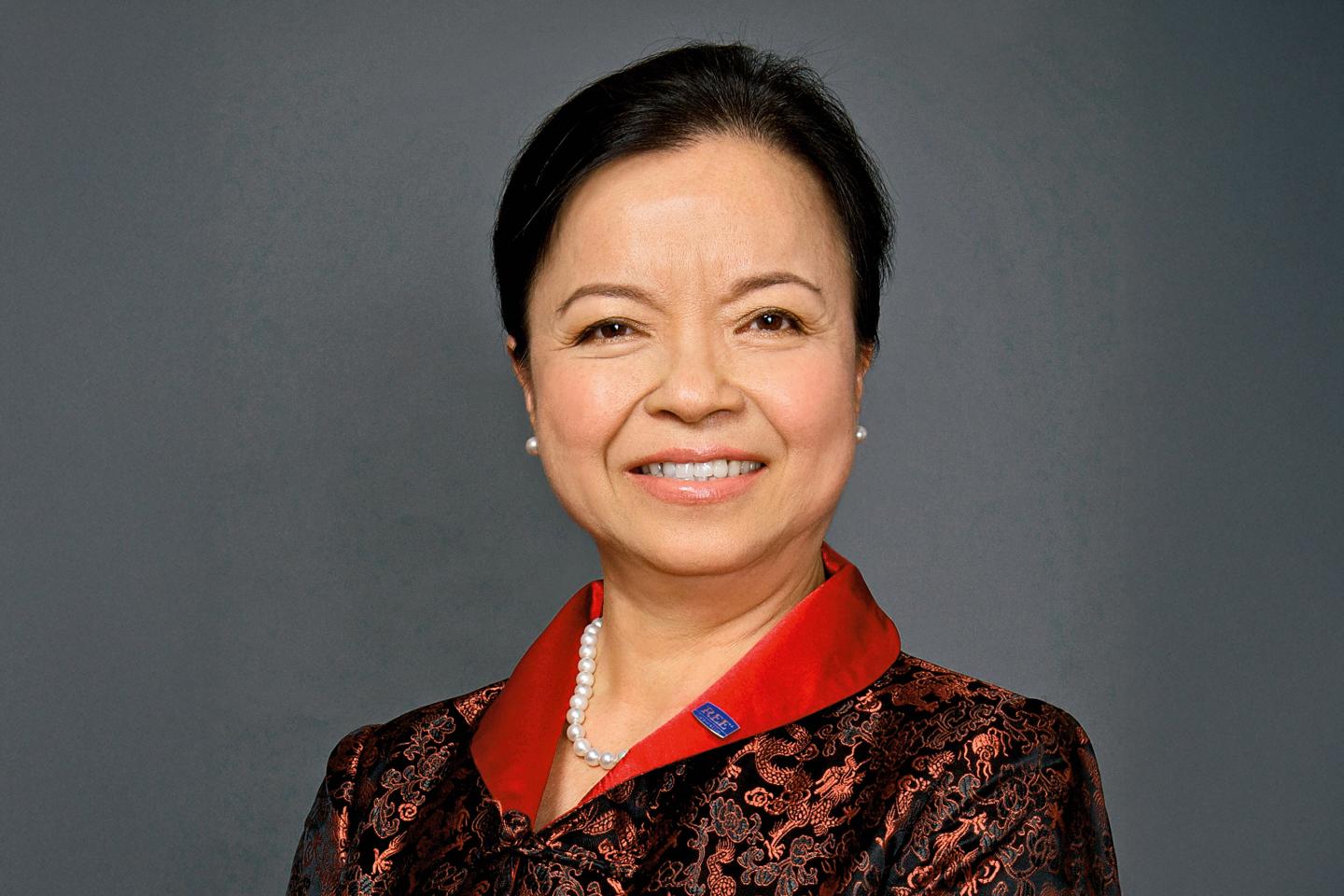
In 1961, at just 8 years old, Nguyen Thi Mai Thanh was ordered by officials in then–South Vietnam to live in a “strategic hamlet,” an attempt to separate rural villagers from the National Liberation Front (which U.S. readers know better as the Vietcong). As much as one-third of South Vietnam’s rural population was sent to the hamlets, which ultimately became a strategic failure, increasing resentment against officials in Saigon.
“It was a very painful process,” she remembers. “People who had close ties to the village suddenly have to uproot their entire existence into these hamlets. It was very heartbreaking.” When the conflict grew more intense in 1968, she joined the Communist forces as a medic at the age of 16, “concocting basic medication, saline solutions.”
That experience is a far cry from her current position, as chair of REE Corp., one of Vietnam’s leading developers of renewable energy projects, particularly in wind, hydropower, and solar. She spoke with Fortune in her Ho Chi Minh City office, answering questions in a mix of English and Vietnamese, with her Western-educated daughter translating.
Nguyen joined REE in 1982, when it was still a rusty state-owned enterprise with just one factory. Three years later, she became its director—and led the company through its privatization, its IPO, its pivot to renewable energy, and its backing by one of the world’s largest conglomerates.
Nguyen’s long career parallels the story of Vietnam as a whole: managing the consequences of a lengthy war; riding out a rapid reopening that forced the country’s companies to improve quickly; and now aligning to the most important global growth trends of the decade, like the energy transition and supply chain resilience.
Now, she is handing over REE to the next generation, stepping down from the chair role on July 10; she plans to hand over key roles to her children. But Nguyen sees plenty of opportunities in Vietnam for a renewable energy company like hers. Electricity is in increasingly high demand in Vietnam, through new goods like electric vehicles. “If dirty electricity is going into an EV, then it’s not really a green car,” she says. More important, “a lot of nascent industries here, like semiconductors and AI, all need electricity,” she notes. “We’re not self-harming in the name of development and growth. For every dollar of growth, a part of that has to go to protecting the environment.”
After the Paris Peace Accords in 1973 ended U.S. involvement in Vietnam, Nguyen returned to her education, walking for three whole months to reach Hanoi, with plans to stay in medicine. The government, however, had other plans. “The government wanted to send those with high scores to study abroad, so I was sent to East Germany—not to study medicine, but to study refrigeration.”
When she returned to Vietnam in 1982, Nguyen took a job at the Refrigeration Electrical Engineering Corp., then a sleepy state-owned enterprise with just one factory that—contrary to its name—mostly made cans for food. She had to rely on secondhand machines, like old Frick compressors, and Russian pipes; in those early days, Vietnam was still closed off from the outside world.
That changed in 1986, when Vietnam launched its Doi Moi reform program, a series of measures to open up space for the private sector and start trading with the outside world, similar to what Deng Xiaoping had launched in China almost a decade earlier. “The fundamental problem was simple: Goods were scarce while money kept being printed,” she says. “Doi Moi was like a fresh wind blowing into the Vietnamese economy.”
But new foreign competition brought its own problems, particularly for an SOE bound up in Communist-era rules. “Foreign companies could make their own decisions on who to hire, what to pay them, and investment decisions, with no one holding them back,” she says. “Vietnamese SOEs felt suffocated by comparison.”
In 1985, shortly before those reforms kicked in, the head of REE asked Nguyen to take over. “I had one condition: ‘You let me choose my own people,’ ” she says. “Many people quit.”
Now in control, Nguyen got to work revamping the company. “There was no money and no goods. I had to do it myself,” she says. Nguyen quickly realized that Vietnam, in those early days, wasn’t ready for some of her ambitions. She briefly explored manufacturing goods for Carrier and Hitachi in Vietnam, but realized that she’d need to import all the components owing to the country’s lack of basic industry. “If we’re importing everything,” she recalls thinking, “we’re not adding value.”
Since then, Nguyen has been at the forefront of Vietnam’s rapid reforms. In 1993, REE Corp. became the country’s first SOE to privatize. Then, in 2000, REE became the first company to list on the Ho Chi Minh Stock Exchange.
REE Corp. pivoted to energy in 2010, with investments in hydro-power, solar, and wind power generation. Energy now contributes almost half of its revenue, which was 10 trillion Vietnamese dong ($380 million) in 2025. It’s also a leading mechanical and electrical contractor, and has smaller businesses in real estate and environmental services. REE now targets revenue of $489 million for 2026, an increase of 22% over 2025, and net income of $112 million. It’s also planning a $1 billion push to expand its offshore wind capability.
One of REE’s major backers is Jardine Cycle & Carriage, a Singapore-listed subsidiary of the Hong Kong–based Global 500 conglomerate, Jardine Matheson. Cycle & Carriage owns just over 40% of REE’s shares.
On May 16, after Fortune’s interview, Nguyen announced that she will step down as REE’s chair in July, handing the role to Lee Liang Whye, Cycle & Carriage’s CEO. Her son, Nguyen Ngoc Thai Binh, will take over as CEO; he currently serves as deputy CEO and has spent 18 years at the company.
Vietnam is now pushing an aggressive economic campaign to lift GDP growth to 10% by the end of the decade, and become a high-income country by 2045, backed by an aggressive infrastructure investment program.
All that economic activity will need electricity. By 2030, Vietnam hopes to generate 150 gigawatts of power, with one-third of that coming from renewable energy. By 2050, Vietnam wants to be net zero, with as much as 70% coming from green energy. The country also hopes to impose a cap on coal power generation, and in March 2026 it announced a deal with Russian firm Rosatom to build two nuclear reactors at a plant in Ninh Thuan province in southern Vietnam.
The war in Iran has only heightened Vietnam’s need to change its energy mix. Vietnam imported 14.1 million tonnes of crude oil and 3.63 million tonnes of liquefied natural gas last year; while Vietnam has a large domestic refining industry, it still sources about a third of its refined fuel products from overseas.
“We’re not self-harming in the name of development. For every dollar of growth, a part of that has to go to protecting the environment.”
Nguyen Thi Mai Thanh, on the role of green energy.
Vietnam draws most of its imported oil from the Middle East, yet this trade has been blocked by Iran’s decision to close the Strait of Hormuz. China’s decision to halt exports of refined fuel products has also led to shortages. Vietnam has managed to avoid some of the energy conservation measures imposed by its neighbors, like Thailand’s order for government workers to take the stairs instead of the elevator. Yet consumer prices rose by 5.5% in April, and Vietnam posted a rare trade deficit as increased oil prices inflated its import numbers.
Nguyen thinks one thing Vietnam can change in response to the Iran shock is expanding offshore wind, though she warns that it could take as long as six years to get a project up and running.
Hanoi’s energy push is part of a broader investment scheme across the country. Hanoi is spending billions of dollars on new transport infrastructure, including new expressways, railways, ports, and airports.
But all that investment is costly—and the money needs to come from somewhere.
“The country is expected to double its energy generation, but it requires a lot of capital to develop these power generation assets,” Nguyen says. Beyond energy, “the government has estimated a total investment cost of $1.5 trillion for development as a whole. It can bear about 20% of this cost, meaning the remaining 80% has to come from other parts of the economy.”
Nguyen is still as blunt as she was four decades ago, when she took over REE. “My concern on the financing side is that Vietnamese banks do not have the ability to fund these projects on their own.”
She’s also concerned that Vietnam’s much-touted export boom is shallower than it appears. The Southeast Asian country has attracted manufacturing in sectors like apparel and electronics, as companies look to avoid China’s higher labor costs and build some supply-chain resilience.
In an echo of her observations about Vietnam’s lack of basic industry back in her early days running REE, Nguyen still feels like Vietnamese manufacturing isn’t as deep as it needs to be. “Let’s take Samsung, for example. They have large manufacturing facilities here. But what exactly are we contributing to the supply chain?” she asks. (Samsung is Vietnam’s largest foreign investor, committing more than $20 billion in direct investment, and accounts for as much as 16% of the country’s total exports.) “The cleaning, the assembly, the packaging, it’s less than 10% of the value. There’s no technology transfer.”
That’s why she thinks Vietnam’s future lies elsewhere, in agriculture and fisheries. “We should be investing in technology to help us amplify these strengths,” she says.
And as it happens, the same natural endowments that power her renewable energy business underpin those agricultural strengths, too.
“We’re blessed with sun, wind, water, and land,” she says.
Additional reporting by Nam Nguyen.
This article appears in the June/July 2026: Asia issue of Fortune with the headline “Four decades at the top: A career that tracks Vietnam’s rise.”