When Wang Chuanfu, CEO of Chinese EV company BYD, told shareholders in Shenzhen this week that the company would become the world’s largest automaker within five years, he pointed to growing production and sales overseas as one of the major paths to get there.
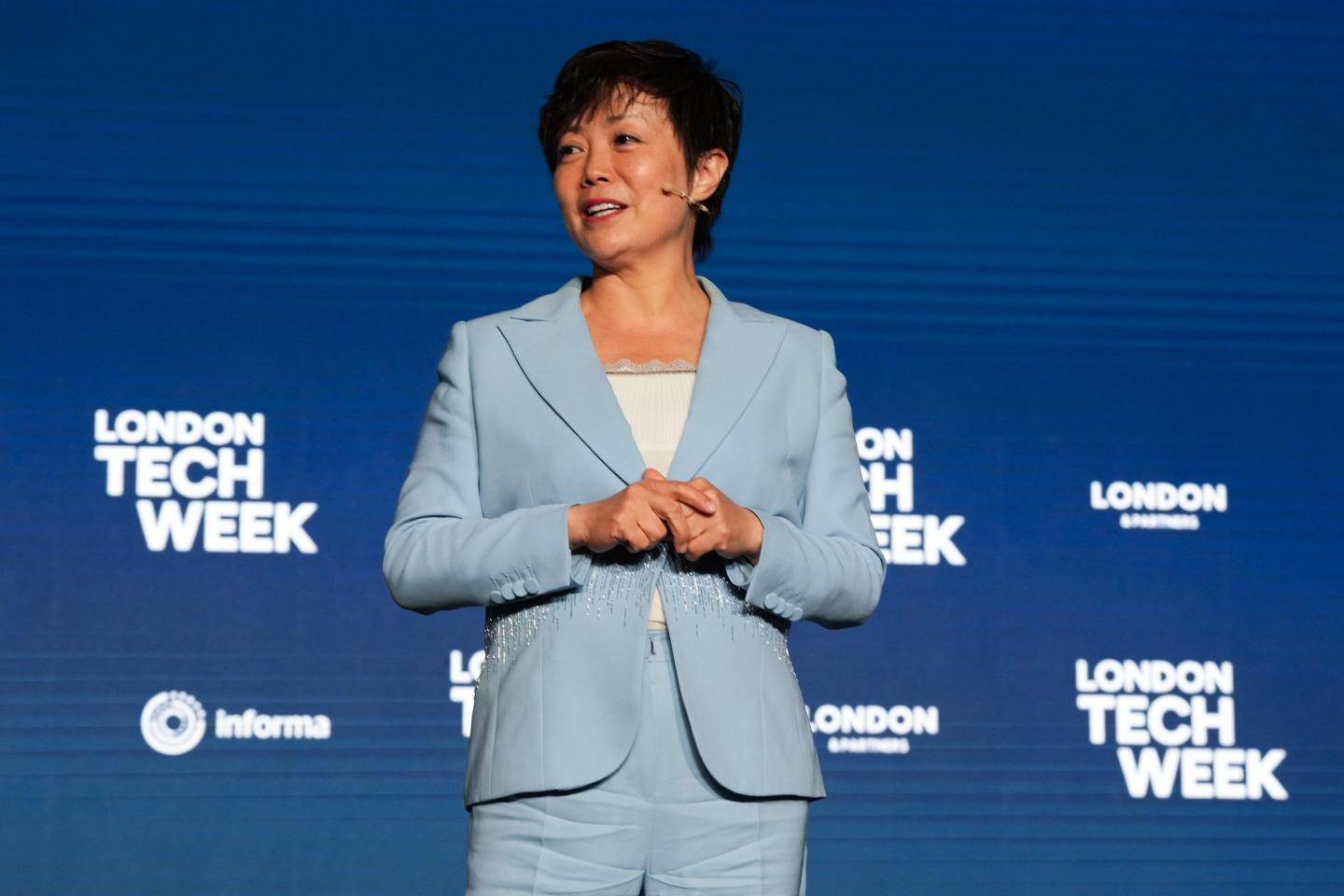
As BYD faces increasing pressure at home, this international expansion has become a vital part of the company’s business model. At the forefront of this is Wang’s longtime partner, Stella Li, BYD’s executive VP. Over her 30-year career at the Chinese EV and technology giant, Li has overseen the company’s transformation from its origins as a maker of mobile phone batteries to the world’s top seller of electric vehicles.
She’s widely seen as the architect of the company’s rapid international expansion. In an interview, Li told Fortune she spends roughly 70% of her time traveling, meeting government officials, hiring local executives, and personally shaping pricing and product strategy market by market. She also leads the company’s road shows, touring countries to demonstrate BYD’s newest offerings.
In April, when Li arrived at the Paris Opera House to showcase the European launch of BYD’s newest luxury car—flanked by ballerinas and opera singers—it was clear why some colleagues had dubbed BYD’s international road show “The Stella Show.”
In the past few years, BYD has been on an impressive sales trajectory. In 2022, the company dropped pure internal-combustion models from its lineup, focusing solely on electric vehicles and plug-in hybrids. By 2024, global vehicle sales had reached 4.27 million units, ranking the company fourth among global car manufacturers. In 2025, BYD sold a record 4.6 million new-energy vehicles, making it the world’s top-selling EV maker by pure-electric sales—stealing the crown from Elon Musk’s Tesla.
Much of this growth has been driven by its global expansion. International sales more than doubled in 2025 to just over 1 million vehicles as BYD pushed into Europe, Southeast Asia, and Latin America, where higher pricing helps offset fierce domestic competition and ongoing price wars in China’s EV market. In May, BYD sold more than 160,000 vehicles abroad, up 80% year on year, and is targeting 1.5 million overseas sales in 2026.
But the road ahead is far from straightforward. At home, BYD faces brutal price wars in China’s increasingly competitive EV market. Overseas, it is navigating regulatory pressure, labor rights allegations, and a U.S. market that remains effectively closed. Li has historically been the key figure bridging those gaps, but as the company’s ambitions have skyrocketed, so have its challenges.
BYD’s international push
Li has effectively built the company’s overseas presence from scratch over her 30-year tenure. Within a few years of joining forces with Wang, she had opened BYD’s first international outposts—with BYD Europe founded in 1998, before moving into the U.S. and Japan.
BYD’s current international foothold is a far cry from the company’s shabby, rented factory floors, which Li first toured in 1996.
When Li first met BYD founder and CEO Wang Chuanfu, he was operating out of a two-room apartment—one acting as his office, the other the finance department, she told Fortune. She said she was initially struck by his ambition, but won over by a tour of the factory floor.
“Outside it was an old, terrible building,” she recalled. “But when you walked in, they had put down a red carpet, and I had to take off my shoes … because the inside had to be completely clean. I thought, ‘Wow, this guy really has a big dream.’”
While Li credits Wang (rumored to be her partner in both business and life) as the “true genius” who handles much of the technological side of the business, she is very much the company’s public face.
In the early years, Li’s role was primarily hustling at trade shows and pitching to what she describes as often skeptical Western partners. Li was also one of the first high‑profile female executives in the male‑dominated auto sector and became the first woman to win the prestigious World Car Person of the Year award in 2025. (She’s also been named twice on Fortune’s list of China’s Most Powerful Women.)
Li said skepticism around her gender was more overt when she started, particularly when she walked into European boardrooms and sat across the table from towering—primarily male—tech executives.
“A lot of people don’t trust you at the beginning,” she said. “But once you start the conversation, and you talk about the technology … When you deliver and make things happen, gender is no longer important—most people forget if you are male or female. They just see you handle business professionally.”
The breakthrough moment, she said, came after a major battery conference in Paris in 1999. After being struck by China’s absence from the conference, she lobbied to return the following year as a speaker.
In 2000, she took the stage as a speaker to argue that China would soon become the world’s biggest market for both mobile phones and the batteries that powered them. The speech helped win over customers like Nokia and Motorola, she said, and laid the groundwork for BYD’s first global relationships.
“Immediately after this speech, it was like a nuclear bomb in this Western‑dominated industry,” she said.
By 2002, BYD had become a major global manufacturer of rechargeable batteries, with Motorola—its first major Western client—and Nokia among its key customers. The partnerships helped underwrite BYD’s IPO on the Hong Kong Stock Exchange that same year.
Growing pains
BYD’s international push hasn’t always been smooth sailing.
As the company has expanded into Europe, it has encountered growing regulatory and political friction. It is already under scrutiny as part of EU investigations into foreign subsidies. In recent months, a labor rights group has also brought forward alleged violations at its flagship plant in Hungary.
China Labor Watch reported allegations of labor-rights violations at BYD’s Szeged plant in Hungary, including seven-day workweeks, excessive overtime, recruitment fees leading to debt bondage, visa breaches, and harsh living conditions for Chinese migrant workers hired through subcontractors.
In response to the claims around its Hungary plant, BYD said in an official statement: “BYD Hungary places the highest priority on the protection of labor rights and the strict compliance with Hungarian and European laws and regulations. BYD Hungary maintains strict compliance requirements for all relevant stakeholders, including all contractors, subcontractors, and labor providers. We remain committed to ensuring that all activities related to our projects in Hungary are conducted responsibly, transparently, and in alignment with our global principles.”
Despite the controversy, Li told reporters in London this week that BYD will begin assembling cars at the Hungary plant in the fourth quarter of this year, describing it as “the number one priority right now.” She added that BYD has paused work on a planned plant in Turkey while it focuses on Hungary, and is already seeking a second European production facility.
When asked about some of the opposition, Li is keen to frame the scrutiny as less of a structural barrier and more of a trust issue. “When you’re new, people don’t trust you,” she said. “You just have to be transparent and show the facts.”
But concerns around BYD’s overseas operations extend beyond Europe. In Brazil, labor prosecutors have accused the company and its contractors of trafficking workers and subjecting them to conditions “analogous to slavery.” The company has denied the allegations, calling them misleading and culturally biased, and later settled with authorities in a deal that included payments and commitments to improve conditions, without admitting wrongdoing.
These tensions come as BYD increasingly looks overseas to offset mounting pressure at home. China’s EV market has become brutally competitive, with intense price wars squeezing margins and forcing even dominant players to fight to maintain their share. Even Tesla, the only major Western carmaker competing in China, has struggled to keep pace in the country as local automakers slash car prices.
“The Chinese market is very tough competition,” Li acknowledges, noting that, historically, no leading car brand has managed to hold more than a mid‑teens share for long. BYD, according to Li, expects its own slice of the market to fluctuate even as it fights to retain the number one spot.
The company is hoping that new technologies, such as BYD’s ultrafast charging system, along with a build-out of charging infrastructure, will allow the company to expand beyond the EV segment and compete head‑on with traditional gasoline cars in China and the rest of the world. To that end, BYD announced this week plans to spend roughly £1.8 billion building flash-charging infrastructure across Europe.
A recent analysis from Rhodium Group that compared BYD, Geely—one of China’s largest automakers and owner of Volvo—and Leapmotor, a fast-growing Chinese EV startup, against Tesla’s China operations found that subsidies account for just 5% of BYD’s cost advantage over Tesla. The real drivers are vertical integration and lower overhead (including cheaper R&D). BYD manufactures around 80% of tier‑1 components in-house, compared with roughly 37% for Tesla, and engineering talent in China costs a fraction of what it does in Europe or the U.S.
Together, those two factors account for three-quarters of the gap. The findings complicate the case for anti-subsidy tariffs as a tool against Chinese EV makers, since they target government support rather than the structural cost advantages that Rhodium says matter more.
One major gap in BYD’s global ambitions remains the United States. The world’s second-largest auto market is effectively closed to the company owing to steep tariffs and political resistance to Chinese-made vehicles. Instead, BYD has focused on some of North America’s neighbors. Mexico, where the company has rapidly expanded, has been viewed by analysts as a potential backdoor into the U.S. market.
But these political headwinds have intensified recently, as the Pentagon added BYD to its list of companies it has determined aid China’s People’s Liberation Army—a designation that carries few immediate legal penalties but serves as a warning to U.S. investors and can precede more punitive trade restrictions. BYD joins Alibaba, Baidu, and Tencent, which are all on the list. China urged the United States to immediately correct its wrong practices and provide a fair, just, and nondiscriminatory business environment for Chinese companies, and critics of the move noted that by the Pentagon’s logic, any large Chinese manufacturer could qualify.
“By expanding the list to Chinese car companies like BYD and Nio, they’re revealing how ridiculous the justification is. By their logic, Ford and GM should be classified as American military companies,” John McEntee, a former senior Trump White House official who lobbies for Tencent, told the Associated Press.
AI ambitions
BYD’s cars are already increasingly defined by software, with advanced driver assistance systems and in-car AI becoming central to how the company differentiates itself from rivals. But Li is also already thinking beyond cars, to a world where robots work on BYD’s lines and are eventually operating in customers’ homes.
These aims put it on a similar trajectory to old rival Tesla, with both companies eyeing humanoid robots as a new frontier, even if the technology is still in its early stages.
While the intelligence that powers humanoid robots is advancing quickly, getting that intelligence into machines that can operate reliably in the real world is a far harder challenge. That gap—between increasingly capable software and still-limited hardware—is one of the biggest constraints on humanoid robots today. While AI-powered perception and decision-making systems are rapidly approaching human-level performance in pattern recognition, physical manipulation capabilities lag far behind; a robot may “see” and “understand” what needs to be done, but lack the dexterity and adaptive control to execute the task reliably.
While companies, including Tesla, have showcased early prototypes, scaling them into something widely commercially viable is still anyone’s race to win.
“It’s not the brain,” Li said of the mismatch in capabilities. “It’s the body.” But give BYD engineers a few more years, Li argued, and that gap will close, too.
She touts the company’s strength in vertical integration—as the company produces everything from batteries to semiconductors in-house—as giving BYD an edge if robotics begins to scale in the same way EVs did.
When that moment comes, it will open up an entirely new front for BYD’s global push—one that may put the company on a fresh collision path with its old rival and send Li back on the road.