
• Home
  • Latest
  • Fortune 500
  • Finance
  • Tech
  • Leadership
  • Lifestyle
  • Rankings
  • Multimedia

Trendingnow

1

CEO says anyone who works from home is grabbing groceries or at the vet 30% of the time—and shows off his busy office at Friday 5 p.m. to prove it

2

Ohio city workers are covering automated license plate readers with trash bags as officials sound the alarm on 'egregious violations' of privacy

3

A single new sentence in SpaceX's amended IPO filing could signal the biggest merger in history

1

CEO says anyone who works from home is grabbing groceries or at the vet 30% of the time—and shows off his busy office at Friday 5 p.m. to prove it

2

Ohio city workers are covering automated license plate readers with trash bags as officials sound the alarm on 'egregious violations' of privacy

3

A single new sentence in SpaceX's amended IPO filing could signal the biggest merger in history
Arts & EntertainmentWorld Cup

Taylor Swift, the economics of hype, and what the World Cup gets wrong

Nick Lichtenberg
By
Nick Lichtenberg
Nick Lichtenberg
Business Editor
Down Arrow Button Icon
Nick Lichtenberg
By
Nick Lichtenberg
Nick Lichtenberg
Business Editor
Down Arrow Button Icon
June 5, 2026, 3:05 AM ET
ts
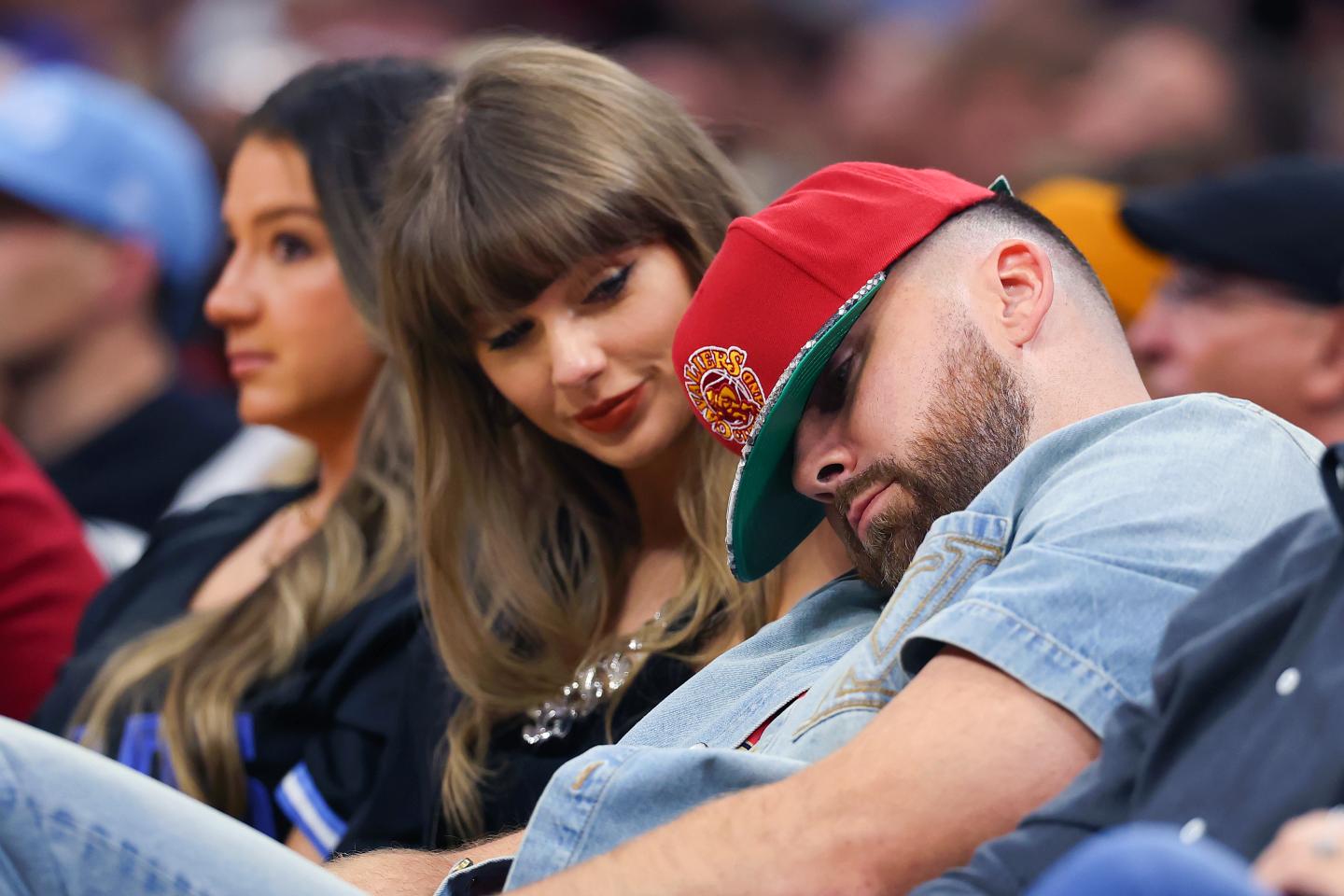
Travis Kelce (R) of the Kansas City Chiefs reacts as Singer Taylor Swift looks on during the fourth quarter in Game Three between the New York Knicks and the Cleveland Cavaliers in the NBA Eastern Conference Finals at Rocket Arena on May 23, 2026 in Cleveland, Ohio. Gregory Shamus/Getty Images

Taylor Swift accidentally ran a cleaner economic‑impact experiment than the World Cup—and she did it at the right scale. When her Eras Tour hit Philadelphia in May 2023, the Federal Reserve’s Beige Book recorded the strongest hotel revenue since the pandemic, explicitly crediting an “influx of guests for the Taylor Swift concerts in the city.”

Recommended Video

City officials in Chicago, Cincinnati, Denver, and Los Angeles told similar stories: record or near‑record hotel occupancy, packed trains, and downtowns flooded with out‑of‑town fans spending more than $1,000 apiece on tickets, outfits, food, and travel. In Los Angeles County, six shows translated into an estimated $320 million bump to local GDP and 3,300 jobs; in Denver, two dates were pegged around $140 million in state output. For economists, what matters isn’t just the dollar figure—it’s that the spike is measured where it happens: in a handful of zip codes over a specific weekend.

That’s the frame worth carrying into the summer of 2026, when the World Cup arrives with far bigger promises and far blurrier baselines. The White House task force touts up to $40.9 billion in gross output and $17.2 billion in GDP, projections quickly embraced by local boosters. But when independent researchers examine past tournaments at the national scale, the macro story stubbornly refuses to emerge. Goldman Sachs, using data back to 1982, finds that hosting the World Cup has a “marginally positive but not statistically significant” effect on real GDP in the year of the event, and that the long‑run effect is effectively zero.

This isn’t a paradox so much as a units problem. Swift’s Beige Book cameo is a statement about Philadelphia’s hotel revenue in a single month. The World Cup sales pitch is usually about “transformative” effects on a country’s growth path. Natixis, for example, estimates that the 2026 tournament might lift U.S. GDP by roughly 0.05 percentage points and Mexico’s by 0.1%–0.2%—positive, but modest and temporary against economies of that size. At the city level, both Swift and the World Cup can produce crowded hotels and busy bars. At the national level, the data say neither is an engine of structural growth.

Once you line the scales up correctly, the asymmetry sharpens. Swift’s impact is hyper‑concentrated and privately financed. Cities don’t underwrite stadiums or guarantee minimum ticket sales for her to show up; they just cope with the surge. The World Cup’s impact is diffuse and publicly backstopped: U.S. hosts are leaning on studies that promise hundreds of millions or even billions in “economic activity,” like New York–New Jersey’s projected $3.3 billion, to justify infrastructure upgrades, security costs, and years of planning. When the dust settles, the realized national gains look more like Swift’s Philadelphia weekend—only stretched over a month and a continent, and paid for, in part, by taxpayers.

Economists have become increasingly blunt about this pattern. Independent work finds that league‑sponsored impact models systematically overstate net benefits by ignoring displacement, imports, and the opportunity cost of public money. Natixis notes that for 2026, much of what fans will buy is made elsewhere, and that the U.S., Mexico, and Canada are simply too large for even a multi‑billion‑dollar event to materially alter their growth trajectories. The result is a familiar arc: eye‑popping ex‑ante projections, modest ex‑post data, and then a hurried pivot away from GDP toward less tangible payoffs.

The ‘psychic income’ lift

That pivot is where “psychic income” comes in. Faced with underwhelming macro effects, Goldman’s World Cup report leans on the literature showing that people are willing to pay real money for pride, joy, and belonging, even when tournaments don’t raise trend growth. Surveys suggest citizens place surprisingly high monetary value on hosting or winning—evidence of genuine welfare gains that don’t show up in national accounts. In this telling, the “return” on World Cup spending is the emotional dividend: the month when a country feels like the center of the world.

Swift delivers her own version of psychic income, but she doesn’t need contingent valuation surveys to prove it. Fans reveal their willingness to pay in real time, dropping an average of more than $1,300 per Eras show on tickets, travel, hotels, merch, and outfits; resale prices can climb into five figures. Local “Swiftonomics” reports that tally $320 million here and $140 million there are really just capturing the tail of that distribution—the part that spills into hotel ledgers and tax receipts. The rest of the value lives where psychic income always has: in the stories, the social media feeds, the feeling of having been there.

Put together, the comparison isn’t about proving that Swift “beats” the World Cup at economics; it’s about showing how scale and financing change the story we should tell about both. At the city‑weekend level, Swift delivers exactly the boom that World Cup promoters promise: maxed‑out occupancy, record restaurant nights, public transit running at or above pre‑COVID levels. At the national level, both are rounding errors in GDP. The difference is that Swift’s experiment is clean and voluntary, while the World Cup’s is muddied by public guarantees and a habit of selling localized, temporary uplifts as if they were national development strategy.

For policymakers and investors, that’s the useful reframing. Mega‑events can absolutely juice a weekend balance sheet and recharge a city’s sense of itself. They are far less convincing as macro policy tools. If the real prize is psychic income rather than productivity, then the honest questions are: what unit are we measuring, how much are we actually buying, and who is writing the check? Swift’s fans have already answered those questions with their wallets. World Cup hosts are about to answer them with public budgets.

The Fortune 500 Innovation Forum will convene Fortune 500 executives, U.S. policy officials, top founders, and thought leaders to help define what’s next for the American economy, Nov. 16-17 in Detroit. Apply here.
About the Author
Nick Lichtenberg
By Nick LichtenbergBusiness Editor
LinkedIn icon

Nick Lichtenberg is business editor and was formerly Fortune's executive editor of global news.

See full bioRight Arrow Button Icon

Latest in Arts & Entertainment

Finance
Lorem ipsum dolor sit amet, consectetur adipiscing elit, sed do eiusmod tempor incididunt ut labore et dolore magna aliqua. Ut enim ad minim veniam
By Fortune Editors
October 20, 2025
Finance
Lorem ipsum dolor sit amet, consectetur adipiscing elit, sed do eiusmod tempor incididunt ut labore et dolore magna aliqua. Ut enim ad minim veniam
By Fortune Editors
October 20, 2025
Finance
Lorem ipsum dolor sit amet, consectetur adipiscing elit, sed do eiusmod tempor incididunt ut labore et dolore magna aliqua. Ut enim ad minim veniam
By Fortune Editors
October 20, 2025
Finance
Lorem ipsum dolor sit amet, consectetur adipiscing elit, sed do eiusmod tempor incididunt ut labore et dolore magna aliqua. Ut enim ad minim veniam
By Fortune Editors
October 20, 2025
Finance
Lorem ipsum dolor sit amet, consectetur adipiscing elit, sed do eiusmod tempor incididunt ut labore et dolore magna aliqua. Ut enim ad minim veniam
By Fortune Editors
October 20, 2025
Finance
Lorem ipsum dolor sit amet, consectetur adipiscing elit, sed do eiusmod tempor incididunt ut labore et dolore magna aliqua. Ut enim ad minim veniam
By Fortune Editors
October 20, 2025

Most Popular

Finance
Lorem ipsum dolor sit amet, consectetur adipiscing elit, sed do eiusmod tempor incididunt ut labore et dolore magna aliqua. Ut enim ad minim veniam
By Fortune Editors
October 20, 2025
Finance
Lorem ipsum dolor sit amet, consectetur adipiscing elit, sed do eiusmod tempor incididunt ut labore et dolore magna aliqua. Ut enim ad minim veniam
By Fortune Editors
October 20, 2025
Finance
Lorem ipsum dolor sit amet, consectetur adipiscing elit, sed do eiusmod tempor incididunt ut labore et dolore magna aliqua. Ut enim ad minim veniam
By Fortune Editors
October 20, 2025
Finance
Lorem ipsum dolor sit amet, consectetur adipiscing elit, sed do eiusmod tempor incididunt ut labore et dolore magna aliqua. Ut enim ad minim veniam
By Fortune Editors
October 20, 2025
Finance
Lorem ipsum dolor sit amet, consectetur adipiscing elit, sed do eiusmod tempor incididunt ut labore et dolore magna aliqua. Ut enim ad minim veniam
By Fortune Editors
October 20, 2025
Finance
Lorem ipsum dolor sit amet, consectetur adipiscing elit, sed do eiusmod tempor incididunt ut labore et dolore magna aliqua. Ut enim ad minim veniam
By Fortune Editors
October 20, 2025
Fortune Secondary Logo
Rankings
  • 100 Best Companies
  • Fortune 500
  • Global 500
  • Fortune 500 Europe
  • Most Powerful Women
  • World's Most Admired Companies
  • See All Rankings
  • Lists Calendar
Sections
  • Finance
  • Fortune Crypto
  • Features
  • Leadership
  • Health
  • Commentary
  • Success
  • Retail
  • Mpw
  • Tech
  • Lifestyle
  • CEO Initiative
  • Asia
  • Politics
  • Conferences
  • Europe
  • Newsletters
  • Personal Finance
  • Environment
  • Magazine
  • Education
Customer Support
  • Frequently Asked Questions
  • Customer Service Portal
  • Privacy Policy
  • Terms Of Use
  • Single Issues For Purchase
  • International Print
Commercial Services
  • Advertising
  • Fortune Brand Studio
  • Fortune Analytics
  • Fortune Conferences
  • Business Development
  • Group Subscriptions
About Us
  • About Us
  • Press Center
  • Work At Fortune
  • Terms And Conditions
  • Site Map
  • About Us
  • Press Center
  • Work At Fortune
  • Terms And Conditions
  • Site Map
  • Facebook icon
  • Twitter icon
  • LinkedIn icon
  • Instagram icon
  • Pinterest icon

Latest in Arts & Entertainment

ts
Arts & EntertainmentWorld Cup
Taylor Swift, the economics of hype, and what the World Cup gets wrong
By Nick LichtenbergJune 5, 2026
1 hour ago
MacKenzie Scott’s approach to her $26 billion giving spree was inspired by a book she read in college about writing
SuccessMacKenzie Scott
MacKenzie Scott’s approach to her $26 billion giving spree was inspired by a book she read in college about writing
By Sydney LakeJune 5, 2026
1 hour ago
60
Arts & EntertainmentMedia
‘My first response is, it started in 1968 — not a bad run’: Some see the death of 60 Minutes after Pelley’s firing, ‘murder’ comments
By Jocelyn Noveck and The Associated PressJune 4, 2026
19 hours ago
What Alix Earle knows about business that many of my Harvard Business School students don’t get
CommentaryFortune Media Network
What Alix Earle knows about business that many of my Harvard Business School students don’t get
By Reza SatchuJune 4, 2026
21 hours ago
Artist who painted life-sized swimming whale mural in Dallas sues FIFA for allegedly illegally painting over his work
LawFifa
Artist who painted life-sized swimming whale mural in Dallas sues FIFA for allegedly illegally painting over his work
By Russ Bynum and The Associated PressJune 3, 2026
2 days ago
Soldier Field in Chicago during 1994 FIFA World Cup opening ceremonies
EconomyWorld Cup
Some of the biggest U.S. sporting towns decided not to host any World Cup games, fearing a ‘major financial burden to our cities’
By Tristan BoveJune 3, 2026
2 days ago

Most Popular

CEO says anyone who works from home is grabbing groceries or at the vet 30% of the time—and shows off his busy office at Friday 5 p.m. to prove it
Success
CEO says anyone who works from home is grabbing groceries or at the vet 30% of the time—and shows off his busy office at Friday 5 p.m. to prove it
By Orianna Rosa RoyleJune 4, 2026
1 day ago
Ohio city workers are covering automated license plate readers with trash bags as officials sound the alarm on 'egregious violations' of privacy
Cybersecurity
Ohio city workers are covering automated license plate readers with trash bags as officials sound the alarm on 'egregious violations' of privacy
By Sasha RogelbergJune 3, 2026
2 days ago
A single new sentence in SpaceX's amended IPO filing could signal the biggest merger in history
Startups & Venture
A single new sentence in SpaceX's amended IPO filing could signal the biggest merger in history
By Shawn TullyJune 4, 2026
1 day ago
10,000 Boomers a day, $39 trillion in debt, and no benefit cuts: Bessent stakes Social Security on the Trump economy
Economy
10,000 Boomers a day, $39 trillion in debt, and no benefit cuts: Bessent stakes Social Security on the Trump economy
By Nick LichtenbergJune 4, 2026
17 hours ago
Current price of oil as of June 4, 2026
Personal Finance
Current price of oil as of June 4, 2026
By Joseph HostetlerJune 4, 2026
19 hours ago
Teens are up against the worst summer job market in nearly 80 years—they’re fighting against hundreds to work at ice cream shops and swimming pools
Success
Teens are up against the worst summer job market in nearly 80 years—they’re fighting against hundreds to work at ice cream shops and swimming pools
By Emma BurleighJune 2, 2026
3 days ago

© 2026 Fortune Media IP Limited. All Rights Reserved. Use of this site constitutes acceptance of our Terms of Use and Privacy Policy | CA Notice at Collection and Privacy Notice | Do Not Sell/Share My Personal Information
FORTUNE is a trademark of Fortune Media IP Limited, registered in the U.S. and other countries. FORTUNE may receive compensation for some links to products and services on this website. Offers may be subject to change without notice.