
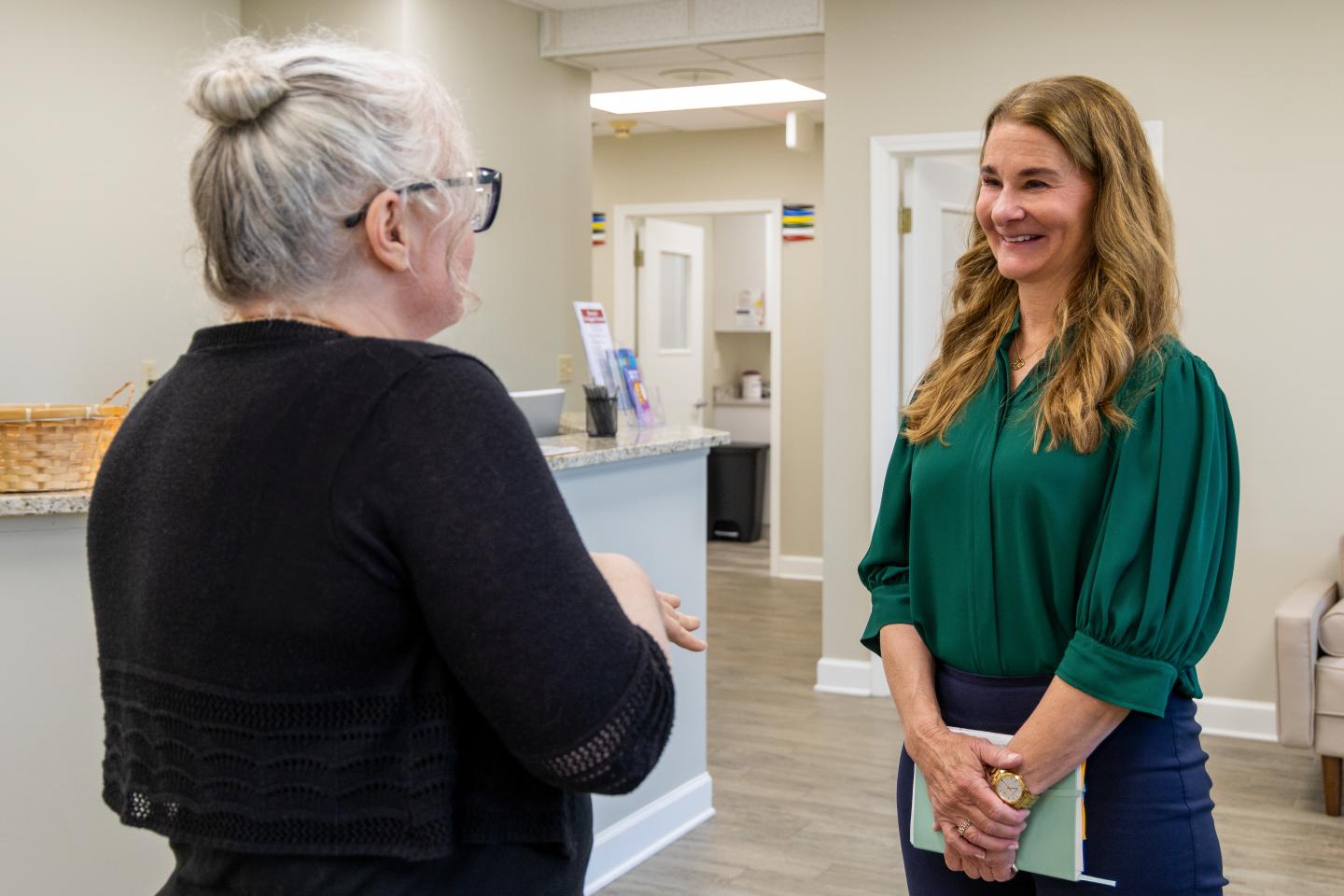
Earlier this month, I took a trip to Tuscaloosa, Alabama. I was there to meet up with Melinda French Gates.
It was also her first time in Tuscaloosa—but she’s already had a major impact on the city. She was there to visit WAWC, a former abortion clinic that briefly shut down after the overturn of Roe v. Wade. Her firm Pivotal’s $5 million grant helped the clinic reopen providing other women’s health services, from pregnancy and midwife care to mental health support. It moved to a stately brick home that used to house a software company—and that the clinic’s director calls their “dream house.”
This grant is just one of several French Gates will support through a new $215 million commitment to women’s health, which she spoke with me about exclusively before announcing her new strategy today. The commitment brings Pivotal’s total money toward women’s health up to $600 million. And this is all still considered a “testing phase” that French Gates expects to last two to three years. Right now, her women’s health strategy is focused on access to care during women’s reproductive years, health during midlife and menopause, and mental health. Some of Pivotal’s initial partners include the research-focused Wellcome Leap (previously announced); the Menopause Society, which trains health care professionals on the life stage; and Co‑Impact, which works to embed mental health into maternal care around the world. The deep dive into women’s health will play out across Pivotal’s three signature pillars, which in addition to philanthropy include policy advocacy and investment in startups and funds.
I just published a long interview with French Gates about this work—as well as the message she hopes it sends. “I’m trying to send a signal,” she told me. To other philanthropists and other billionaires—who either haven’t believed in the category or are scared to touch it for fear of retaliation from the Trump administration.
We talked at length about why she believes in women’s health as a place to put her money, whether she’s disappointed in her fellow billionaires (answer: some of them), and what’s “freeing” about this era of her life and career. You can read our full interview here—and stay tuned on social for more clips.
Emma Hinchliffe
emma.hinchliffe@fortune.com
The Most Powerful Women Daily newsletter is Fortune’s daily briefing for and about the women leading the business world. Subscribe here.
ALSO IN THE HEADLINES
About those elections in California. In the state's governor's race, Katie Porter conceded. She was the only woman in the race. In Los Angeles, Mayor Karen Bass is headed to a runoff—most likely against reality star Spencer Pratt, but progressive Nithya Raman is in third place. It's the first runoff for an incumbent L.A. mayor since 2005; here's some reporting on why Bass's path to reelection is so challenging.
SpaceX's IPO price sets a valuation of $1.77 trillion. That would make SpaceX the largest IPO ever. Huge news for Gwynne Shotwell, No. 32 on Fortune's recent Most Powerful Women list. The NYT today writes about Shotwell as "the steady hand at SpaceX."
Women just took over the cabinet in Denmark. Women outnumber men 11-10 in Prime Minister Mette Frederiksen's cabinet. Frederiksen is the first woman to win a third term in Denmark—even if her most recent election was more difficult than expected.
ON MY RADAR
Caitlin Clark is always under a microscope. Handling it is big part of Stephanie White’s job The Athletic
The meltdown inside 60 Minutes WSJ
The most contrarian and durable bet in AI is 85 million moms Fortune
PARTING WORDS
"I think an audience will always let you know what works for them and what doesn’t work for them."
— Lisa Kudrow on the future of AI in the entertainment industry