
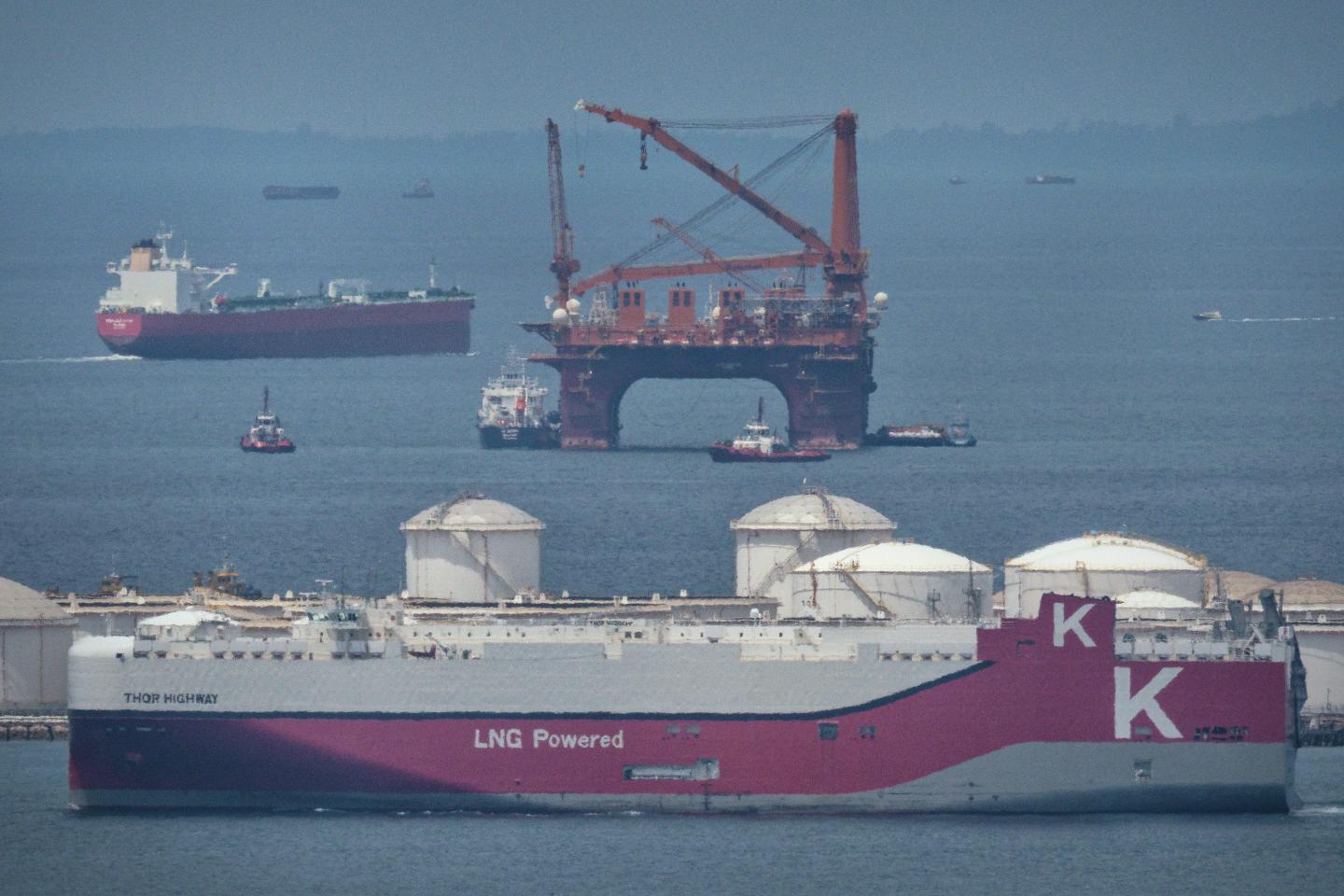
The disruption of Middle Eastern oil and gas supplies to energy-hungry Asia comes at a time when the U.S. is rapidly building out its natural gas-exporting infrastructure, and Asian energy officials acknowledge they need to embrace U.S. supplies for “energy security” and deemphasize ambitious “tree-hugging” targets.
“To address our energy challenges, it is not possible to do it all on our own,” Puah Kok Keong, CEO of Singapore’s regulatory Energy Market Authority, told Fortune. “I think I can say that not just of Singapore, but for many other countries in Asia who are also facing the same kind of challenges.”
A delegation visited Texas for a Singapore International Energy Week event in Houston, touring Cheniere Energy’s pioneering Sabine Pass liquefied natural gas (LNG) export hub in Louisiana, and meeting with leaders from Exxon Mobil, Chevron, Shell, and more. More than 90% of Singapore’s electricity comes from natural gas imports, including LNG, along with a burgeoning solar power industry. And about 10% of Singapore’s total gas supplies come from Qatar, which remains offline since the beginning of March.
And much of Asia, Australia—and even California—depend on Singapore’s large oil-refining complex for gasoline and jet fuel. “The government is very clear that we will continue to let the refineries and the oil traders continue to export products from Singapore,” he said, so there’s no need for panic on the U.S. West Coast just yet.
And Singapore will rely more on the U.S., especially for LNG.
“The United States has undergone a remarkable energy transformation,” Keong said. “That is why the U.S. is right now in the driver’s seat to support the energy needs of the global economy”
U.S. natural gas production is on track to essentially double from 2015 to 2032, And the country’s LNG export capacity is quadrupling from 2020 to 2032, said Wolfgang Moehler, Americas gas director for S&P Global Energy. Including exports, almost half of all U.S. natural gas demand will be concentrated in just two states—Texas and Louisiana—where almost all the LNG export capacity is concentrated.
Singapore evolution
Just last year, Singapore founded the Singapore GasCo to centralize the procurement and supply of natural gas for the country’s power sector, which now seems well timed.
That helped Singapore buy enough LNG cargoes to set aside in storage to keep the country powered through the end of the year if the Strait of Hormuz remains effectively shuttered, Keong said.
Goh Tiak Boon, GasCo chief commercial officer, said most of the world didn’t learn lessons from the still-ongoing Russia invasion of Ukraine and the resulting disruption of global energy supplies—“We have very short memories.” But now countries are finally beginning to emphasize more natural gas strategic reserves, he said.
“We get too much into that tree-hugging mode,” Boon said. “Energy security is fuel agnostic. That doesn’t mean we don’t care about renewables.”
Keong emphasized Singapore is still maintaining net-zero energy goals by 2050. But the top priorities are energy security and affordability. Longer-term, Singapore is developing cleaner geothermal and next-generation nuclear technologies—in cooperation with American players too.
In the meantime, Singapore is building another LNG import hub, called a regasification terminals, which would increase its LNG import capacity 50% by 2030. And, in the interim, Singapore is promoting more energy conservation domestically.
“If we look at the next five to 10 years where the major increase in LNG exports, a big part of that will be the U.S. just because of the sheer availability of the shale gas and the huge investments that many U.S. companies are actually taking to [export] LNG,” Keong said.
Although Singapore will increase its reliance on U.S. supplies, he said, the country will remain diversified, including importing more from Qatar once it’s back online.
“What would the next supply disruption be? No one can foretell. It may not be in the Middle East; it may be somewhere elsewhere in the world,” Keong said. “It may not be a military conflict; it may be a climate event. So, we always plan for the unknown.”
And, although he didn’t specify it, a major hurricane or winter storm hitting Texas and Louisiana just right could dramatically disrupt U.S. oil and gas exports.
Asian and U.S. views
This is far from just a Singapore trend. JERA is the top power producer, in Japan, which relies on LNG for about 30% of its power, including a heavy reliance on U.S. supplies.
James Tinsley, chief commercial officer for JERA Americas, boasted that U.S. gas production volumes have bucked projections and are actually cheaper than they were 15 years ago.
“The efficiency that has been gained through the years has outpaced the demand, which is really remarkable,” Tinsley said. “The question a lot of us have is, ‘Is there a limit to that?’”
The problem is that spot prices for global LNG cargoes have risen much higher since the Iran war began—for volumes not under long-term contracts—and there’s risk of some countries turning more to dirtier coal instead. He mentioned Thailand building new coal plants as an example.
As for the Big Oil players, in a panel discussion, Rob Nunmaker, Chevron vice president of new energies, said that—unlike some competitors—Chevron focuses on what customers and countries need for energy security, and not a more utopian “Field of Dreams” approach.
“‘If you build it, they will come,’” Nunmaker said, quoting the 1989 film. “We don’t believe in that.”
Cheniere director of global fundamentals, Najla Jamoussi, agreed that a more pragmatic “all of the above” energy approach is winning out—politically and commercially—noting that BP and Shell have backed away from more aggressive climate and renewable energy ambitions.
That left Shell LNG Americas vice president Ryan Lawrence to agree about a more balanced portfolio approach, making a roulette metaphor. “To put everything on black or red is a little too risky.”
And he emphasized the benefits of U.S. and diversified LNG strategies amid the biggest energy supply shock ever in the Middle East.
“We were obviously kidding ourselves that there wasn’t a different kind of geography risk,” Lawrence said.