
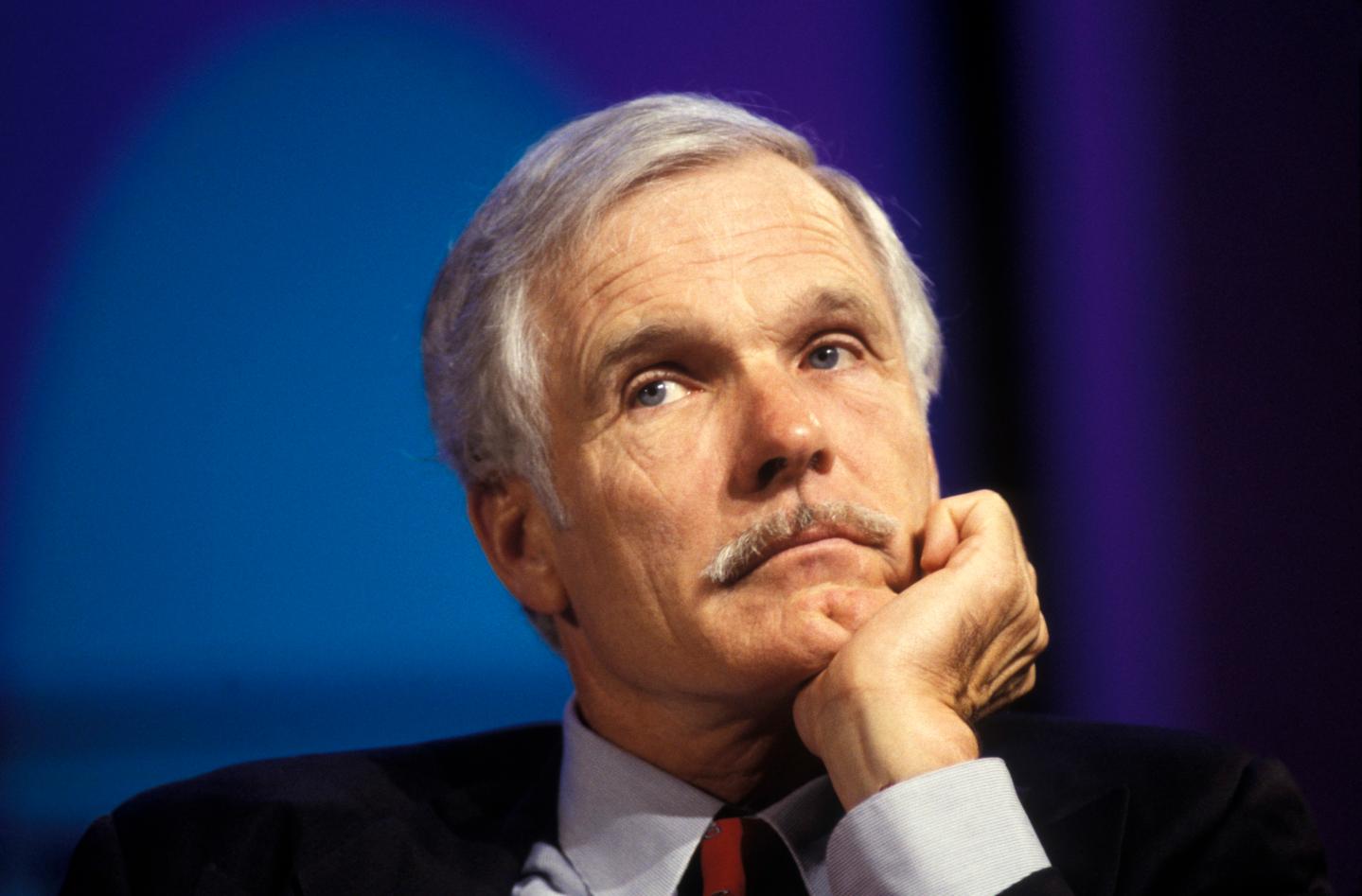
When Ted Turner launched CNN on June 1, 1980, the assumption he broke was the one nobody had thought to question: that a story ends.
News before Turner was a closed transaction. A half-hour broadcast. A morning paper. A finite product you finished and set down. Turner replaced that with the stream — the developing story, the chyron crawl, the always-on feed. He invented the open loop, and that format has since eaten every consumer business that touches information.
That’s the part of his obituary that anyone running a company today should heed.
The format was the innovation
Nothing quite sums up the humbling of the aging process as the passing of a figure like Ted Turner, a figure that is hard to sum up to a digital generation raised on Twitter and TikTok.
Back in his mustachioed day, Turner was the man through which information flowed, unshackling the flow of information from one or two newspapers and one or two broadcasts per day.
It was an achievement out of Greek myth, so rich in metaphor that it recalls cliches like Prometheus and the discovery of fire, Pandora opening up her famous box, Phaethon and the chariot of the Sun. But I think he’s most like a goldfinger: the man with the Midas touch. Everything that came into Turner’s orbit became a massive, overwhelming success, and then the world just had too much of it. It still does.
King Midas didn’t want to destroy his kingdom. He wanted to enrich it. He asked for the golden touch as an act of ambition on behalf of his people — and the gods gave him precisely what he wished. Ted Turner wanted the world to watch the news. And we all got a lot more than he bargained for. Maybe the reason it’s so hard to explain how big Turner was, how larger than life, is because he created the ecosystem where nobody could ever get that big again.
Breaking the news
Turner’s friends and rivals credit him with two things: betting on satellite distribution before anyone else, and being stubborn enough to bleed money for years until the bet paid off. Both true, and both incidental to the durable invention, which was structural. Filling 24 hours required keeping viewers from feeling released. So his producers engineered around that constraint: live cut-ins, “breaking news” applied to non-breaking events, panels of pundits filling time between facts, the implicit promise that something might happen at any moment.
In 1994, when CNN broke into programming to show O.J. Simpson’s white Bronco crawling down the 405, the network was demonstrating a product format more than covering a story. Indefinite attention, sustained by the suggestion of imminent payoff. Hours passed. Nothing happened. The format worked anyway.
A decade later, engineers at Facebook, YouTube, and Twitter built the same architecture in software. The infinite scroll isn’t analogous to cable news. It’s cable news, ported to a phone.
What Turner sold for $7.3 billion
When Turner sold Turner Broadcasting to Time Warner in 1996 for $7.3 billion, the network came with a template. By 2025, that template had fully escaped its origin. The Reuters Institute’s Digital News Report that year surveyed roughly 100,000 people across 48 countries and found 54% of Americans now getting news from social platforms rather than traditional outlets. Nearly half of respondents worldwide identified online personalities as a major source of misinformation. Populist politicians, the report noted, were increasingly able to bypass traditional journalism in favor of friendly partisan media.
The format Turner pioneered had migrated to platforms he never built, optimizing for engagement metrics he never set. The lesson that business readers should take from his career: the architecture you ship outlives your intentions for it.
Turner genuinely believed continuous global news would create what Marshall McLuhan called the global village — a shared informational commons that would reduce conflict by increasing understanding. His architecture was value-neutral. Once it left his hands, it optimized for whatever its new owners wanted: cable ratings under Time Warner, engagement under Meta, watch-time under YouTube. The Bronco chase begat the algorithmic feed begat the rage-bait economy, and at no point did the underlying format change.
Turner spent his last two decades visibly uncomfortable with what cable news had become. He gave away most of his fortune — $1 billion to the UN, and more to environmental and anti-nuclear causes. He died at 87 with a net worth of $2.2 billion-$2.9 billion, down from a peak near $10 billion before the AOL-Time Warner collapse vaporized the rest. His remorse was real enough, but changed nothing about the changed world that he had set in motion himself.
Turner was right about what the technology could do, wrong about what it would be used for, and the gap between those two things has become the dominant business model of the 21st century. Every founder shipping into the attention economy today is selling a variant of the same product he launched at a converted Atlanta country club in 1980.
He was the first person to discover you could hold an audience forever. He was also the first to discover what that costs — and his last 20 years were spent trying, and failing, to give some of it back. When everything you touch turns to gold, elation soon turns to horror, because you’ve changed everything.
The opinions expressed in Fortune.com commentary pieces are solely the views of their authors and do not necessarily reflect the opinions and beliefs of Fortune.