
The business model for Wyndham Hotels & Resorts purposefully embraces sprawl. The hotel franchising company has about 8,400 hotels across six continents, comprising a portfolio of 25 brands, including Days Inn, La Quinta, and Ramada.
But the $450 million that Wyndham has spent on technology since 2018 favors standardization and fewer vendors. “We realized years ago that it was better for our franchisees if we created an overall technology bundle,” says Scott Strickland, Wyndham’s chief commercial officer. “We have buying power because we represent thousands of hotels that allow us to get things at a lower price.”
A former CIO at three organizations—Black & Decker, D&M Holdings, and Wyndham—Strickland became CCO in January 2024 to oversee all the traditional CIO responsibilities, including IT and cybersecurity, but also oversee revenue management decisions like pricing, marketing, and public relations.
He has been the central figure steering Wyndham’s decade-long technology overhaul that includes lifting and shifting to the cloud, hiring and building out a centralized data team, and mandating that all properties use a centralized reservation system built by Aven Hospitality, a software-as-a-service vendor that specializes in the hospitality sector. Strickland says that these infrastructure investments have also made it easier for Wyndham to deploy generative AI features.
To get feedback from Wyndham’s base of hotel property owners, Strickland formed a franchisee technology committee to learn more about their biggest technology and business priorities. They came back with a list of 72 requests, such as adding EV charging stations. Several concepts were consolidated and led to the creation of the AI-enabled guest engagement platform, Wyndham Connect, which uses AI to send proactive texts or respond to inbound guest questions, handle mobile check-ins, and allow staff to use AI-generated messaging to answer questions.
“What it does for the guests is it removes friction from the entire journey,” says Strickland.
Jason Hoehne, general manager of the 53-room AmericInn by Wyndham hotel in Lincoln, Nebraska, was among the pilot participants for Wyndham Connect. The hotel owner says he’s used the tool to upsell, speed up the check-in process, more efficiently track when guests depart and a room is ready for housekeeping, and add more layers of communication with guests, but led by AI.
“We would never replace a front desk agent with a kiosk or device, that’s not my ownership style,” says Hoehne. “But it gives the staff tools to be more efficient and productive.”
He adds that the system both adds incremental revenue and boosts productivity. On the former, hotel owners can use the tool to upsell early check-ins or extended departures, while mobile-enabled digital tipping has led to an average tip of close to $10 for housekeepers. The latter can help incentivize staff to stay at Wyndham properties, lowering costly turnover rates.
Unlike other technology offerings from the corporate parent, Wyndham Connect and the AI functionality isn’t mandated. Still, the company said the tool has been embraced by over 5,000 hotels across North America and 100 properties internationally to handle 4.6 million mobile check-ins, $9 million in upselling, 12 million AI messaging engagements, and a 300-basis-points increase in direct booking for hotels using the AI voice functionality.
More recently, Wyndham rolled out an AI feature that enables AI to handle calls to the front desk. Around 1,100 hotels are using that tool today.
On Wednesday, Wyndham also rolled out its newest travel app on ChatGPT, with the company claiming it is the first hotelier to have direct integrations with the three largest LLMs (Google’s Gemini and Anthropic’s Claude are the other two). Wyndham says it is embracing AI in this manner because conversational and visual travel discovery is migrating to these chatbots, with Strickland citing the scale of ChatGPT’s weekly user base of 900 million.
“It needs structured data to understand things about your hotel,” says Strickland. “It can get that data by scraping your website, but it can’t get everything it needs to execute a booking. We created an app that has all that data that it needs to help someone through that booking.”
For internal applications of AI, Strickland has leaned on existing vendors such as Google, Amazon Web Services, and Salesforce’s autonomous AI agents platform, Agentforce. “Go ahead and use the agent that’s closest to the data source,” says Strickland. “We are multimodal, and we’re also using OpenAI for our internal, large LLM. We’re going to look at every use case and apply the best one.”
As for employee training, Strickland says Wyndham offers courses and has leaned on vendors like Amazon and Atlassian.
Wyndham’s agentic AI deployments include allowing customers to book a room directly through an agent. For those who prefer to speak to a staff member, that option is still available, but also with AI in a less obvious way. Strickland says AI assists employees with the booking process, including sharing proactive information like if a caller is a loyalty member or perhaps complained about noise during their last stay and should be offered a quieter room. When used in this manner, AI can lead to better hospitality, Strickland says.
“If you’re the person that just wants the AI and goes straight to your room, we have it,” says Strickland. “If you want to talk to a front desk agent, we have it. But we’re going to make that engagement now even better than it used to be, with AI.”
John Kell
Send thoughts or suggestions to CIO Intelligence here.
NEWS PACKETS
Big Tech’s big earnings and bigger AI spending. Overall, the largest technology firms reported strong quarterly earnings last week, but as Wall Street likes to do, it picked winners and losers when taking a closer look at the numbers. Google had a particularly strong quarter that sent shares to an all-time high, due to strong digital ad sales for its search engine and fast growth from its Cloud division. Shares at Meta, conversely, were battered after the Instagram and Facebook parent reported a drop of 20 million users, big AI spending, and that it continues to pour billions into its money-losing metaverse and virtual reality business. But the collective figure that Wall Street is keeping a particularly close eye on is AI capital expenditures: they could surpass $700 billion in 2026, and some analysts expect they will climb above $1 trillion in 2027.
Washington also has a big tech week. President Donald Trump’s light-touch approach to AI regulation appears to be evolving, as the New York Times reports that the federal government is weighing an executive order that would explore potential oversight of new AI models before they are publicly released. Shortly after that story was published, Bloomberg reported that Google, Microsoft, and xAI had joined OpenAI and Anthropic in agreeing to give the U.S. government early access to their AI models, which would be reviewed by the Commerce Department’s Center for AI Standards and Innovation. In other related news, the White House’s fraught relationship with Anthropic continues as it opposed the AI startup’s plan to expand access to its Mythos model, while separately, the Pentagon has inked agreements with Nvidia, Microsoft, Reflection AI, and Amazon to expand the use of AI tools on classified military networks.
PayPal, Coinbase latest to cut jobs amid AI push. The Wall Street Journal reports that PayPal, which is in the process of reorganization operations to make the mobile payments app Venmo a standalone unit, plans to cut 20% of its staff over the next two to three years as it accelerates its adoption of AI and cuts costs. Coinbase, meanwhile, on Tuesday announced it would trim 14% of its staff, partly due to a crypto downturn but also a reflection of AI. Fortune reports that the company’s leadership structure will become flatter and cut managers in favor of “player-coaches,” who oversee team members but can also be individual contributors. The more AI savvy employees may also be leveraged to direct agents in one-person teams that would include the responsibilities of engineers and designers.
Elon Musk goes to trial against OpenAI. The legal squabble between the billionaire founder of SpaceX and the ChatGPT maker took a few twists in federal court over the past week, in a case that centers on Musk’s complaint that OpenAI and CEO Sam Altman breached the AI startup’s founding mission as a nonprofit by becoming a commercial enterprise. Musk himself took to the stand, at times facing terse cross-examination from OpenAI’s lawyers, making the case that he was “a fool who provided them free funding to create a startup.” Interestingly, two days before the trial was to start, Musk reached out to Greg Brockman, OpenAI’s president and co-founder, to ask him if he wanted to settle the case. OpenAI has consistently said Musk’s claims are “baseless.”
Study shows OpenAI’s model outperforms doctors. A Harvard study comparing the diagnosis of 76 cases at a Boston hospital found that an AI reasoning model developed by OpenAI outperformed human clinicians and prior model generations. The research, which was published in the journal Science, centered on Open AI’s model and two physicians at three diagnostic touch points, beginning in the ER through admission to the hospital, and found that AI identified the exact or very close diagnosis in 67% of the cases, while human doctors were right 50% to 55% of the time. Already, more than 80% of physicians are using AI tools, according to a recent survey published by the American Medical Association, mostly for lower stakes use cases like combing through medical research and documentation. But the Harvard research points to a future where AI may play more of a role in clinical settings.
ADOPTION CURVE
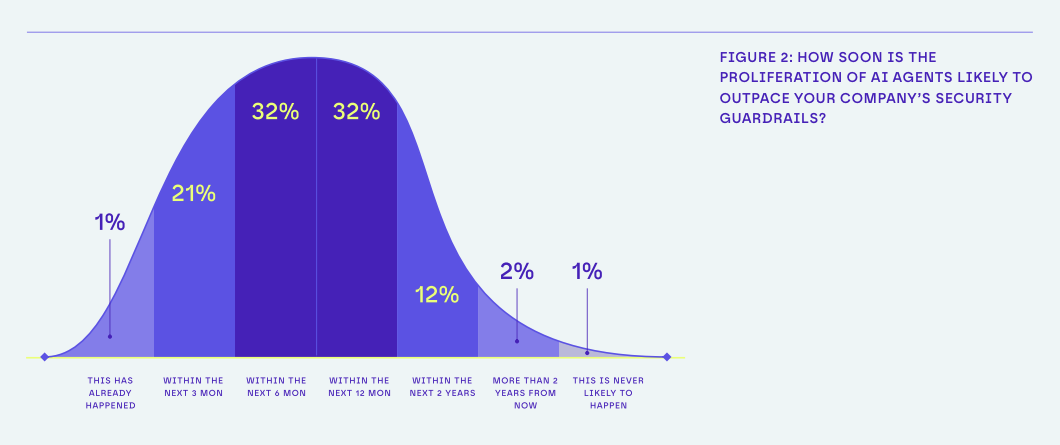
AI agents are outpacing security guardrails. 86% of organizations say they expect AI agents will outpace the security guardrails they have in place within the next 12 months, with more than one out of every two saying it will occur in the next six months, according to a survey of more than 1,600 IT and security leaders conducted by cybersecurity vendor Rubrik.
The study also found that only 23% of technologists report having full visibility into the AI agents that are operating within their enterprises. Nearly nine out of ten (88%) say they lack the ability to roll back agent actions without disrupting their systems.
Kavitha Mariappan, Rubrik's chief transformation officer, tells Fortune that AI agents have “the potential to operate outside of IT’s view if the right sort of guardrails are not there.” While many CIOs have placed guardrails around data and tasks that AI agents can perform, Mariappan says they need to extend their thinking beyond visibility into what data is accessed and the outputs that are being produced and be more focused on “observability,” which encompasses context, intent, and reasoning.
“Real-time guardrails need to be implemented,” says Mariappan. “It goes beyond identity and permissions. We're in that world now where we're talking about business logic that is applied in real time.”
Courtesy of Rubrik
JOBS RADAR
Hiring:
- Grand Circle is seeking a CTO, based in Boston. Posted salary range: $350K-$425K/year.
- The Supreme Court of Ohio is seeking a CIO, based in Columbus, Ohio. Posted salary range: $175K-$189K/year.
- Gap is seeking a senior director of IT strategic transformation, based in San Francisco. Posted salary range: $217.9K-$294.2K/year.
- Christy Sports is seeking a VP of technology, based in Lakewood, Colorado. Posted salary range: $190K-$220K/year.
Hired:
- Citigroup appointed Brian Saluzzo to serve as CIO, joining the banking giant from Google, where he served as VP of core developer engineering and product management. Prior to Google, Saluzzo spent nearly nine years in technology executive leadership roles at American Express and nearly two decades at Goldman Sachs.
- Intel appointed Pushkar Ranade to the CTO role after serving in that capacity on an interim basis since December. Ranade will advance the chipmaker’s technology strategy, lead special projects, and lead the development of emerging areas, including quantum computing. Ranade initially joined Intel in 2003 as a staff engineer, left in 2010, and returned several years later after his former employer, Altera, was acquired by Intel.
- Yelp promoted Alex Levy, currently senior vice president of engineering, to the role of CTO. He succeeds Sam Eaton, who told the review site he would step down as CTO on June 30. Levy has worked at Yelp for nearly 13 years, joining in 2013 as an engineering manager. He also previously served as a director of engineering at healthcare data analytics firm Arcadia.
- BDO USA appointed Jim Maza to serve as CIO, succeeding Russ Ahlers, who will retire on September 1. Most recently, Maza served as CIO of insurance brokerage and risk management firm Marsh McLennan Agency. He also previously served as CIO at Opportunity International, Officite, and Rasmussen College.
- Nature’s Sunshine Products appointed John Hnanicek as CTO, effective May 4. He joins the maker of herbal supplements and vitamins after most recently serving as chief digital innovation officer at online wellness products company Melaleuca. Prior to that, he served as chief customer innovation and technology officer and CIO at retailer The Vitamin Shoppe.
- Trust & Will announced the appointment of Bill Parker as CTO, where he will lead platform development, AI, and infrastructure for the online estate planning company. Most recently, Parker served as CTO at Leap, where he led product, engineering, information security, and infrastructure. He also previously served as CTO at Built Technologies and spent nearly 17 years at Quicken Loans, now known as Rocket Mortgage.
- Cutera appointed Chris House as CTO, where he will lead the aesthetic and dermatological device maker’s global technology and product development strategy. Most recently, House served as CTO at healthcare management software provider HealthAxis. He also previously served as SVP of product development at healthcare IT company NantHealth.
AI Playbook: Keeping up with AI's rapid evolution

AI is becoming an even more useful—and dangerous—tool as it gets smarter. Fortune AI Editor Jeremy Kahn breaks down best practices for deploying AI agents, how to protect your data from AI-powered cyberattacks, and just how smart AI can really get. Watch the playbook.