• Home
  • Latest
  • Fortune 500
  • Finance
  • Tech
  • Leadership
  • Lifestyle
  • Rankings
  • Multimedia

Trendingnow

1

The U.S. campaigned to host the World Cup. Now soccer fans will trade their countries' train system for the U.S.'s 'D' rated infrastructure

2

The pig in the python: Baby Boomers are strangling the economy they built by refusing to move or retire

3

Jeff Bezos wants the bottom half of earners to pay zero income tax—he says nurses making just $75K should save $12K a year

1

The U.S. campaigned to host the World Cup. Now soccer fans will trade their countries' train system for the U.S.'s 'D' rated infrastructure

2

The pig in the python: Baby Boomers are strangling the economy they built by refusing to move or retire

3

Jeff Bezos wants the bottom half of earners to pay zero income tax—he says nurses making just $75K should save $12K a year
Environmentgas prices

Gas crisis? Kelp could be the biofuel answer to high gas prices, but only if the government removes some red tape

By
The Associated Press
,
Ana Georgescu
Ana Georgescu
, and
Zoe Beketova
Zoe Beketova
Down Arrow Button Icon
By
The Associated Press
,
Ana Georgescu
Ana Georgescu
, and
Zoe Beketova
Zoe Beketova
Down Arrow Button Icon
May 6, 2026, 10:14 AM ET
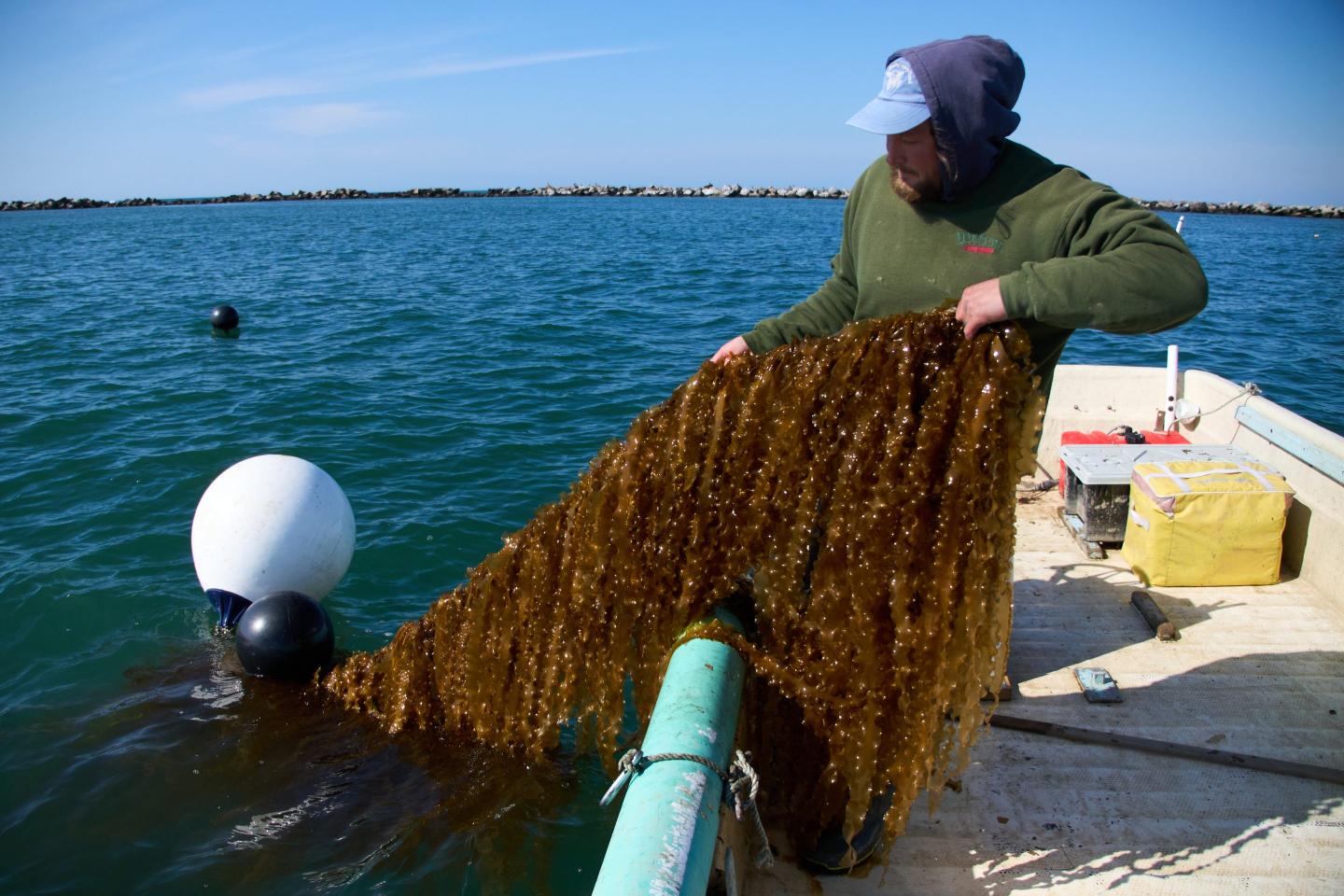
Kelp could potentially fuel planes and ships in the future.
Kelp could potentially fuel planes and ships in the future. Zoe Beketova/MIT Graduate Program in Science Writing via AP

Green cells whirl around a red-light chamber, propelled by a blade through bubbling water. These little seaweed cells, called gametophytes, will develop into a strain of fast-growing kelp — part of what was once a government-funded initiative to develop sustainable biofuels for American transport.

Recommended Video

Electricity from solar and wind energy can power cars, however ships and aircraft largely run on liquid fuels made with a large percentage of oil or gasoline. When burned, those emit carbon dioxide, a greenhouse gas that causes global warming. Biofuel, refined from organic material like plants or algae, is a potential option to change the fuel makeup.

One kind of biofuel comes from kelp. Through a process that uses heat and pressure to produce fuel, known as hydrothermal liquefaction, this humble seaweed could power ships and aircraft without any petroleum.

“We need other sources of energy that are sustainable, we can’t just rely on petroleum,” said Scott Lindell, a marine scientist at the Woods Hole Oceanographic Institution about a 90-minute drive south of Boston. “There’s hardly anything simpler, or anything that grows quite as fast and as sustainably, as seaweed.”

___

EDITOR’S NOTE: This story is a collaboration between the MIT Graduate Program in Science Writing and The Associated Press.

___

Existing biofuels, like corn-derived ethanol, primarily work as gasoline additives. Corn crops require agricultural land, fresh water and pesticides while kelp, by contrast, can be grown in the ocean with minimal resources.

Although any bioethanol — whether produced from corn or kelp — releases hazardous gases when burned, such as acetaldehyde, these fuels produce fewer greenhouse gases overall compared to petroleum-based fuels.

Researchers like Lindell have successfully bred kelp varieties that in some cases produce up to three times more biomass than conventional strains. Yet energy companies are hesitant to invest in large-scale aquaculture projects without demonstrated demand, and farmers are reluctant to scale up without a guaranteed buyer, forming a circular problem that has slowed industry development.

Government interest in biofuels is inconsistent

Aquaculture farms today remain small, supplying kelp primarily to restaurants, cosmetics companies and fertilizer producers. Hauke Kite-Powell, an engineer and economic analyst at Woods Hole, said scaling kelp production to support a biofuel economy would require sustained government support, beyond just the private sector.

While oil price volatility, driven in part by international conflicts such as the war in Iran, has led to bursts of renewed interest in energy independence, government support for options like biofuel fluctuates in the United States. In 2016, a program run by the Department of Energy set out to develop tools for kelp-based biofuel production.

The program, known as MARINER — Macroalgae Research Inspiring Novel Energy Resources — consisted of projects ranging from developing heat-resistant kelp strains that can withstand warming oceans to studies on seaweed genomes. The Department of Energy often backs exploratory, high-risk high-return projects, and researchers involved in MARINER said they made progress, such as increasing kelp yields.

The program mirrored a similar feasibility-testing venture that began in the 1970s, which was swiftly terminated once oil prices stabilized. Lindell’s lab, funded by MARINER, focused on improving crop yield by selectively breeding kelp with desirable qualities — such as nonreproductive capabilities to prevent interbreeding with wild kelp — so that, down the line, farmers could scale up their kelp production.

Lindell’s MARINER funding lasted six years, finishing in 2024. Since then, federal research funding opportunities have been fewer and delayed. But the urgent need for sustainable energy remains, he said. “I don’t think things have changed incredibly since the first oil crisis.”

A middle market for kelp has yet to materialize

Farmers note the difficulties of finding consistent kelp buyers. Oliver Dixon, a shellfish farmer based in Point Judith, Rhode Island, grows kelp to supplement his oyster business during the winter. As of this month, he expects to harvest about 10,000 pounds (4,500 kilograms) of kelp, selling most of it to local restaurants and seafood markets.

“The buyers come in and out, it’s pretty discouraging,” Dixon said. His 9-acre (3.6-hectare) farm is hundreds of times smaller than what would be needed to produce biofuel, and without proven demand from the energy sector, he has no plans to expand.

Bren Smith, an ocean farmer and co-founder of GreenWave, a nonprofit supporting ocean farmers, argues that the issue isn’t a lack of demand, but instead where kelp makes sense economically: Kelp is currently more viable in products like cosmetics or food, rather than fuel, which remains one of its lowest-value uses.

“We’ve made this mistake before, right?” Smith said, referring to large-scale investments in kelp research focused on fuel production instead of the seaweed’s myriad other uses. “Competing with the most technically advanced, subsidized industry on the globe, the fossil fuel industry.”

Red tape slows expansion, but researchers bet on the long game

Even with a guaranteed buyer, expanding kelp farming would face regulatory hurdles, according to Kite-Powell. In the United States, coastal waters are largely prioritized for recreation, fishing and conservation, making it difficult to obtain permits for large aquaculture projects. By contrast, countries in Asia often prioritize extensive seaweed farms, sometimes covering entire bays.

For now, most U.S. farms remain small and nearshore. Dixon said that he cannot obtain a permit to keep his farm infrastructure in the water year-round, requiring him to remove his lines and anchors each spring and reinstall them in the fall.

Moving farms further offshore could allow for larger operations, but it introduces engineering and environmental challenges, including the risk of entangling marine animals and the possibility that farmed kelp could compete with other marine life for nutrients.

“We don’t yet have a full understanding of what all the ecological side effects of very large-scale ocean farming might be,” Kite-Powell said.

Even so, scientists like Lindell remain confident that their work will be applied to a biofuel industry in the future. Around Lindell’s lab are glass vials and flasks of over 2,600 strains of sugar kelp collected from across New England, which he continues to study and breed selectively in hopes of the energy industry transitioning to renewable sources. To him, volatile fuel prices and the finite nature of resources like oil point to an eventual change.

“We’ll come to the realization that things have shifted in the marketplace,” Lindell said, “and we can’t squeeze any more oil out of the earth in 30 years’ time.”

Subscribe to Fortune Gulf Brief. Every Tuesday, this new newsletter will deliver clear-eyed, authoritative intelligence on the deals, decisions, policies, and power shifts shaping one of the world’s most consequential regions, written for the people who need to act on it. Sign up here.
About the Authors
By The Associated Press
See full bioRight Arrow Button Icon
By Ana Georgescu
See full bioRight Arrow Button Icon
By Zoe Beketova
See full bioRight Arrow Button Icon

Latest in Environment

Finance
Lorem ipsum dolor sit amet, consectetur adipiscing elit, sed do eiusmod tempor incididunt ut labore et dolore magna aliqua. Ut enim ad minim veniam
By Fortune Editors
October 20, 2025
Finance
Lorem ipsum dolor sit amet, consectetur adipiscing elit, sed do eiusmod tempor incididunt ut labore et dolore magna aliqua. Ut enim ad minim veniam
By Fortune Editors
October 20, 2025
Finance
Lorem ipsum dolor sit amet, consectetur adipiscing elit, sed do eiusmod tempor incididunt ut labore et dolore magna aliqua. Ut enim ad minim veniam
By Fortune Editors
October 20, 2025
Finance
Lorem ipsum dolor sit amet, consectetur adipiscing elit, sed do eiusmod tempor incididunt ut labore et dolore magna aliqua. Ut enim ad minim veniam
By Fortune Editors
October 20, 2025
Finance
Lorem ipsum dolor sit amet, consectetur adipiscing elit, sed do eiusmod tempor incididunt ut labore et dolore magna aliqua. Ut enim ad minim veniam
By Fortune Editors
October 20, 2025
Finance
Lorem ipsum dolor sit amet, consectetur adipiscing elit, sed do eiusmod tempor incididunt ut labore et dolore magna aliqua. Ut enim ad minim veniam
By Fortune Editors
October 20, 2025

Most Popular

Finance
Lorem ipsum dolor sit amet, consectetur adipiscing elit, sed do eiusmod tempor incididunt ut labore et dolore magna aliqua. Ut enim ad minim veniam
By Fortune Editors
October 20, 2025
Finance
Lorem ipsum dolor sit amet, consectetur adipiscing elit, sed do eiusmod tempor incididunt ut labore et dolore magna aliqua. Ut enim ad minim veniam
By Fortune Editors
October 20, 2025
Finance
Lorem ipsum dolor sit amet, consectetur adipiscing elit, sed do eiusmod tempor incididunt ut labore et dolore magna aliqua. Ut enim ad minim veniam
By Fortune Editors
October 20, 2025
Finance
Lorem ipsum dolor sit amet, consectetur adipiscing elit, sed do eiusmod tempor incididunt ut labore et dolore magna aliqua. Ut enim ad minim veniam
By Fortune Editors
October 20, 2025
Finance
Lorem ipsum dolor sit amet, consectetur adipiscing elit, sed do eiusmod tempor incididunt ut labore et dolore magna aliqua. Ut enim ad minim veniam
By Fortune Editors
October 20, 2025
Finance
Lorem ipsum dolor sit amet, consectetur adipiscing elit, sed do eiusmod tempor incididunt ut labore et dolore magna aliqua. Ut enim ad minim veniam
By Fortune Editors
October 20, 2025
Fortune Secondary Logo
Rankings
  • 100 Best Companies
  • Fortune 500
  • Global 500
  • Fortune 500 Europe
  • Most Powerful Women
  • World's Most Admired Companies
  • See All Rankings
  • Lists Calendar
Sections
  • Finance
  • Fortune Crypto
  • Features
  • Leadership
  • Health
  • Commentary
  • Success
  • Retail
  • Mpw
  • Tech
  • Lifestyle
  • CEO Initiative
  • Asia
  • Politics
  • Conferences
  • Europe
  • Newsletters
  • Personal Finance
  • Environment
  • Magazine
  • Education
Customer Support
  • Frequently Asked Questions
  • Customer Service Portal
  • Privacy Policy
  • Terms Of Use
  • Single Issues For Purchase
  • International Print
Commercial Services
  • Advertising
  • Fortune Brand Studio
  • Fortune Analytics
  • Fortune Conferences
  • Business Development
  • Group Subscriptions
About Us
  • About Us
  • Press Center
  • Work At Fortune
  • Terms And Conditions
  • Site Map
  • About Us
  • Press Center
  • Work At Fortune
  • Terms And Conditions
  • Site Map
  • Facebook icon
  • Twitter icon
  • LinkedIn icon
  • Instagram icon
  • Pinterest icon

Latest in Environment

a
EnergyCorporate Governance
BP ousts chairman months into his tenure, citing ‘important governance standards, oversight and conduct’ concerns
By Michelle Chapman and The Associated PressMay 26, 2026
1 hour ago
As the U.S. and Europe pull back from global climate aid, can Asian funders fill the gap?
Asiaphilanthropy
As the U.S. and Europe pull back from global climate aid, can Asian funders fill the gap?
By Angelica AngMay 25, 2026
19 hours ago
g
North Americawater use and conservation
America’s largest oil export hub is so starved of water that it’s been illegal to have a green lawn for 2 years
By Michelle Hummel and The ConversationMay 25, 2026
1 day ago
g
EnvironmentLaw
You can’t repair your tractor because Hollywood was terrified of the VCR
By Oana Godeanu-Kenworthy and The ConversationMay 25, 2026
1 day ago
r
Environmentclimate change
Rice feeds more than half the world. It’s also the climate equivalent of 239 million cars
By Hanqin Tian, Jingting Zhang, Pep Canadell, Shufen (Susan) Pan and The ConversationMay 25, 2026
1 day ago
Richard McCathron is President & CEO, Hippo.
CommentaryInsurance
I’m leading a $100 million corporate turnaround. Here’s why I learned to distrust the growth mindset
By Richard McCathronMay 25, 2026
1 day ago

Most Popular

The U.S. campaigned to host the World Cup. Now soccer fans will trade their countries' train system for the U.S.'s 'D' rated infrastructure
Travel & Leisure
The U.S. campaigned to host the World Cup. Now soccer fans will trade their countries' train system for the U.S.'s 'D' rated infrastructure
By Catherina GioinoMay 25, 2026
1 day ago
The pig in the python: Baby Boomers are strangling the economy they built by refusing to move or retire
Economy
The pig in the python: Baby Boomers are strangling the economy they built by refusing to move or retire
By Nick LichtenbergMay 25, 2026
1 day ago
Jeff Bezos wants the bottom half of earners to pay zero income tax—he says nurses making just $75K should save $12K a year
Success
Jeff Bezos wants the bottom half of earners to pay zero income tax—he says nurses making just $75K should save $12K a year
By Preston ForeMay 21, 2026
5 days ago
A billionaire and an A-list actor found refuge in a 37-home Florida neighborhood with armed guards—proof that privacy is now the ultimate luxury
Real Estate
A billionaire and an A-list actor found refuge in a 37-home Florida neighborhood with armed guards—proof that privacy is now the ultimate luxury
By Marco Quiroz-GutierrezMay 25, 2026
1 day ago
Elon Musk's best friend could make more than $100 billion from SpaceX's IPO. His firm is also owed billions by SpaceX
Investing
Elon Musk's best friend could make more than $100 billion from SpaceX's IPO. His firm is also owed billions by SpaceX
By Eva RoytburgMay 25, 2026
1 day ago
America's largest oil export hub is so starved of water that it's been illegal to have a green lawn for 2 years
North America
America's largest oil export hub is so starved of water that it's been illegal to have a green lawn for 2 years
By Michelle Hummel and The ConversationMay 25, 2026
1 day ago

© 2026 Fortune Media IP Limited. All Rights Reserved. Use of this site constitutes acceptance of our Terms of Use and Privacy Policy | CA Notice at Collection and Privacy Notice | Do Not Sell/Share My Personal Information
FORTUNE is a trademark of Fortune Media IP Limited, registered in the U.S. and other countries. FORTUNE may receive compensation for some links to products and services on this website. Offers may be subject to change without notice.