
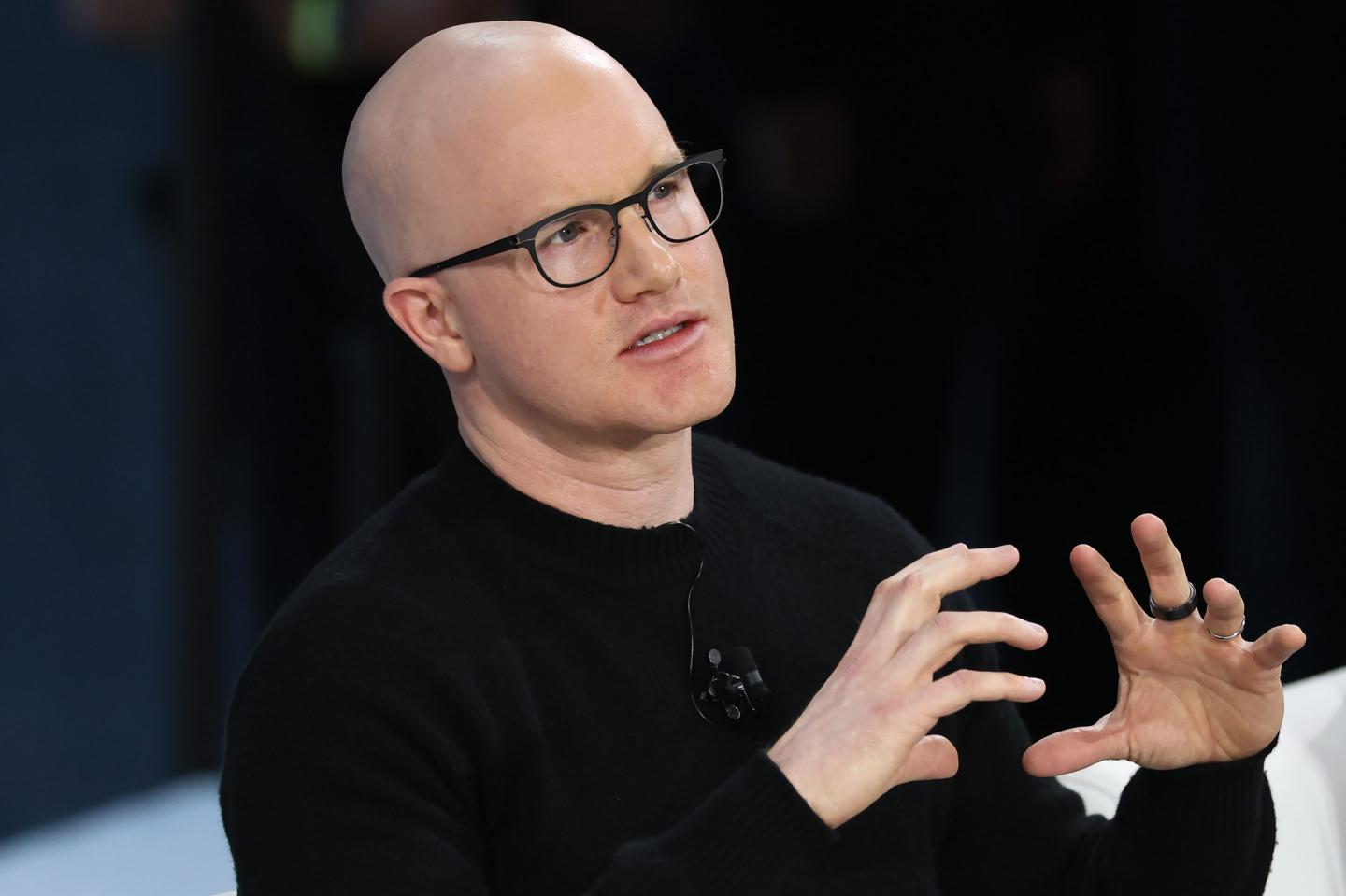
On Tuesday, Coinbase CEO Brian Armstrong announced he was laying off 14% of the company’s workforce—just under 700 people — and turning the company’s org chart upside down.
Out went what Armstrong calls “pure managers.” In came “player-coaches,” flat hierarchies capped at five layers, and “AI-native pods” that could include one-person teams directing agents that do the work of engineers, designers, and product managers.
“We are not just reducing headcount and cutting costs,” Armstrong wrote on X. “We’re fundamentally changing how we operate: rebuilding Coinbase as an intelligence, with humans around the edge aligning it.”
Layoffs economywide are relatively low. But inside tech, the AI layoff is the story of 2026. And Armstrong put his finger on something real: The org chart of the American corporation is under a kind of pressure that most companies have not yet figured out how to relieve.
Something is breaking inside the American corporation. Not the balance sheet, not the brand, not the technology stack—those are mostly fine. What’s breaking is harder to see on a slide deck and harder to fix with a budget line: the unwritten rules, shared assumptions, and organizational muscle memory that tell people how to behave, what to say, who to listen to, and what happens when you get it wrong.
Artificial intelligence didn’t create this tension. But it is making it impossible to ignore.
A sweeping new index from KPMG, built from surveys of 300 C-suite leaders, analysis of earnings calls from 177 publicly traded companies, and hard capital data across six industry groups, puts numbers to what many executives are quietly living. The verdict: 81% of executives said boards have raised expectations for their organizations’ adaptability. The organizations beneath them, in most cases, are not ready to meet it.
The report said conditions are no longer stable, with open trade, predictable regulation, inexpensive capital, and consistent labor markets all shifting simultaneously, redefining how CEOs and senior executives have to lead their organizations.
“Against this backdrop,” the report continued, “CEOs must understand how to rewire their organizations to keep pace with change.”
The survey shows a war inside big corporations as that rewiring is resisted at all levels.
The changing org chart of the 2020s
For most of the 20th century, the Fortune 500 org chart was a machine for execution. Decisions flowed down, information flowed up, and the hierarchy was the system. It was slow by design: Slow meant controlled, and controlled meant safe.
AI doesn’t work that way. It compresses timelines, flattens information asymmetries, and rewards organizations that can act before the picture is complete. The executives who built their careers in the old machine are now being asked to rewire it while it’s running.
Atif Zaim, KPMG’s deputy chair and U.S. managing principal, frames it as a factory floor reckoning.
“When electricity first came about … it wasn’t until much later that folks said, you can reorganize the entire factory—proximity to the boiler or proximity to the river or the water wheel is no longer important,” he told Fortune. Most large companies, he suggests, are still standing next to the boiler, acting as if they are still in the steam era when electricity is rewiring the factory floor.
Coinbase’s restructuring is one of the most explicit public expressions yet of this dynamic. By capping its hierarchy at five layers and increasing its employee-to-manager ratio to 15-to-1, Armstrong is making a structural bet the old command-and-control machine cannot survive the AI era. He is not alone: Meta’s new applied engineering team runs at a 50-to-1 ratio, and the broader “megamanager” trend has pushed the average manager’s span of control to 12.1 employees, up from 10.9 in 2024, according to Gallup.

The KPMG data bears this out in sometimes uncomfortable detail. Only 30% of executives say their organization’s structures, roles, and processes can reconfigure quickly as business needs change. Only 24% identified more dynamic talent deployment as a key change made over the last year. The C-suite has embraced the language of transformation. The org chart hasn’t moved.
In a separate interview with Fortune that predated the KPMG index, Zak Kidd, an economist and cofounder of the organizational feedback startup Ask Humans, said he thinks the AI reorg will go further than most executives are prepared to admit. In his view, the management layer that most Fortune 500 org charts are built around is not just being challenged. It is structurally threatened.
“The future organization is just equity holders and essential workers with LLMs in between,” he said, adding agents will play a large role. “There’s really no need for the management function of human beings if large language models can do the discernment.”
The disconnect between executive expectation and organizational reality shows up in the numbers CFOs are watching most closely. A new survey by the Federal Reserve Bank of Richmond, cited by Apollo chief economist Torsten Slok, finds CFOs expect AI’s biggest impacts to fall on decision speed and accuracy, output per worker, and time spent on high-value tasks—in that order. Total employment, by their own projections, remains essentially unchanged. In other words, the C-suite expects AI to rewire how work happens inside the existing structure—without substantially reorganizing the structure itself. Kidd’s argument is this is exactly the wrong way to think about it.
The spending tells the real story
Follow the money and the culture war becomes concrete. Across every industry group in the KPMG index, executives report that increasing investment in new technology was the top action they took last year. They are nearly twice as likely to increase tech spending as to invest in employee training. Less than half say they find technology “very effective” at improving adaptability.
The math of that trade-off has a human cost. Four out of six industry groups in the index recorded year-over-year declines in hiring. Consumer retail shed headcount at a 7.9% rate. Health care, already strained, dropped 5.6%. Companies are simultaneously demanding more adaptability from their workforces and making those workforces smaller. The result: 46% of executives report burnout and change fatigue as an unintended consequence of their adaptability efforts.
The macro data is beginning to validate what the KPMG index measures at the organizational level. An AI disruption tracker published on April 13 by Morgan Stanley economists finds AI’s impact on the labor market is “narrow, early-stage, and largely visible in micro data rather than aggregate outcomes”—but the micro signals are pointed in one direction. Young workers in high-AI-exposure occupations have seen unemployment rise more sharply since 2023, and they are taking longer to find new jobs. Meanwhile, company earnings calls are increasingly referencing AI in the context of labor, with mentions of displacement rising faster than mentions of job creation. The macro picture looks stable. Beneath the surface, the adjustment is already underway.
“In times of disruption, workers need more training and support, not less,” the KPMG report states flatly. Almost no one is providing it. While 57% of leaders say improving performance and efficiency was a top priority last year, fewer than 10% say developing stronger workforce training programs was among their primary objectives.
Zaim has a theory about why.
“Changing human behavior is one of the hardest things you’re going to do,” he said, “especially in these organizations.”
Pointing out that KPMG itself is more than 150 years old (Fortune is a relatively spry 96), Zaim added, “You’ve got layers upon layers of lore and culture and muscle memory that has been built into, ‘Yeah, this is how we do things.’ A lot of this stuff is not written down anywhere. It’s not like you can go and change the policy and suddenly things change.”
The innovation trap
Here is where the white-collar culture war gets its most revealing data point. The industries most focused on innovation—most aggressive about new technologies, business model experimentation, and accelerating R&D—are not the most adaptable. The correlation is essentially zero.
Manufacturing and energy, which scores the highest strategic adaptability of any sector in the index at 71 out of 100, is not a sector known for radical reinvention. It adapts through disciplined scenario planning, centralized decision authority, and operational execution. Health care leads the overall index at 53—not because it innovates fastest, but because it scores consistently across culture, ecosystem, and strategy. TMT—the sector that most loudly evangelizes transformation—scores 41 on cultural adaptability, near the bottom.
Zaim invoked Kodak, a company that literally invented the digital camera and was destroyed by it anyway.
“Is there a risk that you are a leader, excellent in innovation, but somehow that diffusion, that adoption, that getting it into the rest of the organization didn’t happen because you didn’t have the culture for it?” The answer, the index suggests, is yes—and it is happening at scale, right now, inside some of the most sophisticated companies in the world.

Kidd said he sees such failures as symptomatic of something deeper—a fundamental misunderstanding of what AI actually does to organizational intelligence. He said he was skeptical of consulting firms and corporations that try to draw bright lines between what humans can do and what AI cannot. “Human skill capability ceiling is fixed,” he said, “whereas on the other side of the curve, it’s not fixed.” Any boundary you draw today, he said, is just a “sandcastle.”
The companies investing heavily in innovation while neglecting culture, he argued, are making the same category error: assuming the gap between human and machine capability is stable when it is, in fact, closing faster than most org charts can process.
The psychological safety gap
Beneath every data point in this report is a more fundamental question: Do the people inside these organizations feel safe enough to actually change?
The answer, in aggregate, is no. Just 9% of executives—across all industries—identify increased psychological safety as one of the behaviors their organization changed most in the past year.
Zaim said he has pushed CEOs on this directly, recalling one particular conversation with a CEO, years before AI, about transformation in general.
“He was agreeing vehemently—yes, you need a culture where people can bring up ideas. I said, ‘When was the last time you celebrated a failure?’ And the penny dropped instantly. He’s like, ‘You know what, Atif? You’re 100% correct. We just don’t do that,'” he said. It’s not about having a mindset where failure is good, Zaim clarified, but that risk-taking definitely is, and failures are a byproduct of that.
Kidd, who has spent months meeting with chief impact officers at major consulting firms and Fortune 100 companies as part of his own research, kept seeing versions of this reluctance to take risks, people who “see the org chart shifting underneath them in real time and are trying to figure out what the other side looks like.”
It’s understandable to want to distinguish human work from AI work, Kidd said, before concluding that was ultimately “pissing in the wind.” When the gap between human and machine capability closes, he added, the only durable advantage for any organization will be its culture. “When you remove the management buffer and hand execution over to AI, the remaining humans are no longer the engine—they are the steering wheel. if your culture is misaligned, the AI will just scale your dysfunction at light speed.”
Firms designing their cultures around a stable human-AI boundary, Kidd explained, are making a bet that the boundary will hold. The KPMG data suggests most of them are already losing that bet—they just haven’t looked at the score.
The board is watching
What’s different now is the pressure is structural, not optional. Boards have noticed. Eighty-one percent of executives say their boards or owners have raised expectations for organizational adaptability. Companies that pushed through transformation—that made the cultural and structural bets, not just the technological ones—saw 4.4 times higher shareholder returns and nearly triple the revenue growth of more passive peers. Leaders in organizations they describe as genuinely adaptable are 13 percentage points more likely to report revenue growth and to expect more of it.
Zaim acknowledged that the competitive threat is no longer abstract, agreeing that he’s heard anecdotes of three-person companies operating with a dozen AI agents, generating millions in revenue, chipping away at Fortune 500 business. “The price of knowledge, one could argue, has come down,” he said. “And therefore it allows you to go into businesses and challenge established businesses with a lot less initial capital expense than has ever been the case.”
“I don’t want to be dramatic and say it’s life or death,” Zaim said. Then he paused. “But I think it is life or death for some.”
A version of this story was originally published on Fortune.com on April 15, 2026.