

• Home
  • Latest
  • Fortune 500
  • Finance
  • Tech
  • Leadership
  • Lifestyle
  • Rankings
  • Multimedia

Trendingnow

1

Billionaires Elon Musk and Mark Zuckerberg used mortgages to buy multimillion-dollar mansions. Here’s why that’s a savvy financial decision

2

AI CEOs from OpenAI, Anthropic, and Microsoft set aside their rivalry to warn Congress AI is making it too easy to design and create bioweapons

3

The Strait of Hormuz is more open than previously thought as the U.S. shoots down Iranian drones threatening ships and provides 'naval overwatch'

1

Billionaires Elon Musk and Mark Zuckerberg used mortgages to buy multimillion-dollar mansions. Here’s why that’s a savvy financial decision

2

AI CEOs from OpenAI, Anthropic, and Microsoft set aside their rivalry to warn Congress AI is making it too easy to design and create bioweapons

3

The Strait of Hormuz is more open than previously thought as the U.S. shoots down Iranian drones threatening ships and provides 'naval overwatch'
Future of Workdisruption

Goldman just looked at 40 years of data on the ‘scarring’ effects of technological disruption and finds Gen Z isn’t the most at risk

Nick Lichtenberg
By
Nick Lichtenberg
Nick Lichtenberg
Business Editor
Down Arrow Button Icon
Nick Lichtenberg
By
Nick Lichtenberg
Nick Lichtenberg
Business Editor
Down Arrow Button Icon
April 6, 2026, 3:58 PM ET
worker
Who’s most at risk of displacement?Getty Images

Wall Street’s most-watched economics team has a warning for workers displaced by AI: The damage could last for years. But in a surprising twist, the people most expected to bear the brunt of the coming disruption—recent college graduates—may actually be the best equipped to weather it.

Recommended Video

In a research note published Monday, Goldman Sachs economists Pierfrancesco Mei and Jessica Rindels drew on four decades of individual-level data to assess what they call the “scarring” effects of technological displacement on U.S. workers. Their verdict is sobering. Workers whose jobs are eliminated by technology don’t just struggle in the short term—they can spend the better part of a decade fighting to recover.

“Over the 10 years following a job loss, real earnings for technology-displaced workers grow nearly 10 percentage points less than for never-displaced workers,” the report found, “and 5 percentage points less than for other displaced workers.”

The research team tracked more than 20,000 individuals across two cohorts—one born in the 1950s and ’60s, and another in the 1980s—using the National Longitudinal Surveys sponsored by the Bureau of Labor Statistics. By identifying which occupations faced the steepest technology-driven employment declines in each decade since 1980, they were able to map the full career arcs of workers caught in automation’s path.

The immediate pain is real

The short-run picture is rough. Workers displaced from technology-disrupted occupations take approximately one month longer to find a new job and suffer real earnings losses more than 3% larger upon reemployment compared with workers let go from more stable fields. The core culprit, Goldman found, is occupational downgrading: Displaced workers tend to slide into roles that are more routine and require fewer analytical and interpersonal skills, not less, because the same technological forces that eliminated their old jobs also eroded the market value of their existing skills.
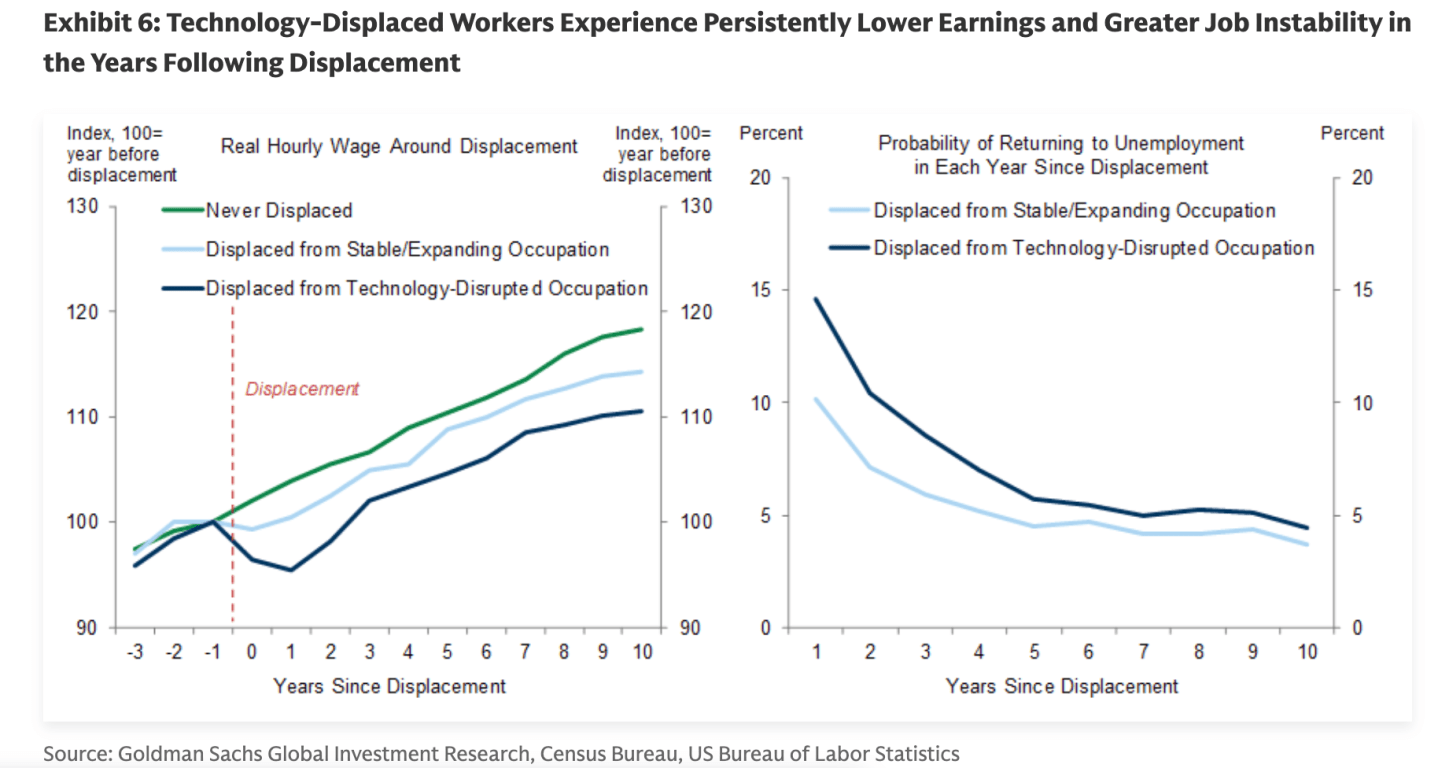
The scarring doesn’t stop at paychecks. Goldman found that workers displaced early in their careers—between ages 25 and 35—accumulate less wealth over time, largely because they delay buying homes. They’re also less likely to be married at any given age compared with never-displaced peers, suggesting the economic shock ripples into their personal lives as well.

Recessions make everything worse

Goldman’s most urgent warning may be about timing. Firms disproportionately shed routine jobs during economic downturns, when efficiency pressure peaks. For workers, a recession-era technology displacement widens the already painful gap versus other displaced workers by roughly three additional weeks of unemployment and five percentage points each for the risk of returning to unemployment and exiting the labor force entirely. With AI adoption accelerating at a moment of unusual macroeconomic uncertainty, that compounding risk is hard to ignore.

The Gen Z twist

Here’s where the report defies the prevailing narrative. Much of the public anxiety about AI-driven job losses has centered on young workers—particularly new graduates entering a market increasingly shaped by automation. Goldman’s data tells a different story. Younger, college-educated, and urban workers experience cumulative earnings losses roughly half as large as other technology-displaced workers over the decade following a job loss. Their advantage comes from flexibility: They switch occupations more readily and migrate up the skills ladder into roles with higher analytical content that complement, rather than compete with, new technology.

“Contrary to current concerns that the costs of AI will fall especially hard on new graduates,” the report states, “younger workers have actually been able to adjust more flexibly through occupational mobility and skill upgrading in the past.”

Retraining also helps cushion the blow. Workers who participated in vocational or technical programs within three years of displacement saw roughly two percentage points more cumulative wage growth over the following decade and a 10-percentage-point lower probability of returning to unemployment.

Goldman has been estimating for several years that AI could displace 6% to 7% of U.S. workers over the next decade. This 40-year sweep of data suggests the workers who should be most worried aren’t the youngest ones in the room—they’re the older, less mobile workers with deeply occupation-specific skills and no recession-proof timing on their side.

For this story, Fortune journalists used generative AI as a research tool. An editor verified the accuracy of the information before publishing.

The Fortune 500 Innovation Forum will convene Fortune 500 executives, U.S. policy officials, top founders, and thought leaders to help define what’s next for the American economy, Nov. 16-17 in Detroit. Apply here.
About the Author
Nick Lichtenberg
By Nick LichtenbergBusiness Editor
LinkedIn icon

Nick Lichtenberg is business editor and was formerly Fortune's executive editor of global news.

See full bioRight Arrow Button Icon

Latest in Future of Work

Finance
Lorem ipsum dolor sit amet, consectetur adipiscing elit, sed do eiusmod tempor incididunt ut labore et dolore magna aliqua. Ut enim ad minim veniam
By Fortune Editors
October 20, 2025
Finance
Lorem ipsum dolor sit amet, consectetur adipiscing elit, sed do eiusmod tempor incididunt ut labore et dolore magna aliqua. Ut enim ad minim veniam
By Fortune Editors
October 20, 2025
Finance
Lorem ipsum dolor sit amet, consectetur adipiscing elit, sed do eiusmod tempor incididunt ut labore et dolore magna aliqua. Ut enim ad minim veniam
By Fortune Editors
October 20, 2025
Finance
Lorem ipsum dolor sit amet, consectetur adipiscing elit, sed do eiusmod tempor incididunt ut labore et dolore magna aliqua. Ut enim ad minim veniam
By Fortune Editors
October 20, 2025
Finance
Lorem ipsum dolor sit amet, consectetur adipiscing elit, sed do eiusmod tempor incididunt ut labore et dolore magna aliqua. Ut enim ad minim veniam
By Fortune Editors
October 20, 2025
Finance
Lorem ipsum dolor sit amet, consectetur adipiscing elit, sed do eiusmod tempor incididunt ut labore et dolore magna aliqua. Ut enim ad minim veniam
By Fortune Editors
October 20, 2025

Most Popular

Finance
Lorem ipsum dolor sit amet, consectetur adipiscing elit, sed do eiusmod tempor incididunt ut labore et dolore magna aliqua. Ut enim ad minim veniam
By Fortune Editors
October 20, 2025
Finance
Lorem ipsum dolor sit amet, consectetur adipiscing elit, sed do eiusmod tempor incididunt ut labore et dolore magna aliqua. Ut enim ad minim veniam
By Fortune Editors
October 20, 2025
Finance
Lorem ipsum dolor sit amet, consectetur adipiscing elit, sed do eiusmod tempor incididunt ut labore et dolore magna aliqua. Ut enim ad minim veniam
By Fortune Editors
October 20, 2025
Finance
Lorem ipsum dolor sit amet, consectetur adipiscing elit, sed do eiusmod tempor incididunt ut labore et dolore magna aliqua. Ut enim ad minim veniam
By Fortune Editors
October 20, 2025
Finance
Lorem ipsum dolor sit amet, consectetur adipiscing elit, sed do eiusmod tempor incididunt ut labore et dolore magna aliqua. Ut enim ad minim veniam
By Fortune Editors
October 20, 2025
Finance
Lorem ipsum dolor sit amet, consectetur adipiscing elit, sed do eiusmod tempor incididunt ut labore et dolore magna aliqua. Ut enim ad minim veniam
By Fortune Editors
October 20, 2025
Fortune Secondary Logo
Rankings
  • 100 Best Companies
  • Fortune 500
  • Global 500
  • Fortune 500 Europe
  • Most Powerful Women
  • World's Most Admired Companies
  • See All Rankings
  • Lists Calendar
Sections
  • Finance
  • Fortune Crypto
  • Features
  • Leadership
  • Health
  • Commentary
  • Success
  • Retail
  • Mpw
  • Tech
  • Lifestyle
  • CEO Initiative
  • Asia
  • Politics
  • Conferences
  • Europe
  • Newsletters
  • Personal Finance
  • Environment
  • Magazine
  • Education
Customer Support
  • Frequently Asked Questions
  • Customer Service Portal
  • Privacy Policy
  • Terms Of Use
  • Single Issues For Purchase
  • International Print
Commercial Services
  • Advertising
  • Fortune Brand Studio
  • Fortune Analytics
  • Fortune Conferences
  • Business Development
  • Group Subscriptions
About Us
  • About Us
  • Press Center
  • Work At Fortune
  • Terms And Conditions
  • Site Map
  • About Us
  • Press Center
  • Work At Fortune
  • Terms And Conditions
  • Site Map
  • Facebook icon
  • Twitter icon
  • LinkedIn icon
  • Instagram icon
  • Pinterest icon

Latest in Future of Work

Portrait of upset unhappy diligent tired male student preparing for exam in university library
SuccessEducation
Gen Zers are arriving to college unable to even read a sentence—professors warn it could lead to a generation of anxious and lonely graduates
By Preston ForeJune 7, 2026
2 hours ago
Allison Sheehan
SuccessJobs
This Gen Zer got reprimanded at Goldman for making cake videos as the ‘Investment Baker.’ She quit her job and is building a dessert empire
By Emma BurleighJune 7, 2026
4 hours ago
Chinese humanoid robots dominate the market with thousands shipped a year. But most are still performative rather than functional
InnovationRobots
Chinese humanoid robots dominate the market with thousands shipped a year. But most are still performative rather than functional
By Chan Ho-Him and The Associated PressJune 6, 2026
1 day ago
Gen Z is ditching college for ‘more secure’ trade jobs—but boilermakers and welders actually rank among the worst entry-level jobs
SuccessGen Z
Gen Z is ditching college for ‘more secure’ trade jobs—but boilermakers and welders actually rank among the worst entry-level jobs
By Orianna Rosa RoyleJune 6, 2026
1 day ago
Serena Williams
SuccessSerena Williams
Serena Williams’ secret to success is about more than talent: You have to grind ‘every day’
By Emma BurleighJune 6, 2026
1 day ago
Upset frustrated and confused female worker folding hands on chin
Future of Workcompensation
A CEO denied raises to spend money on AI instead. Companies have ‘no idea what they’re going to need in a workforce’ when the AI race is over
By Jacqueline MunisJune 6, 2026
1 day ago

Most Popular

Billionaires Elon Musk and Mark Zuckerberg used mortgages to buy multimillion-dollar mansions. Here’s why that’s a savvy financial decision
Real Estate
Billionaires Elon Musk and Mark Zuckerberg used mortgages to buy multimillion-dollar mansions. Here’s why that’s a savvy financial decision
By Sydney LakeJune 6, 2026
1 day ago
AI CEOs from OpenAI, Anthropic, and Microsoft set aside their rivalry to warn Congress AI is making it too easy to design and create bioweapons
AI
AI CEOs from OpenAI, Anthropic, and Microsoft set aside their rivalry to warn Congress AI is making it too easy to design and create bioweapons
By Marco Quiroz-GutierrezJune 5, 2026
2 days ago
The Strait of Hormuz is more open than previously thought as the U.S. shoots down Iranian drones threatening ships and provides 'naval overwatch'
Energy
The Strait of Hormuz is more open than previously thought as the U.S. shoots down Iranian drones threatening ships and provides 'naval overwatch'
By Jason MaJune 6, 2026
13 hours ago
I've sold property on California's Central Coast for decades. The buyers chasing ranch and winery estates are after more than a lifestyle
Commentary
I've sold property on California's Central Coast for decades. The buyers chasing ranch and winery estates are after more than a lifestyle
By Lindsey HarnJune 6, 2026
1 day ago
Here's where U.S. debt may become unsustainable with interest payments triggering a default crisis that even steep tax hikes can't fix
Economy
Here's where U.S. debt may become unsustainable with interest payments triggering a default crisis that even steep tax hikes can't fix
By Jason MaJune 6, 2026
16 hours ago
Social Security faces a 24% cut in 2032—that's a $345 billion hit to retirees nationwide, watchdog says
Economy
Social Security faces a 24% cut in 2032—that's a $345 billion hit to retirees nationwide, watchdog says
By Nick LichtenbergJune 5, 2026
2 days ago

© 2026 Fortune Media IP Limited. All Rights Reserved. Use of this site constitutes acceptance of our Terms of Use and Privacy Policy | CA Notice at Collection and Privacy Notice | Do Not Sell/Share My Personal Information
FORTUNE is a trademark of Fortune Media IP Limited, registered in the U.S. and other countries. FORTUNE may receive compensation for some links to products and services on this website. Offers may be subject to change without notice.