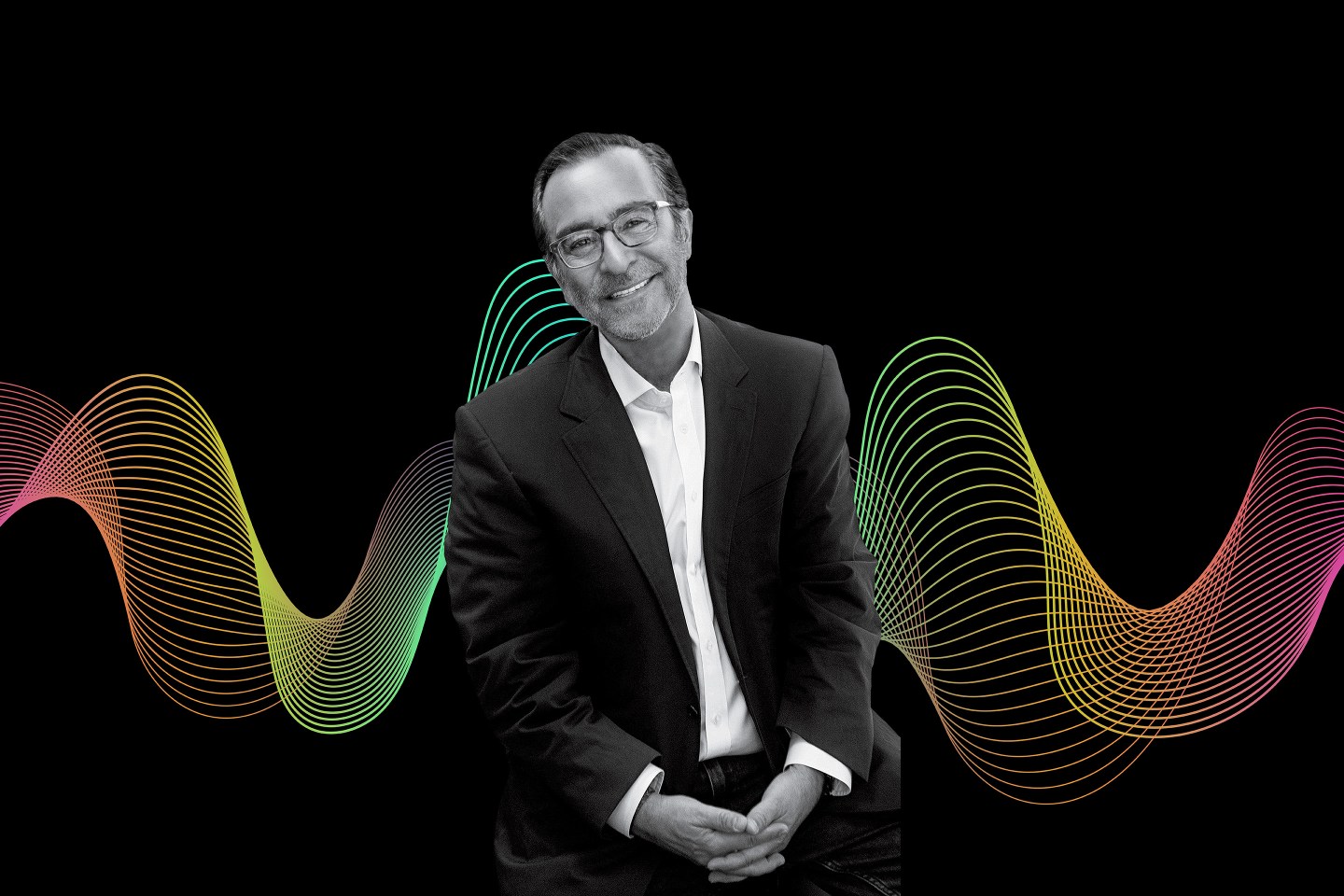
On this episode of Fortune’s Leadership Next podcast, cohosts Diane Brady, executive editorial director, and Kristin Stoller, editorial director of Fortune Live Media, talk with Dani Richa. Richa is the chairman and group CEO of Impact BBDO International. The three discuss how the ad agency inspired the hit show Mad Men; how to use AI to bring out the best of you; and optimism in the rapidly developing EMEA region.
Listen to the episode or read the transcript below.
Transcript:
Dani Richa: It’s only humans that can do things that have never been done before. We spoke about risk—it’s only humans that can decide the level of risk they want to go into.
Diane Brady: Hello everybody, and welcome to Leadership Next. I’m Diane Brady.
Kristin Stoller: And I’m Kristin Stoller.
Brady: This week, Kristin, Dani Richa.
Stoller: Yes, he is the Chairman and Group CEO of Impact BBDO International. Now, Diane, I have to admit, I had no idea what BBDO even was. I think that’s very ignorant of me. And then I Googled it, and I was like, Oh, it is the firm that “Mad Men” is based on, okay.
Brady: Yeah, it is. It’s an iconic advertising firm And that obviously goes back decades, but more recently, you might remember those Snickers commercials, they did that. Have it your way, Burger King. So they were the OG really, sort of advertising agency that, to your point, Madison Avenue, “Mad Men.” But now, of course, it’s a global agency. It’s also one that, really, if you’re looking at where the growth pockets in the world, it’s the areas that he’s overseeing: Africa, Middle East, etc.
Stoller: And I think that’s what makes Danny the most interesting, right? Because he has the unique challenge of advertising in regions where it’s a lot stricter and the culture is very different than where BBDO primarily operates. So he is making advertisements and campaigns that have to fit in boxes that no one else has to do.
Brady: And he’s also operating in a part of the world that is the fastest growing consumer market, which is Africa. And you know, by 2050, one out of four people on this planet are going to be African. So if you’re looking for where to grow in the world and how you market to those people, I think you’ll enjoy this conversation with Danny. So we’ll be right back after the break.
Brady: In the spring 2025 fortune Deloitte CEO survey, 42% of CEOs said they’re planning to cut costs. Leaders are shifting away from traditional cost cutting measures to more growth oriented cost optimization strategies. Jason Girzadas, the CEO of Deloitte US, is the sponsor of this podcast, and he joins us now. Jason, great to see you.
Jason Girzadas: Great to see you, Diane.
Brady: So what’s driving leaders to adopt this approach? What are the benefits?
Girzadas: I think a couple of things. I think all businesses are endeavoring to get to a cost leadership position because it gives you maximum flexibility to deal with other variables and effectuate performance through cost leadership. But growth-oriented cost leadership is made possible today because technology and other business model innovations allow for it.
Stoller: Jason, could you give us some examples of growth-focused approaches to cost optimization that leaders are actually using? And what are some examples of how they’ve been successfully implemented?
Jason Girzadas: One is, you know, we have many clients that have legacy technologies that they can now integrate different technology and data sets into that legacy technology that allow them to create additional insights. Think about a core legacy ERP system that can then be augmented with point of sale data or supply chain data that allows for different types of insights to be gleaned and operations to be managed in a more effective way. Another example is today, there are many opportunities to leverage third-party relationships to create different synergies, so you can take what had been fixed costs and make them more variable.
Brady: I think it’s more proof that we’re entering a whole new era of innovation. Thanks, Jason.
Brady: Danny, thank you so much for joining us here at the Fortune Global Forum in Riyadh. We are in your home region, thank you for welcoming us. You run Impact BBDO, which is a subsidiary of Omnicon, and you’re in charge of all the Middle East and Africa. But I want to start by getting a sense of you. Can you tell us about the campaigns that you are the most proud of?
Richa: Look, there are many campaigns that we’ve worked on that are really dear to me, but one that has consistently, over the last few years, received several Grand Prix at Cannes, year after year. So that consistency, and that’s something that I encourage clients to do, is to really stick the course and not just do one off and continue. So it started with Nahar. It’s a newspaper in Lebanon, struggling back then as much as paper newspapers are at this time and in a country with problems and economies and wars and all that. And they got tired of publishing the lies of the politicians, there was a country in a standstill with no government, nothing’s happening. So the first campaign was really inviting them to publish the first ever blank edition from cover to cover, and it was a shock for the market. They thought that they actually went out of business, and that’s it. That’s the last edition.
Brady: Your advice to the editor was to publish a blank edition?
Richa: A blank edition with no advertising revenue, no nothing. And then a few hours later, in the press conference, we invited people to write with their own pens on those blank editions what they wanted the politicians to do, how they wanted the country to be fixed. And it caught like fire on social media and really it created a movement. It was a big success. And it actually helped trigger—get back a government in place that—to do justice, I’ll invite the audience maybe to to check these out. The second one, a year later, there was a parliamentary election, and they were using as an excuse the economic problems to say they didn’t even have money for paper and ink for the ballots. So we again took another brave stand, and the newspaper said, Okay, we will not publish that day. We will donate the ink and the paper for you to do the ballots. And again, really people liked it. They created movement, created a lot of noise, and ended up having an election. The following year, there were like six publications that, really unfortunately, had to close down. We took the six newspapers that were out of business and gave their editors a full page, or two full pages. So it was a newspaper inside the newspaper. You’d open a Nahar, you’d find another newspaper. You’d find another newspaper. Six newspapers that had closed were brought back to life and were able to create. And then the following year…
Brady: …I’m going to stop you there, because I feel like you’ve had so much impact that we’re going to be up to the present day. But let me ask you, because as you’re talking, it is a reminder to me that BBDO, which you’re a part of, was the original “Mad Men” ad agency, right? And so it’s Don Draper, the creativity. What you’re talking about is the kind of old school creativity that, frankly, I don’t associate with ad agencies anymore. Am I wrong about that? Obviously, you just gave us some examples.
Richa: Old school in trying to do things that matter, that move people, that create positive change, but totally new in the means that we’re using them in the technology that’s available. A lot of what I explained uses digital and social like never before to amplify that messaging. So, yeah, I mean, look—the basics. And hopefully, we’ll get to talk a bit about AI and how important it is to stick to the basics, because at the end of the day, with all the tech that’s happening, the one constant that will always remain is the need for big ideas. Big ideas that touch people, that move people, that move businesses, and that never changes from the days of “Mad Men” maybe for the next 50 years. Who knows?
Stoller: Well, Danny, the ideas you described are so bold and also kind of risky in the regions that you operate. So how do you convince clients or governments to take on these ideas that they may be a little shy to do for reasons of being scared or geopolitical reasons, cultural reasons. How do you do that?
Richa: One, you’ve got to find the right partners. Those who share your passion to do change and to take calculated risk. We once asked a client, we did quite a bold campaign with that client, and then we went after the campaign was really successful—I’m not going to talk too much about the campaign—and thanked the CEO for taking that risk. And then the CEO, he said, What? What risk? What do you mean? The biggest risk I would have taken is not doing that. And again, risk is a relative term. I was in a discussion with one of the biggest developers in our region, and part of the discussion with the CEO was, what’s your risk appetite like? Because we want to know. And he said something that I really liked. I said, you know, I’m going to borrow that. He said, There is no risk. There’s just extreme optimism. And if you see this region and how fast it’s developing, and the projects that they’re doing, obviously there’s risk, but it’s extreme optimism. And it’s believing that, if you build it, they’ll come. And if you look at places like the UAE, if you look at Saudi where we’re sitting here, in Qatar, the kind of projects, the ambition is unbelievable. And if we went back 20-25 years, and we said we’re going to be here today, a lot of people wouldn’t have believed us. So, yeah, risk is important. Why is it important? Because you want to do something for the first time, you want to do something that’s never been done before. There is no benchmarking. There is no benchmarking, there are no safety nets. You’re taking a creative leap, but we do that with a lot of insights, a lot of data. We make sure that it’s founded in a real human truth or a business truth. So it’s not art for the sake of art. There’s a part of it that’s really scientific, and then that’s why you’re taking risk, but it’s calculated risk.
Stoller: The science of it, in today’s day and age, is it to go viral? How do you look at virality? How do you think about virality? Do you like going viral?
Richa: Well, I don’t like the term viral. It sounds like a virus or a disease or an illness. Look, you never intend to go viral. You intend to touch people in a meaningful way, in a way that resonates with them to the point that they want to share it with their loved ones, they want to share it with their friends. And then if you strike that emotional chord, that’s when it goes viral. That’s when people want to share it, talk about it, but it’s never an objective to go viral. The objective really is to get the message to the right people at the right time.
Brady: Before we go into the future of marketing and advertising, I want to go to the past and just ask what made you want to be an ad guy?
Richa: Look, I come from a family of architects, and I went to France to study architecture, and I ended, by mistake, watching “Night of the Ad Eaters.” In France, they call it “La Nuit des Publivores.”
Brady: Is that a horror movie?
Richa: No, they take a movie theater and they run ads back to back, from 8pm to 8am in the morning. Back to back ads from around the world. People normally go for half an hour, watch a bit of ads, and then go have some popcorn and go have dinner. I stayed from eight to eight, I did a whole night. In the morning, I called my dad, God bless him, and I said, Look, I’m sorry. I’m not going to be an architect. I don’t want to be limited to building with stone, glass, steel. The world is your canvas. And I got into it and never looked back.
Brady: What was your first job?
Richa: My first job, actually, was an art director at a very good agency. It was back in the days where you were still drawing the storyboards one by one and frame by frame, and I had the chance to work on some fantastic brands. And then a bit later, I joined BBDO, and there I had, again, the opportunity to partner with some of the most exciting clients, where we did some great work over the years.
Stoller: I want to turn now to AI, because I think that’s such a big part of the space, your story, what you’re doing next. Can you just give us an explanation first of how you’re using Gen AI, if at all, in your campaigns?
Richa: I mean, look, it’ll be a real missed opportunity. It’ll be really silly not to use Gen AI. And the way we use it is—in the creative process, there’s a starting point. And the starting point, what does Ai do? There’s so much data out there, and AI allows us to make sense of that data at a speed we could have never been able to before. So really making sense of the data, finding the right insights that we would build our strategy on. So that’s fantastic. That’s before. Also, part of the ideation, I encourage my creative team to brainstorm with AI. I don’t know if you know, but the O in BBDO came up with a brainstorming concept. So brainstorming is really important for us, but use AI not to get the best out of AI, but allow AI to get the best out of you. So kind of like a bouncing board, have AI challenge your ideas. And we’ve developed tools, for example, the brave bot. It’s the Gordon Ramsay of creativity. We told that large language model, the best ads, the most effective ads from the last 20-30 years. And then, when you’re discussing ideas, it benchmarks against them, and it kind of challenges you based on that. It’s not your typical, you know, ChatGPT, where it’s comparing to everything that’s out there. This is comparing to the best that’s out there.
Stoller: Does it make it so you can’t plagiarize others?
Richa: In a way, but it’s Gordon Ramsay in a way where it criticizes the hell out of you, like tears your ideas apart, and then sometimes it suggests some fixes, but you’re the one coming up with the idea. So between getting the right insights, because you want to build it on something that’s meaningful, using AI to partner with AI to get the best out of you, and then validating the work, that’s the starting phase. Then what AI has done is, as creatives, we’ve always had a problem of time. Actually producing the work took a lot of time, the cost, and what AI does—it frees us from that. You know, we can, we can produce at speed. We can produce at low cost, if need be.
Brady: Doesn’t it free your customers to do that as well, though, because being in the creative space ourselves, there was a point where every company thought they could be a media company. Now, every company thinks they can be an advertising company because they have these tools themselves.
Richa: Yes, you have the tools. It’s like giving everybody a camera, but giving the best photographer a camera. You’re not going to get the same pictures. It’s more difficult to judge a good idea than to come up with one. AI is going to give you tons of stuff and the ability to work with AI and to pick the right message. I mean, it takes a lot of experience. It takes a lot of creative judgment. And unfortunately, not everybody’s equipped to do that. And it’s a good question, because, some clients tell you, this took you an hour to do? Yeah, it took me an hour and 30 years of experience to not just the problem, but the [unintelligible] between the different outputs that you get to select, to reiterate, to work, to fine tune. So to help produce the work, AI is playing great role. And then the after, which is the personalization—being able to reach the right people at the right time with the right message. At first we used to broadcast, have one message to millions. Then we got a bit more sophisticated, and we’re able to personalize So, for example, in your feed, if we know from the algorithm that you’re interested in SUVs, you’ll be served an SUV. If you like red, you’ll be getting it in red. Yeah, what AI allows us to do now, it’s not just personalizing the messaging, it is engaging into a stream where people give feedback and get part of the storytelling. And not even the offering, even changing the product, suggesting and then the ability to listen in real time, the ability to respond in real time to give customers tools to play around. I mean, you look at Nike, they’re co-creating designs with people, and based on the outcome and the testing, some are actually produced at masses.
Stoller: How transparent are you with the client, the customers, anyone who’s seeing a campaign, about, this is produced by AI or fueled by AI, and what’s the feedback been like? Because I know we talked a lot previously about AI slop, and how I feel like my feed is constantly all these generated videos, and I’m like, Oh, I’m so exhausted with all this AI-generated stuff. How do you talk to investors about it?
Richa: So look, there’s work that is fully produced with AI, there’s work that’s co-produced with AI—so you do some shooting, and then AI kind of does the backgrounds—and then there’s work that’s completely shot by humans. It’s a bit like handmade versus machine-made.
Brady: Artisanal cheese versus mass-produced.
Richa: Exactly, and there’s value in handmade. And the ability to use all of that—I mean, we have the opportunity to use all of these tools that are available to us and the horses for courses. When you need something that cannot be done or can be done more effectively using just AI, you do that. When you need something more raw, more authentic, a real life story with—nothing beats the emotion you get in the eyes shooting somebody who’s telling their own story.
Brady: That’s why you win the awards. But let me ask you, because you’re doing the Middle East and Africa, those are a lot of different economies at different stages of development. So what have you gleaned in terms of—what does connect with consumers? I know we’re talking about one-to-one marketing, but you get into the front lines. Tell us a bit about how those markets are developing and what’s changing there.
Richa: I also had the chance to look after Europe as well, so I can compare the benchmarking. And one of the things we try to do is in all these countries, especially Africa and the Middle East and the subcontinent, we look at some of the tension points. I mean, we, for example, in Pakistan, cricket is crazy, it’s the number one sport. And it’s frustrating, because the women there want to play cricket and they can’t because it’s reserved to men. And mostly it’s reserved to men because the equipment is expensive, and they have no access to equipment. So we partnered with…
Brady: …sounds like women’s soccer in the U.S….
Richa: …but women’s soccer, all you need is a ball. So we partnered with one of our clients, Pepsi, and we did a huge billboard. And in that billboard, you had women posing, playing cricket, but we actually put the equipment in the billboard so people could actually pull the equipment, play with it, and then return it in different fields around the country. And they loved it, and they started playing, and the coverage was fantastic. So in these different countries, depending on the needs, depending on the challenges, the tension points. You do things that are relevant. Sometimes, when you’re doing regional campaigns, it becomes more complex, because you don’t want to do a film or a campaign for each country. And here you look at the commonalities. And there’s so much more in common that we have than differences that sets us apart. So you do look at the differences in some of the multinational brands, they tend to find [that] the human truth that connects with a mother in Egypt is not that different from a mother in Saudi Arabia or a mother in London. Some of the values are the same. Some of the aspirations are the same, and we kind of focus on those.
Stoller: I want to go back to your word, truth, because I’ve read a lot of your interviews, and you consistently say, trust is built on honesty. It’s built on truth. Was there ever a time where you had to tell a client an honest truth, and maybe you lost them, maybe it was a challenge you had to get through. Was there a time you had to do that? And how did you work past it look?
Richa: I mean, the starting point is choosing partners and choosing partners that share your values. And so once you’ve chosen—we’ve said no to many partners because we felt the chemistry wasn’t right, the values weren’t shared. So often, the clients that we work with would never ask us to tell something that’s not true or to exaggerate. I mean, I remember an experience. It was many, many years ago, a product claim that was a bit ridiculous. I mean, it was a disinfectant that you cleaned a surface with that repelled flies. And we tell the client, well, it repels them where? They don’t land on the table. They land on you, on the children, on the food? And they said, no, no, no. We said, look, sorry, we can’t do that. It doesn’t make sense. I mean, it’s an over-claim. It doesn’t make sense. And we lost the business. The client launched that product at millions and millions of dollars, and it completely failed. We felt, you know, that it was the right thing to do. We would never, and I had an experience with one of my colleagues who—we’re doing a campaign, it was like a real life experiment. And we did it. It was beautiful, very touching, very powerful for Alzheimer’s. We found out that people, their short term memory is gone, but the long term memory is still there. So they wouldn’t recognize their own children, but they would recognize them from when they were young. So we did an experiment with a Hollywood makeup artist and made up their children to look exactly the way they were 15-20 years ago, and tried to see whether they would recognize them. And we shot it, and it worked. And it was so emotional. I said, Are you sure these are all their children? He said, Yes, yes, yes. He said, but just one because she was a lousy actor. And we killed the project. We dumped the project because one of the people wasn’t a real person, and it was meant to be a real experiment, and we threw away quite a lot of money.
Brady: The whole thing?
Stoller: Did you redo it? Or you were just like, we’re done?
Richa: No, no. We gave up on the project, because we felt that, and he was a great guy, tried to convince me, it’s an enactment. We can put a disclaimer. I said, No, absolutely not.
Brady: Yes, many a journalist has been felled by such things too, right? Once you lose trust, you don’t get it back. But let me ask, how has this region evolved? Both in terms of the marketing messages and like many fast-changing parts—Africa, Middle East, etc—has that changed the nature of advertising itself here?
Richa: Absolutely, the reason I chose to come back is I found—and as you can see—in the last two or three years, so many companies are coming here, so many global companies are coming to establish their regional headquarters in the region. One, because of growth potential. But two, because of the development that’s happening. So I came back because I found the potential of positively impacting and accelerating that change that’s coming. And the nuances are huge. I mean, if you look back 20 years ago, some of the television stations in this region couldn’t show, for example, a man and a woman in the same commercial. You had to have children around them to say that this is a family. We would do a shampoo commercial without even showing women’s hair, because we weren’t allowed to show an unveiled person. All this has evolved and changed with satellite TV and now the internet and all that. But more importantly, people became more open and more welcoming, with a global kind of vision to everything. So the change has been unbelievable, and it has impacted the way we talk to these customers and the way brands engage with these customers.
Brady: I want to reframe it a little bit too, because I used to live in China. And one of the things—when you grow up in a culture, you grew up in France, you have an appreciation of fine cooking. America, to me, is a place that’s always kind of rewarded creativity. When you’re in a place where people have not grown up with that, how do you actually free them up? Has that been a challenge? Almost teaching them how to be creative when they’ve had this script that’s not allowed them to think that way?
Richa: Look, they were creative in literature, they were creative—I mean, poetry is really big in this part of the world, so I would never say they weren’t creative. I would just say they were…
Brady: …cultural restrictions…
Richa: …cultural restrictions kind of limited them. I mean, back in the day we had a section for women to work in in the office and a section for the men, and they never interacted. That’s not the case anymore. We look at our agency, one of our agencies in the region has 90+ nationalities. So you can imagine the kind of melting pot and the exchange of cultures and all that. There were certain professions that were not allowed for women, and now that’s not the case anymore. So it’s more through this great leadership and the transformation that’s happening, it’s more freeing them to be creative,rather than them not being creative. They were always creative in their own way.
Brady: I remember when Swiffer—there was a story that it went to Italy, they had to take the value proposition and turn it upside down because Italian women didn’t believe a Swiffer could clean their floors. They put in scrub brushes. And the reason I mentioned that is the cultural nuance. At the heart of it, marketing is the science of how we buy, what we buy. And give me some sense of how customers are behaving, because a lot of the assumptions that even women had as to what they could and couldn’t do, are now changing. Are you helping to drive that through marketing? Or give us some insights on that?
Richa: Absolutely, and brands have a responsibility to give back to society, especially a site like this one that’s developing and the transformation I’ve seen in the last few years. And it’s not just the giga-projects that are being built and the mega-projects, it’s the people.
Brady: Can you give us a story as to how that change is…?
Richa: Just look at women driving. I mean, a few years ago, they couldn’t drive. And we work with a lot of automotive brands, and just that, by itself, that major shift of women being able to drive and how we would communicate, and how we would, more important than communicate, is to celebrate that. And we ran a campaign, it was the very first day where women were out to drive, how the whole family was a bit hesitant to be in the car. And then we did a whole campaign encouraging people that they will drive much better than you could possibly imagine. Encourage them to drive, encouraging everybody else to be supportive. Many, many examples. And most recently, again, we talk about—Starbucks is one of our clients, and a lot of young people here in this country, and at certain points, they have their local coffee, which is really big and delicious, but we just ran a campaign. I mean, Starbucks has been here for over two decades, and it’s all based on the original. And if you see the campaign, it looks nothing like—by the way, it’s different from the positioning anywhere else in the world—but if you look at it, and if you see the Saudi youth and how they’re interacting with Starbucks, and the Gen Z’s and all that, it is specific to this country. It wouldn’t work anywhere else. I mean, the asset test is, if you took that and ran it in Paris, it wouldn’t work.
Stoller: I hope you’re bringing cold brew everywhere, because…
Brady: …you are not the target customer, Kristin…
Stoller: …but Danny, I know we’re coming to the end of our time here, but I do want to talk about—and you touched on this a bit—where humanness comes back into all of this. I’m curious, where you think human creativity matters the most in what you do, in a time where you are using your Gordon Ramsay bots and all that. Where does being human shine?
Richa: To start with, AI has learned from us and from everything that’s out there. And it’s only humans that can do things that have never been done before. We spoke about risk—it’s only humans that can decide the level of risk they want to go into. And the messaging, the idea, for it to really connect with humans, it’s got to have authentic humans in the soul. And if AI is used in a smart way, there are things that we can do that we weren’t able to do before. I mean, people thought that people are losing power because of AI. On the contrary, Now, with the fact that you can listen to what humans want, you can listen to what customers want, adapt it, make it to their own taste, actually, people are getting more control because of AI, and not losing control because of AI. Again, with AI, we’re able to give human experiences—you can build immersive worlds. Google’s Genie 3 Project, which is still in development, one little prompt allows you to create a world that you can, as a human, enter. So it’s interacting between the real you and an AI-created world. I mean, you could just put a prompt, and then say city made of candy, and you’d find yourself walking through those towers made of candy, sliding down a strawberry-flavored something. I’m betting on human talent, human excellence with cutting edge technology and the combinations can offer something we’ve never seen before. I want to finish with the Dali example. Dali, who’s a great artist we all love, wrote a film. Wrote a film 100 years ago, and tried desperately to get it shot, to get it produced. Went to Hollywood time after time, got rejected by different directors simply because they couldn’t do it. It was not possible to do his film. Was not possible to produce. He passed away, unfortunately, didn’t see his film, but one of our Omnicom agencies teamed up with the Dali Museum and decided to bring this film to life. They actually reproduced, scene by scene, moment by moment, just the way he imagined it. And the film is mind-blowing. I wish he would have seen it. I said, it’s gonna make his jaw probably drop, his mustache too. It is superb. And when you see it, it’s called Giraffes on Horseback Salad.
Brady: Very Dali-esque.
Richa: But if you see it, you’re going to look at it, and you’re not going to say, AI is brilliant. You’re going to say, Dali is brilliant. So AI is allowing humans to imagine and to create like they never created before. It’s unleashing human creativity, not the other way around.
Stoller: That’s a great way to think about it. Thank you so much, Dani.
Richa: Thank you.
Brady: Leadership Next is produced and edited by Joyce Koh.
Brady: Our head of video is Adam Banicki.
Stoller: Our theme is by Jason Snell.
Leadership Next episodes are produced by Fortune‘s editorial team. The views and opinions expressed by podcasters and guests are solely their own and do not reflect the opinions of Deloitte or its personnel. Nor does Deloitte advocate or endorse any individuals or entities featured on the episodes