• Home
  • Latest
  • Fortune 500
  • Finance
  • Tech
  • Leadership
  • Lifestyle
  • Rankings
  • Multimedia
Future of Workreturn to office

KPMG’s new CEO joined as an intern 33 years ago. Now he wants to lure Gen Z back with a new office outfitted with moody lounges and a barista bar

By
Eva Roytburg
Eva Roytburg
Fellow, News
Down Arrow Button Icon
By
Eva Roytburg
Eva Roytburg
Fellow, News
Down Arrow Button Icon
November 5, 2025, 9:40 AM ET
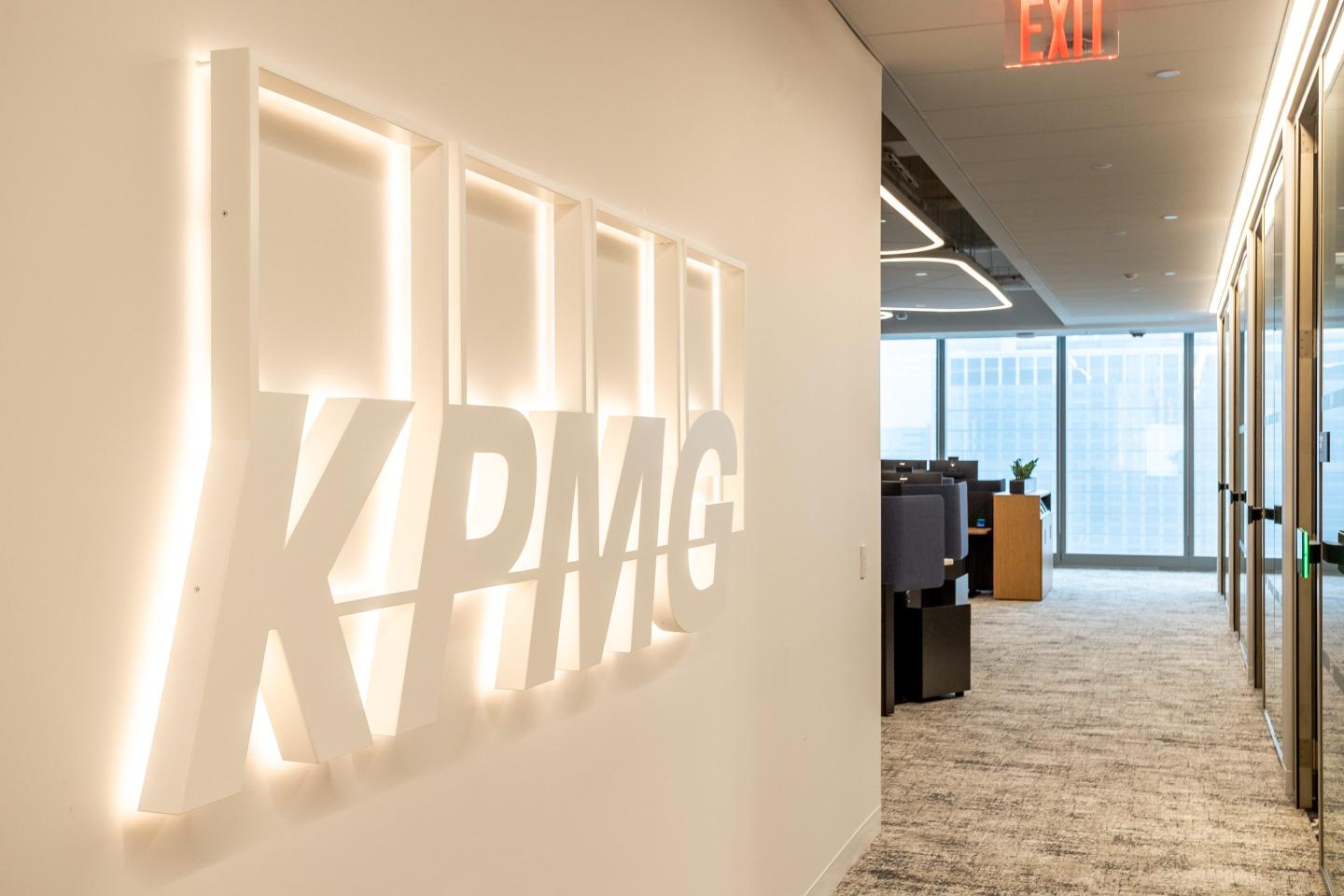
KPMG logo in new building.
KPMG’s gleaming new U.S. headquarters comprises 12 floors at Two Manhattan West.Courtesy of Emily Louick Photography and Entropy Film Works Inc.

When Timothy Walsh walked into KPMG for the first time 33 years ago, he was handed a stack of loan files and sent straight to a copy machine. The new intern spent his first week feeding paper into the copier at a New Jersey bank, the monotonous work that now seems worlds away from the gleaming glass headquarters he leads today.

Recommended Video

“It’s funny,” Walsh said in an interview with Fortune. “I stood at that copy machine all week making copies of loan files for audit evidence. When I look at what our people do today—and the kind of skills they bring—it’s completely transformed.”

That transformation is both personal and symbolic. Walsh, who took over as KPMG’s U.S. chair and CEO in July, began as an intern and climbed every rung of the firm’s hierarchy. His path from copy room to corner office has become part of how he talks about opportunity and staying power in an era when most new grads are expected to job-hop their way through a tight labor market. 

Yet even as Walsh champions the value of entry-level work and promises to keep hiring younger people—“I still think the internship is the most important part of what we do”—the definition of “junior” is shifting fast.

Inside KPMG’s consulting arm, new hires are being trained to manage teams of AI agents to help build decks or spreadsheets. The firm’s global AI workforce lead, Niale Cleobury, told Business Insider that KPMG wants “juniors to become managers of agents,” delegating grunt work like data analysis and research to automated assistants to free them up to become more involved in more advanced, strategic decisions. 

That modernization push extends beyond workflows to the workplace itself. Now he’s betting that the effort KPMG is putting into its new headquarters in Manhattan, complete with “war-mapping” strategy rooms, skyline lounges, and even what one executive called “MTV-style” confession rooms for clients to record reflections after big projects, will provide the next generation with that same sense of opportunity. 

KPMG has consolidated three legacy Manhattan offices—345 Park Avenue, 560 Lexington Avenue, and 1350 Avenue of the Americas—into one 450,000-square-foot space, a footprint reduction of approximately 40%. Walsh sees it as key to getting interns on a trajectory similar to his own. 

“I really do believe that someone can start here as an intern, like I did, and build a long-term career,” he said. “It’s still possible, maybe even more so now, because there are so many ways to grow inside one firm.”

Glossy new building

The gleaming new location comprises 12 floors at Two Manhattan West, the final skyscraper in Brookfield’s eight-acre development between Moynihan Train Hall and Hudson Yards. It arrives at a delicate moment for white-collar work. 

Five years after the pandemic scattered office life, corporate America is still in the process of negotiating its terms of return. 

“Hybrid creep” is quietly pushing people back—63% of U.S. workers are now fully in-office, according to Owl Labs data—even as surveys show that rigid mandates tank morale and drive attrition.

Walsh and his leadership team insist their version is voluntary, not punitive. 

“We already have minimums in place, and those are working really just fine,” he said. “I’m more worried about being oversold in this space than people not coming in.”

The firm expects most professionals to be in roughly three days a week, varying by business. Audit and advisory staff often spend long stretches at client sites, while partners and internal teams flow through on staggered schedules.

“People want to come in,” said Vanessa Scaglione, head of real estate services. “People want to be seen and heard and valued.” 

Scaglione led a Fortune reporter on a private tour of the office ahead of their doors opening Nov. 5. There, a group of KPMG staffers followed and sometimes interjected their own thoughts on the building, while workers fastened the last screws on light bulbs and organized plants strewn around the office. 

A smaller footprint, a bigger statement

The 12 floors are split into four New York–inspired “neighborhoods”—the Financial District, downtown Manhattan, Midtown, Upper Manhattan—connected by monumental staircases. There’s a barista bar called Common Ground with views of lower Manhattan; an employee lounge, The Manhattan, designed to feel “more like your living room than an office”; and an open terrace with skyline seating for impromptu meetings. A digital booking app replaces assigned seating, and early demand is so high it’s already “sold out,” Walsh said. 

The centerpiece is Ignition, the firm’s design-thinking lab that doubles as a client theater. There, executives simulate everything from AI rollouts to supply-chain shocks using wall-size, LED touch screens and movable furniture. Brian Miske, who heads Ignition nationally, called it a “thinking accelerator.”

“People get more done in one day here than they would in 30 days anywhere else,” he said. “It’s designed and engineered to maximize space for thinking as well as work.”

Miske, however, admitted that even for leaders like him, the office isn’t a five-day affair. 

“We travel, we’re with clients all the time,” he said. “Some weeks we’re here, some weeks we’re in Orlando or California: This isn’t meant to be full every day. It’s meant to be buzzy and busy when it matters.”

That sentiment captures KPMG’s bet: that offices no longer need to be constantly filled—only consistently valuable. 

“We designed to be hybrid,” Scaglione explained, as she pointed to a small room fitted with large cameras that transform in-person employees into large apparitions on their remote worker colleagues’ screens. 

The design of the building is embedded with that philosophy. Each “neighborhood” offers different work modes in a way that echoes, perhaps, a classic college library—quiet focus zones, collaborative “thrive hubs,” and transient rooms for short bursts of work. Lighting and sound adjust to occupancy, and video systems auto-frame speakers to make hybrid meetings feel equal. Even the materials were chosen through a neurodiversity lens to balance stimulus and calm; bright blue patterned wallpaper here, calmer tones there. 

The idea, Miske said, isn’t to re-create home but to offer what home can’t.

“That’s why I say people want to be in person,” he said. “Because once you’re able to build that road map … so you can feel seen and heard and valued, you’re able to go back to wherever your working place is, whether you’re in a virtual environment or hybrid environment, and really execute on those.”

Across corporate America, companies are using architecture to reverse the isolation of remote work. But the stakes are high. Surveys show that 99% of RTO mandates lower engagement, and nearly half increase attrition. KPMG’s approach, a gentle pull rather than a push, is testing whether space itself can restore culture.

Walsh calls the tower “a representation of everything we are at KPMG.” 

He knows not everyone will be there every day, and that’s fine. 

“The most important place for our people,” he said, “is with our clients.”

At the Fortune Workplace Innovation Summit, Fortune 500 leaders will convene to explore the defining questions shaping the workforce of the future—delivering bold ideas, powerful connections, and actionable insights for building resilient organizations for the decade ahead. Join Fortune May 19–20 in Atlanta. Register now.
About the Author
By Eva RoytburgFellow, News
Instagram iconLinkedIn icon

Eva covers macroeconomics, market-moving news, and the forces shaping the global economy.

See full bioRight Arrow Button Icon

Latest in Future of Work

Finance
Lorem ipsum dolor sit amet, consectetur adipiscing elit, sed do eiusmod tempor incididunt ut labore et dolore magna aliqua. Ut enim ad minim veniam
By Fortune Editors
October 20, 2025
Finance
Lorem ipsum dolor sit amet, consectetur adipiscing elit, sed do eiusmod tempor incididunt ut labore et dolore magna aliqua. Ut enim ad minim veniam
By Fortune Editors
October 20, 2025
Finance
Lorem ipsum dolor sit amet, consectetur adipiscing elit, sed do eiusmod tempor incididunt ut labore et dolore magna aliqua. Ut enim ad minim veniam
By Fortune Editors
October 20, 2025
Finance
Lorem ipsum dolor sit amet, consectetur adipiscing elit, sed do eiusmod tempor incididunt ut labore et dolore magna aliqua. Ut enim ad minim veniam
By Fortune Editors
October 20, 2025
Finance
Lorem ipsum dolor sit amet, consectetur adipiscing elit, sed do eiusmod tempor incididunt ut labore et dolore magna aliqua. Ut enim ad minim veniam
By Fortune Editors
October 20, 2025
Finance
Lorem ipsum dolor sit amet, consectetur adipiscing elit, sed do eiusmod tempor incididunt ut labore et dolore magna aliqua. Ut enim ad minim veniam
By Fortune Editors
October 20, 2025

Most Popular

Finance
Lorem ipsum dolor sit amet, consectetur adipiscing elit, sed do eiusmod tempor incididunt ut labore et dolore magna aliqua. Ut enim ad minim veniam
By Fortune Editors
October 20, 2025
Finance
Lorem ipsum dolor sit amet, consectetur adipiscing elit, sed do eiusmod tempor incididunt ut labore et dolore magna aliqua. Ut enim ad minim veniam
By Fortune Editors
October 20, 2025
Finance
Lorem ipsum dolor sit amet, consectetur adipiscing elit, sed do eiusmod tempor incididunt ut labore et dolore magna aliqua. Ut enim ad minim veniam
By Fortune Editors
October 20, 2025
Finance
Lorem ipsum dolor sit amet, consectetur adipiscing elit, sed do eiusmod tempor incididunt ut labore et dolore magna aliqua. Ut enim ad minim veniam
By Fortune Editors
October 20, 2025
Finance
Lorem ipsum dolor sit amet, consectetur adipiscing elit, sed do eiusmod tempor incididunt ut labore et dolore magna aliqua. Ut enim ad minim veniam
By Fortune Editors
October 20, 2025
Finance
Lorem ipsum dolor sit amet, consectetur adipiscing elit, sed do eiusmod tempor incididunt ut labore et dolore magna aliqua. Ut enim ad minim veniam
By Fortune Editors
October 20, 2025
Fortune Secondary Logo
Rankings
  • 100 Best Companies
  • Fortune 500
  • Global 500
  • Fortune 500 Europe
  • Most Powerful Women
  • World's Most Admired Companies
  • See All Rankings
  • Lists Calendar
Sections
  • Finance
  • Fortune Crypto
  • Features
  • Leadership
  • Health
  • Commentary
  • Success
  • Retail
  • Mpw
  • Tech
  • Lifestyle
  • CEO Initiative
  • Asia
  • Politics
  • Conferences
  • Europe
  • Newsletters
  • Personal Finance
  • Environment
  • Magazine
  • Education
Customer Support
  • Frequently Asked Questions
  • Customer Service Portal
  • Privacy Policy
  • Terms Of Use
  • Single Issues For Purchase
  • International Print
Commercial Services
  • Advertising
  • Fortune Brand Studio
  • Fortune Analytics
  • Fortune Conferences
  • Business Development
  • Group Subscriptions
About Us
  • About Us
  • Press Center
  • Work At Fortune
  • Terms And Conditions
  • Site Map
  • About Us
  • Press Center
  • Work At Fortune
  • Terms And Conditions
  • Site Map
  • Facebook icon
  • Twitter icon
  • LinkedIn icon
  • Instagram icon
  • Pinterest icon

Latest in Future of Work

hoskins
Commentaryoffices
Gensler Co-Chair: Hot-desking was supposed to save money. It may be costing you your culture
By Diane HoskinsApril 30, 2026
4 hours ago
Lloyd Blankfein, former chief executive officer of Goldman Sachs
SuccessCareers
Former Goldman Sachs CEO: Ivy League geniuses aren’t always the most successful—This overlooked skill is key
By Emma BurleighApril 29, 2026
22 hours ago
Jamie Dimon
SuccessProductivity
JPMorgan CEO Jamie Dimon warns a ‘great’ meeting is usually a bad one—here’s how he ends them instead
By Preston ForeApril 29, 2026
22 hours ago
hollywood
CommentaryMarketing
I spent 20 years learning to navigate an industry. Then I built a campaign for the man who’s dismantling it
By Matti YahavApril 29, 2026
1 day ago
gen z
Commentarydisruption
AI won’t kill your job — it will kill the path to your first one
By Jeffrey Sonnenfeld, Stephen Henriques, Johan Griesel, Andrew Alam-Nist and Peter YuApril 29, 2026
1 day ago
Bruce Broussard, HP CEO
AIProductivity
AI is changing who gets to be an expert. Are your colleagues ready to become ‘directors of intelligence’?
By Bruce BroussardApril 29, 2026
1 day ago

Most Popular

Apple cofounder Ronald Wayne—whose stake would be worth up to $400 billion had he not sold it in 1976—says that at 91, he has no regrets
Success
Apple cofounder Ronald Wayne—whose stake would be worth up to $400 billion had he not sold it in 1976—says that at 91, he has no regrets
By Preston ForeApril 27, 2026
3 days ago
Jamie Dimon gets candid about national debt: ‘There will be a bond crisis, and then we’ll have to deal with it’
Economy
Jamie Dimon gets candid about national debt: ‘There will be a bond crisis, and then we’ll have to deal with it’
By Eleanor PringleApril 29, 2026
1 day ago
‘They left me no choice’: Powell isn’t going anywhere—blocking Trump from another Fed appointee
Banking
‘They left me no choice’: Powell isn’t going anywhere—blocking Trump from another Fed appointee
By Eva RoytburgApril 29, 2026
19 hours ago
‘The cost of compute is far beyond the costs of the employees’: Nvidia executive says right now AI is more expensive than paying human workers
AI
‘The cost of compute is far beyond the costs of the employees’: Nvidia executive says right now AI is more expensive than paying human workers
By Sasha RogelbergApril 28, 2026
2 days ago
‘Take the money and run’: Johns Hopkins economist Steve Hanke on why the UAE quit OPEC
Energy
‘Take the money and run’: Johns Hopkins economist Steve Hanke on why the UAE quit OPEC
By Shawn TullyApril 29, 2026
1 day ago
More than two-thirds of U.S. schools say they’re unable to afford the cost of student free lunch—and MAHA’s dietary guidelines may make it worse
Economy
More than two-thirds of U.S. schools say they’re unable to afford the cost of student free lunch—and MAHA’s dietary guidelines may make it worse
By Sasha RogelbergApril 29, 2026
1 day ago

© 2026 Fortune Media IP Limited. All Rights Reserved. Use of this site constitutes acceptance of our Terms of Use and Privacy Policy | CA Notice at Collection and Privacy Notice | Do Not Sell/Share My Personal Information
FORTUNE is a trademark of Fortune Media IP Limited, registered in the U.S. and other countries. FORTUNE may receive compensation for some links to products and services on this website. Offers may be subject to change without notice.