For Amazon delivery drivers, new glasses promise something more than just clearer vision or the blocked sun glare.
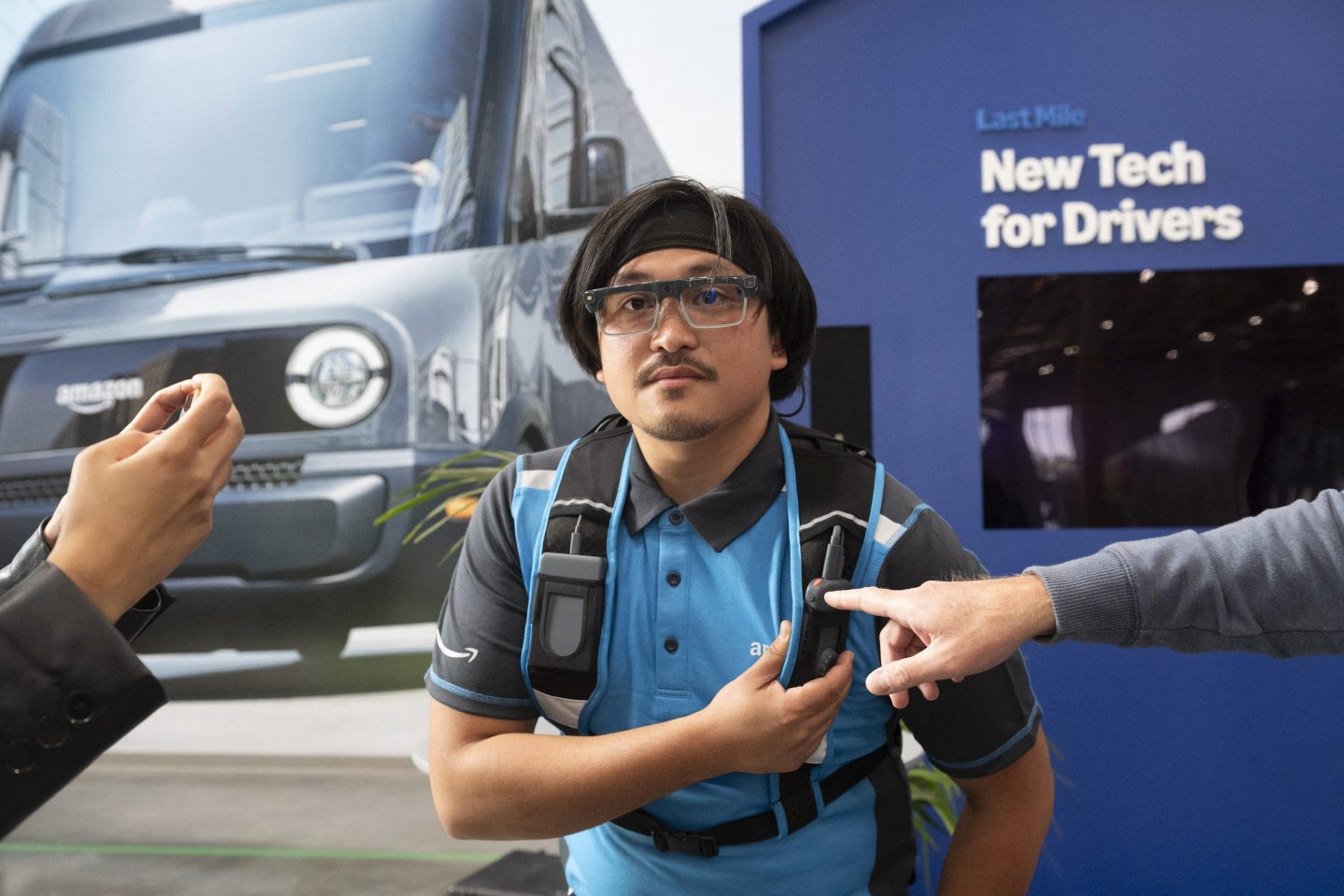
Amazon is developing AI-powered smart glasses for its delivery drivers, the company said in a Wednesday blog post. The glasses will allow drivers to scan packages, following detailed walking directions, and document proof-of-delivery without their phones. Using cameras, as well as AI-powered sensing abilities, the technology will create an augmented reality display for drivers that includes information like hazards, as well as maps that direct drivers to particular building unit numbers.
The glasses will automatically activate once a driver parks at a delivery location and can support prescription and transition lenses within its design. Eliminating needing to use a phone, as was the provision of convenience instructions, is aimed to increase the safety and efficiency of the delivery process, the company said.
Future iterations of the glasses aim to give drivers “real-time defect detection” if they drop off a package at a wrong address. The device will also be able to adjust to low-light conditions and detect pets in customers’ yards.
Expedited delivery has remained a hallmark of Amazon’s business as it competes with the growing e-commerce capabilities of Walmart and other retail giants. Amazon announced in June a $4 billion investment in tripling its delivery network size, particularly in rural areas, by 2026. One Amazon delivery driver made on average 65,700 deliveries in 2024, translating to 100,375 packages annually, according to data compiled by CapitalOne Shopping. That’s about 27 deliveries per hour.

Reuters reported the product’s development last November. Anonymous sources told the outlet that while the glasses could increase driver productivity by freeing up hand space for workers to carry more packages, the company may have trouble developing a battery able to last an entire shift, which can be up to 10 hours. Drivers may also not want to wear the devices, which may be uncomfortable or distracting, the sources said.
Amazon did not respond to Fortune’s request for comment on concerns about the battery duration or comfortability of the glasses.
Amazon’s automation push
In addition to AI-powered glasses for drivers, Amazon is also developing operational technologies for warehouse workers, the company announced Wednesday. Blue Jay, a robotics system using multiple arms to lift and sort packages, aims to mitigate the need for employees to lift heavy items. Project Eluna is an agentic AI model that will monitor numerous dashboards and make decisions, such as about reducing sorting bottlenecks, with the goal to lessen the “cognitive load” of workers. The AI agent will be piloted at a Tennessee fulfillment center during the holiday season.
The company’s automation push has brought with it concern about the future of human employment. Some AI experts have said automation processes will surely displace human workers, with University of Louisville professor of computer science Roman Yampolskiy saying AI could spike unemployment levels up to 99% in the next five years—a more eye-popping figure than even Anthropic CEO Dario Amodei’s projection of the technology replacing 50% of entry-level white-collar jobs in the same period.
“Before we always said, ‘This job is going to be automated, retrain to do this other job,’” Yampolskiy said in an episode of The Diary of a CEO podcast last month. “But if I’m telling you that all jobs will be automated, then there is no plan B. You cannot retrain.”
A New York Times investigation published on Tuesday reported, citing internal documents, Amazon plans to automate 75% of its operations. That translates to roughly 600,000 jobs for which the company would not need to hire in the future.
Amazon spokesperson Kelly Nantel said the investigation did not accurately reflect the company’s hiring strategy, and that the company recently announced plans to fill 250,000 positions ahead of the end-of-year holiday push.
“Leaked documents often paint an incomplete and misleading picture of our plans, and that’s the case here,” Nantel told Fortune in a statement. “In this instance, the materials appear to reflect the perspective of just one team and don’t represent our overall hiring strategy across our various operations business lines—now or moving forward.”
Amazon executives have made an effort to assuage anxieties about the future of employment. Amazon Robotics’ chief technologist Tye Brady told Fortune in May the company’s automation advancements are meant to enhance, not replace, the jobs of humans. The interview at Fortune’s Brainstorm AI conference in London took place after Amazon announced the launch of Vulcan, a robot arm with a sense of touch.
“I will be unabashedly proud that we aim to eliminate, I mean eliminate, every menial, mundane, and repetitive job out there,” Brady said. “And if it’s repetitive, we want to automate that, because we will never run out of things to do for our employees. We want them to focus on higher-level tasks.”
“People are amazing at using common sense, reasoning, and understanding complex problems,” he continued. “Why would you not use that?”