It’s a site you may not expect in one of the world’s most expensive cities. But on the outskirts of Geneva, known for its discreet wealth, high wages and multimillion-dollar homes, the Fortune 500 Europe fragrance producer dsm-firmenich has its biggest perfumery plant in the world, and conducts a huge part of its manufacturing and R&D. (dsm-firmenich’s headquarters are in Kaiseraugst, in Northern Switzerland.)
In one wing of the sprawling site, a few dozen so-called “Master Perfumers” mix vials to create the next Acqua di Gio or CK One luxury perfume, or a new detergent for a client aiming to reach new customers in Singapore, the U.S., or the Middle East. There are thousands of vials, many of them containing copyrighted scents. A friendly robot fetches them for the perfumers, saving time.
A little further out, there’s a much more conventional factory site, where giant industrial mixers mass-produce dsm-firmenich’s scents. A few workers overlook the process. Others pick the fluids up in trucks and send them across Europe and the world.
In another, central building, the factory workers, master perfumers, and office workers all mingle over lunch. In a way, it feels like a throwback to the 1960s, the high tide of Europe’s postwar industrialization boom, before the mass outsourcing of industrial activity from the West to low-cost economies like China.
304
DSM-Firmenich’s rank on Fortune 500 Europe
How does a century-old industrial company such as dsm-firmenich (the current company came into existence in 2023, following a merger of Swiss company firmenich, founded in 1895, with Dutch chemical firm DSM, founded in 1902) manage to remain globally competitive today, given that a large share of its cost base is in the most expensive country in the world? And does the approach of dsm-firmenich and other Swiss companies like it hold any lessons for the rest of corporate Europe as it tries to regain its footing in world markets?
Talent in depth
There are good reasons for wanting to learn from Switzerland’s experience. Its economy today is one that defies gravity. Despite having a safe haven currency that stands at record highs against the dollar and euro, and despite seeing the erosion of some of its historical competitive advantages, such as its bank secrecy and tariff-free access to global markets, it has so far retained its status as one of the most productive, diverse, and innovative economies in the world.
A case in point: with 12 companies on the Fortune Global 500, and 36 on the Fortune 500 Europe 2024, Switzerland has the highest per capita density of such companies in the world. And like dsm-firmerich, many of them continue to make things in their home country.
Over the past few months, I tried to understand what the secret to Switzerland’s modern industrial success is. I visited Hitachi Energy’s high-voltage switchgear manufacturing plant in a gentrified, yet still industrial, neighborhood in the city of Zurich. I talked to the Ouboter family of textile producers-turned-inventors, who created the modern kick scooter and sold 70 million units of their “Micro” globally, and to the CEO of On, the Roger Federer-backed running shoe company, which became a global phenomenon in less than a decade, with over $3 billion in sales. I spent time around Lausanne, where the university EPFL created a scale-up incubator. And I visited DSM-Firmenich’s site in Geneva.
If there is one magic ingredient for Switzerland’s enduring economic success, I found, it is that its businesses often combine blue-collar know-how with white-collar innovation. Switzerland, like Germany, built its 20th-century industrial economy on training and valuing all types of workers—those that work with their hands and those that work at a desk. But unlike in most places, this system endures to the present day.
At dsm-firmenich, for example, as its CEO Dimitri de Vreeze explained, the company turned the complexity enabled by its talent base into an effective barrier to entry.
Three elements make up this complexity: an “ingredient toolbox” with 1,800 copyrighted scents, created by its perfumers over decades; a “creation center” where a few dozen master perfumers, who are apprenticed internally over many years, work with customers on consumer needs; and an AI and regulatory intelligence office, essential for new ingredient creation and approval.
“It’s a complex system with thousands of ingredients, customized briefs daily, and deep expertise. But it also means that if a competitor wanted to copy us, buying our talent alone wouldn’t be enough; they’d need the ingredient base and processes, which takes decades to build,” he said.
Reinvesting in the ecosystem
This competitive edge—including its blue and white-collar contributions—is also only possible because of the complete ecosystem that Geneva offers for this industry.
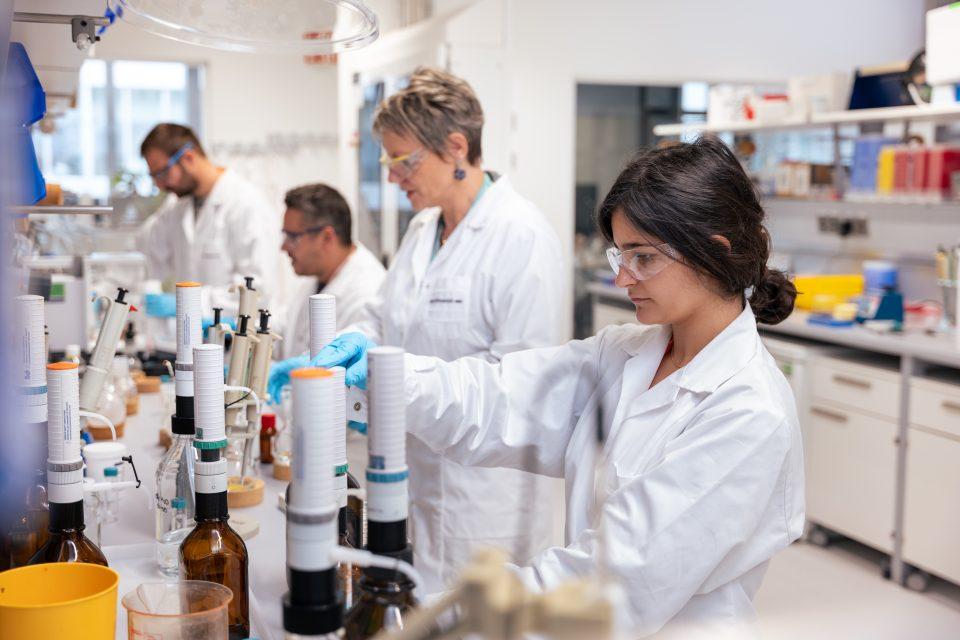
At its headquarters, PhDs and technical university graduates work alongside factory workers to create dsm-firmenich’s magic potions. Elsewhere on Lake Geneva are competitors such as Givaudan, (potential) clients such as P&G and Nestle, and technical schools such as EPFL, or the world-famous hospitality business school École hôtelière de Lausanne.
Dimitri de Vreeze is far from the only Fortune 500 company that benefits from Switzerland’s unique industrial-academic nexus. In Basel, pharma giants Roche and Novartis, and chemical companies such as Syngenta, benefit from and contribute to a similar setup, with local universities and “Fachhochschule” (trade schools) providing the scientific and skilled labor underpinning the multinationals, and its unique location by the Rhine providing natural capital services, such as maritime transport, links with Germany and France, and industrial access to water.
“It’s a complex system with thousands of ingredients, customized briefs daily, and deep expertise.”
Dimitri de Vreeze, CEO of dsm-firmenich
Zurich has even been called the Swiss Silicon Valley, as it is home to ETH, Europe’s leading technical university, industrial behemoths such as ABB and Hitachi Energy, European R&D outposts from U.S. Big Tech companies such as Alphabet, Microsoft, and IBM, and trendy consumer good innovators such as On Running and mini electric car maker Microlino, a spinoff of Ouboter’s Micro Mobility Systems.
In all of these places, the broad availability of talent—whether as founders, knowledge workers, or highly skilled blue-collar workers—is viewed as one core element of the corporate ecosystem’s success. The permeable ties between universities and business are another.
“The Swiss ecosystem is incredibly important,” Martin Hoffmann, the CEO of On, told me as he recounted the company’s founding. The company’s original “cloud” technology, for example, was developed by an ETH Zurich researcher, and then bought by the startup company.
To this day, Hoffman said, “All our products are engineered in Switzerland, and we work a lot with universities, especially on sustainability and material science.”
It’s a common story here, across sectors. In Geneva, for example, a nuclear invention from CERN researchers in the early 2000s led to the founding of a novel cancer treatment, and ultimately, to its $4 billion acquisition by Novartis.
Sharing success
When scientific research doesn’t play a direct role in the founding of startups, another linkage in the Swiss economy does: the tie-up between industries, and between industry and finance.
As Wim Ouboter recalled, when he created Micro Mobility Systems—now the world leader in kick scooters—25 years ago in Zurich, two elements helped him a great deal: a letter of intent from Swatch’s Smart car joint venture, committing to buy the first batch of kick scooters, and the access to capital from Swiss banks, which themselves accrued the capital from having developed international wealth management expertise.
“All our products are engineered in Switzerland, and we work a lot with universities, especially on sustainability and material science.”
Martin Hoffmann, CEO of On
In other words, the country’s existing industrial and financial ecosystem often helps nascent industries, benefiting both.
The result of skilled labor, universities, banks and existing industry bonding together becomes clear in many ways, including, of course, a top layer of entrepreneurs and capitalists owning and deploying billions of Swiss Francs.
But two indicators in particular demonstrate just how widely shared the Alpine economy’s success is: Swiss unemployment stands at a mere 2.8%, meaning the country is near full employment. And, its median salary of approximately over $90,000 per year, is about 50% higher than in the U.S. despite having a similar GDP per capita.
What is the lesson of Swiss Fortune 500 companies for the rest of Europe, and the world?
It would be going too far to say that Switzerland’s model of shared success could be applied to any company or economy, or indeed that all Swiss multinationals choose to produce their wares domestically.
Some, including On, Micro, and PC accessory maker Logitech, now manufacture virtually all of their products in Asia, because of the lower costs and expertise in mass manufacturing there.
Many of those that still produce a large share of their products in cities and towns such as Geneva, Vevey, and Zurich—like Nestlé’s Nespresso coffee arm, dsm-firmenich, and heavy industrial equipment makers like ABB and Hitachi Energy—are unusual in being able to do so competitively.
In some cases, for example, that’s because niche know-how sometimes matters more than cost, while in other cases, it’s because the cost of certain Swiss-made products fades in comparison to the total cost of projects they are part of.
There are, nonetheless, lessons that could apply to businesses and policymakers anywhere. Value each part of a corporate ecosystem, from the factory worker to the competitor next door. Be altruistic and self-interested at the same time: if you have success, invest your proceeds in nascent and innovative companies.
And don’t try to save pennies in manufacturing or other built-up know-how by outsourcing, if it could lose you pounds (or billions of Swiss Francs) down the line.
This article has been edited to reflect the correct spelling of the company name dsm-firmenich, to clarify that Firmenich as a standalone company no longer exists as such, and that the company’s headquarters are in Kaiseraugst, Switzerland.
This article appears in the December 2025/January 2026: Europe issue of Fortune with the headline “Switzerland’s winning formula.”