• Home
  • Latest
  • Fortune 500
  • Finance
  • Tech
  • Leadership
  • Lifestyle
  • Rankings
  • Multimedia
Big Tech

People destroyed the ‘friend.com’ AI necklace ads with graffiti. The 22-year-old founder loves it: ‘Capitalism is the greatest artistic medium.’

By
Eva Roytburg
Eva Roytburg
Fellow, News
Down Arrow Button Icon
By
Eva Roytburg
Eva Roytburg
Fellow, News
Down Arrow Button Icon
October 1, 2025, 2:16 PM ET
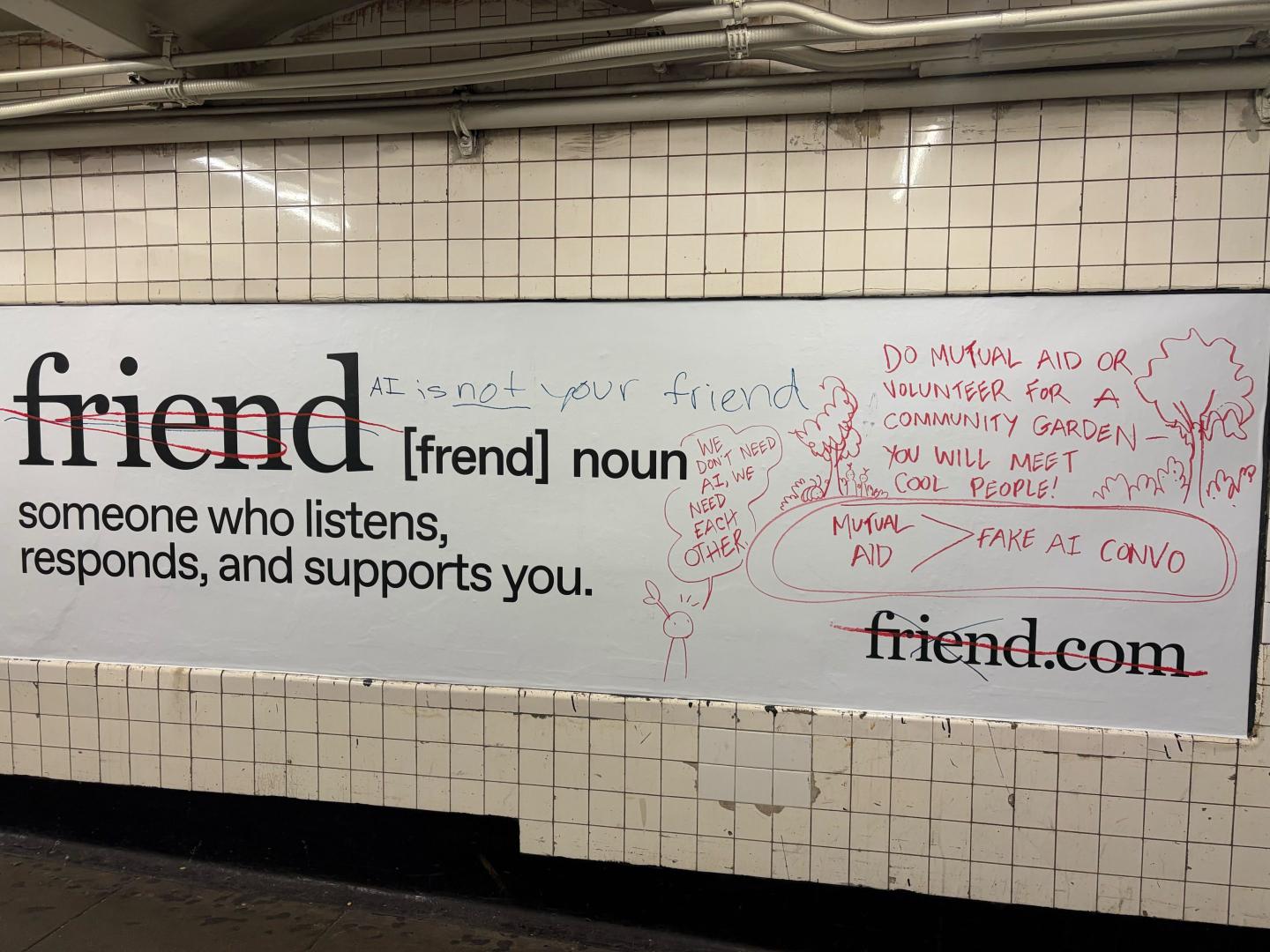
A photo of a poster for friend.com defaced with graffiti.
Friend.com posters have blanketed New York’s subways—and become canvases for graffiti.Courtesy of Avi Schiffmann

If you take the subway in New York City, or drive a car in Los Angeles, you’ve seen the ads for Friend.com.

Recommended Video

“I’ll binge the entire series with you.”
“I’ll never leave dirty dishes in the sink.”
“I’ll never bail on dinner plans.”

The slogans are simple, intimate, needy, and impossible to avoid. Friend.com is the biggest campaign in the New York City subway this year, according to Outfront, an MTA billboard marketing agency. 

The AI wearable has 11,000 “always on” advertisements in the MTA, some covering a whole train station. Avi Schiffmann, the 22-year-old creator of Friend, told Fortune that the ad campaign cost him $1 million—an enormous outlay for a startup with barely $7 million in venture capital.

The product itself is simple: a microphone, a Bluetooth chip, and an always-listening mode that pings Google’s Gemini AI to generate responses and store “memories” in a visual graph. The pendant is manufactured in Toronto and marketed as “your closest confidant.” About 3,000 units have been sold, with 1,000 shipped so far, generating roughly $348,000 in revenue—much of which, Schiffmann said, was spent on manufacturing and marketing. “I don’t have that much money left,” he admitted.

But Schiffmann doesn’t care about the skeptics, or even about profitability. “Profitability is ideal,” he says, “but right now it costs me an unfathomable amount of money if you actually use the product.” 

Schiffmann said he sees Friend as “an expression of my early twenties”—down to the materials. He obsessed over the fidget-friendly circular shape, pushed his industrial designers to copy the paper stock of one of his favorite CDs for the user manual, and insisted the packaging be printed only in English and French—because he’s French.

“You can ask about any aspect of it, and I can tell you a specific detail,” he said. “It’s just what I like and what I don’t like … an amalgamation of my tastes at this point in time.”

Victoria Mottesheard, a vice president of marketing at Outfront, the billboard marketing agency Schiffmann worked with for the advertisements, told Fortune the campaign was “taking over” the Gotham underworld, as well as over 500 bus shelters in Los Angeles.

“Everyone’s talking about it,” Mottesheard said.

And they are—but not necessarily in a positive light. Within days, the posters became a magnet for graffiti. Some doodles were harmless, but plenty look like protest art: “AI doesn’t care if you live or die.” “Surveillance capitalism.” “AI will promote suicide if prompted.” Posts about the ads, and the graffiti, are everywhere on social media.

Most founders would cringe at that kind of backlash, but Schiffmann called it “artistically validating.” The white space in the ads was intentional, he claimed—the vandalism was part of the plan. “The audience completes the work,” he said, beaming. “Capitalism is the greatest artistic medium.”

To Schiffmann, the vandalized billboards aren’t defacement: They’re proof that his subway takeover is working exactly as intended. The goal, he says, isn’t just to sell a $129 AI pendant. It’s to provoke a cultural debate about what counts as friendship in the age of artificial intelligence.

The fine print

First, though, comes the fine print. The AI version of a friend comes with more than just packaging and a charger—it has paperwork. Friend’s terms require waiving the right to jury trials, class actions, and court proceedings, funneling disputes into arbitration in San Francisco. Buried within are clauses on “biometric data consent,” which grant the company permission to passively record audio and video, collect facial and voice data, and use these to train AI.

Schiffmann’s answer to the legal fine print is that Friend is a weird, first-of-its-kind product, so the terms of service are intentionally heavy. He added that the terms are “a bit extreme” by design—“so I don’t have to keep editing it”—and that with a three-person team and pricey lawyers he’s avoiding extra legal exposure. (He said he’s not selling in Europe to duck the regulatory headache.)

He expects a fight eventually: “I think one day we’ll probably be sued, and we’ll figure it out. It’ll be really cool to see.”

He frames the “always listening” bits as speaker attribution, not surveillance.

“Technically, it’s not recording stuff—it’s really for an AI, not for a human,” he said. The pendant has a mic and, he claims, only listens when you feel the haptics; if the phone disconnects, “it’s not recording,” and they aren’t caching audio for later upload. He also said they’re not training models on user data right now: “Google’s not doing that for the API, and we’re not doing that … We’re saying it [in the terms of service] so we’re covered, but we’re not doing it yet.”

On storage and access, he leans hard on the device as the gate. He described Friend as “a living YubiKey,” with the encryption key baked into the pendant itself; without it, “your data is completely inaccessible.”

Hence his blunt line: “If I smash your Friend with a hammer, your data is gone forever.” (He even told me a journalist’s husband actually smashed her pendant—which, by his design, nuked the memories.)

That swagger is part of the appeal for investors. Friend has raised money from Pace Capital, Caffeinated Capital, and Solana founders Anatoly Yakovenko and Raj Gokal, among others. The business model is still in flux—Schiffmann has floated accessories, AppleCare-style insurance, maybe subscriptions—but for now it’s all about attention. 

“I purchased the zeitgeist,” he said of the subway buy. He compares his subway tunnel campaign to an “international destination” for AI culture, insisting the graffiti proves he’s succeeded.

Critics see something different. Suresh Venkatasubramanian, director of the Center for Technological Responsibility, Reimagination, and Redesign at Brown University, said that Friend is clearly an example of a frothy AI company, but that it also bore a “pernicious” resemblance to a mostly forgotten early-20th-century fad: “radium necklaces.”

When Marie Curie’s new glowing discovery first hit the market, jewelers embedded radium in pendants and bracelets and sold them as chic wellness accessories—until decades later, people started dying of cancer.

“I look at Friend and I think, ‘Are we making the same mistake?’” Venkatasubramanian told Fortune. “We’re rushing these intimacy machines into people’s lives with no evidence they’re safe, or even helpful.”

The critique echoes larger skepticism in Silicon Valley, where hardware plays like Humane’s AI Pin and Rabbit’s R1 have already flopped. 

Avi Schiffmann, wunderkind

​​Schiffmann, since he was a teenager, has always had a knack for drawing spectacle. At just 17, he made the COVID-19 tracking website that tens of millions used each day, winning a Webby Award handed to him by Anthony Fauci. He dropped out of Harvard after one semester to build a refugee-housing site in response to the Ukraine war, claiming to connect 100,000 Ukrainians with homes. He’s spun up similar projects for earthquake victims in Turkey and for Black Lives Matter protests. Those quick, high-profile moves have given him a kind of bulletproof confidence. 

“You can just do things,” he told Fortune last year. “I don’t think I’m any smarter than anyone else, I just don’t have as much fear.”

Schiffmann claims the median user sends 238 messages a day to their pendant—more messages than you’d send to someone you’re dating, he noted. He frames this not as a productivity tool but as the dawn of “post-AGI companies,” building emotional products instead of utilitarian ones.

“My plans are measured in centuries,” he said with a smirk.

For now, though, Friend’s reality is glitchier. When a Fortune reporter tried it, it had lag, forgetfulness, random disconnections. Wired mocked its “annoying personality,” which was modeled after Schiffmann, and he conceded he “lobotomized” the AI after complaints.

“Not everyone wants to be my friend,” he said.

“You’re not going to change the world that much if you make it slightly easier to order a pizza,” he said. “The future is digital relationships.”

In 2001, Fortune first convened “The Smartest People We Know,” bringing together CEOs and founders, builders and investors, thinkers and doers. Since then, Fortune Brainstorm Tech has been the place where bold ideas collide. From June 8–10, we will return to Aspen—where it all began—to mark 25 years of Brainstorm. Register now.
About the Author
By Eva RoytburgFellow, News
Instagram iconLinkedIn icon

Eva covers macroeconomics, market-moving news, and the forces shaping the global economy.

See full bioRight Arrow Button Icon

Latest in Big Tech

Finance
Lorem ipsum dolor sit amet, consectetur adipiscing elit, sed do eiusmod tempor incididunt ut labore et dolore magna aliqua. Ut enim ad minim veniam
By Fortune Editors
October 20, 2025
Finance
Lorem ipsum dolor sit amet, consectetur adipiscing elit, sed do eiusmod tempor incididunt ut labore et dolore magna aliqua. Ut enim ad minim veniam
By Fortune Editors
October 20, 2025
Finance
Lorem ipsum dolor sit amet, consectetur adipiscing elit, sed do eiusmod tempor incididunt ut labore et dolore magna aliqua. Ut enim ad minim veniam
By Fortune Editors
October 20, 2025
Finance
Lorem ipsum dolor sit amet, consectetur adipiscing elit, sed do eiusmod tempor incididunt ut labore et dolore magna aliqua. Ut enim ad minim veniam
By Fortune Editors
October 20, 2025
Finance
Lorem ipsum dolor sit amet, consectetur adipiscing elit, sed do eiusmod tempor incididunt ut labore et dolore magna aliqua. Ut enim ad minim veniam
By Fortune Editors
October 20, 2025
Finance
Lorem ipsum dolor sit amet, consectetur adipiscing elit, sed do eiusmod tempor incididunt ut labore et dolore magna aliqua. Ut enim ad minim veniam
By Fortune Editors
October 20, 2025

Most Popular

Finance
Lorem ipsum dolor sit amet, consectetur adipiscing elit, sed do eiusmod tempor incididunt ut labore et dolore magna aliqua. Ut enim ad minim veniam
By Fortune Editors
October 20, 2025
Finance
Lorem ipsum dolor sit amet, consectetur adipiscing elit, sed do eiusmod tempor incididunt ut labore et dolore magna aliqua. Ut enim ad minim veniam
By Fortune Editors
October 20, 2025
Finance
Lorem ipsum dolor sit amet, consectetur adipiscing elit, sed do eiusmod tempor incididunt ut labore et dolore magna aliqua. Ut enim ad minim veniam
By Fortune Editors
October 20, 2025
Finance
Lorem ipsum dolor sit amet, consectetur adipiscing elit, sed do eiusmod tempor incididunt ut labore et dolore magna aliqua. Ut enim ad minim veniam
By Fortune Editors
October 20, 2025
Finance
Lorem ipsum dolor sit amet, consectetur adipiscing elit, sed do eiusmod tempor incididunt ut labore et dolore magna aliqua. Ut enim ad minim veniam
By Fortune Editors
October 20, 2025
Finance
Lorem ipsum dolor sit amet, consectetur adipiscing elit, sed do eiusmod tempor incididunt ut labore et dolore magna aliqua. Ut enim ad minim veniam
By Fortune Editors
October 20, 2025
Fortune Secondary Logo
Rankings
  • 100 Best Companies
  • Fortune 500
  • Global 500
  • Fortune 500 Europe
  • Most Powerful Women
  • World's Most Admired Companies
  • See All Rankings
  • Lists Calendar
Sections
  • Finance
  • Fortune Crypto
  • Features
  • Leadership
  • Health
  • Commentary
  • Success
  • Retail
  • Mpw
  • Tech
  • Lifestyle
  • CEO Initiative
  • Asia
  • Politics
  • Conferences
  • Europe
  • Newsletters
  • Personal Finance
  • Environment
  • Magazine
  • Education
Customer Support
  • Frequently Asked Questions
  • Customer Service Portal
  • Privacy Policy
  • Terms Of Use
  • Single Issues For Purchase
  • International Print
Commercial Services
  • Advertising
  • Fortune Brand Studio
  • Fortune Analytics
  • Fortune Conferences
  • Business Development
  • Group Subscriptions
About Us
  • About Us
  • Press Center
  • Work At Fortune
  • Terms And Conditions
  • Site Map
  • About Us
  • Press Center
  • Work At Fortune
  • Terms And Conditions
  • Site Map
  • Facebook icon
  • Twitter icon
  • LinkedIn icon
  • Instagram icon
  • Pinterest icon

Latest in Big Tech

google
InvestingMarkets
Google shares hit all-time high on blowout earnings, market cap doubles to $4.4 trillion in just a year
By Michael Liedtke and The Associated PressApril 30, 2026
33 minutes ago
AWS
Big TechMarkets
Amazon’s cloud sales are growing the most in 15 quarters. Investors sent the stock down on AI capex fears
By Anne D'Innocenzio and The Associated PressApril 30, 2026
41 minutes ago
Google Cloud CEO Thomas Kurian at Fortune Brainstorm AI 2025 in San Francisco. (Photo: Stuart Isett/Fortune)
NewslettersFortune Tech
Google Cloud is almost one-fifth of Alphabet’s business
By Andrew NuscaApril 30, 2026
4 hours ago
Photo: Donald Trump
Big TechMarkets
With no end in sight, Trump considers new options in Iran war—including the ‘Dark Eagle’ hypersonic missile
By Jim EdwardsApril 30, 2026
5 hours ago
Google Cloud revenue is now 18% of Alphabet’s business. Is this the beginning of the end of Google’s search identity?
Big TechGoogle
Google Cloud revenue is now 18% of Alphabet’s business. Is this the beginning of the end of Google’s search identity?
By Alexei OreskovicApril 29, 2026
13 hours ago
Man wearing a suit and tie and glasses
Big TechTech
Microsoft, Meta, and Google just announced billions more in AI spending. Only Google convinced investors it’s paying off
By Amanda GerutApril 29, 2026
14 hours ago

Most Popular

Apple cofounder Ronald Wayne—whose stake would be worth up to $400 billion had he not sold it in 1976—says that at 91, he has no regrets
Success
Apple cofounder Ronald Wayne—whose stake would be worth up to $400 billion had he not sold it in 1976—says that at 91, he has no regrets
By Preston ForeApril 27, 2026
3 days ago
Jamie Dimon gets candid about national debt: ‘There will be a bond crisis, and then we’ll have to deal with it’
Economy
Jamie Dimon gets candid about national debt: ‘There will be a bond crisis, and then we’ll have to deal with it’
By Eleanor PringleApril 29, 2026
1 day ago
‘They left me no choice’: Powell isn’t going anywhere—blocking Trump from another Fed appointee
Banking
‘They left me no choice’: Powell isn’t going anywhere—blocking Trump from another Fed appointee
By Eva RoytburgApril 29, 2026
20 hours ago
‘The cost of compute is far beyond the costs of the employees’: Nvidia executive says right now AI is more expensive than paying human workers
AI
‘The cost of compute is far beyond the costs of the employees’: Nvidia executive says right now AI is more expensive than paying human workers
By Sasha RogelbergApril 28, 2026
2 days ago
‘Take the money and run’: Johns Hopkins economist Steve Hanke on why the UAE quit OPEC
Energy
‘Take the money and run’: Johns Hopkins economist Steve Hanke on why the UAE quit OPEC
By Shawn TullyApril 29, 2026
1 day ago
Google Cloud revenue is now 18% of Alphabet's business. Is this the beginning of the end of Google's search identity?
Big Tech
Google Cloud revenue is now 18% of Alphabet's business. Is this the beginning of the end of Google's search identity?
By Alexei OreskovicApril 29, 2026
13 hours ago

© 2026 Fortune Media IP Limited. All Rights Reserved. Use of this site constitutes acceptance of our Terms of Use and Privacy Policy | CA Notice at Collection and Privacy Notice | Do Not Sell/Share My Personal Information
FORTUNE is a trademark of Fortune Media IP Limited, registered in the U.S. and other countries. FORTUNE may receive compensation for some links to products and services on this website. Offers may be subject to change without notice.