• Home
  • Latest
  • Fortune 500
  • Finance
  • Tech
  • Leadership
  • Lifestyle
  • Rankings
  • Multimedia

Trendingnow

1

The millennial generation is split in 2: an older crowd with boomer-style comfort, a younger set going 'back to the early 1900s'

2

Trump pulls back after Iran crosses his red line as U.S. military breaks two-week streak of airstrikes amid talks for potential Hormuz deal

3

'The demographic dividend of the last 40 years is ending': J.P. Morgan says the world is running out of the two things that kept interest rates down

1

The millennial generation is split in 2: an older crowd with boomer-style comfort, a younger set going 'back to the early 1900s'

2

Trump pulls back after Iran crosses his red line as U.S. military breaks two-week streak of airstrikes amid talks for potential Hormuz deal

3

'The demographic dividend of the last 40 years is ending': J.P. Morgan says the world is running out of the two things that kept interest rates down
Commentary

The AI bull case for the republic

By
Tanner H. Jones
Tanner H. Jones
and
Patrick A. McLaughlin
Down Arrow Button Icon
By
Tanner H. Jones
Tanner H. Jones
and
Patrick A. McLaughlin
Down Arrow Button Icon
September 16, 2025, 8:00 AM ET
Congress
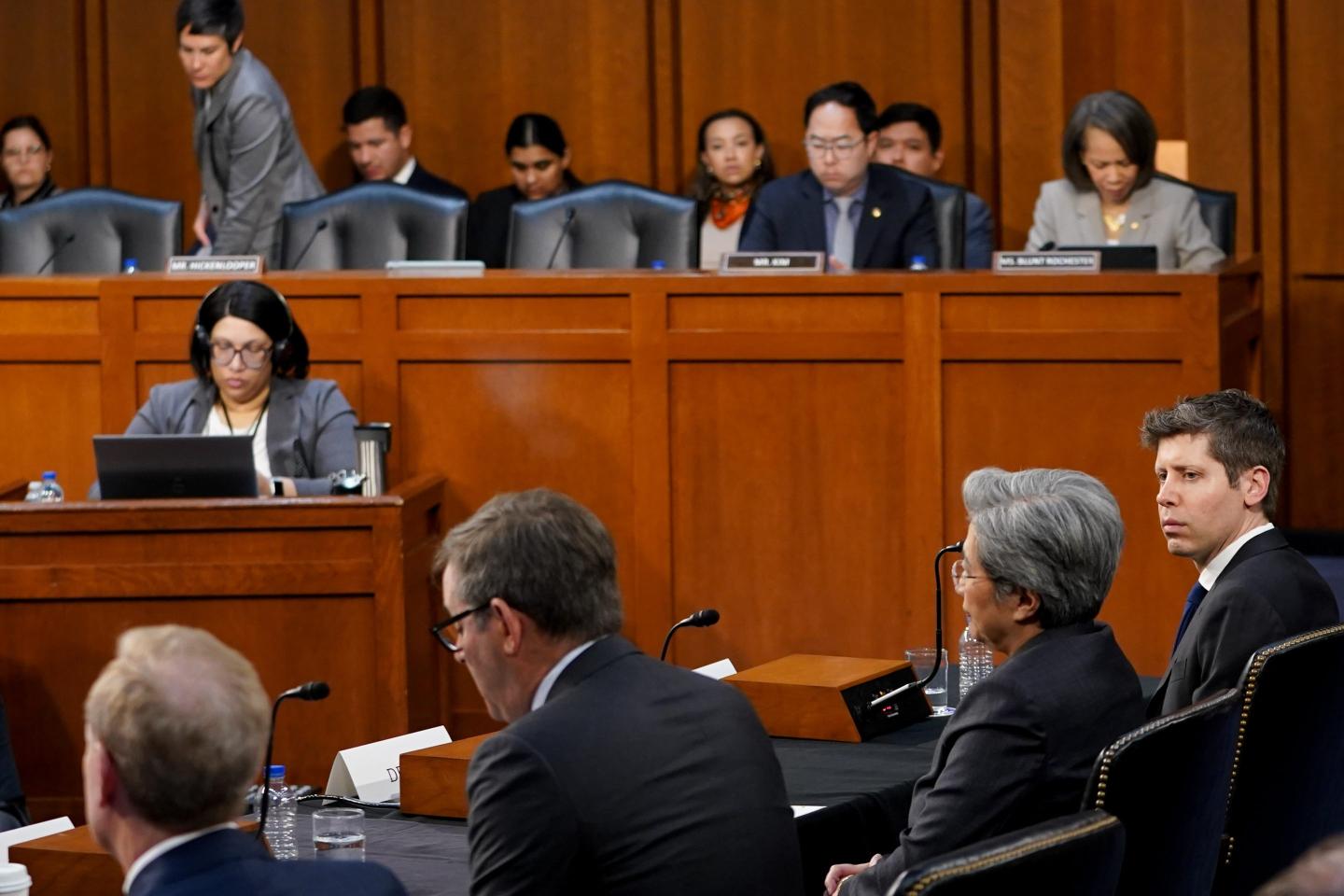
AI figures such as Brad Smith of Microsoft and Sam Altman of OpenAI have repeatedly testified before Congress.Nathan Howard/Bloomberg via Getty Images
Add Fortune on Google for similar content.

In 528 AD, Emperor Justinian inherited a Roman legal system drowning in centuries of accumulated laws, conflicting edicts, and contradictory jurisprudence. His solution was radical: commission the Corpus Juris Civilis, a comprehensive codification and streamlining of Roman law across all provinces. Over 14 months, Justinian’s commission reduced approximately 3 million lines of legal text to just 150,000, laying the foundation for the Western legal canon.

Recommended Video

America faces its own Justinian moment, but AI raises the stakes, creating a fork between two futures. One future, already emerging in China, is AI-driven totalitarianism. The other is an AI-powered republican renewal.

Between regulations, statutes, and case law, our country has accumulated around 260 million lines of law at the federal level alone. Agencies write rules to expand their authority and incumbents lobby for regulations that raise barriers to entry. While many politicians have tried with varied success to streamline modern law, the advent of AI changes the realm of possibility entirely. 

AI is capable of writing new laws and is already deployed by some states and federal agencies to identify opportunities for regulatory streamlining. In this new governance frontier, large language models are shaping American policy. Just recently, we learned that the Department of Government Efficiency (DOGE) — which thus far has focused on government spending — is now using AI to propose regulatory reductions.

AI-driven reform is exciting because republics die from institutional sclerosis. Plato and Cicero both observed this in their respective Republics. Indeed, Rome’s Senate accumulated powers and procedures until effective governance became impossible, beckoning an emperor. The French Directory multiplied bureaucracies until Napoleon seemed the only solution. The Weimar Republic’s financial and regulatory morass made strongman rule attractive.

Modern America exhibits its own early symptoms of regulatory morass and accompanying decay. Since 1980, regulatory accumulation has cost our economy $4 trillion in forgone annual GDP growth. The Code of Federal Regulations spans 185,984 pages containing over 1 million restrictions. Small manufacturers pay $50,100 per employee in compliance costs versus $24,800 for large corporations.

Just like in our predecessor republics, each law and regulation began with good intentions — protecting workers, ensuring safety, preventing fraud. But institutions and policies designed to solve old problems often outlive their goals and yield new, compounding problems. Nobel laureate economist George Stigler contended: “Regulation is acquired by the industry and is designed and operated primarily for its benefit.”

China offers one answer to bureaucratic paralysis and capture: algorithmic authoritarianism. Their social credit system tracks citizens across every domain — financial transactions, social media, personal associations. Algorithms automatically restrict travel, education, and employment. China achieves what no human bureaucracy could: real-time monitoring and control of 1.4 billion people.

An unlikely alliance

In America, an unlikely alliance offers a different path. Progressive economists like Ezra Klein champion abundance while conservative governors slash regulations. As left-leaning Matt Yglesias promotes red-tape reduction to promote homebuilding, President Trump endeavors to eliminate federal bureaucracy. This ideological convergence reflects the recognition that artificial scarcity driven by regulation helps no one except the rent-seekers described by Stigler.

AI offers the first realistic tool to efficiently disrupt, capture and cut the correct amounts and types of modern red tape. Unlike human bureaucrats who resist change, algorithms execute precisely. Where manual review takes decades, AI can process millions of pages in weeks.

State governments and federal DOGE embrace this reality. Virginia Governor Glenn Youngkin’s Executive Order 51, issued in July, requires that all agencies use “agentic AI” to regularly review their rulebooks. This builds on the state’s recent success: a 26.8% reduction in regulatory requirements, $1.2 billion in annual savings, and a $24,000 decrease in new home costs, all in just four years. Federally, DOGE’s announcement referenced 100,000 federal regulations lacking statutory authority.

When factoring for the necessary human oversight, in essence, AI enables power to flow away from bureaucracy and back to elected officials.

Writing in the Federalist papers as Publius, our constitution’s progenitor, James Madison, warned that “every new regulation … presents a new harvest to those who watch the change.” Our Framers understood that republics die when institutions escape democratic control. Their solutions — separated powers, checks and balances, federalism — today matriculate into the age of AI.

While China uses AI for tyranny, we should use it for renewal, embracing technology to reverse legal and institutional decay. A millennium and a half ago, Justinian chose transformation over decline. History will judge whether we do the same.

The opinions expressed in Fortune.com commentary pieces are solely the views of their authors and do not necessarily reflect the opinions and beliefs of Fortune.

About the Authors
By Tanner H. Jones
See full bioRight Arrow Button Icon
By Patrick A. McLaughlin
See full bioRight Arrow Button Icon
Add Fortune on Google for similar content.

Latest in Commentary

Finance
Lorem ipsum dolor sit amet, consectetur adipiscing elit, sed do eiusmod tempor incididunt ut labore et dolore magna aliqua. Ut enim ad minim veniam
By Fortune Editors
October 20, 2025
Finance
Lorem ipsum dolor sit amet, consectetur adipiscing elit, sed do eiusmod tempor incididunt ut labore et dolore magna aliqua. Ut enim ad minim veniam
By Fortune Editors
October 20, 2025
Finance
Lorem ipsum dolor sit amet, consectetur adipiscing elit, sed do eiusmod tempor incididunt ut labore et dolore magna aliqua. Ut enim ad minim veniam
By Fortune Editors
October 20, 2025
Finance
Lorem ipsum dolor sit amet, consectetur adipiscing elit, sed do eiusmod tempor incididunt ut labore et dolore magna aliqua. Ut enim ad minim veniam
By Fortune Editors
October 20, 2025
Finance
Lorem ipsum dolor sit amet, consectetur adipiscing elit, sed do eiusmod tempor incididunt ut labore et dolore magna aliqua. Ut enim ad minim veniam
By Fortune Editors
October 20, 2025
Finance
Lorem ipsum dolor sit amet, consectetur adipiscing elit, sed do eiusmod tempor incididunt ut labore et dolore magna aliqua. Ut enim ad minim veniam
By Fortune Editors
October 20, 2025

Most Popular

Finance
Lorem ipsum dolor sit amet, consectetur adipiscing elit, sed do eiusmod tempor incididunt ut labore et dolore magna aliqua. Ut enim ad minim veniam
By Fortune Editors
October 20, 2025
Finance
Lorem ipsum dolor sit amet, consectetur adipiscing elit, sed do eiusmod tempor incididunt ut labore et dolore magna aliqua. Ut enim ad minim veniam
By Fortune Editors
October 20, 2025
Finance
Lorem ipsum dolor sit amet, consectetur adipiscing elit, sed do eiusmod tempor incididunt ut labore et dolore magna aliqua. Ut enim ad minim veniam
By Fortune Editors
October 20, 2025
Finance
Lorem ipsum dolor sit amet, consectetur adipiscing elit, sed do eiusmod tempor incididunt ut labore et dolore magna aliqua. Ut enim ad minim veniam
By Fortune Editors
October 20, 2025
Finance
Lorem ipsum dolor sit amet, consectetur adipiscing elit, sed do eiusmod tempor incididunt ut labore et dolore magna aliqua. Ut enim ad minim veniam
By Fortune Editors
October 20, 2025
Finance
Lorem ipsum dolor sit amet, consectetur adipiscing elit, sed do eiusmod tempor incididunt ut labore et dolore magna aliqua. Ut enim ad minim veniam
By Fortune Editors
October 20, 2025
Fortune Secondary Logo
Rankings
  • 100 Best Companies
  • Fortune 500
  • Global 500
  • Fortune 500 Europe
  • Most Powerful Women
  • World's Most Admired Companies
  • See All Rankings
  • Lists Calendar
Sections
  • Finance
  • Fortune Crypto
  • Features
  • Leadership
  • Health
  • Commentary
  • Success
  • Retail
  • Mpw
  • Tech
  • Lifestyle
  • CEO Initiative
  • Asia
  • Politics
  • Conferences
  • Europe
  • Newsletters
  • Personal Finance
  • Environment
  • Magazine
  • Education
Customer Support
  • Frequently Asked Questions
  • Customer Service Portal
  • Privacy Policy
  • Terms Of Use
  • Single Issues For Purchase
  • International Print
Commercial Services
  • Advertising
  • Fortune Brand Studio
  • Fortune Analytics
  • Fortune Conferences
  • Business Development
  • Group Subscriptions
About Us
  • About Us
  • Press Center
  • Work At Fortune
  • Terms And Conditions
  • Site Map
  • About Us
  • Press Center
  • Work At Fortune
  • Terms And Conditions
  • Site Map
  • Facebook icon
  • Twitter icon
  • LinkedIn icon
  • Instagram icon
  • TikTok icon
  • YouTube icon

Tanner H. Jones is the CEO of Vulcan Technologies, the Y Combinator backed company which conducted Virginia’s AI regulatory reduction pilot program.

Patrick A. McLaughlin is a PhD economist and a research fellow at the Hoover Institution; he created the RegData and QuantGov projects, which quantify regulations using data-science tools and have informed reforms in several states.


Latest in Commentary

raikes
CommentaryMicrosoft
Jeff Raikes: The talent debt I warned about is now showing up in the data
By Jeff RaikesJuly 26, 2026
2 hours ago
beatles
CommentaryLeadership
George Martin never out-wrote the Beatles. That’s exactly why he’s the AI leadership lesson we need now
By Jeff DeGraffJuly 26, 2026
3 hours ago
students
CommentaryEducation
I’ve been teach college students for decades. Most of them can no longer finish a book
By Austin SaratJuly 26, 2026
4 hours ago
katty
CommentaryLeadership
Katty Kay: confidence is the skill that turns thoughts into action—and companies need to start teaching it
By Katty KayJuly 26, 2026
4 hours ago
Roderick Wong, MD is Managing Partner and Chief Investment Officer of RTW Investments
Commentary250 Years of Innovation
When 10,000 doctors stood up and cheered for a cancer drug — America’s innovation machine made it possible
By Roderick WongJuly 25, 2026
1 day ago
t
CommentaryCommunity
Ronald Reagan center director: How to talk politics with family, friends and neighbors, without losing them
By Frederick J. Ryan, Jr.July 25, 2026
1 day ago

Most Popular

The millennial generation is split in 2: an older crowd with boomer-style comfort, a younger set going 'back to the early 1900s'
Real Estate
The millennial generation is split in 2: an older crowd with boomer-style comfort, a younger set going 'back to the early 1900s'
By Nick LichtenbergJuly 25, 2026
1 day ago
Trump pulls back after Iran crosses his red line as U.S. military breaks two-week streak of airstrikes amid talks for potential Hormuz deal
Middle East
Trump pulls back after Iran crosses his red line as U.S. military breaks two-week streak of airstrikes amid talks for potential Hormuz deal
By Jason MaJuly 25, 2026
18 hours ago
'The demographic dividend of the last 40 years is ending': J.P. Morgan says the world is running out of the two things that kept interest rates down
Economy
'The demographic dividend of the last 40 years is ending': J.P. Morgan says the world is running out of the two things that kept interest rates down
By Eleanor PringleJuly 24, 2026
2 days ago
An 11-year-old is cleaning his neighbors' trash cans for $10 each—he now has 100K followers as teens face the worst summer job market since 1948
Success
An 11-year-old is cleaning his neighbors' trash cans for $10 each—he now has 100K followers as teens face the worst summer job market since 1948
By Orianna Rosa RoyleJuly 25, 2026
1 day ago
Startups are installing tiny data centers in people’s homes to reduce strain on the beleaguered electrical grid
Environment
Startups are installing tiny data centers in people’s homes to reduce strain on the beleaguered electrical grid
By Sasha RogelbergJuly 25, 2026
1 day ago
A Hims cofounder fired his entire marketing team for AI. Now his 24/7 online vet service is growing 20% a month
Success
A Hims cofounder fired his entire marketing team for AI. Now his 24/7 online vet service is growing 20% a month
By Sydney LakeJuly 25, 2026
24 hours ago

© 2026 Fortune Media IP Limited. All Rights Reserved. Use of this site constitutes acceptance of our Terms of Use and Privacy Policy | CA Notice at Collection and Privacy Notice | Do Not Sell/Share My Personal Information
FORTUNE is a trademark of Fortune Media IP Limited, registered in the U.S. and other countries. FORTUNE may receive compensation for some links to products and services on this website. Offers may be subject to change without notice.