
• Home
  • Latest
  • Fortune 500
  • Finance
  • Tech
  • Leadership
  • Lifestyle
  • Rankings
  • Multimedia

Trendingnow

1

Mark Cuban says he has the solution to growing income inequality, and it's to reward every employee—from CEO to janitor—with company stock

2

‘I want to die broke’: Billionaire philanthropist Denny Sanford dies after giving away $4 billion

3

'Dr. Doom' Nouriel Roubini says we're headed for universal basic income or 'some form of socialism' as AI revolutionizes work—He calls that optimistic

1

Mark Cuban says he has the solution to growing income inequality, and it's to reward every employee—from CEO to janitor—with company stock

2

‘I want to die broke’: Billionaire philanthropist Denny Sanford dies after giving away $4 billion

3

'Dr. Doom' Nouriel Roubini says we're headed for universal basic income or 'some form of socialism' as AI revolutionizes work—He calls that optimistic
PoliticsTariffs

A $100 billion mystery is unfolding on tariffs and inflation and economists are cracking the case

Irina Ivanova
By
Irina Ivanova
Irina Ivanova
Deputy US News Editor
Down Arrow Button Icon
Irina Ivanova
By
Irina Ivanova
Irina Ivanova
Deputy US News Editor
Down Arrow Button Icon
July 13, 2025, 6:32 AM ET
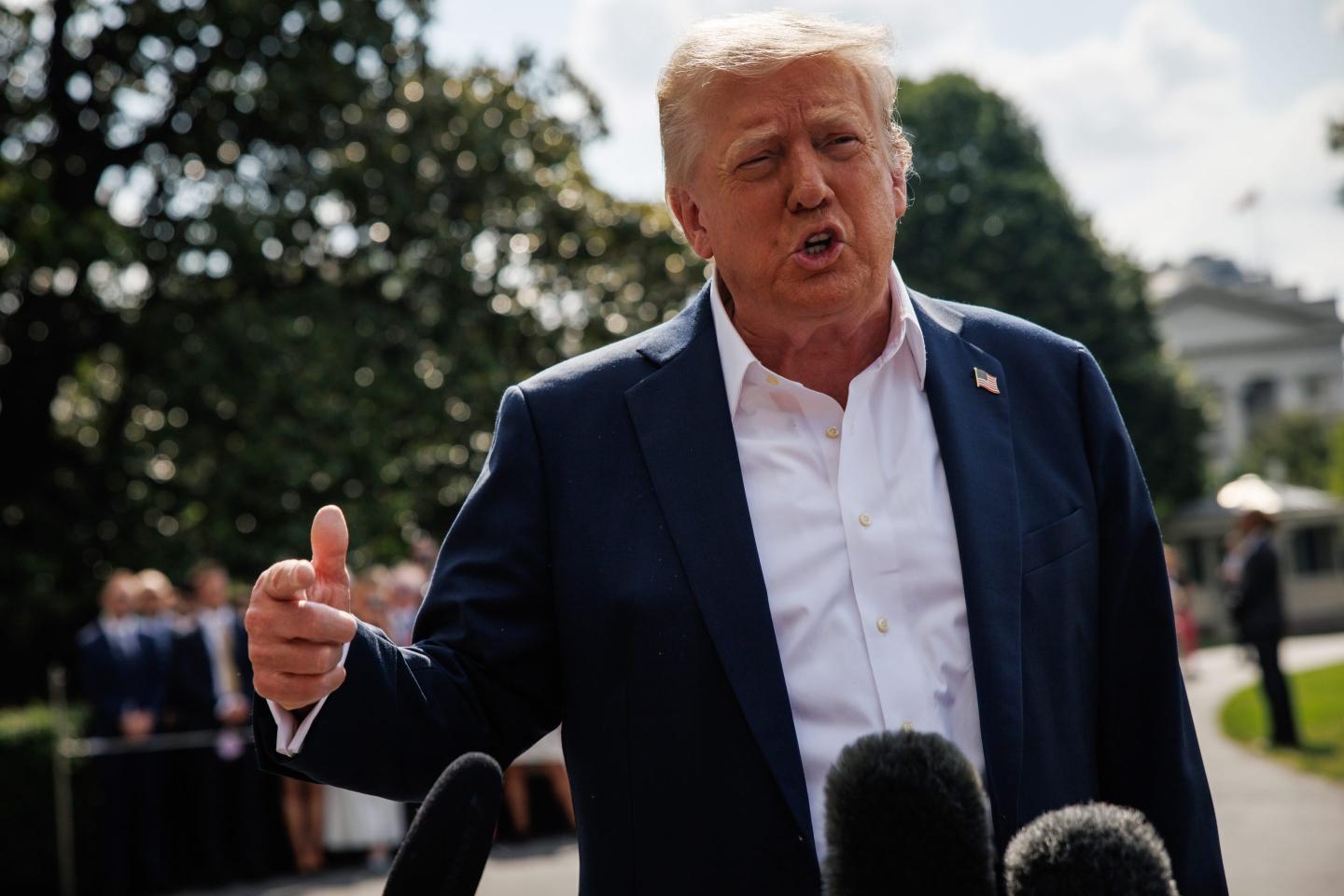
Donald Trump points while talking
Donald Trump has claimed that consumers won't pay the costs of tariffs—and so far, he's been mostly correct. Getty Images
Add Fortune on Google for similar content.
  • Economists have for months warned that tariffs would cause an inflation surge, but as of July, there’s little evidence of that in economic data, despite about $100 billion in tariffs already collected by the Treasury. Fortune asked economists to explain why. The possible reasons range from “it’s too soon” to “consumers won’t stand for it.” 

Since the first weeks of President Donald Trump’s second term, when the president signaled a wholesale reimagining of the international trade system on a scale not seen in decades, mainstream economists have warned that prices would surge.

Recommended Video

The mantra, repeated by everyone from mainstream economists to factions of the GOP, has been clear: A tariff is a tax on consumers. Businesses said the same, with three -quarters of importers in a recent New York Fed study declaring they planned to pass on some tariff costs to customers. 

But halfway into the year and well into the most consequential reshuffling of trade in half a century, tariff-fueled inflation is missing in action. 

The tariffs are certainly in place: The Treasury so far has collected a record-setting $100 billion in customs duties, and is on track to pull in $300 billion this year. The tariffs are paid by U.S. importers—think Walmart and other retailers—when goods cross the border into the U.S. It takes some time to work their way into the system, but eventually higher prices get passed onto consumers. Those higher prices directly influence the overall price levels in inflation measures.  

Except there’s a mystery, wrapped in an enigma, and coated in a puzzle. One place tariffs aren’t showing up? In the inflation numbers. 

For four months, official inflation readings from the Bureau of Labor Statistics have come in under expectations, with the latest inflation reading a relatively modest 2.4%. The president’s Council of Economic Advisers (CEA) this week released a brief arguing that import prices have actually been falling. 

Why doesn’t the data show a tariff hit? Here’s what leading economists told Fortune. 

It’s too soon

Though tariffs have been discussed for months, they haven’t actually been in place for that long.

“Regarding the impact of tariffs on prices, the timeframe used by the CEA is way too short to draw any definitive conclusions,” said the fiscally conservative National Taxpayers Union said in a critique on the study, which looked at prices through May. “Trump’s 10% nonreciprocal tariffs were only imposed in April.”

Tariffs on steel and aluminum went into effect in March and increased in June, while Chinese imports have been subject to a 30% tax since March; dozens more “reciprocal” tariffs, initially announced in early April, have now been postponed. 

Meanwhile, official government price data takes time to collect and release. As of mid-July, the most recent data for the Consumer Price Index and Personal Consumption Expenditures deflator, covers May. 

Big businesses are stockpiling

Immediately after tariffs were announced, importers rushed to bring in goods before they were subject to a higher rate. Businesses brought in so many goods, with no corresponding sales, that it briefly flipped the U.S.’ GDP into negative territory. (In economist math, imports count as a negative to GDP.) 

That surge means that businesses could still be largely selling goods brought in under pre-tariff prices. 

“Businesses stockpiled inventory, and presumably haven’t had to raise prices on goods because they’re sitting on the shelf. Eventually they will, and once they start to raise prices it’ll start impacting consumers,” said Eric Winograd, chief U.S. economist at AllianceBernstein, to explain this theory.

No one knows how much to raise prices

Uncertainty, in a word, is “the most important reason” the hard data doesn’t yet show tariff impact, according to Eugenio Aleman, chief economist at Raymond James. 

“Business owners price their goods at replacement cost. If they have to buy the same good in the future, they have to increase the price [charged to the customer] if the price of the replacement is higher,” he told Fortune. The problem, though, is uncertainty. “Everybody knows the prices that firms will pay for replacement goods will be higher, but nobody knows by how much. That uncertainty is keeping many firms from repricing their goods.”

It’s coming out of profits instead

Businesses, particularly small businesses, could be choosing to eat the cost of tariffs for the time being. Unlike large businesses, they have a smaller client base and could be reluctant to hike prices, Aleman said. 

“Maybe small firms are eating some large portion of the tariffs. Why? Because they can’t afford to lose clients,” he said. One potential data point indicating this possibility is recent Commerce Department figures showing growth in proprietors’ income—a proxy for small businesses—flatlining in May. Aleman stressed that more than one month of data would be needed to determine if this is the case. 

Recent Bank of America research shows the amount of tariffs paid by small businesses in May nearly doubled from 2022 levels. “Small businesses may be, in some ways, more susceptible to tariff pressures than larger businesses, given their access to capital is more limited,” the note read. 

They’re scared of Trump

An added factor is the bully pulpit of Truth Social, which Trump has wielded freely at even the largest retailer thinking of hiking costs.

“If the president sees significant pass-through of tariffs via prices, you’ll see a lot more public policy, probably via Twitter,” Jeff Klingelhofer, a managing director at Aristotle Pacific, told Fortune. 

Customers won’t pay higher costs

Klingelhofer previously suggested that companies would take the brunt of the tariff impact because they’re the only ones who could afford to, with consumers being “tapped out” after years of high inflation. Former Federal Reserve economist Claudia Sahm also noted that  companies today are less quick to hike prices now than they were during pandemic inflation, when Americans were flush with cash and eager to spend it. 

In 2021 and 2022, “consumers up and down the income distribution, had some cash, and there were a lot of corporate earnings calls saying ‘We’re passing these [costs] through,’ and the consumer could kind of handle it,” she told Fortune. 

Three years later, Americans have spent all the excess savings accumulated during Covid, and businesses “realize if they increase prices dramatically, they could be losing customers,” she said. “There is more hesitation. There is some raising of prices, but not the exuberance” of the pandemic.

Inflation might never come

That’s the position of Mark DiPlacido, policy advisor at American Compass, a conservative economic outfit that supports tariffs as a way to rebalance the U.S. economy.

“Foreign exporters have ended up absorbing a lot of [the costs], and businesses—very little has gotten to consumers at this point,” he said. Japanese carmakers, he noted, are slashing prices—sometimes nearly 20%—to compensate for the added costs U.S. buyers will pay. In other words, “Japan itself and Japanese companies are eating the costs of the tariffs.”  

Every economist Fortune spoke with made some version of this point—that a tariff, rather than giving a blank check for a seller to boost prices, sets off a complicated negotiation between importers, exporters, and American end buyers. Finding the balance of which party pays how much will take time, and will be individual for each good and sector of the economy.

“Tariffs are a tax on imported goods,” Sahm said. “Nobody wants to pay the tax, so who is the weakest link? Walmart can go in and tell their Chinese producers, ‘You have to cut the price.’ Maybe in the pandemic the consumers said, ‘OK, I’ll pay it—I’m not really happy about it, but I have the money.”

The final answer, she added, “can be very specific to the business, the industry, and also the general macroeconomic conditions.” 

Subscribe to Fortune Gulf Brief. Every Tuesday, this new newsletter delivers clear-eyed, authoritative intelligence on the deals, decisions, policies, and power shifts shaping one of the world’s most consequential regions, written for the people who need to act on it. Sign up here.
About the Author
Irina Ivanova
By Irina IvanovaDeputy US News Editor

Irina Ivanova is the former deputy U.S. news editor at Fortune.


See full bioRight Arrow Button Icon
Add Fortune on Google for similar content.

Latest in Politics

Finance
Lorem ipsum dolor sit amet, consectetur adipiscing elit, sed do eiusmod tempor incididunt ut labore et dolore magna aliqua. Ut enim ad minim veniam
By Fortune Editors
October 20, 2025
Finance
Lorem ipsum dolor sit amet, consectetur adipiscing elit, sed do eiusmod tempor incididunt ut labore et dolore magna aliqua. Ut enim ad minim veniam
By Fortune Editors
October 20, 2025
Finance
Lorem ipsum dolor sit amet, consectetur adipiscing elit, sed do eiusmod tempor incididunt ut labore et dolore magna aliqua. Ut enim ad minim veniam
By Fortune Editors
October 20, 2025
Finance
Lorem ipsum dolor sit amet, consectetur adipiscing elit, sed do eiusmod tempor incididunt ut labore et dolore magna aliqua. Ut enim ad minim veniam
By Fortune Editors
October 20, 2025
Finance
Lorem ipsum dolor sit amet, consectetur adipiscing elit, sed do eiusmod tempor incididunt ut labore et dolore magna aliqua. Ut enim ad minim veniam
By Fortune Editors
October 20, 2025
Finance
Lorem ipsum dolor sit amet, consectetur adipiscing elit, sed do eiusmod tempor incididunt ut labore et dolore magna aliqua. Ut enim ad minim veniam
By Fortune Editors
October 20, 2025

Most Popular

Finance
Lorem ipsum dolor sit amet, consectetur adipiscing elit, sed do eiusmod tempor incididunt ut labore et dolore magna aliqua. Ut enim ad minim veniam
By Fortune Editors
October 20, 2025
Finance
Lorem ipsum dolor sit amet, consectetur adipiscing elit, sed do eiusmod tempor incididunt ut labore et dolore magna aliqua. Ut enim ad minim veniam
By Fortune Editors
October 20, 2025
Finance
Lorem ipsum dolor sit amet, consectetur adipiscing elit, sed do eiusmod tempor incididunt ut labore et dolore magna aliqua. Ut enim ad minim veniam
By Fortune Editors
October 20, 2025
Finance
Lorem ipsum dolor sit amet, consectetur adipiscing elit, sed do eiusmod tempor incididunt ut labore et dolore magna aliqua. Ut enim ad minim veniam
By Fortune Editors
October 20, 2025
Finance
Lorem ipsum dolor sit amet, consectetur adipiscing elit, sed do eiusmod tempor incididunt ut labore et dolore magna aliqua. Ut enim ad minim veniam
By Fortune Editors
October 20, 2025
Finance
Lorem ipsum dolor sit amet, consectetur adipiscing elit, sed do eiusmod tempor incididunt ut labore et dolore magna aliqua. Ut enim ad minim veniam
By Fortune Editors
October 20, 2025
Fortune Secondary Logo
Rankings
  • 100 Best Companies
  • Fortune 500
  • Global 500
  • Fortune 500 Europe
  • Most Powerful Women
  • World's Most Admired Companies
  • See All Rankings
  • Lists Calendar
Sections
  • Finance
  • Fortune Crypto
  • Features
  • Leadership
  • Health
  • Commentary
  • Success
  • Retail
  • Mpw
  • Tech
  • Lifestyle
  • CEO Initiative
  • Asia
  • Politics
  • Conferences
  • Europe
  • Newsletters
  • Personal Finance
  • Environment
  • Magazine
  • Education
Customer Support
  • Frequently Asked Questions
  • Customer Service Portal
  • Privacy Policy
  • Terms Of Use
  • Single Issues For Purchase
  • International Print
Commercial Services
  • Advertising
  • Fortune Brand Studio
  • Fortune Analytics
  • Fortune Conferences
  • Business Development
  • Group Subscriptions
About Us
  • About Us
  • Press Center
  • Work At Fortune
  • Terms And Conditions
  • Site Map
  • About Us
  • Press Center
  • Work At Fortune
  • Terms And Conditions
  • Site Map
  • Facebook icon
  • Twitter icon
  • LinkedIn icon
  • Instagram icon
  • TikTok icon
  • YouTube icon

Latest in Politics

harvard
LawEducation
Harvard took hundreds of millions from Chinese donors—now the DOJ is asking if Americans were left out on purpose
By Collin Binkley, Didi Tang and The Associated PressJuly 21, 2026
4 hours ago
ice
North AmericaImmigration
Army veteran with ‘ICE Off Our Streets’ sign sets fire and opens pellet gun attack outside Manhattan immigration court, injuring three: authorities
By Michael R. Sisak, Jamie Stengle and The Associated PressJuly 21, 2026
4 hours ago
fuel
North AmericaWhite House
Trump’s $3.47 ‘Freedom Fuel’ gas network leans on an NFL kicking coach, a GOP fundraiser and a N.J. entrepreneur with a fuel theft rap sheet
By Brian Slodysko, Michael Biesecker, Josh Boak and The Associated PressJuly 21, 2026
4 hours ago
fl
North AmericaElections
Trump-backed hopeful to succeed DeSantis unveils plan to protect local water, electricity from data centers
By Matt Brown and The Associated PressJuly 21, 2026
5 hours ago
Trump to impose 50% tariffs on most Canadian goods, invoking the ‘nuclear option’ that could unleash a new wave of economic chaos and inflation
EconomyTariffs
Trump to impose 50% tariffs on most Canadian goods, invoking the ‘nuclear option’ that could unleash a new wave of economic chaos and inflation
By Josh Boak and The Associated PressJuly 20, 2026
18 hours ago
President Donald Trump walks down the steps from Air Force One.
PoliticsDonald Trump
Trump admin attempted to uncover phone records of NYT journalists and sources related to coverage of Qatari-gifted Air Force One
By The Associated Press, Eric Tucker and Jocelyn NoveckJuly 20, 2026
19 hours ago

Most Popular

Mark Cuban says he has the solution to growing income inequality, and it's to reward every employee—from CEO to janitor—with company stock
Success
Mark Cuban says he has the solution to growing income inequality, and it's to reward every employee—from CEO to janitor—with company stock
By Sasha RogelbergJuly 20, 2026
23 hours ago
‘I want to die broke’: Billionaire philanthropist Denny Sanford dies after giving away $4 billion
Success
‘I want to die broke’: Billionaire philanthropist Denny Sanford dies after giving away $4 billion
By Sydney LakeJuly 20, 2026
1 day ago
'Dr. Doom' Nouriel Roubini says we're headed for universal basic income or 'some form of socialism' as AI revolutionizes work—He calls that optimistic
AI
'Dr. Doom' Nouriel Roubini says we're headed for universal basic income or 'some form of socialism' as AI revolutionizes work—He calls that optimistic
By Jason MaJuly 18, 2026
3 days ago
Current price of silver as of Monday, July 20, 2026
Personal Finance
Current price of silver as of Monday, July 20, 2026
By Joseph HostetlerJuly 20, 2026
1 day ago
It’s not just Taco Bell lettuce and possible glass in Pillsbury rolls: Food and drink recall events reached a 6-year year-over-year high
Retail
It’s not just Taco Bell lettuce and possible glass in Pillsbury rolls: Food and drink recall events reached a 6-year year-over-year high
By Sasha RogelbergJuly 20, 2026
1 day ago
The Treasury is walking a tightrope on U.S. debt by relying so much on short-term rates that are at the mercy of a suddenly very hawkish Fed
Economy
The Treasury is walking a tightrope on U.S. debt by relying so much on short-term rates that are at the mercy of a suddenly very hawkish Fed
By Jason MaJuly 20, 2026
1 day ago

© 2026 Fortune Media IP Limited. All Rights Reserved. Use of this site constitutes acceptance of our Terms of Use and Privacy Policy | CA Notice at Collection and Privacy Notice | Do Not Sell/Share My Personal Information
FORTUNE is a trademark of Fortune Media IP Limited, registered in the U.S. and other countries. FORTUNE may receive compensation for some links to products and services on this website. Offers may be subject to change without notice.