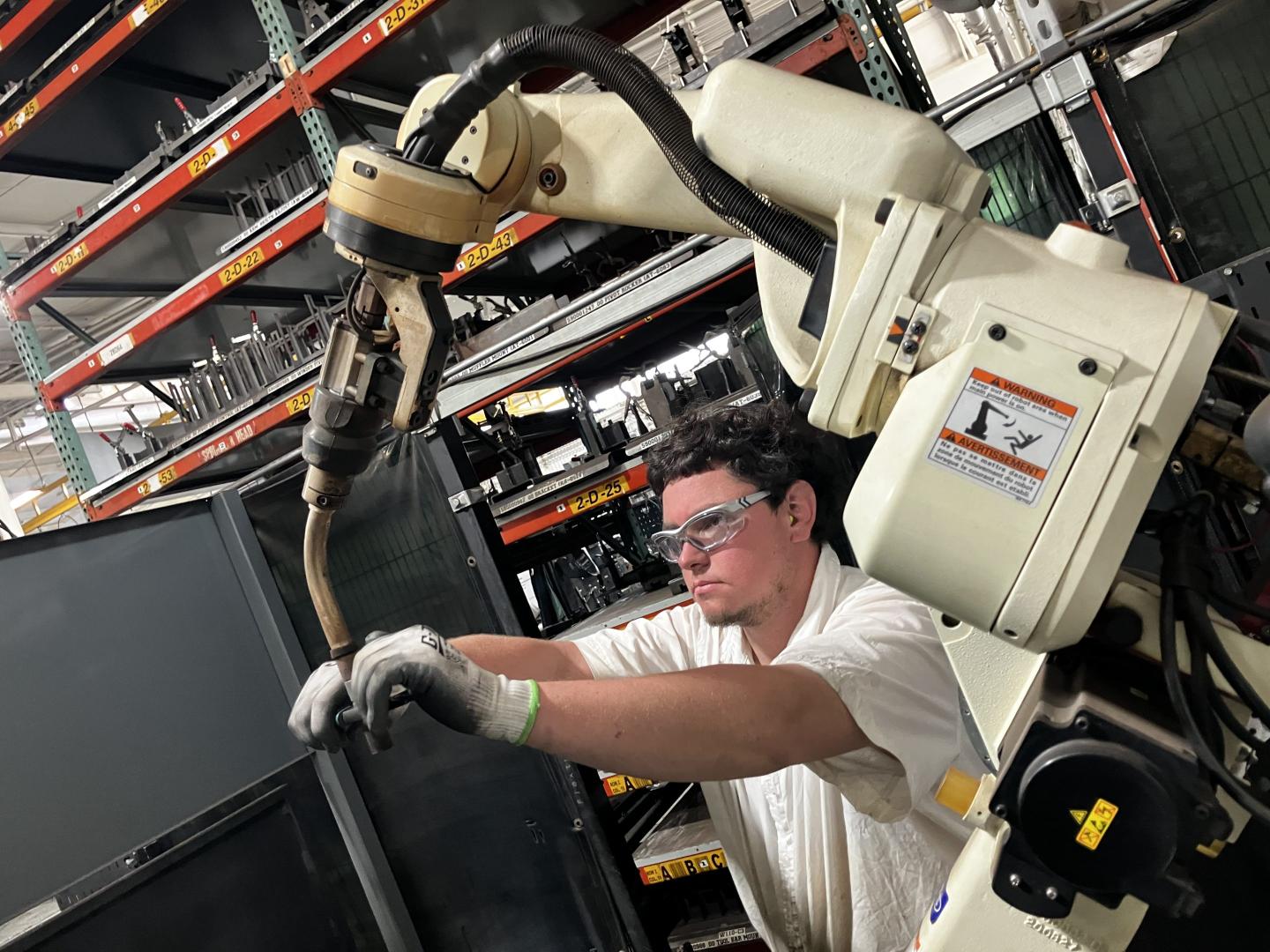
Every weekday morning, a 53-year-old tradesman drives his horse and buggy through the heart of Ohio Amish country to begin his workday in a factory full of robots.
Emanuel Hershberger—Manny to his friends—has an iron handshake, a bushy chin-strap beard, and the burly shoulders of a man who spends his downtime tending a 40-acre farm without mechanized equipment. But that’s at home. At work, Hershberger parks the buggy and horse in a barn behind the factory. After clocking in, he operates a $170,000 computer-controlled metalworking lathe that looks like it’s borrowed from the engineering deck of the starship Enterprise.
“I didn’t grow up with computers,” Hershberger told Fortune as he tapped keys on the machine’s control board. At first, he said, the bosses asked someone more tech-savvy to set up the programming before he cut metal parts on the lathe. “I didn’t like that,” he said, recalling that he told a supervisor, “I’ll run it, but I want training. I don’t want to halfway or almost know how.”
“Now I’m comfortable setting it up and shutting it down. I can edit a program,” he said, adjusting his plastic safety glasses. “I can fly it and land it.”
At the next workstation, an Amish colleague in goggles presses a power buffer against a new steel lawn-mower part, fresh off a robotic welding table. The robot beside him is welding an identical piece, casting blooms of sparks as it swivels over the work. A few paces away, a bearded technician in plain-front trousers and black suspenders types commands into a keypad that controls yet another robotic welder.
These craftsmen work for a small Amish-owned contract manufacturing powerhouse called Flextur—a portmanteau of “fixture” and “flexible.” On the factory floor and in the corporate offices, the main emphasis here seems to be on “flexible.” For more than 40 years, the company was widely known in the Amish community by a different name—Pioneer Equipment—and was for decades the largest maker of horse-drawn farm machinery in the United States.
But three years ago, the company undertook a corporate transformation. Once devoted to making horse-drawn plows and other implements for traditional Amish and Mennonite farmers, this factory now builds machinery, steel parts, and fixtures for a much broader clientele: aerospace firms, petroleum operations and equipment manufacturers that you likely haven’t heard of, and larger companies, like La-Z-Boy, that you have. And Flextur’s choice to adopt a new name and enter new markets offers lessons for any business that needs to adapt to change.
“I’m basically working for a different company,” said Larry Weaver, Flextur’s lead engineer, when asked about the transformation. “It’s just the same ownership.”
Like most of Flextur’s Amish employees, Weaver ended his formal schooling in the eighth grade. He’s been working for the family-owned company for more than 30 years, and he taught himself computer-aided design on the job. He wears a studious-looking pair of square browline glasses, but has the thick beard and thicker forearms of an Amishman who hasn’t strayed too far from fieldwork. Weaver grew up farming alongside nine siblings. He now lives on a farm across the road from the Flextur factory. Traditional agriculture is his first love, and Weaver said some of his most satisfying design challenges came from making horse-drawn machinery with modern materials. But the horse-drawn-farming market wasn’t going to keep Flextur’s 55 employees prospering into the next decade.
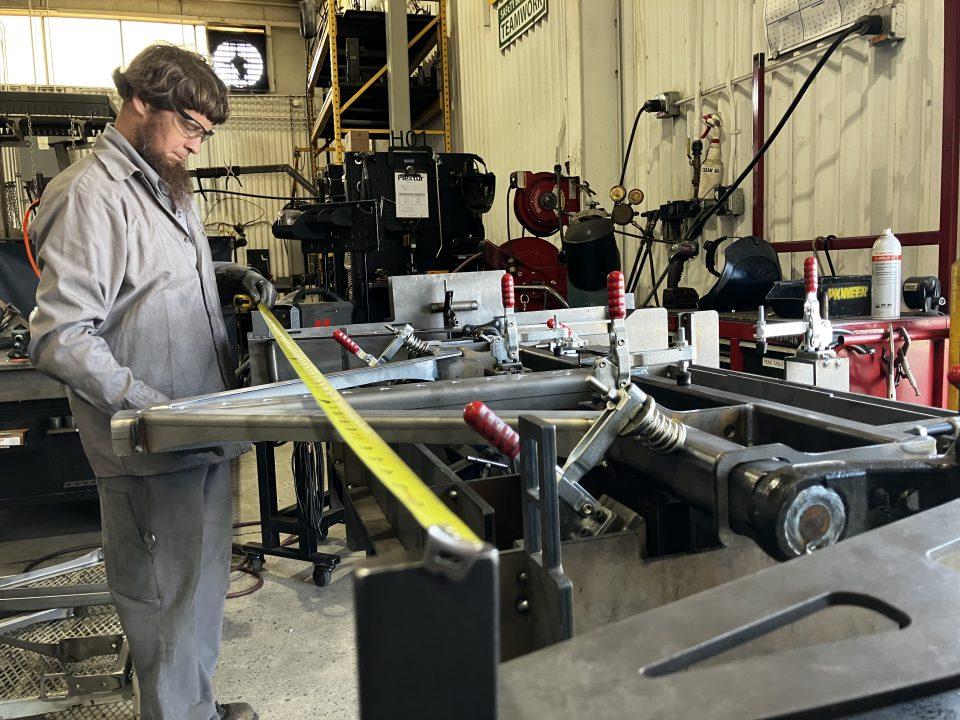
“We would not be doing well as a company if we never made any change,” Weaver said. “We would not be here anymore.”
Flextur’s current CEO, Daniel Wengerd, agrees, but says the seeds of this change were sown well before the company took a new name. He spoke with Fortune over dinner recently, at his home just down the road from the factory. Wengerd wears mostly traditional Amish clothes, as do his wife, Mary Ellen, and their six children.There’s no TV in the house, which sits on a 20-acre working farm with cattle in the pasture and 18,000 chicks in a 400-foot-long poultry barn. On the desk in Wengerd’s study, you’ll find handwritten notes for the sermon he’s planning to deliver in church the following Sunday. Wengerd isn’t incidentally part of his Old Order Amish community; he’s a pillar of it.
Yet he’s also a shrewd businessman running a high-tech company that posted $12.6 million in sales last year. He’s plugged in to the global economy and constantly on the lookout for opportunities to stay competitive.
One of those opportunities came in 2008, when sales in the horse-powered ag market were still brisk. Pioneer was churning out plows in batches of 250 at a time and running out of space to store the inventory. Rather than expanding the factory, an accounting firm it worked with recommended, the Wengerd family should consider trying something new: talk to a consultant about “lean manufacturing,” a production management system pioneered by Toyota.
Initially, some members of management were skeptical. “Here we’ve been building farm equipment for 20 years,” Wengerd said. “We’re going to bring in outside people who don’t know which end of a horse to hitch to a plow and they’re going to tell us how to do this better?”
But over the course of several four-hour consulting sessions, he said, the employees came around. The Toyota Production System emphasizes matching inventory to demand, seeking efficiency across all aspects of the operation, and encouraging a culture of continuous improvement that solicits input from every employee. Even now, if you talk to managers in the Flextur office or to guys in the workshop, you’ll hear these ideas discussed and see them put into practice.
“It really changed our thinking,” said Doug Scheetz, Flextur’s VP of marketing and product development. “We allowed people on the floor to learn the process. And now this continuous improvement is at the core of our culture. We think of it as the freedom to try, freedom to fail, freedom to bounce back from it.”
As it turned out, offering employees this freedom gave birth to ideas that helped set the company on its new path. In early discussions about how to streamline operations, for example, a few of the welders suggested modifying their workstations to be more modular. The company sold such a wide variety of farm machines, they said, that their purpose-built tables and tool racks couldn’t be quickly reconfigured to match new jobs.
So the employees designed a sturdy line of mobile, modular tool racks and welding tables, covered with grids of laser-cut holes, allowing any shape of tool or work piece to be securely attached to them. The tables could be combined together to create assembly lines for bigger jobs. These flexible fixtures—hence the company name—caught the attention of other metal fabricators, and the company began selling them alongside the farm equipment.
Sometime around 2018, not long after the company bought its first robotic welder, Wengerd said it became clear that the horse-drawn-equipment business was in decline. Dairy sales had plummeted by more than $1 billion in the US that year, hitting small Amish producers hard, and cutting their appetite for new equipment. At the same time, competition was springing up as other Amish metal shops began making horse-drawn machinery to rival Pioneer’s. Every trade show, it seemed, Wengerd saw new competing models that borrowed heavily from Pioneer’s own designs. “We went to events where we had to look twice to make sure it wasn’t ours,” he said, laughing.
Then came the slow-moving collision between Amish demographics and McMansions. The sociologist Donald Kraybill, a leading scholar of Amish life, has extensively chronicled the problem faced by an agrarian culture raising huge families in a country furiously converting its farmland into suburbs. “Even if development had been frozen,” Kraybill writes, “the growth of the population itself would have created a crisis with too many babies and too few farms.” In fact, if you meet an Amish person today, chances are they run or work for a small business, and maybe farm a little on the side. A few decades from now, it’s likely many Amish people won’t farm at all.
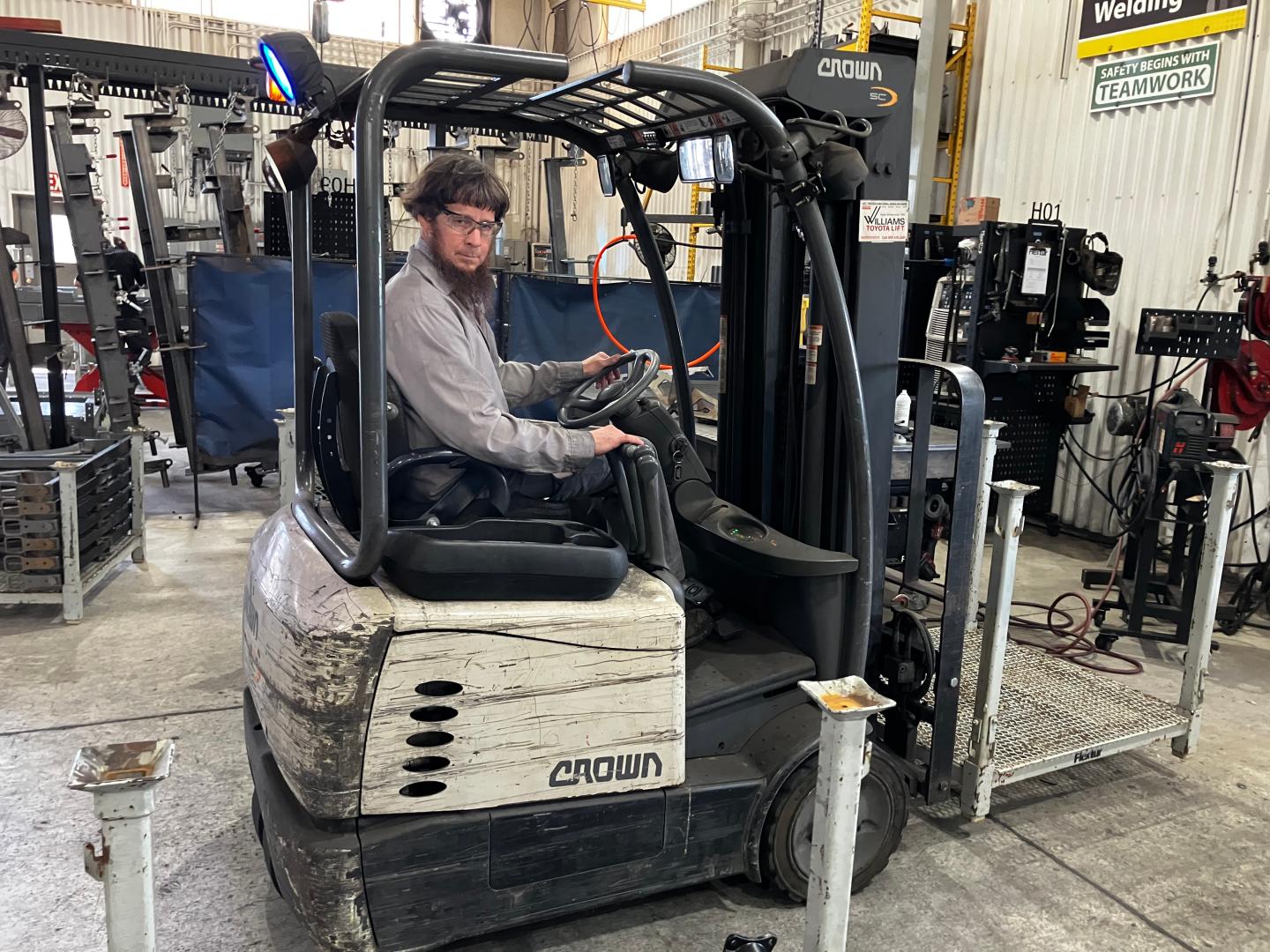
“The handwriting was on the wall,” Wengerd said. “We had another consultant who told us, ‘You guys need a bigger sandbox.’” To the Wengerd family, the future of selling into the Amish ag market—especially after the economic shock of the 2020 pandemic—looked grim.
So, the company leaned in to selling its line of welding products to other manufacturers. It began taking on increasing amounts of design and fabrication work for companies that had nothing to do with agriculture. Finally, in 2023, Pioneer retired its brand name and auctioned off its agricultural inventory, along with the rights to continue manufacturing its horse-drawn product lines.
“We had a lot of people in the industry that were just shocked,” Wengerd said. “This was what we did for 40 years… That was our DNA. It was almost a cultural thing: ‘Those are the plow guys, right?’”
“ A lot of the customers that we had were dear friends to us,” he added. “They slept in our home, and they visited us, and they shared their hearts with us.”
Currently, the company says about 60% of its business comes from contract manufacturing, and 40% from selling its own products. Flextur’s new customers aren’t part of its kinship community, but they can sustain the company as it grows.
Daniel Wengerd’s younger brother, Steven, is Flextur’s VP of sales, and he says he doesn’t miss the horse-drawn business at all. “It was dragging us down, keeping us from other projects that were our future,” Steven Wengerd said. “I don’t care how the future looks as long as we’re solving problems.”
In the meantime, the company won’t stop innovating—and listening to employee ideas—in an effort to keep doing so.
“That’s not a new thing,” said Manny Hershberger as he prepared to fire up his lathe. “Even on a farm, you try to find the shortest way from here to there.”