Germany is reaching a point of no return. Business leaders know it, the people in the country feel it, but politicians haven’t come up with answers.
That has set Europe’s largest economy on a path of decline that threatens to become irreversible.
Following five years of stagnation, Germany’s economy is now 5% smaller than it would have been if the pre-pandemic growth trend had been maintained.
More worryingly, Bloomberg Economics estimates that the bulk of the shortfall will be tough to recover, due to structural blows such as the loss of cheap Russian energy and Volkswagen AG and Mercedes-Benz Group AG struggling to keep pace with China’s auto firms. The decline in national competitiveness means every household is worse off by about €2,500 ($2,600) a year.
With Chancellor Olaf Scholz expected to lose a confidence vote on Monday, snap elections offers a chance for a change of course, but the trend of gradual decay creates little sense of urgency. The risk is dull policy responses that lack the ambition needed to tackle underlying challenges.
“Germany doesn’t collapse overnight. That’s what makes this scenario so absolutely gut-wrenchingly terrifying,” said Amy Webb, founder and chief executive officer of Future Today Institute, which advises German companies on strategy. “It is a very slow, very protracted decline. Not of a company, not of a city, but of the entire country and Europe gets dragged down with it.”
What that looks like is Germany losing more of its energy-intensive manufacturing and exports sliding as unsettled companies rein in domestic investment. As living standards erode, voters cast around for someone to blame, and the social tensions drive away the foreign talent the country desperately needs. The toxic cocktail of caution and resentment would then ripple out across Europe.
“Everyone’s life, little by little, gets a little bit worse for the rest of their existence,” said Webb.
Years of poor decisions and some bad luck have shattered Germany’s economic model just when the rest of Europe needs its industrial muscle to help the region keep pace with China, deal with Russia’s war in Ukraine and respond to an increasingly isolationist US. Instead, the Germany is facing its biggest crisis since reunification.
Thirty-five years ago, the fall of the Berlin Wall brought Germans together behind a vast spending plan to integrate the former communist East. Now the country is bitterly divided and the polarized electorate is unlikely to issue a clear mandate for the administration that takes control after February’s election.
“The competitive position of German industry has worsened,” Joachim Nagel, president of the Bundesbank, said in a speech in Luxembourg earlier this month. “Growing foreign markets have not provided growth impulses as they did in the past.”
After falling out with the pro-business Free Democrats, Scholz is bringing down the curtain on his government by submitting to a parliamentary confidence vote that he has no chance of winning. That will trigger the snap election that’s slated for Feb. 23, seven months earlier than the scheduled end of his term. But a weaker mainstream points to more political paralysis.
Friedrich Merz is the front-runner from the Christian Democrats, but his play-it-safe reforms are unlikely to go far enough to reinvent an economy struggling to deliver prosperity for 84 million people.
Merz is looking to return to a policy framework that helped drive Germany’s postwar reconstruction, including low taxes, limited regulation and basic social handouts. Overall, that means a smaller role for the state and consequently a reluctance to significantly ease public-spending restrictions — known as the debt brake.
“We do not need a government in debt, but a new political course that tackles the root of the problems,” Merz said in an interview with Deutschlandfunk radio in late November. “Until we have made radical corrections on the expenditure side, there will certainly be no change to the debt brake.”
Read More: Germany’s Would-Be Leader Touts His Recipe for a Growth Miracle
Scholz’s Social Democrats, by contrast, are campaigning for more meaningful changes to constitutional rules on borrowing. They’ve also vowed to protect jobs in aging sectors like steel and cars and subsidize energy prices to support companies.
The ruling center-left party is a distant third place, with about half the support of the CDU-led conservatives, and Scholz’s re-election bid is in part based on cynical expectations that Merz — prone to divisive comments about women and foreigners — turns off voters.
While a “grand coalition” of the only two parties that have fielded a postwar German chancellor might be able to secure a majority and avoid an unwieldy three-way alliance, that’s not guaranteed as frustration drives voters toward fringe parties.
The far-right Alternative for Germany, or AfD, is second place in the polls and the left-leaning Alliance Sahra Wagenknecht, or BSW, could make it into the Bundestag just a year after being formed. Combined, they have support from roughly a quarter of the electorate.
As economists and business leaders clamor for cutting red tape, modernizing infrastructure and accelerating digitalization efforts, political division threatens to keep Germany on a track that focuses on protecting the status quo rather than pivoting toward the future. That trend predates Scholz.
During Angela Merkel’s 16 years as chancellor, the controversial debt brake was passed, contributing to underinvestment in defense, transport and education. She also deepened Germany’s reliance on cheap Russian energy, a weakness that was exposed after Vladimir Putin ordered the full-scale invasion of Ukraine in February 2022.
“If it helps, then you can say it’s Merkel’s fault,” the former Christian Democratic chancellor said in late November during an event promoting her memoirs. “I just think that we don’t help the country by doing that.”
Defending her legacy, Merkel argued that she isn’t to blame for the problems that have since burdened the country, saying the SPD — her partner for three of her four terms — wasn’t interested in boosting spending on military equipment. She also blamed the Greens for not wanting to reduce regulation, although she was never in alliance with the environmental group.
As the list of problems gets longer, Germany’s growth potential — the rate at which its economy can expand without generating inflation — has narrowed to just 0.4%, according to the country’s Council of Economic Experts. Add cyclical swings and a frequent flirt with recession becomes very real.
Read More: Germany’s Days as an Industrial Superpower Are Coming to an End
“We must finally create attractive conditions for companies,” said Veronika Grimm, a member of the government’s panel of independent economic advisers and a professor at the Technical University of Nuremberg, urging the next government to adopt a wide-ranging agenda to revive competitiveness.
She called for a reform program in similar scope and scale of the Agenda 2010 plan under Chancellor Gerhard Schröder in the early 2000s, which loosened labor rules and helped pave the way for long-run expansion. That rebound was also propelled by a surge in exports to China, which has since become a rival in advanced manufacturing — and a leader in electric vehicles.
To revive competitiveness, Germany ultimately needs to spend more. Just to catch up with other advanced economies, the country will have to increase annual investment on infrastructure and other public goods by about a third to €160 billion, according to Bloomberg Economics. That’s a rise equivalent to more than 1% of GDP.
Even if an upturn in growth softens the impact of higher borrowing, looser fiscal policy is unlikely. Although there are discussions aimed at easing rules that limit net new debt to 0.35% of GDP, a constitutional change is challenging in Germany’s fragmented political landscape.
The private sector has also held back. Expenditures on machinery are more than 9% below pre-pandemic levels. A recent survey among family-owned companies showed nearly half aren’t even planning to replace what breaks, blaming bureaucracy and unpredictable policies. That’s effectively a no-confidence vote in an economy fighting to retain its status as third-largest in the world.
Read More: The €650 Billion Exodus at the Heart of Germany’s Turmoil
Germany’s rapid deindustrialization “necessitates a deep rethink of what ‘the German economy’ actually means,” Stefan Koopman, a senior macro strategist at Rabobank, said in a note after the latest slump in industrial production figures. “So far, there are scant indications this is happening.”
But it’s not all bleak. Germany clearly has the lowest debt ratio of any Group of Seven country, which provides scope to spend if the political will is there. The near-term outlook could also provide some tailwind, with economists predicting a modest recovery.
While that’s good news, “policymakers must not mistake this for a sign that reforms are becoming less urgent,” said Salomon Fiedler, an economist at Berenberg.
Germany is also home to nearly half of the world’s “hidden champions” — small companies that are still global leaders in their field. Many belong to the so-called Mittelstand, including some century-old stalwarts that have weathered wars and hyperinflation.
“Most of their products are irreplaceable,” said Hermann Simon, who’s written several books about these firms. “That creates some stability but provides no guarantees for the future. The first condition for being a world champion also tomorrow is innovation.”
There’s no glossing over Germany’s challenges. Economists at Bantleon predict the country’s once-vaunted automotive industry will lose market share and accelerate the relocation of production abroad. As a result, the sector will lose as much as 40% of its value-added in Germany over the next 10 years.
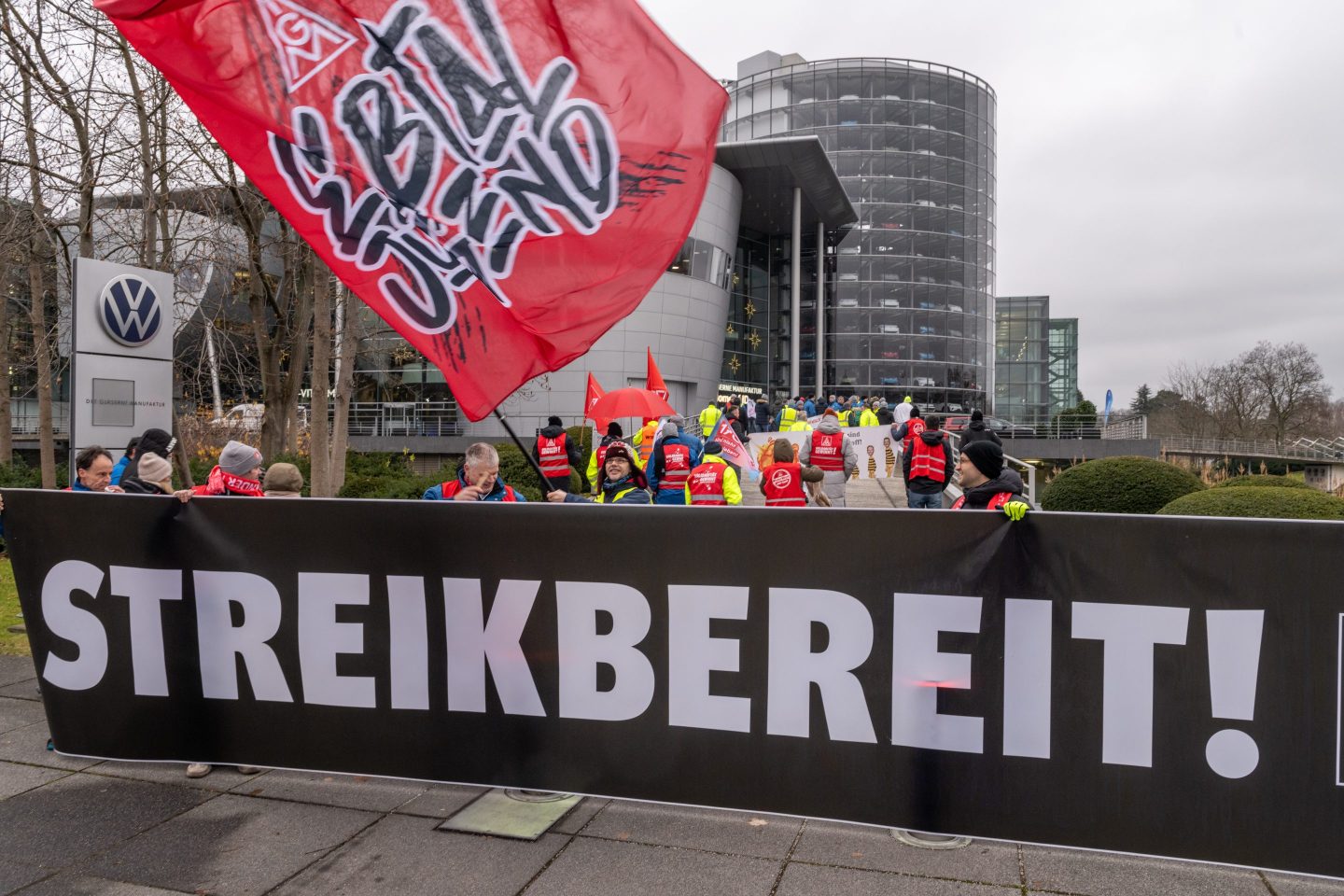
The struggles have burst into the open, with VW facing strikes over plans to close domestic plants and cuts looming at suppliers including Schaeffler AG, Robert Bosch GmbH and Continental AG. Overall, German firms in the Fortune 500 Europe have announced more than 60,000 layoffs so far this year.
Thyssenkrupp AG, the country’s largest steelmaker and one of the original forces behind German industrialization, is one of those cutting back at home. It plans to reduce the labor force at its steel unit by about 40% this decade and shutter two blast furnaces.
“The stability of Germany’s economic system as we’ve known it for decades is crumbling,” said Chief Executive Officer Miguel Lopez. “There is no doubting the need to act now.”