• Home
  • Latest
  • Fortune 500
  • Finance
  • Tech
  • Leadership
  • Lifestyle
  • Rankings
  • Multimedia
Commentary

4 potential scenarios—and 1 map—showing how the world will trade goods for the next decade, according to BCG

By
Nikolaus Lang
Nikolaus Lang
,
Marc Gilbert
Marc Gilbert
, and
Michael McAdoo
Michael McAdoo
Down Arrow Button Icon
By
Nikolaus Lang
Nikolaus Lang
,
Marc Gilbert
Marc Gilbert
, and
Michael McAdoo
Michael McAdoo
Down Arrow Button Icon
August 7, 2024, 10:09 AM ET
Nikolaus Lang, PhD, is a managing director and senior partner at Boston Consulting Group (BCG) based in Munich. He is also the global leader of the BCG Henderson Institute and chair of the BCG’s Center for Geopolitics. Marc Gilbert is a managing director and senior partner at Boston Consulting Group based in Toronto. Michael McAdoo is partner and director at Boston Consulting Group based in Montreal.
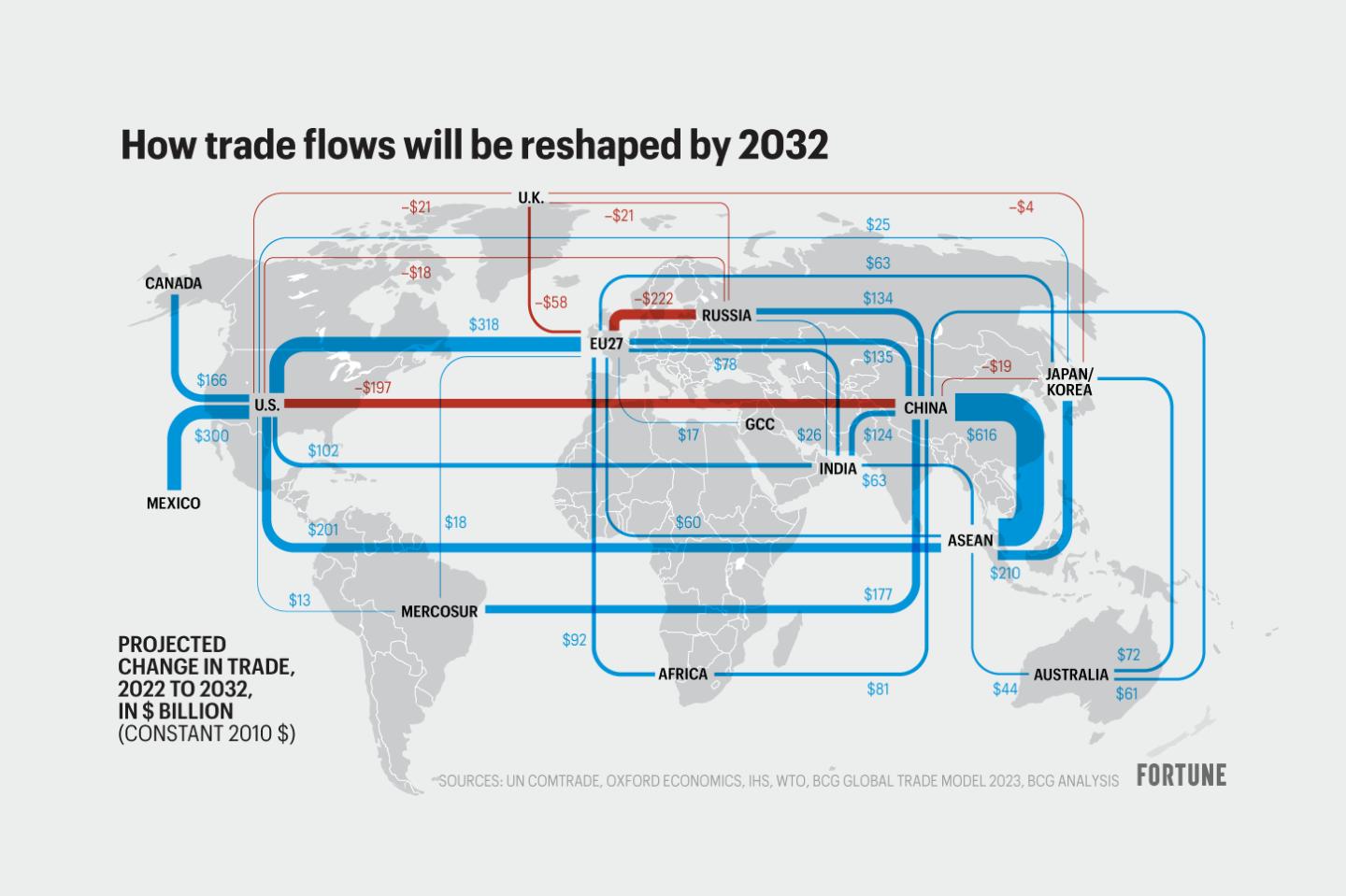
Map shows projected 2033 trade changes
Map shows projected trade changes by 2032Nicolas Rapp

The world order is on shaky ground. A financial crisis, the global pandemic, regional conflicts, and high inflation have spurred humanity’s departure from the relative stability and openness of the 1990s and early 2000s. What’s more, some 70 countries and territories have held or will hold national elections this year—some of which could have profound effects on both domestic populations and global institutions. 

In this environment, traditional strategic planning is rendered obsolete. Rather than being predictive or attempting to be exhaustive, we need to think in terms of scenarios—alternative visions of how the world might look—and assess the business impact of potential geopolitical events under these assumptions. For instance, many experts didn’t expect Russia’s military buildup on the Ukrainian border to become a full-blown invasion, and many multinationals didn’t hedge against the risk of war. After the invasion in February 2022, corporations were left scrambling to handle disrupted supply chains and inflationary pressures. This crisis may have been an unlikely scenario, but it was a plausible one.

The critical takeaway is that we need to consider scenarios for the 2030s—a time horizon beyond the typical two-to-three-year corporate planning cycle, but not so distant that the scenarios are too theoretical or academic to be useful.

How geopolitics could reshape the world by 2032

The least likely scenario today—because of stagnant WTO reforms, the UN’s inability to stop conflicts in Gaza and Ukraine, and the rise of protectionist industrial policies—is a return to the days of global cooperation and peace. Western-values-based global institutions and peace mechanisms would regain dominance, and as sanctions and conflicts recede, global trade would reach historic highs.

A more likely scenario envisions the proliferation of regional conflicts. Although total global trade would be stable, regionalization would shift its flows, and supply shocks would multiply. These disruptions would strain commodity markets, while sanctions complicate capital flows. Global talent flows would also be obstructed.

Sitting between the first two scenarios in terms of likelihood, based on the state of tensions in the South China Sea and the Taiwan Strait, Russia’s nuclear rhetoric, and the risk of full-scale conflict in the Middle East, is a possibility of global escalation as major powers become directly involved. Global trade would plunge, and supply chains would go local. Technological innovation would focus on warfare and cybersecurity, and talent mobility would grind to a halt.

Currently, the scenario with the most momentum is defined by multipolar rivalry—consider the revitalization of NATO in the last two years, the recent expansion of BRICS, and the “no-limits” friendship between China and Russia. In this scenario, competing poles coexist. With limited trust among these blocs, they would form their own norms, institutions, tech stacks, and trade platforms. In decoupled global financial markets, access to capital would be limited. Innovation and climate policy would also be polarized. Though total global trade would be stable, trade lanes would shift, and preferred partners would trade within poles, not between them.

The shifting global trade map

Our analysis of more than 500 million data points, as well as macroeconomic and geopolitical drivers such as GDP growth, the evolution of free trade agreements, potential tariff policies, and export restrictions, has confirmed that distinct poles will be the drivers of global trade activity—a prime illustration of the multipolar scenario.

A powerful pole is developing in North America. U.S. trade with Canada and Mexico is forecast to increase by $466 billion over the next decade. Recent U.S. policies, such as the Infrastructure Investment and Jobs Act (IIJA), CHIPS Act, and the Inflation Reduction Act (IRA) are reinforcing the U.S.-Mexico-Canada Agreement (USMCA) and resulting in more reshoring and nearshoring. The IRA, for instance, includes “Buy North American” incentives.

While trade flows within North America grow, we forecast that trade between the U.S. and China will drop by $197 billion by 2032, amid continued tensions and barriers. Over the same period, trade between China and Southeast Asia is expected to grow by an impressive $616 billion. Southeast Asian nations will also see a surge in trade with Japan and South Korea. In total, additional trade from and to Southeast Asia will reach more than $1.4 trillion—largely driven by a diversification of supply chains away from China, as well as a favorable trade environment in many ASEAN countries.

Another pole is emerging among the BRICS. When Russia’s trade with the U.S. and the EU was disrupted by its war in Ukraine, it looked to its fellow BRICS nations to bridge the gap. So while Russia’s trade with the EU will fall by $222 billion by 2032 compared with 2022, its trade with China and India will grow by $134 billion and $26 billion, respectively. This trade diversion trend should be considered alongside the evolution of BRICS+. The 10 BRICS+ nations currently account for half the world’s population, two-fifths of global trade, and around 40% of both crude oil production and exports—and 12 more nations have applied for membership.

Of course, global trade is just one lens. Scenarios can reveal how various conditions will affect such macroeconomic indicators as GDP growth, inflation, oil prices, the trajectory of global warming, and international migration, to name a few.

In this fast-changing world, geopolitics must become a strategic priority for all companies—their future depends on it. The time to start is now.

More must-read commentary published by Fortune:

  • Markets have overestimated AI-driven productivity gains, says MIT economist
  • Private equity is devouring the economy as boomer entrepreneurs exit—but a new approach to employee ownership can change that
  • ‘The Godmother of AI’ says California’s well-intended AI bill will harm the U.S. ecosystem
  • The ‘Trump dump’ is back—and the stocks that he targets are crashing

The opinions expressed in Fortune.com commentary pieces are solely the views of their authors and do not necessarily reflect the opinions and beliefs of Fortune.

Join us at the Fortune Workplace Innovation Summit May 19–20, 2026, in Atlanta. The next era of workplace innovation is here—and the old playbook is being rewritten. At this exclusive, high-energy event, the world’s most innovative leaders will convene to explore how AI, humanity, and strategy converge to redefine, again, the future of work. Register now.
About the Authors
By Nikolaus Lang
See full bioRight Arrow Button Icon
By Marc Gilbert
See full bioRight Arrow Button Icon
By Michael McAdoo
See full bioRight Arrow Button Icon

Latest in Commentary

Finance
Lorem ipsum dolor sit amet, consectetur adipiscing elit, sed do eiusmod tempor incididunt ut labore et dolore magna aliqua. Ut enim ad minim veniam
By Fortune Editors
October 20, 2025
Finance
Lorem ipsum dolor sit amet, consectetur adipiscing elit, sed do eiusmod tempor incididunt ut labore et dolore magna aliqua. Ut enim ad minim veniam
By Fortune Editors
October 20, 2025
Finance
Lorem ipsum dolor sit amet, consectetur adipiscing elit, sed do eiusmod tempor incididunt ut labore et dolore magna aliqua. Ut enim ad minim veniam
By Fortune Editors
October 20, 2025
Finance
Lorem ipsum dolor sit amet, consectetur adipiscing elit, sed do eiusmod tempor incididunt ut labore et dolore magna aliqua. Ut enim ad minim veniam
By Fortune Editors
October 20, 2025
Finance
Lorem ipsum dolor sit amet, consectetur adipiscing elit, sed do eiusmod tempor incididunt ut labore et dolore magna aliqua. Ut enim ad minim veniam
By Fortune Editors
October 20, 2025
Finance
Lorem ipsum dolor sit amet, consectetur adipiscing elit, sed do eiusmod tempor incididunt ut labore et dolore magna aliqua. Ut enim ad minim veniam
By Fortune Editors
October 20, 2025

Most Popular

Finance
Lorem ipsum dolor sit amet, consectetur adipiscing elit, sed do eiusmod tempor incididunt ut labore et dolore magna aliqua. Ut enim ad minim veniam
By Fortune Editors
October 20, 2025
Finance
Lorem ipsum dolor sit amet, consectetur adipiscing elit, sed do eiusmod tempor incididunt ut labore et dolore magna aliqua. Ut enim ad minim veniam
By Fortune Editors
October 20, 2025
Finance
Lorem ipsum dolor sit amet, consectetur adipiscing elit, sed do eiusmod tempor incididunt ut labore et dolore magna aliqua. Ut enim ad minim veniam
By Fortune Editors
October 20, 2025
Finance
Lorem ipsum dolor sit amet, consectetur adipiscing elit, sed do eiusmod tempor incididunt ut labore et dolore magna aliqua. Ut enim ad minim veniam
By Fortune Editors
October 20, 2025
Finance
Lorem ipsum dolor sit amet, consectetur adipiscing elit, sed do eiusmod tempor incididunt ut labore et dolore magna aliqua. Ut enim ad minim veniam
By Fortune Editors
October 20, 2025
Finance
Lorem ipsum dolor sit amet, consectetur adipiscing elit, sed do eiusmod tempor incididunt ut labore et dolore magna aliqua. Ut enim ad minim veniam
By Fortune Editors
October 20, 2025
Fortune Secondary Logo
Rankings
  • 100 Best Companies
  • Fortune 500
  • Global 500
  • Fortune 500 Europe
  • Most Powerful Women
  • World's Most Admired Companies
  • See All Rankings
  • Lists Calendar
Sections
  • Finance
  • Fortune Crypto
  • Features
  • Leadership
  • Health
  • Commentary
  • Success
  • Retail
  • Mpw
  • Tech
  • Lifestyle
  • CEO Initiative
  • Asia
  • Politics
  • Conferences
  • Europe
  • Newsletters
  • Personal Finance
  • Environment
  • Magazine
  • Education
Customer Support
  • Frequently Asked Questions
  • Customer Service Portal
  • Privacy Policy
  • Terms Of Use
  • Single Issues For Purchase
  • International Print
Commercial Services
  • Advertising
  • Fortune Brand Studio
  • Fortune Analytics
  • Fortune Conferences
  • Business Development
  • Group Subscriptions
About Us
  • About Us
  • Press Center
  • Work At Fortune
  • Terms And Conditions
  • Site Map
  • About Us
  • Press Center
  • Work At Fortune
  • Terms And Conditions
  • Site Map
  • Facebook icon
  • Twitter icon
  • LinkedIn icon
  • Instagram icon
  • Pinterest icon

Latest in Commentary

francis
CommentaryFlorida
Former Miami Mayor Francis Suarez: Why I’m joining Stephen Ross and Ken Griffin in betting big on ambitious business leaders
By Francis SuarezMay 1, 2026
16 hours ago
valerie
CommentaryLayoffs
Tesla’s former HR chief: the AI layoff panic Is built on a false premise—here’s what most workers need to know
By Valerie Capers WorkmanMay 1, 2026
17 hours ago
tamas
CommentaryPolymarket
SEON CEO: Prediction markets can forecast the future. Can they survive their own manipulation problem?
By Tamas KadarMay 1, 2026
20 hours ago
sundar
Commentary250 Years of Innovation
America at 250: immigration and the making of an innovative nation
By Nasser KazeminyMay 1, 2026
22 hours ago
Derek Kilmer
CommentaryEconomics
The U.S. economy is booming — just not where 50 million Americans live
By Derek KilmerMay 1, 2026
22 hours ago
hegseth
CommentaryMilitary
America shot its arsenal empty in 2 wars. Now it needs Beijing’s permission to reload
By Steve H. Hanke and Jeffrey WengApril 30, 2026
2 days ago

Most Popular

Scott Bessent on financial literacy: 'it drives me crazy' to see young men in blue-collar construction jobs playing the lottery
Personal Finance
Scott Bessent on financial literacy: 'it drives me crazy' to see young men in blue-collar construction jobs playing the lottery
By Fatima Hussein and The Associated PressMay 1, 2026
17 hours ago
China dominates the world's lithium supply. The U.S. just found 328 years' worth in its own backyard
North America
China dominates the world's lithium supply. The U.S. just found 328 years' worth in its own backyard
By Jake AngeloApril 30, 2026
2 days ago
The U.S. economy is booming — just not where 50 million Americans live
Commentary
The U.S. economy is booming — just not where 50 million Americans live
By Derek KilmerMay 1, 2026
22 hours ago
Apple cofounder Ronald Wayne—whose stake would be worth up to $400 billion had he not sold it in 1976—says that at 91, he has no regrets
Success
Apple cofounder Ronald Wayne—whose stake would be worth up to $400 billion had he not sold it in 1976—says that at 91, he has no regrets
By Preston ForeApril 27, 2026
5 days ago
Accenture's Julie Sweet blew up 50 years of company history. She says the hardest part is still ahead
Conferences
Accenture's Julie Sweet blew up 50 years of company history. She says the hardest part is still ahead
By Nick LichtenbergApril 29, 2026
3 days ago
Current price of oil as of May 1, 2026
Personal Finance
Current price of oil as of May 1, 2026
By Joseph HostetlerMay 1, 2026
18 hours ago

© 2026 Fortune Media IP Limited. All Rights Reserved. Use of this site constitutes acceptance of our Terms of Use and Privacy Policy | CA Notice at Collection and Privacy Notice | Do Not Sell/Share My Personal Information
FORTUNE is a trademark of Fortune Media IP Limited, registered in the U.S. and other countries. FORTUNE may receive compensation for some links to products and services on this website. Offers may be subject to change without notice.