
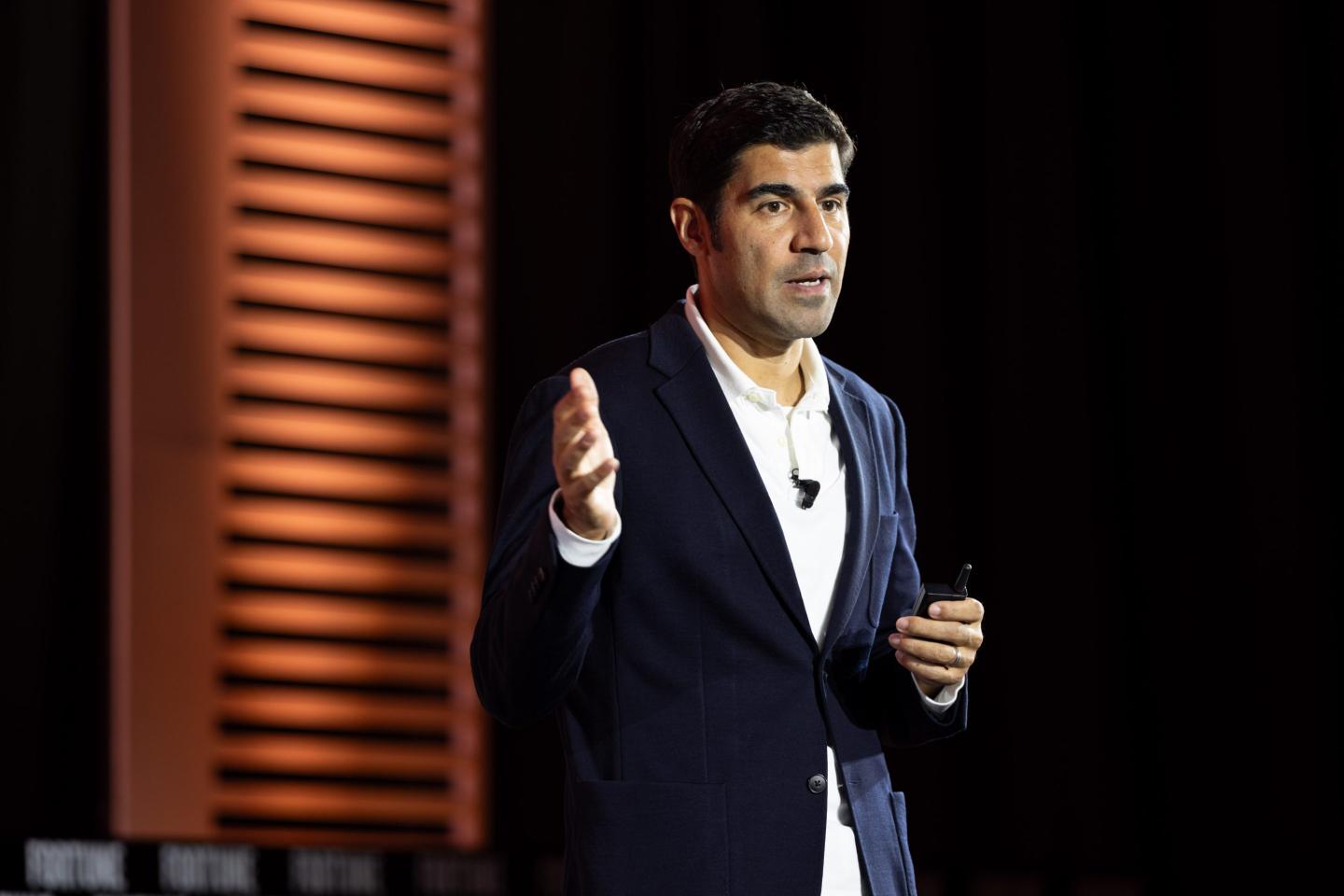
Parag Khanna wants to help people “future-proof” their real estate. The author of more than 20 books has long been known for his analysis and macroeconomic forecasts, and his new firm, the AI-powered analytics platform Climate Alpha, seeks to harness data to track trends in migration, climate change, and finance to know which locations will provide both resilience and profit when the world changes. He argues that the Black Swan is not the right way to think of climate risk, but rather the Green Swans are flocking, and headed straight for millions of miles of real estate.
At an estimated value of over $300 trillion, land and real estate remains the world’s most valuable asset class and yet it is directly exposed to climate change and demographic decline. As Khanna noted in his presentation to the Fortune Global Forum in Abu Dhabi, real estate is by definition “trapped and immobile.”
Watch the video interview above or see the full transcript below.
Parag Khanna:
You’re all familiar with the concept of the Black Swan, it hardly needs to be explained anymore: a low probability, high-impact event. But the real risks in the world today are the Green Swans and they are flocking. And what’s different, of course, between them and a Black Swan is that they are not unpredictable or low probability. In fact, they’re happening all the time. So much so that the total annual estimated damage and payouts from climate disasters is increasing by tens of billions every single year, reaching $250 billion last year.
So we now know what we have to prepare for, but we are not. We have a major collective action problem. And here, as we gather on the eve of COP28, we know over the last several decades that while heroic amounts of resources are being committed to mitigation, decarbonisation, greening our industries and supply chains, not enough is being committed to adaptation, which is how we retrofit our infrastructure, relocate populations, invest in climate resilience for our societies for our economies That has not happened yet. And therefore, as the Bank of International Settlements has warned us, without that collective action, climate risks are largely unbearable at a systematic level.
And indeed, the industry that is most exposed is the largest now, as if high interest rates, COVID-related abandonment of offices and worker relocation after COVID wasn’t bad enough. Now you have the climate factor, potentially decimating certain geographies. We’ve all been accustomed to real estate going up and to the right for generation after generation after generation, but, not only due to climate change, the plateauing of the world population means that there is a zero sum game under way in the geography of global real estate. All of these are slamming the global real estate industry which, as valuable as it is, is by definition trapped and immobile.
Now, if you take the present distribution of the world population, all 8 billion of us on this map, literally every human being is a pixel and forecast of what happens to the livability, the suitability for human habitation of geographies over the next five, 10, 15, 20 years, as temperatures rise toward the two-degree threshold, you get a picture that looks somewhat like this [points to map].
Now, I think we all unfortunately have been made aware in recent years that this is not a map of the year 2050 or 2060. We cannot be complacent in believing that if we simply meet the Paris Agreement targets and limit greenhouse gas emissions and try to slow temperature rise that we can avert certain negative chain reactions that are already well under way in our biosphere generally, and certainly when it comes to the consequences of temperature rise itself.
For example, if you look at South Asia, now the most populous region of the entire world, India alone, with more people than China, and if you take Pakistan, India, Bangladesh, that alone is 1.8 billion people as a subregion, that is one of the most climate-stressed regions of the entire world. So it wouldn’t be a stretch to posit that over the next five to 10 years, or in the coming decades, the number of people who are going to relocate as a result of climate phenomena, which is already one-third of the total dislocated people in the world today, is going to cross hundreds of millions of people. That’s what the World Bank has already forecast, and they’re potentially understating the case.
So the question becomes not just what to do next. But where is next? Because unfortunately, not only the real-estate industry, but by extension, our habitats or settlements or towns or cities or communities are going to be affected and many people are going to move and investors are going to need to anticipate the new geographies that are more climate resilient, more fertile. To build new towns and communities and so forth as we adapt to climate change, because remember, the climate is not going to adapt to us. We have to adapt to it.
But one of the things that we have neglected in the focus on mitigation and decarbonisation, instead of adaptation, is really quantifying financial impact. We simply have the studies and forecasts that say that it will get worse in place X or Y, but without putting a price on that phenomenon, we’re not able to really incentivize and shape industry behavior. There was a lot of focus on again, the decarbonisation space, and regulations there, particularly in Europe, and in a couple of other countries, it’s starting to happen more in the United States. But generally speaking, adaptation is considered a private good, not a global public good like decarbonisation. So you have much more localized impact assessments and calculations and time horizons under which firms operate.
What we’ve done in our research is to think about how spatially, geographically, you should look not only at the risk indicators from climate, where it’s uncertain under what time horizon or scale those are going to play out, and also layer in the resilience, the local resilience. The truth is that any given place in the world is going to be determined by how adapted that location is, what are its investments in resilience, and one of the things we have not done is to quantify resilience. Resilience is a term that gets talked about a lot, especially during COVID. What made for a resilient society? How did communities bounce back? But have we quantified it? We haven’t.
And that’s what we’ve started to do is to say, what is in fact, the financial impact of positive financial impact to offset climate risk of having an energy grid powered by renewables? What about the availability of health care, the quality of life in a given location, the quality of infrastructure, the public spending, the social robustness? All of these indicators that you can in fact back-test, the climate stuff, climate change is new, but a lot of the socioeconomic and infrastructural investments that we can and need to make more of now, you can prove [they] have a historical impact on real-estate assets, retaining their value.
So it’s at the confluence of risk and resilience and turning that index into financial impact that we believe creates a very actionable scorecard dashboard, and set of coefficients that we generate that help real estate investors plan accordingly. Now, there are a lot of things you can do in the real estate space, the built environment, to cope with risks. In fact, for every single physical risk, there is an intervention that you can make, where there’s going to be heat stress, you have to invest more in in air conditioning, or in district cooling. Where there’s hurricane risk, you want to do more around coastal inundation protection, drainage systems, and so on and so forth. We can do so much more with water conservation, water management, and the like. But that said, part of what’s happening is the demographics and the investment landscape changing as a result of everything from the interest-rate environment to relocations of companies to human migration, and a young generation that is less wedded to any particular geography. And so you have a competition among locations to be the most adapted to attract investment to attract people. And this is one of the macro trends that if you really pan back and think about this reality of us having to adapt to climate change, rather than the climate adapting to us.
You realize that if you go back 7,000 or 8,000 years, the history of human settlements, there has always been a competition among geographies, to be the places that are the most open, that attract talent, that are the centers of industry and innovation. And that process is under way today, as well. Some of the most significant commercial hubs and economic centers of the world are also very climate stress geographies. And if they don’t adapt new centers of excellence, new civilizational centers and hubs are going to arise.
In my travels and research. I’ve spotlighted some of the locations that I see as being not only climate resilient, but doing a lot to build micro climates of energy efficiency, places that are trying to retrofit their infrastructure, trying to keep temperatures down in their built environment and all of these kinds of things that make them attractive and livable. So it’s a lot of things that are going to make a lot of ingredients that are going into make places resilient. To what extent they are making those investments and that’s going to make them attractive destinations for the global asset management, global investment industry and indeed for young talent.
Now note there is a star right there over this country, the United Arab Emirates. And so let’s remember that the climate model is saying it’s going to be searing scorching hot here, right? Can’t argue with that. It already is. However, think about the adaptation investments. Not nearly enough countries are doing what this country has already done and started to do: everything from air conditioning, coastal mangroves, water desalination, and so on and so forth. And that, again, is the differentiator, the climate model tells us, many places are doomed. But we have that capacity for investment and ingenuity and innovation, to adapt. And so places have to adapt, or they will lose out in this competition for investment and talent.
Now, as you saw in that previous map, we have many geographies in the world that are sadly becoming unlivable or certainly less suitable for human habitation. And so really, you can create a simple supply demand curve, right, the supply of climate-resilient assets and geographies is getting smaller, and therefore the demand for them and as the demand for them rises, their prices, their price is going to rise as well. So this inevitably becomes something of an investment proposition, to be the first movers to invest in those climate resilient geographies, to start to retrofit them to build the food, water, energy, housing, transportation and other systems, they’re going to be necessary as the populations of climate resilient geographies grow over time. And that time is in fact now.
Indeed, resilient geography I would say is the most valuable asset class in the world. If real estate is already the largest industry, we haven’t quantified it, priced it, located it and made it an investable proposition. In fact, if you think about the way in which we calculate sovereign risk today, so often it’s based strictly on regulatory norms or a rule of law. But it doesn’t take into account whether a country is really investing in climate resilience or not. And yet, there are entire swaths of the world—it might be Central Asia or other places in in Asia or even parts of Europe—that may not be investor darlings right now, but that are making the right investments and are climate propitious and more capital should be allocated there.
One of the things that we’re doing is to help guide asset managers to really allocate capital to these climate-resilient locations, because not only is their income generation off of those investments, but there’s actually capital appreciation as well in the long term, given that supply-demand curve.
So in summary, we have a very important opportunity. Here we are at a crossroads in the world where we have this massive misalignment in the world between the geography of people, the geography of borders, the geography of infrastructure and the geography of economic activity. And it’s up to us to actually realign it, it’s not going to happen on its own. COP28 is not going to give us that solution. It’s really up to the corporates, the CEOs, the investors, the leaders of the world, to realign the map by building where we need to build to adapt all of human civilization collectively.