
• Home
  • Latest
  • Fortune 500
  • Finance
  • Tech
  • Leadership
  • Lifestyle
  • Rankings
  • Multimedia
China

Chinese real estate may be the world economy’s ‘most important single sector,’ says Fitch. But don’t expect Beijing to save it from crisis

Nicholas Gordon
By
Nicholas Gordon
Nicholas Gordon
Asia Editor
Down Arrow Button Icon
Nicholas Gordon
By
Nicholas Gordon
Nicholas Gordon
Asia Editor
Down Arrow Button Icon
August 17, 2023, 8:10 AM ET
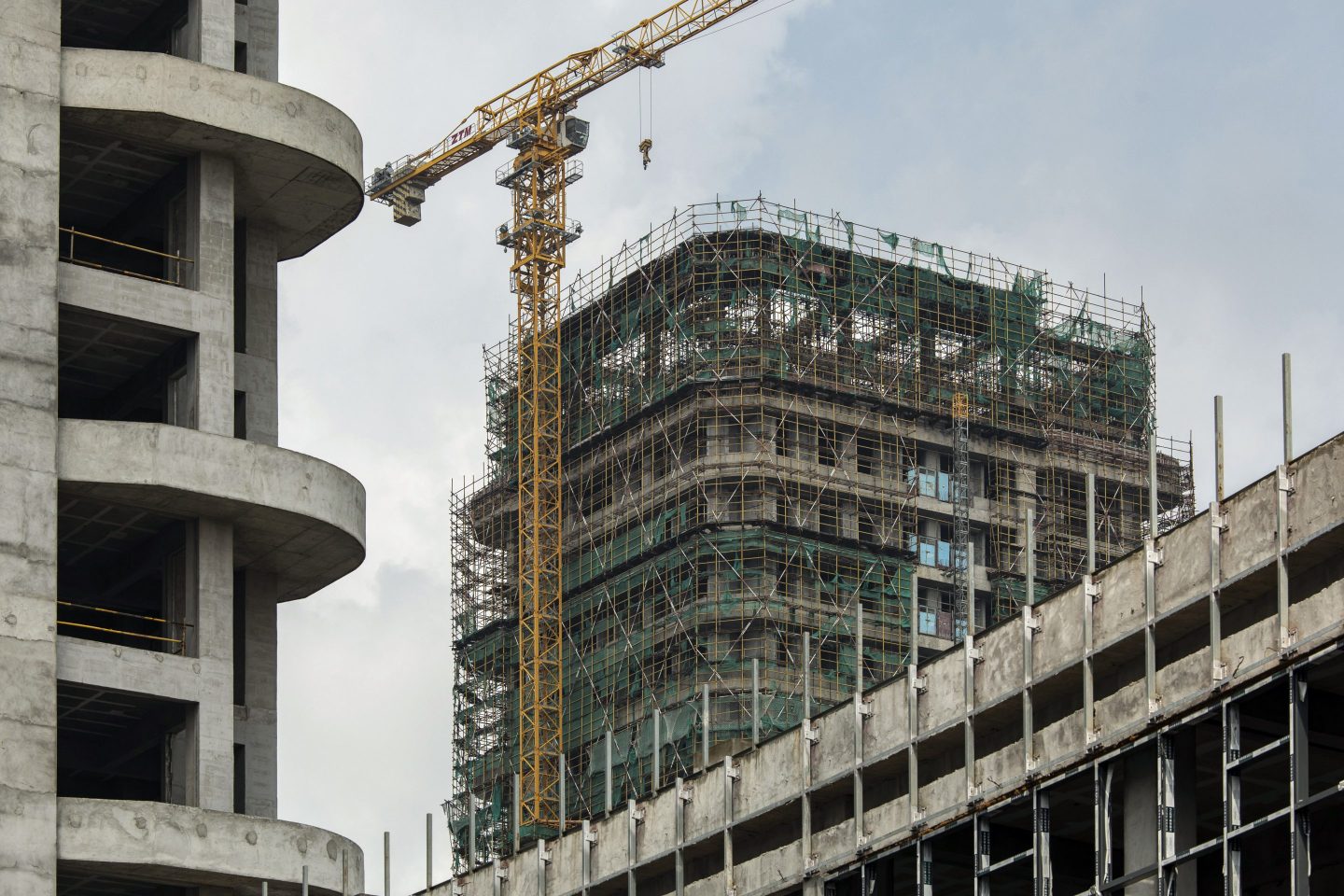
Buildings under construction at the Legend of Sea project, codeveloped by Country Garden Holdings Co. and Jiangsu Zhongnan Construction Industry Group, in Ningbo, China, on Wednesday, Aug. 16, 2023.
Chinese property developers like Country Garden are struggling to make debt payments following a prolonged slump in China’s housing market. Qilai Shen—Bloomberg/Getty Images

China’s property sector is continuing its yearslong crisis, as giant developers risk default and home prices continue to sink, perhaps by more than what official data suggests.

Recommended Video

Real estate constitutes about 30% of China’s GDP, making it the single biggest contributor to the world’s second-largest economy.

That makes it the “most important single sector of the global economy,” James McCormack, Fitch’s global head of sovereigns, told Bloomberg TV in a Thursday interview. 

“There’s a structural change underway; it is not going to be the growth driver of the Chinese economy the way it has been in the past,” he continued.

Yet China is unlikely to step in and provide “massive support to property developers,” McCormack predicted, given Beijing’s previous wish to lower debt in the real estate sector and reduce property’s overall importance to the economy. 

The decline of real estate was not “unintended,” McCormack believes, even though the “spillovers to the broader economy and confidence” probably weren’t expected by officials.

China’s property crisis is just one warning sign for the country’s economy, already struggling with stagnant consumption, high youth unemployment, and now potential liquidity issues in the financial sector.

Downgrading China’s debt

Weeks after Fitch Ratings knocked the sovereign debt of the U.S. from the premium level, McCormack suggested how the world’s second-largest economy could also get its downgrade. 

Fitch currently ranks China as A+, meaning it considers Chinese debt to be of “high credit quality.” The country has held that status since 2007, making it one of Fitch’s “most stable ratings,” McCormack said.

But if debt grows to dangerous levels in corporate and banking sectors it may become a “real [liability] for the government,” he said. If that prompts Beijing to step in, that may in turn push the rating agency to reconsider China’s rating, he suggested.

China’s “debt-to-GDP ratio is a little bit on the high side for a single ‘A’ credit,” McCormack said. China currently has a debt-to-GDP ratio of 281.5%, according to Bloomberg calculations—a record high.

When Fitch last affirmed its rating of Chinese debt in December, the agency cited “a sustained upward trajectory in government debt,” and “abrupt policy shifts” as factors that might lead to a downgrade.

Fellow rating agencies Moody’s and S&P both downgraded China in 2017, citing high levels of domestic debt. 

McCormack said that the government extending its balance sheet to support the economy was unlikely. “Recent evidence doesn’t suggest that would be the case,” he told Bloomberg. 

In fact, some economists are worried that Beijing is not spending too much money, but rather too little. China has largely avoided direct stimulus to boost its flagging economy, as officials resort to slashing interest rates and taxes instead of direct support to households. 

Wary of stimulus

Unlike the U.S., China’s economy is anything but strong.

China reported below-expectations growth in retail sales and manufacturing on Tuesday, following an 89% plunge in new loans in July compared with the previous month.

The country’s statistics bureau also said Tuesday that it would stop measuring youth unemployment, which hit a record 21.3% in June.

Home prices continued their decline in July—perhaps even worse than what official data suggests—putting pressure on China’s private property developers.

Yet Beijing is avoiding the use of stimulus to boost consumption and the economy, instead relying on tax cuts and other incentives for businesses to spend and invest. 

That’s starting to worry some prominent Chinese economists, who argue that Beijing needs to start giving money to households directly. Beijing needs to “use all reasonable, legally compliant, and economic channels to put money in residents’ pockets,” Cai Fang, an advisor to the central bank, wrote in an article Monday. Cai has previously called for over $550 billion in stimulus to Chinese households.

Still, Chinese officials are wary of direct stimulus. Party officials have previously warned about “welfarism,” instead wanting Chinese households to build wealth through work. 

Join us at the Fortune Workplace Innovation Summit May 19–20, 2026, in Atlanta. The next era of workplace innovation is here—and the old playbook is being rewritten. At this exclusive, high-energy event, the world’s most innovative leaders will convene to explore how AI, humanity, and strategy converge to redefine, again, the future of work. Register now.
About the Author
Nicholas Gordon
By Nicholas GordonAsia Editor
LinkedIn iconTwitter icon

Nicholas Gordon is an Asia editor based in Hong Kong, where he helps to drive Fortune’s coverage of Asian business and economics news.

See full bioRight Arrow Button Icon

Latest in

PoliticsAffordable Care Act (ACA)
With just days to go before ACA subsidies expire, Congress is about to wrap up its work with no consensus solution in sight
By Kevin Freking, Lisa Mascaro and The Associated PressDecember 13, 2025
1 minute ago
PoliticsDonald Trump
Trump couldn’t insult his way to victory in Indiana redistricting battle. ‘Folks in our state don’t react well to being bullied’
By Thomas Beaumont, Isabella Volmert and The Associated PressDecember 13, 2025
17 minutes ago
InnovationRobots
Even in Silicon Valley, skepticism looms over robots, while ‘China has certainly a lot more momentum on humanoids’
By Matt O'Brien and The Associated PressDecember 13, 2025
32 minutes ago
HealthAffordable Care Act (ACA)
A Wisconsin couple was paying $2 a month for an ACA health plan. But as subsidies expire, it’s soaring to $1,600, forcing them to downgrade
By Ali Swenson and The Associated PressDecember 13, 2025
46 minutes ago
Julian Braithwaite is the Director General of the International Alliance for Responsible Drinking
CommentaryProductivity
Gen Z is drinking 20% less than Millennials. Productivity is rising. Coincidence? Not quite
By Julian BraithwaiteDecember 13, 2025
2 hours ago
carbon
Commentaryclimate change
Banking on carbon markets 2.0: why financial institutions should engage with carbon credits
By Usha Rao-MonariDecember 13, 2025
3 hours ago

Most Popular

placeholder alt text
Economy
Tariffs are taxes and they were used to finance the federal government until the 1913 income tax. A top economist breaks it down
By Kent JonesDecember 12, 2025
1 day ago
placeholder alt text
Success
Apple cofounder Ronald Wayne sold his 10% stake for $800 in 1976—today it’d be worth up to $400 billion
By Preston ForeDecember 12, 2025
1 day ago
placeholder alt text
Success
40% of Stanford undergrads receive disability accommodations—but it’s become a college-wide phenomenon as Gen Z try to succeed in the current climate
By Preston ForeDecember 12, 2025
1 day ago
placeholder alt text
Economy
For the first time since Trump’s tariff rollout, import tax revenue has fallen, threatening his lofty plans to slash the $38 trillion national debt
By Sasha RogelbergDecember 12, 2025
20 hours ago
placeholder alt text
Economy
The Fed just ‘Trump-proofed’ itself with a unanimous move to preempt a potential leadership shake-up
By Jason MaDecember 12, 2025
18 hours ago
placeholder alt text
Success
At 18, doctors gave him three hours to live. He played video games from his hospital bed—and now, he’s built a $10 million-a-year video game studio
By Preston ForeDecember 10, 2025
3 days ago
Rankings
  • 100 Best Companies
  • Fortune 500
  • Global 500
  • Fortune 500 Europe
  • Most Powerful Women
  • Future 50
  • World’s Most Admired Companies
  • See All Rankings
Sections
  • Finance
  • Leadership
  • Success
  • Tech
  • Asia
  • Europe
  • Environment
  • Fortune Crypto
  • Health
  • Retail
  • Lifestyle
  • Politics
  • Newsletters
  • Magazine
  • Features
  • Commentary
  • Mpw
  • CEO Initiative
  • Conferences
  • Personal Finance
  • Education
Customer Support
  • Frequently Asked Questions
  • Customer Service Portal
  • Privacy Policy
  • Terms Of Use
  • Single Issues For Purchase
  • International Print
Commercial Services
  • Advertising
  • Fortune Brand Studio
  • Fortune Analytics
  • Fortune Conferences
  • Business Development
About Us
  • About Us
  • Editorial Calendar
  • Press Center
  • Work At Fortune
  • Diversity And Inclusion
  • Terms And Conditions
  • Site Map

© 2025 Fortune Media IP Limited. All Rights Reserved. Use of this site constitutes acceptance of our Terms of Use and Privacy Policy | CA Notice at Collection and Privacy Notice | Do Not Sell/Share My Personal Information
FORTUNE is a trademark of Fortune Media IP Limited, registered in the U.S. and other countries. FORTUNE may receive compensation for some links to products and services on this website. Offers may be subject to change without notice.