In March 2020, an experiment in science philanthropy was hatched in the span of a five-minute call.
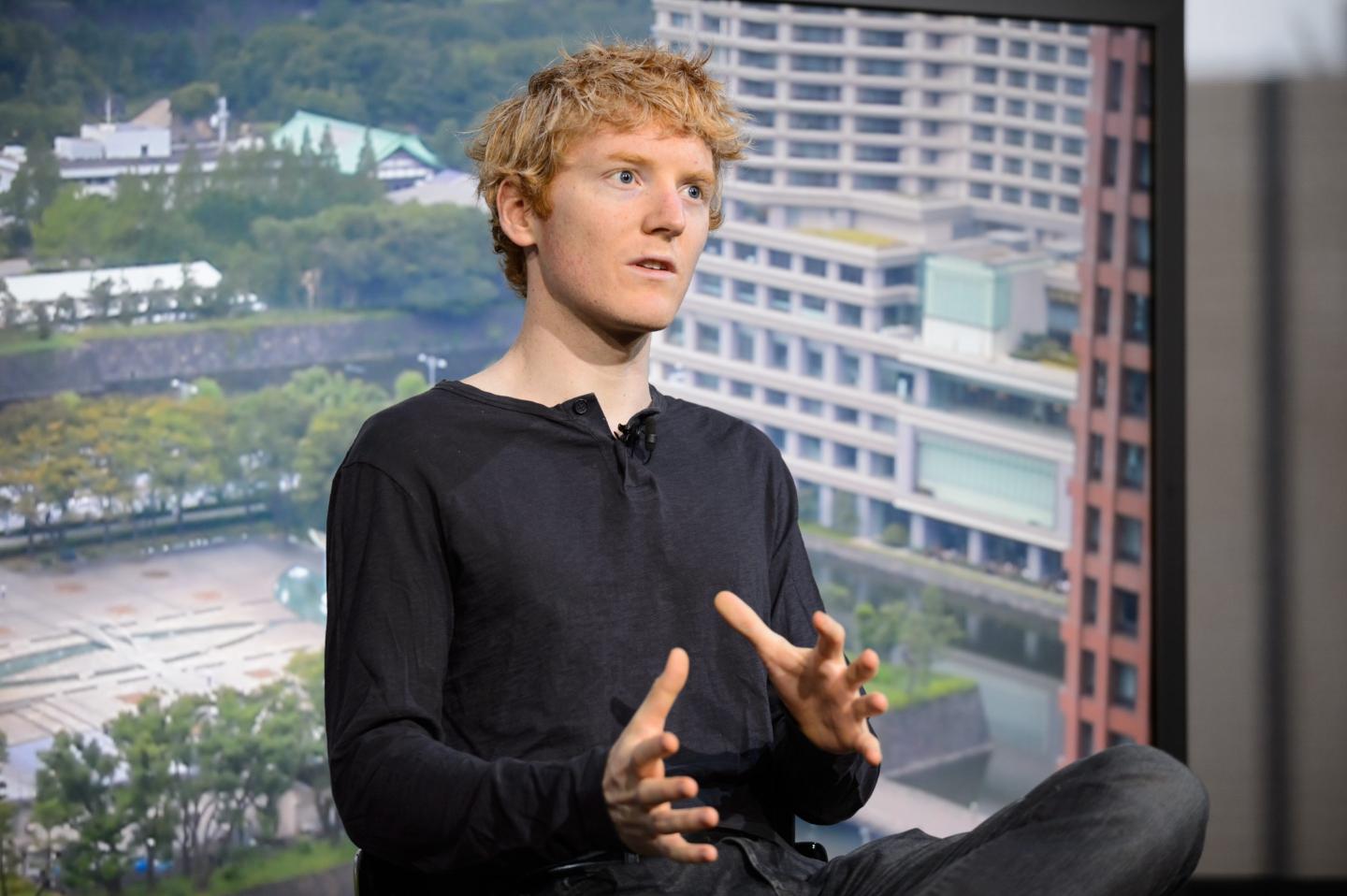
Patrick Collison, the now 34-year-old billionaire CEO of the online payments company Stripe, and economist Tyler Cowen were chewing over a shared concern: Scientific progress seemed to be slowing down. As the first pandemic lockdowns went into effect, researchers were in a holding pattern, waiting to hear if they could redirect their federal grants to COVID-related work. Collison and Cowen worried that the National Institutes of Health wasn’t moving quickly enough, so they launched Fast Grants to get emergency research dollars to virologists, coronavirus experts, and other scientists rapidly.
“We thought: Let’s just do this,” Cowen recalls. “It was a bit like put up or shut up.”
Collison and his brother, John — a Stripe co-founder — contributed and along with Cowen raised more than $50 million from some of the biggest names in tech: Jack Dorsey, Elon Musk, and Peter Thiel. Mark Zuckerberg and Priscilla Chan and former Google CEO Eric Schmidt and his wife, Wendy.
The first round of grants went out in 48 hours, and later rounds were distributed within two weeks, a drastic difference from the hundreds of days a scientist typically waits to hear from the NIH.
Grants of $10,000 to $500,000 backed early efforts to sequence new coronavirus variants, clinical trials for drugs that could potentially be repurposed, and a simple and reliable saliva-based COVID-19 test. By January 2022, all the money had gone out the door to more than 260 projects.
Fast Grants is one of many science improvement projects launched or backed by Silicon Valley billionaires since the pandemic began. Donors have channeled hundreds of millions of dollars into research labs and nonprofits to address what they view as problems with how government agencies and institutional philanthropies fund science. They argue that scientists spend too much time seeking funding for grants that are too restrictive and see a need to support high-potential young scientists and risky or speculative projects that are often overlooked or underfunded.
Collison, along with Vitalik Buterin, creator of the Ethereum blockchain platform, and other donors, pledged more than half a billion dollars to the Arc Institute, a new biomedical research nonprofit that wants scientists to focus on science, not chasing grants.
Eric and Wendy Schmidt spun off Convergent Research, a nonprofit helping to incubate independent organizations to develop research tools and niche or underfunded areas of science.
While these contributions are just a drop in the bucket compared with the nearly $50 billion the NIH spends on research each year, they’ve been met with both applause and ambivalence from scientists and philanthropy observers. Many of the experiments are similar to approaches already backed by government, leading some to question whether small-scale funding experiments in science are money well spent. Others question the societal implications when more science research is driven by a handful of tech elites motivated by the “move fast and break things” ethos.
Private donors have long played a role in shaping science in the United States — from the creation of the modern research universities to the independent research institutions of the early 20th century and beyond.
“There is a sort of ‘back to the future’ element to what these guys are doing,” says Eric John Abrahamson, a historian at work on a book about science philanthropy. He sees parallels between today’s donors and Andrew Carnegie and John D. Rockefeller, who wanted to reimagine the institutions of science in the 1910s, ’20s and ’30s.
The federal government became the majority funder of basic science research at universities and nonprofit research institutes in the post-World War II era. Today federal funding for basic science, which provides a foundation for knowledge and discovery rather than solving a specific problem, still exceeds the combined contributions from corporations, universities, and philanthropy. That margin is narrowing, according to National Science Foundation surveys.
The impact of private donors has grown since the 1990s, says France Córdova, president of the Science Philanthropy Alliance, which works to increase giving to science research. Nonprofit and philanthropic contributions for basic research increased from $1.5 billion in 1990 to $9.8 billion in 2020, according to NSF surveys. Contributions from higher education funds, which include money donors gave to university endowments in the past, increased from $1.9 billion to more than $14 billion in that same period. That growth is largely thanks to new philanthropies built on wealth from technology, data, and finance, she says.
These donors “want to apply some of the same entrepreneurial spirit that they used to get their money to philanthropy,” Córdova says.
Brian Nosek, executive director of the Center for Open Science, which works to increase transparency in the research process, applauds donors for helping to shake up how science is funded.
“There are many possible ways to decide what to fund, who to fund, how to fund them, how to track progress,” Nosek says. “We haven’t had a culture of experimentation.”
Nosek is on the board of the Good Science Project, an advocacy group that’s pushing government agencies to make their science grant making more innovative and efficient. Stuart Buck founded that nonprofit last year after a conversation with Collison. Collison and his brother, John, are its biggest benefactors, though they have not disclosed the size of their contributions.
Collison is also involved in the Arc Institute, which he helped launch in 2021 with $650 million pledged by more than a dozen other donors. The Palo Alto-based biomedical research organization provides scientists with no-strings-attached funding over eight-year terms to study the causes of complex diseases like cancer. The effort builds on lessons from Fast Grants. Funding isn’t tied to a particular research project so if scientists want to change course, their hands aren’t tied.
Funding approaches that shield scientists from bureaucracy or allow a wider range of ideas to get support may be useful in a circumscribed way, says David Peterson, an assistant professor of sociology at Purdue University who studies how scientific organizations are evolving. But he has doubts that these efforts will tilt the scale more broadly.
In Peterson’s conversations with scientists, some said they view these donors’ approaches as an extension of the tech world’s fixation with disruption, he says. “There is a feeling that science is another institution like the music industry or taxicabs that are ripe for fundamental transformation to make it much more efficient.”
But for a select group of scientists doing the kind of work these extremely wealthy donors care about, there’s now more money and opportunity.
At E11 Bio, for example, an interdisciplinary team of nine scientists is developing a technology platform for scientists to map every circuit between the 100 billion or so neurons in the brain. Understanding the full architecture of the brain could eventually lead to new treatments for brain disorders.
E11 bio is funded by Schmidt Futures, founded by former Google CEO Eric Schmidt, which spun off the nonprofit Convergence Research in 2021 to help launch independent organizations focused on areas like synthetic biology or how drugs target human proteins. Each research organization receives a $20 million to $100 million budget for a five- to seven-year duration.
Schmidt Futures declined to disclose total funding amounts for this work but in March announced a joint $50 million commitment with hedge-fund billionaire Ken Griffin to launch two more organizations.
It may take years to know whether these efforts succeed.
New approaches can have a big impact if they’re transparent about what’s working — and what isn’t, says Nosek.
“The main limitation that we’ve had in a lot of these efforts to improve science is that it’s done with good ideas and good intentions,” he says, “but without good evidence” to determine whether they’ve worked.
_____
This article was provided to The Associated Press by the Chronicle of Philanthropy. Eden Stiffman is a senior editor at the Chronicle. Email: eden.stiffman@philanthropy.com. The AP and the Chronicle receive support from the Lilly Endowment for coverage of philanthropy and nonprofits. The AP and the Chronicle are solely responsible for all content.