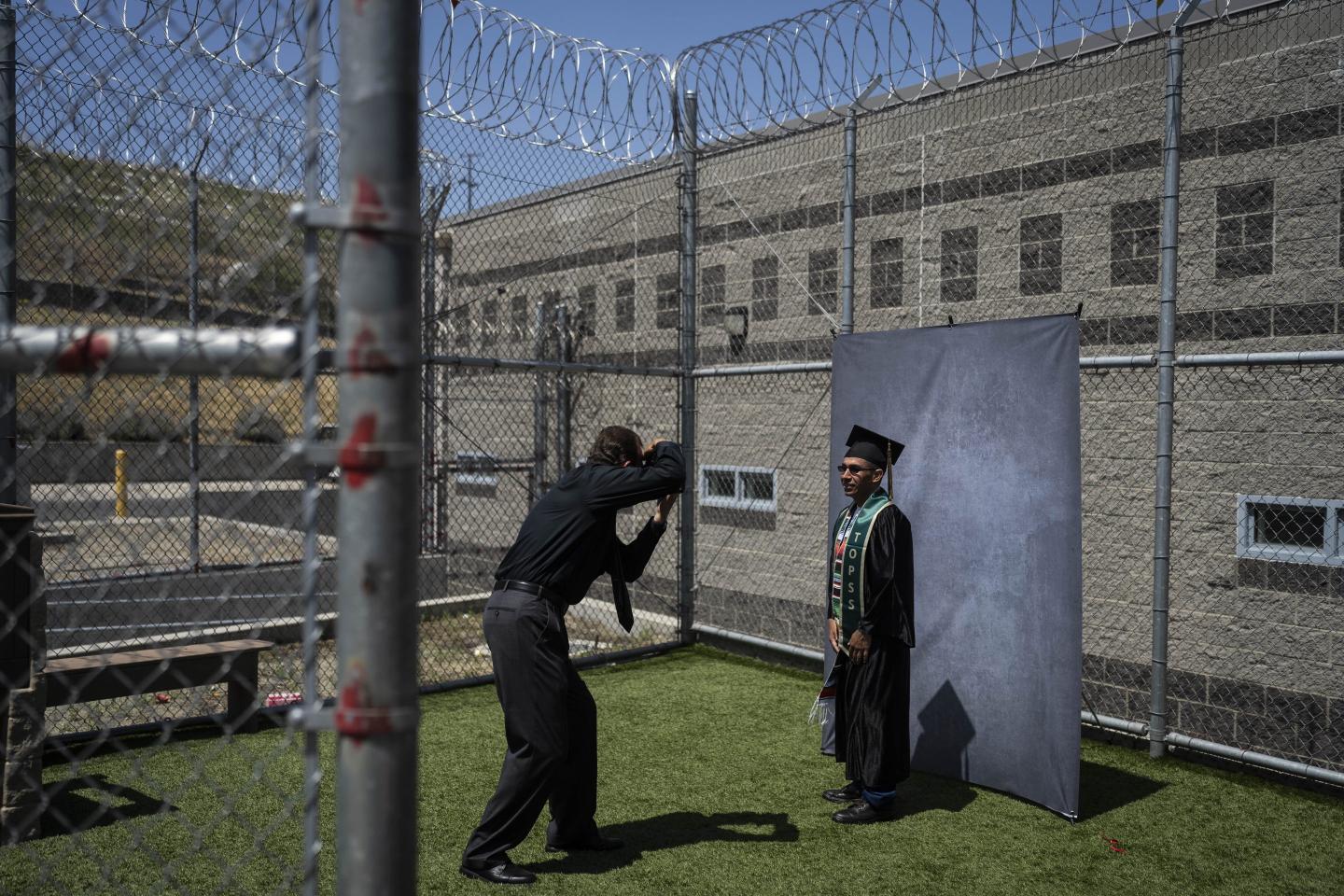
The graduates lined up, brushing off their gowns and adjusting classmates’ tassels and stoles. As the graduation march played, the 85 men appeared to hoots and cheers from their families. They marched to the stage – one surrounded by barbed wire fence and constructed by fellow prisoners.
For these were no ordinary graduates. Their black commencement garb almost hid their aqua and navy-blue prison uniforms as they received college degrees, high school diplomas and vocational certificates earned while they served time.
Thousands of prisoners throughout the United States get their college degrees behind bars, most of them paid for by the federal Pell Grant program, which offers the neediest undergraduates tuition aid that they don’t have to repay.
That program is about to expand exponentially next month, giving about 30,000 more students behind bars some $130 million in financial aid per year.
The new rules, which overturn a 1994 ban on Pell Grants for prisoners, begin to address decades of policy during the “tough on crime” 1970s-2000 that brought about mass incarceration and stark racial disparities in the nation’s 1.9 million prison population.
For prisoners who get their college degrees, including those at Folsom State Prison who got grants during an experimental period that started in 2016, it can be the difference between walking free with a life ahead and ending up back behind bars. Finding a job is difficult with a criminal conviction, and a college degree is an advantage former prisoners desperately need.
Gerald Massey, one of 11 Folsom students graduating with a degree from the California State University at Sacramento, has served nine years of a 15-to-life sentence for a drunken driving incident that killed his close friend.
“The last day I talked to him, he was telling me, I should go back to college,” Massey said. “So when I came into prison and I saw an opportunity to go to college, I took it.”
___
Consider this: It costs roughly $106,000 per year to incarcerate one adult in California.
It costs about $20,000 to educate a prisoner with a bachelor’s degree program through the Transforming Outcomes Project at Sacramento State, or TOPSS.
If a prisoner paroles with a degree, never reoffends, gets a job earning a good salary and pays taxes, then the expansion of prison education shouldn’t be a hard sell, said David Zuckerman, the project’s interim director.
“I would say that return on investment is better than anything I’ve ever invested in,” Zuckerman said.
That doesn’t mean it’s always popular. Using taxpayer money to give college aid to people who’ve broken the law can be controversial. When the Obama administration offered a limited number of Pell Grants to prisoners through executive action in 2015, some prominent Republicans opposed it, arguing in favor of improving the existing federal job training and re-entry programs instead.
The 1990s saw imprisonment rates for Black and Hispanic Americans triple between 1970 and 2000. The rate doubled for white Americans in the same time span.
The ban on Pell Grants for prisoners caused the hundreds of college-in-prison programs that existed in the 1970s and 1980s to go almost entirely extinct by the late nineties.
Congress voted to lift the ban in 2020, and since then about 200 Pell-eligible college programs in 48 states, Washington D.C. and Puerto Rico have been running, like the one at Folsom. Now, the floodgates will open, allowing any college that wants to utilize Pell Grant funding to serve incarcerated students to apply and, if approved, launch their program.
President Joe Biden has strongly supported giving Pell Grants to prisoners in recent years. It’s a turnaround – the Violent Crime Control and Law Enforcement Act of 1994, championed by the former Delaware senator, was what barred prisoners from getting Pell Grants in the first place. Biden has since said he didn’t agree with that part of the compromise legislation.
The California Department of Corrections and Rehabilitation had 200 students enrolled in bachelor’s degree programs this spring, and has partnered with eight universities across the state. The goal, says CDCR press secretary Terri Hardy: Transforming prisoners’ lives through education.
___
Aside from students dressed in prisoner blues, classes inside Folsom Prison look and feel like any college class. Instructors give incarcerated students the same assignments as the pupils on campus.
The students in the Folsom Prison classes come from many different backgrounds. They are Black, white, Hispanic, young, middle aged and senior. Massey, who got his communications degree, is of South Asian heritage.
Born in San Francisco to parents who immigrated to the U.S. from Pakistan, Massey recalls growing up feeling like an outsider. Although most people of his background are Muslim, his family members belonged to a small Christian community in Karachi.
In primary school, he was a target for bullies. As a teen, he remembered seeking acceptance from the wrong people. When he completed high school, Massey joined the Air Force.
“After 9/11, I went in and some people thought I was a terrorist trying to infiltrate,” he said. “It really bothered me. So when I got out of the military, I didn’t want anything to do with them.”
Massey enrolled in college after one year in the military, but dropped out. Later, he became a certified nursing assistant and held the job for 10 years. He married and had two children.
His addiction to alcohol and a marijuana habit knocked him off course.
“I was living like a little kid and I had my own little kids,” Massey said. “And I thought if I do the bare minimum, that’s OK.”
Prison forced him to take responsibility for his actions. He got focused, sought rehabilitation for alcoholism and restarted his pursuit of education. He also took up prison barbering to make money.
In between haircuts for correctional officers and other prison staff, Massey took advantage of his access to WiFi connection to study, take tests and work on assignments. Internet service doesn’t reach the prisoners’ housing units.
On commencement day, Massey was the last of his classmates to put on his cap and gown. He was a member of the ceremony’s honor guard – his prison uniform was decorated with a white aiguillette, the ornamental braided cord denoting his military service.
“It’s a big accomplishment,” Massey said. “I feel, honestly, that God opened the doors and I just walked through them.”
Massey found his mom, wife and daughter for a long-awaited celebratory embrace. He reserved the longest and tightest embrace for his 9-year-old daughter, Grace. Her small frame collapsed into his outstretched arms, as wife Jacq’lene Massey looked on.
“There’s so many different facets and things that can happen when you’re incarcerated, but this kept him focused on his goals,” Massey’s wife Jacq’lene said. “Having the resources and the ability to participate in programs like that really helped him, but it actually helps us, too.”
“There’s the domino effect – it’s good for our kids to see that. It’s good for me to see that,” she said.
In addition to his communications degree, Massey earned degrees in theology and biblical studies. His post-release options began to materialize ahead of graduation. State commissioners have deemed him fit for parole, and he expects to be released any day now. A nonprofit group that assists incarcerated military veterans met with him in May to set up transitional housing, food, clothing and healthcare insurance for his eventual re-entry.
“There’s a radio station I listen to, a Christian radio station, that I’ve been thinking one day I would like to work for,” Massey said. “They are always talking about redemption stories. So I would like to share my redemption story, one day.”
___
College-in-prison programs aren’t perfect. Many prisons barely have enough room to accommodate the few educational and rehabilitation programs that already exist. Prisons will have to figure out how to make space and get the technology to help students succeed.
Racial imbalances in prison college enrollment and completion rates are also a growing concern for advocates. People of color make up a disproportionate segment of the U.S. prison population. Yet white students were enrolled in college programs at a percentage higher than their portion of the overall prison population, according to a six-year Vera Institute of Justice study of Pell Grant experimental programs in prison.
Black and Hispanic students were enrolled by eight and 15 percentage points below their prison population, respectively.
Prisoners with a record of good behavior get preference for the rehabilitative and prison college programs. Black and Hispanic prisoners are more likely to face discipline.
“If you’re tying discipline to college access, then … those folks are not going to have as much access,” said Margaret diZerega, who directs the Vera Institute’s Unlocking Potential initiative, which is focused on expanding college in prison.
“Let’s get them into college and set them on a different trajectory.”
It’s not yet clear if the Pell Grant expansion will grow or narrow the racial disparities. The U.S. Department of Education did not respond to the AP’s inquiry on this issue before publication.
“For America to be a country of second chances, we must uphold education’s promise of a better life for people who’ve been impacted by the criminal justice system,” U.S. Secretary of Education Miguel Cardona said in a written statement to the AP.
Pell Grants will “provide meaningful opportunities for redemption and rehabilitation, reduce recidivism rates, and empower incarcerated people to build brighter futures for themselves, their families, and our communities,” Cardona said.
—
Of the 11 men getting Bachelor’s degrees in the jubilant ceremony at Folsom Prison last month, one was no longer a prisoner.
Michael Love, who had paroled from Folsom Prison five months earlier, came back to give the valedictory speech. He wore a suit and tie underneath his cap and gown.
To his classmates, Love is a tangible example of what is possible for their own redemption journeys.
After serving more than 35 years in prison, the 55-year-old is currently enrolled in a Master’s program at Sacramento State. He’s been hired as a teaching aide and will teach freshmen communications students in the fall, and is also working as a mentor with Project Rebound, an organization that assists formerly incarcerated people.
“You have just as much value as anyone in the community,” he told the other prisoners in his speech. “You are loved. I love you, that’s why I’m here.”
For many of the prisoners, it was the graduation that their families never imagined they’d get to see. A 28-year-old man met his father in person for the first time, as his dad received a GED.
As the ceremony wrapped, Robert Nelsen, the outgoing president of Sacramento State University, choked up with tears. He was retiring, so the graduation at Folsom Prison was the last ceremony he would preside over as a university president.
“There is one final tradition and that is to move the tassel – not yet, not yet, not yet – from the right to the left,” Nelsen instructed to laughter from the audience and graduates.
“The left side is where your heart is,” the university president said. “When you move that tassel, you are moving education and the love of education into your heart forever.”
The ceremony was done. Many graduates joined their loved ones inside a visitation hall for slices of white and chocolate sheet cake and cups of punch.
The graduates walked back to their housing units with more than just hope for what their futures might bring. One day, they’ll walk out of the prison gates with degrees that don’t bear an asterisk revealing they earned it while in prison.
They’ll walk toward a second chance.