• Home
  • News
  • Fortune 500
  • Tech
  • Finance
  • Leadership
  • Lifestyle
  • Rankings
  • Multimedia
EnvironmentCalifornia

California fears even worse fire season as ‘superblooms’ from historic wet winter become kindling

By
David R. Baker
David R. Baker
,
Brian K. Sullivan
Brian K. Sullivan
,
Mark Chediak
Mark Chediak
and
Bloomberg
Bloomberg
Down Arrow Button Icon
By
David R. Baker
David R. Baker
,
Brian K. Sullivan
Brian K. Sullivan
,
Mark Chediak
Mark Chediak
and
Bloomberg
Bloomberg
Down Arrow Button Icon
April 15, 2023, 1:33 PM ET
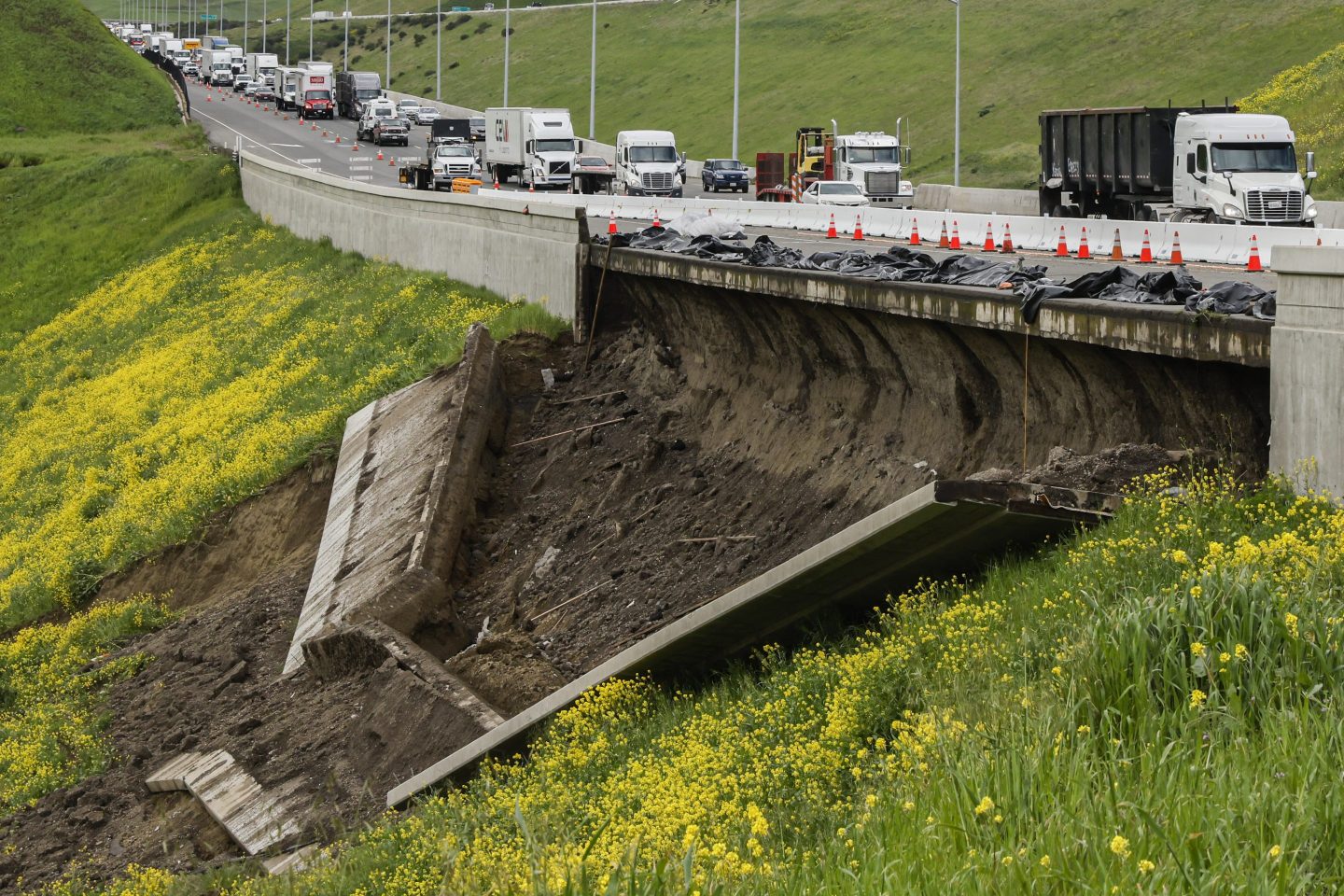
In California last month, this section of Interstate 580 cracked and a retaining wall tumbled down a rain-soaked hill in Livermore.
In California last month, this section of Interstate 580 cracked and a retaining wall tumbled down a rain-soaked hill in Livermore. Santiago Mejia—The San Francisco Chronicle/Getty Images

Don’t let all the flooding fool you: The same rain and snow that have drenched California this winter and spring risk making the state’s next seasonal calamity — fire season — even worse.

An epic winter left parts of the Central Valley underwater, a problem that may persist for months as one of California’s largest mountain snowpacks on record melts. That elevated moisture is now fueling an explosion of plant growth unlike anything the state’s seen in years. Whole landscapes are blossoming into so-called “superblooms,” as flowering bushes starved by years of drought make the most of the bounty. Soon, that growth will dry out, transforming buds and blossoms into kindling.

“What we expect to see out of the rains is an increase in the amount of fuel there is to burn,” said Issac Sanchez, a spokesman for the California Department of Forestry and Fire Protection, known as Cal Fire. 

Although the full price tag won’t become clear for months, California’s first-quarter storms have likely cost billions of dollars in everything from road repairs to lost crops. If a devastating fire season follows on its heels, that one-two punch of climate disasters threatens to sap growth in the US’s largest economy. The same dynamic could also play out elsewhere in the West, with record snows now starting to melt across Nevada, Utah and western Colorado, portending a delayed but dangerous fire season this fall.

While wet winters don’t guarantee historic fire seasons, it has happened before — and with deadly results. The winter of 2016-2017 brought much of the state 30% to 50% more snow and rain than average. The following October, a ferocious wind storm triggered fires that tore through the wine country north of San Francisco, killing 44 people. Blazes across the state burned 1.5 million acres in 2017, more than double the year before.

Experts are watching closely for early signs of how the upcoming fire season might play out. Much will depend on how soon the next rainy season begins, and whether California’s notorious autumn winds arrive first.

“If we get lucky and we get an early-season rain event like we had last year, it might kind of decapitate fire season early. It’s going to get a late start, and it would be great to have an early finish this year,” said Daniel Swain, a climate scientist at the University of California at Los Angeles. “But I wouldn’t count on it because remember: Some of California’s terrible fires in recent years have occurred following wet winters.”

Even in the wettest years, California rarely sees rain in the summer. Once grass and shrubs dry out, they can easily ignite, whether from a cigarette butt tossed out a car window, a lawnmower striking a rock or a stray thunderstorm dropping more lightning than rain. The danger grows as summer shifts to fall, when hot, dry, offshore winds sweep across the parched landscape. Called Santa Anas in Southern California and Diablo winds in the north, they have driven most of the state’s deadliest fires, at times spreading flames faster than people can flee. The start of the rainy season, often around October, usually brings relief. 

“It really depends when the season changes between summer and fall, once we start to get to where the winds pick up,” said Sumeet Singh, chief operating officer of the state’s largest utility, PG&E Corp. In 2019, his company landed in bankruptcy after wind storms repeatedly knocked down its power lines and sparked wildfires, including the 2018 blaze that leveled the town of Paradise. The company is now burying power lines, installing stronger utility poles, trimming trees and trying to get out ahead of wildfire season.

“We expect this fire season to potentially be shifted,” he said. “We anticipate quite a bit of regrowth on the vegetation side, which obviously could elevate the fire risk.”

One area where the burn risk will be lower than normal is high in the mountains, now buried under a snowpack that’s twice its average size. All that snow will take time to melt, and while it will pose a flooding risk in the valleys below, it will help prevent ignition in the higher elevations, whose forests have been ravaged by recent blazes. Among the cool mountain peaks, “things tend to stay wetter longer, and the fuels are larger, so they don’t dry out as quickly,” said Amy DeCastro, a project scientist at the National Center for Atmospheric Research. For grasses and brush at lower elevations, though, it’s a different story. Summer’s dry heat can turn the smaller plants “crispy pretty quickly,” she said.

For now, at least, it appears the long, drenching winter has bought a short-term reprieve from flames. By this time last year, fires had already burned more than 6,000 acres across the state, after the third dry winter in a row. This year, according to Cal Fire, they’ve burned just 110. 

“We can all relax for a few more months,” said Michael Wara, director of the climate and energy policy program at Stanford University. Due to the wet winter, “the time when the oven is turned on is delayed.”

–With assistance from Raeedah Wahid.
Fortune Brainstorm AI returns to San Francisco Dec. 8–9 to convene the smartest people we know—technologists, entrepreneurs, Fortune Global 500 executives, investors, policymakers, and the brilliant minds in between—to explore and interrogate the most pressing questions about AI at another pivotal moment. Register here.
About the Authors
By David R. Baker
See full bioRight Arrow Button Icon
By Brian K. Sullivan
See full bioRight Arrow Button Icon
By Mark Chediak
See full bioRight Arrow Button Icon
By Bloomberg
See full bioRight Arrow Button Icon

Latest in Environment

Jaguar
EnvironmentArizona
‘This species is recovering’: Jaguar spotted in Arizona, far from Central and South American core
By Susan Montoya Bryan and The Associated PressDecember 5, 2025
1 hour ago
Tim Cook stands in front of a giant image of Apple cofounder Steve Jobs
Big TechApple
Apple is experiencing its biggest leadership shakeup since Steve Jobs died
By Dave SmithDecember 5, 2025
1 hour ago
Paul Atkins
CommentaryCorporate Governance
Turning public companies into private companies: the SEC’s retreat from transparency and accountability
By Andrew BeharDecember 5, 2025
3 hours ago
Four years ago, BKV started buying up the two Temple power plants in Texas—located between Austin and Dallas—which now total 1.5 gigawatts of electricity generation capacity—enough to power more than 1.1 million homes, or a major data center campus. There is room to expand.
Energypower
How a Texas gas producer plans to exploit the ‘megatrend’ of power plants for AI hyperscalers
By Jordan BlumDecember 5, 2025
9 hours ago
satellite
AIData centers
Google’s plan to put data centers in the sky faces thousands of (little) problems: space junk
By Mojtaba Akhavan-TaftiDecember 3, 2025
2 days ago
claude
EnvironmentSan Francisco
San Francisco mourns its albino alligator, Claude, dead at 30 years old
By Janie Har and The Associated PressDecember 3, 2025
2 days ago

Most Popular

placeholder alt text
Economy
Two months into the new fiscal year and the U.S. government is already spending more than $10 billion a week servicing national debt
By Eleanor PringleDecember 4, 2025
1 day ago
placeholder alt text
Success
‘Godfather of AI’ says Bill Gates and Elon Musk are right about the future of work—but he predicts mass unemployment is on its way
By Preston ForeDecember 4, 2025
1 day ago
placeholder alt text
Success
Nearly 4 million new manufacturing jobs are coming to America as boomers retire—but it's the one trade job Gen Z doesn't want
By Emma BurleighDecember 4, 2025
1 day ago
placeholder alt text
Success
Nvidia CEO Jensen Huang admits he works 7 days a week, including holidays, in a constant 'state of anxiety' out of fear of going bankrupt
By Jessica CoacciDecember 4, 2025
1 day ago
placeholder alt text
Economy
Tariffs and the $38 trillion national debt: Kevin Hassett sees ’big reductions’ in deficit while Scott Bessent sees a ‘shrinking ice cube’
By Nick LichtenbergDecember 4, 2025
24 hours ago
placeholder alt text
Real Estate
‘There is no Mamdani effect’: Manhattan luxury home sales surge after mayoral election, undercutting predictions of doom and escape to Florida
By Sasha RogelbergDecember 4, 2025
22 hours ago
Rankings
  • 100 Best Companies
  • Fortune 500
  • Global 500
  • Fortune 500 Europe
  • Most Powerful Women
  • Future 50
  • World’s Most Admired Companies
  • See All Rankings
Sections
  • Finance
  • Leadership
  • Success
  • Tech
  • Asia
  • Europe
  • Environment
  • Fortune Crypto
  • Health
  • Retail
  • Lifestyle
  • Politics
  • Newsletters
  • Magazine
  • Features
  • Commentary
  • Mpw
  • CEO Initiative
  • Conferences
  • Personal Finance
  • Education
Customer Support
  • Frequently Asked Questions
  • Customer Service Portal
  • Privacy Policy
  • Terms Of Use
  • Single Issues For Purchase
  • International Print
Commercial Services
  • Advertising
  • Fortune Brand Studio
  • Fortune Analytics
  • Fortune Conferences
  • Business Development
About Us
  • About Us
  • Editorial Calendar
  • Press Center
  • Work At Fortune
  • Diversity And Inclusion
  • Terms And Conditions
  • Site Map

© 2025 Fortune Media IP Limited. All Rights Reserved. Use of this site constitutes acceptance of our Terms of Use and Privacy Policy | CA Notice at Collection and Privacy Notice | Do Not Sell/Share My Personal Information
FORTUNE is a trademark of Fortune Media IP Limited, registered in the U.S. and other countries. FORTUNE may receive compensation for some links to products and services on this website. Offers may be subject to change without notice.