• Home
  • Latest
  • Fortune 500
  • Finance
  • Tech
  • Leadership
  • Lifestyle
  • Rankings
  • Multimedia

Exclusive

An hour in the Oval Office with President Trump Fortune Editor-in-Chief: Alyson Shontell sat down with President Trump in the Oval Office for an hour. Tariffs, Intel, AI, Boeing, Iran—and the question every CEO eventually has to answer: who's next?

An hour in the Oval Office with President Trump Fortune Editor-in-Chief: Alyson Shontell sat down with President Trump in the Oval Office for an hour. Tariffs, Intel, AI, Boeing, Iran—and the question every CEO eventually has to answer: who's next?

An hour in the Oval Office with President Trump Fortune Editor-in-Chief: Alyson Shontell sat down with President Trump in the Oval Office for an hour. Tariffs, Intel, AI, Boeing, Iran—and the question every CEO eventually has to answer: who's next?

An hour in the Oval Office with President Trump Fortune Editor-in-Chief: Alyson Shontell sat down with President Trump in the Oval Office for an hour. Tariffs, Intel, AI, Boeing, Iran—and the question every CEO eventually has to answer: who's next?

An hour in the Oval Office with President Trump Fortune Editor-in-Chief: Alyson Shontell sat down with President Trump in the Oval Office for an hour. Tariffs, Intel, AI, Boeing, Iran—and the question every CEO eventually has to answer: who's next?

An hour in the Oval Office with President Trump Fortune Editor-in-Chief: Alyson Shontell sat down with President Trump in the Oval Office for an hour. Tariffs, Intel, AI, Boeing, Iran—and the question every CEO eventually has to answer: who's next?

An hour in the Oval Office with President Trump Fortune Editor-in-Chief: Alyson Shontell sat down with President Trump in the Oval Office for an hour. Tariffs, Intel, AI, Boeing, Iran—and the question every CEO eventually has to answer: who's next?

An hour in the Oval Office with President Trump Fortune Editor-in-Chief: Alyson Shontell sat down with President Trump in the Oval Office for an hour. Tariffs, Intel, AI, Boeing, Iran—and the question every CEO eventually has to answer: who's next?

An hour in the Oval Office with President Trump Fortune Editor-in-Chief: Alyson Shontell sat down with President Trump in the Oval Office for an hour. Tariffs, Intel, AI, Boeing, Iran—and the question every CEO eventually has to answer: who's next?

An hour in the Oval Office with President Trump Fortune Editor-in-Chief: Alyson Shontell sat down with President Trump in the Oval Office for an hour. Tariffs, Intel, AI, Boeing, Iran—and the question every CEO eventually has to answer: who's next?

TechIntel

Gordon Moore, cofounder of chip titan Intel who helped herald in the PC era, dies at 94

By
Laurence Arnold
Laurence Arnold
,
Jason Kelly
Jason Kelly
,
Ian King
Ian King
, and
Bloomberg
Bloomberg
Down Arrow Button Icon
By
Laurence Arnold
Laurence Arnold
,
Jason Kelly
Jason Kelly
,
Ian King
Ian King
, and
Bloomberg
Bloomberg
Down Arrow Button Icon
March 24, 2023, 9:21 PM ET
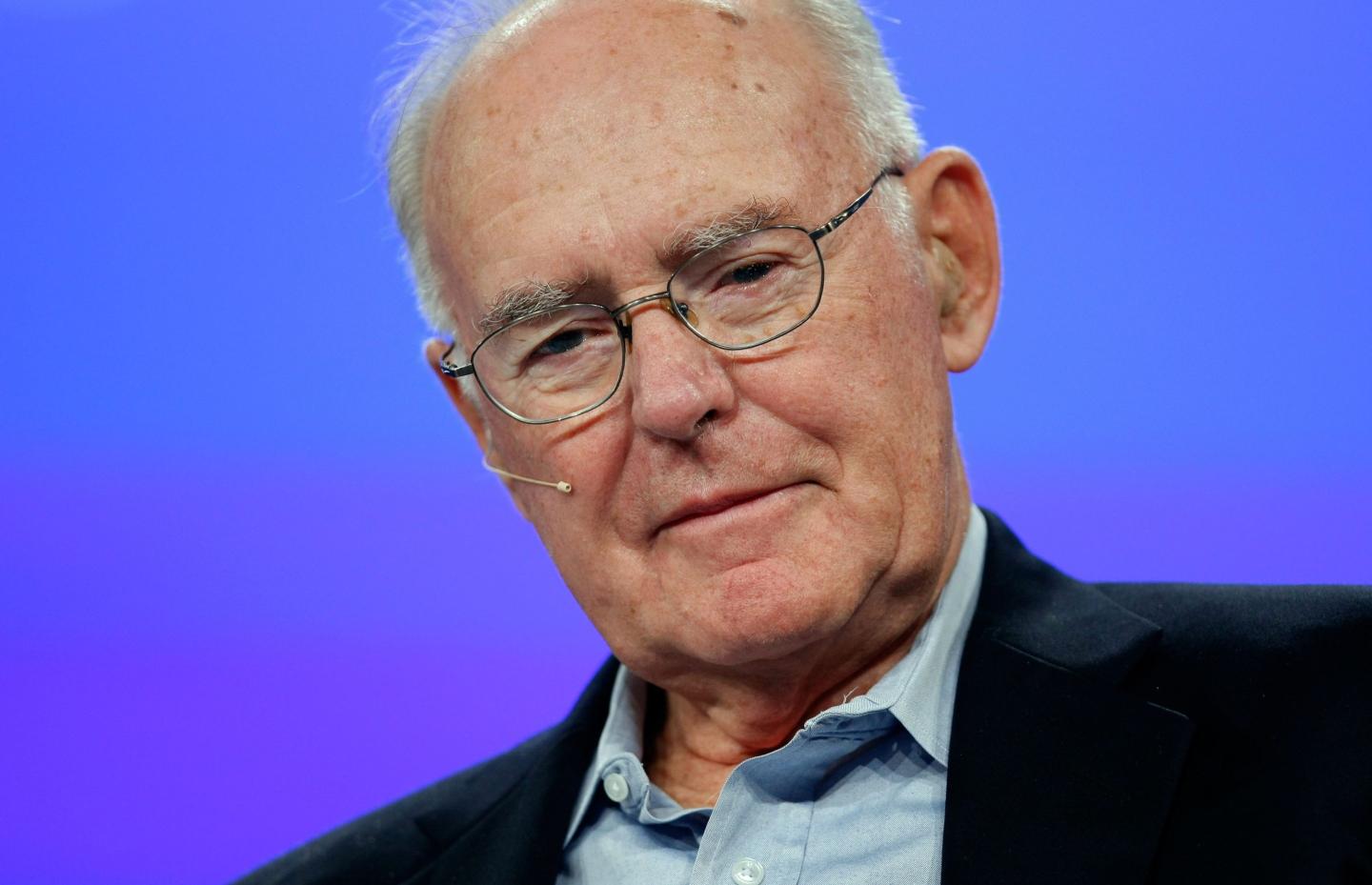
Intel co-founder Gordon Moore.
Intel co-founder Gordon Moore. Justin Sullivan—Getty Images

Gordon Moore, the Intel co-founder whose theory on computer-chip development became the yardstick for progress in the electronics industry, has died. He was 94.

Moore died peacefully surrounded by family at his home in Hawaii on Friday, the Gordon and Betty Moore Foundation said in a statement.  

A founder of industry pioneer Fairchild Semiconductor, Moore in 1968 co-founded Intel, which grew into the world’s largest semiconductor maker at one point. The Santa Clara, California-based company supplies about 80% of the world’s personal computers with their most important part, the microprocessor. Moore was chief executive officer from 1975 to 1987.

Intel and other semiconductor makers still develop products according to a version of Moore’s Law, the scientist’s 1965 observation that the number of transistors on a computer chip — which determines the speed, memory and capabilities of an electronic device — doubles every year. The law, which Moore revised in 1975, remains a yardstick for progress both within and beyond the chip industry, even as its continued applicability is a topic of debate. 

Moore’s observation was fundamental to Intel’s rise to prominence. The company poured increasing sums into improving manufacturing of the tiny electronic components at a pace its rivals couldn’t keep up with. The torrid rate of progress made Intel’s technology the hardware heart of the personal computer revolution, then the internet revolution, until the company’s Asian rivals challenged its leadership.

Alive and Well

“Intel will be the steward of Moore’s Law for decades to come,” Chief Executive Officer Pat Gelsinger said in a January 2022 interview. He said the law “is alive and we’re going to keep it very well.”

Carver Mead, an engineering professor at the California Institute of Technology, came up with the name Moore’s Law. Moore himself expressed surprise at its influence and longevity and preferred to demystify and downplay it. 

“I wanted to get across, here’s an idea where the technology is going to evolve rapidly and it’s going to have a major impact on the cost of electronics,” Moore recalled for a video produced by the Chemical Heritage Foundation. “That was the main point I was trying to get across, that this was going to be the path to low-cost electronics.”

Moore was director of research and development at Fairchild when he made his famous projection in an article, “Cramming More Components Onto Integrated Circuits,” for the April 19, 1965, edition of Electronics magazine. Noting that the most cost-efficient circuit at that time held 50 transistors, he predicted that number would roughly double each year to 65,000. Modern microprocessors have billions of transistors.

In the same article he wrote: “Integrated circuits will lead to such wonders as home computers, or at least terminals connected to a central computer, automatic controls for automobiles and personal portable communications equipment.”

1975 Revision

Revising his law in 1975, Moore said components per chip would grow half as quickly, doubling every two years rather than every year. An Intel colleague, David House, came up with the often-quoted corollary that a chip’s performance, due to both the number and quality of transistors, would double every 18 months.

Intel’s proxy statement in 2006 showed Moore owned 173 million shares. That’s the last time his name appears in the company’s regulatory filings. His net worth was about $7.5 billion, according to the Bloomberg Billionaires Index. 

In 2000, Moore set up the Gordon and Betty Moore Foundation, which reported assets of $9.5 billion as of 2021, making it one of the biggest private grant-making foundations in the US. It supports environmental conservation, patient care and scientific research worldwide, as well as local causes in the San Francisco Bay area. Moore said his concern for the environment stemmed from his love of fishing.

Among their major gifts, Moore and his wife gave $600 million to Caltech, located in Pasadena, California; $200 million to Caltech and the University of California to build the world’s most powerful optical telescope; and $100 million to the University of California at Davis to build a nursing school.

Sheriff’s Son

Gordon Earle Moore was born on Jan. 3, 1929, in San Francisco and raised in Pescadero, California. His family moved to Redwood City, California, when he was 10. His father, Walter, was a deputy sheriff. His mother, Florence Almira Williamson, owned a small general store.

Moore saw a chemistry set at a neighbor’s house and decided he wanted to be a chemist. He began experimenting with making rockets and explosives and studied chemistry at San Jose State University. There, he met his wife, the former Betty Whittaker. They would have two children, Kenneth and Steven.

Moore transferred to the University of California at Berkeley and, in 1950, became the first person in his family to graduate from college. In 1954, he received a Ph.D. in physics and chemistry from Caltech.

He landed a job as a researcher at Johns Hopkins University’s Applied Physics Laboratory in Silver Spring, Maryland. William Shockley, who had created the transistor at Bell Telephone Laboratories, and who would share the 1956 Nobel Prize in physics, recruited Moore to his Shockley Semiconductor Laboratory near Palo Alto, California.

Moore and seven co-workers, including Robert Noyce, left to found Fairchild in 1957 with $3,500 of their own money and a $1.5 million investment from Fairchild Camera and Instrument Corp. Shockley dubbed them the “Traitorous Eight.” Noyce, in the late 1950s, helped invent the integrated circuit, the basis of all chip designs to this day. He died in 1990.

Forms Intel

Noyce and Moore formed Intel, a contraction of “integrated electronics,” in a former Union Carbide factory in Mountain View, the heart of what they would help build into Silicon Valley. Moore’s first title was executive vice president. Andy Grove, another Fairchild employee, soon joined them.

In 1971, Intel introduced its first microprocessor, holding more than 2,000 transistors. Its 8080 microprocessor was in the Altair 8800, introduced in 1975 and widely considered the first successful personal computer. In 1981, IBM selected Intel’s 8088 microprocessor to power its first personal computer.

Moore became president and CEO in 1975, then chairman and CEO in 1979. Grove succeeded him as CEO in 1987, and Moore retired from Intel’s board in 2001 at age 72, in accordance with a mandatory retirement-age policy that he instituted.

Moore “does not boast, although his record of achievement provides a great deal to boast about,” Richard Tedlow wrote in his 2006 biography of Grove. “He appears to be, that is to say, simply a regular person.” Tedlow quoted Grove calling Moore “a smart guy with no airs.”

Today, most chip industry leaders and observers would argue that Moore’s Law no longer holds. Some of the layers of materials used to build semiconductors are only an atom thick, meaning they cannot be shrunk further. At such tiny geometries the properties of those materials that make them semiconductors break down. That destroys their usefulness as the microscopic switches used to represent the most basic form of electronic information. 

Unlike succeeding Intel leaders who rebutted predictions of Moore’s Law’s demise, Moore predicted its irrelevance.

“Someday it has to stop,” Moore said at an event in 2015 to commemorate his law’s 50th anniversary. “No exponential thing like this goes on forever.”

Moore is survived by Betty Irene Whitaker, whom he married in 1950, as well as sons Kenneth and Steven and four grandchildren.

Subscribe to Well Adjusted, our newsletter full of simple strategies to work smarter and live better, from the Fortune Well team. Sign up today.
About the Authors
By Laurence Arnold
See full bioRight Arrow Button Icon
By Jason Kelly
See full bioRight Arrow Button Icon
By Ian King
See full bioRight Arrow Button Icon
By Bloomberg
See full bioRight Arrow Button Icon

Latest in Tech

Finance
Lorem ipsum dolor sit amet, consectetur adipiscing elit, sed do eiusmod tempor incididunt ut labore et dolore magna aliqua. Ut enim ad minim veniam
By Fortune Editors
October 20, 2025
Finance
Lorem ipsum dolor sit amet, consectetur adipiscing elit, sed do eiusmod tempor incididunt ut labore et dolore magna aliqua. Ut enim ad minim veniam
By Fortune Editors
October 20, 2025
Finance
Lorem ipsum dolor sit amet, consectetur adipiscing elit, sed do eiusmod tempor incididunt ut labore et dolore magna aliqua. Ut enim ad minim veniam
By Fortune Editors
October 20, 2025
Finance
Lorem ipsum dolor sit amet, consectetur adipiscing elit, sed do eiusmod tempor incididunt ut labore et dolore magna aliqua. Ut enim ad minim veniam
By Fortune Editors
October 20, 2025
Finance
Lorem ipsum dolor sit amet, consectetur adipiscing elit, sed do eiusmod tempor incididunt ut labore et dolore magna aliqua. Ut enim ad minim veniam
By Fortune Editors
October 20, 2025
Finance
Lorem ipsum dolor sit amet, consectetur adipiscing elit, sed do eiusmod tempor incididunt ut labore et dolore magna aliqua. Ut enim ad minim veniam
By Fortune Editors
October 20, 2025

Most Popular

Finance
Lorem ipsum dolor sit amet, consectetur adipiscing elit, sed do eiusmod tempor incididunt ut labore et dolore magna aliqua. Ut enim ad minim veniam
By Fortune Editors
October 20, 2025
Finance
Lorem ipsum dolor sit amet, consectetur adipiscing elit, sed do eiusmod tempor incididunt ut labore et dolore magna aliqua. Ut enim ad minim veniam
By Fortune Editors
October 20, 2025
Finance
Lorem ipsum dolor sit amet, consectetur adipiscing elit, sed do eiusmod tempor incididunt ut labore et dolore magna aliqua. Ut enim ad minim veniam
By Fortune Editors
October 20, 2025
Finance
Lorem ipsum dolor sit amet, consectetur adipiscing elit, sed do eiusmod tempor incididunt ut labore et dolore magna aliqua. Ut enim ad minim veniam
By Fortune Editors
October 20, 2025
Finance
Lorem ipsum dolor sit amet, consectetur adipiscing elit, sed do eiusmod tempor incididunt ut labore et dolore magna aliqua. Ut enim ad minim veniam
By Fortune Editors
October 20, 2025
Finance
Lorem ipsum dolor sit amet, consectetur adipiscing elit, sed do eiusmod tempor incididunt ut labore et dolore magna aliqua. Ut enim ad minim veniam
By Fortune Editors
October 20, 2025
Fortune Secondary Logo
Rankings
  • 100 Best Companies
  • Fortune 500
  • Global 500
  • Fortune 500 Europe
  • Most Powerful Women
  • World's Most Admired Companies
  • See All Rankings
  • Lists Calendar
Sections
  • Finance
  • Fortune Crypto
  • Features
  • Leadership
  • Health
  • Commentary
  • Success
  • Retail
  • Mpw
  • Tech
  • Lifestyle
  • CEO Initiative
  • Asia
  • Politics
  • Conferences
  • Europe
  • Newsletters
  • Personal Finance
  • Environment
  • Magazine
  • Education
Customer Support
  • Frequently Asked Questions
  • Customer Service Portal
  • Privacy Policy
  • Terms Of Use
  • Single Issues For Purchase
  • International Print
Commercial Services
  • Advertising
  • Fortune Brand Studio
  • Fortune Analytics
  • Fortune Conferences
  • Business Development
  • Group Subscriptions
About Us
  • About Us
  • Press Center
  • Work At Fortune
  • Terms And Conditions
  • Site Map
  • About Us
  • Press Center
  • Work At Fortune
  • Terms And Conditions
  • Site Map
  • Facebook icon
  • Twitter icon
  • LinkedIn icon
  • Instagram icon
  • Pinterest icon

Latest in Tech

College graduates sitting at commencement yell.
AIEducation
College students are booing commencement speakers celebrating AI, but the wave of hate hasn’t stopped them from using it to cheat on their exams
By Sasha RogelbergMay 19, 2026
25 minutes ago
Environmental advocates and progressive lawmakers hold a rally in support of legislation that would put a moratorium on new data centers in the state on Wednesday, May 13, 2026, at the Capitol in Albany, N.Y.
AIData centers
Americans’ AI hate wave might just be gathering steam: Data centers could hike power costs in some states over 50% by 2030
By Tristan BoveMay 19, 2026
1 hour ago
How a book convinced Arundhati Bhattacharya, one of India’s most powerful bankers, to try working for a U.S. tech company
AsiaMost Powerful Women
How a book convinced Arundhati Bhattacharya, one of India’s most powerful bankers, to try working for a U.S. tech company
By Angelica AngMay 19, 2026
1 hour ago
altman
CommentarySam Altman
Musk vs. Altman: AI safety cannot be one man’s job
By Stavros GadinisMay 18, 2026
11 hours ago
Pope Leo launches an AI commission days before he releases a papal letter alongside Anthropic cofounder Christopher Olah
AIPope
Pope Leo launches an AI commission days before he releases a papal letter alongside Anthropic cofounder Christopher Olah
By Catherina GioinoMay 18, 2026
11 hours ago
John Ketchum, CEO of NextEra Energy, speaks during BlackRock's 2026 Infrastructure Summit in Washington, DC, on March 11, 2026. Photographer: Daniel Heuer/Bloomberg via Getty Images
EnergyNextEra Energy
NextEra’s $67 billion Dominion takeover creates the world’s largest utility—just in time to win the AI data-center power surge
By Jordan BlumMay 18, 2026
12 hours ago

Most Popular

The Bezos family just donated $100 million to help achieve one of Mayor Zohran Mamdani’s top campaign promises
Politics
The Bezos family just donated $100 million to help achieve one of Mayor Zohran Mamdani’s top campaign promises
By Jake AngeloMay 12, 2026
7 days ago
While Trump insisted the Iran war would end ‘soon,’ an account in his name was buying millions in oil, defense and gold
Economy
While Trump insisted the Iran war would end ‘soon,’ an account in his name was buying millions in oil, defense and gold
By Eva RoytburgMay 18, 2026
14 hours ago
Current price of oil as of May 18, 2026
Personal Finance
Current price of oil as of May 18, 2026
By Joseph HostetlerMay 18, 2026
19 hours ago
EXCLUSIVE: An hour in the Oval Office with the CEO-in-Chief, President Trump
Politics
EXCLUSIVE: An hour in the Oval Office with the CEO-in-Chief, President Trump
By Alyson ShontellMay 18, 2026
1 day ago
Microsoft AI chief gives it 18 months—for all white-collar work to be automated by AI
AI
Microsoft AI chief gives it 18 months—for all white-collar work to be automated by AI
By Jake AngeloMay 16, 2026
3 days ago
The top foreign holders of U.S. debt may soon dump Treasury bonds and bring their money back home, potentially spiking borrowing costs
Economy
The top foreign holders of U.S. debt may soon dump Treasury bonds and bring their money back home, potentially spiking borrowing costs
By Jason MaMay 17, 2026
2 days ago

© 2026 Fortune Media IP Limited. All Rights Reserved. Use of this site constitutes acceptance of our Terms of Use and Privacy Policy | CA Notice at Collection and Privacy Notice | Do Not Sell/Share My Personal Information
FORTUNE is a trademark of Fortune Media IP Limited, registered in the U.S. and other countries. FORTUNE may receive compensation for some links to products and services on this website. Offers may be subject to change without notice.