• Home
  • Latest
  • Fortune 500
  • Finance
  • Tech
  • Leadership
  • Lifestyle
  • Rankings
  • Multimedia

Trendingnow

1

Elon Musk on MacKenzie Scott giving away $26 billion of her fortune: 'Sadly,' it makes the world a worse place

2

MacKenzie Scott alone accounted for one-third of America's $19.2 billion in megagifts last year

3

Philanthropy leader at Warren Buffett and Bill Gates’ Giving Pledge says children of billionaires are pushing them to give their wealth away faster

1

Elon Musk on MacKenzie Scott giving away $26 billion of her fortune: 'Sadly,' it makes the world a worse place

2

MacKenzie Scott alone accounted for one-third of America's $19.2 billion in megagifts last year

3

Philanthropy leader at Warren Buffett and Bill Gates’ Giving Pledge says children of billionaires are pushing them to give their wealth away faster
Finance

‘The great mystery here is why the supervision was AWOL at Silicon Valley Bank’: Wall Street and DC point fingers amid burbling banking crisis

By
Paul Wiseman
Paul Wiseman
,
Ken Sweet
Ken Sweet
, and
The Associated Press
Down Arrow Button Icon
By
Paul Wiseman
Paul Wiseman
,
Ken Sweet
Ken Sweet
, and
The Associated Press
Down Arrow Button Icon
March 16, 2023, 4:15 PM ET
Barney Frank
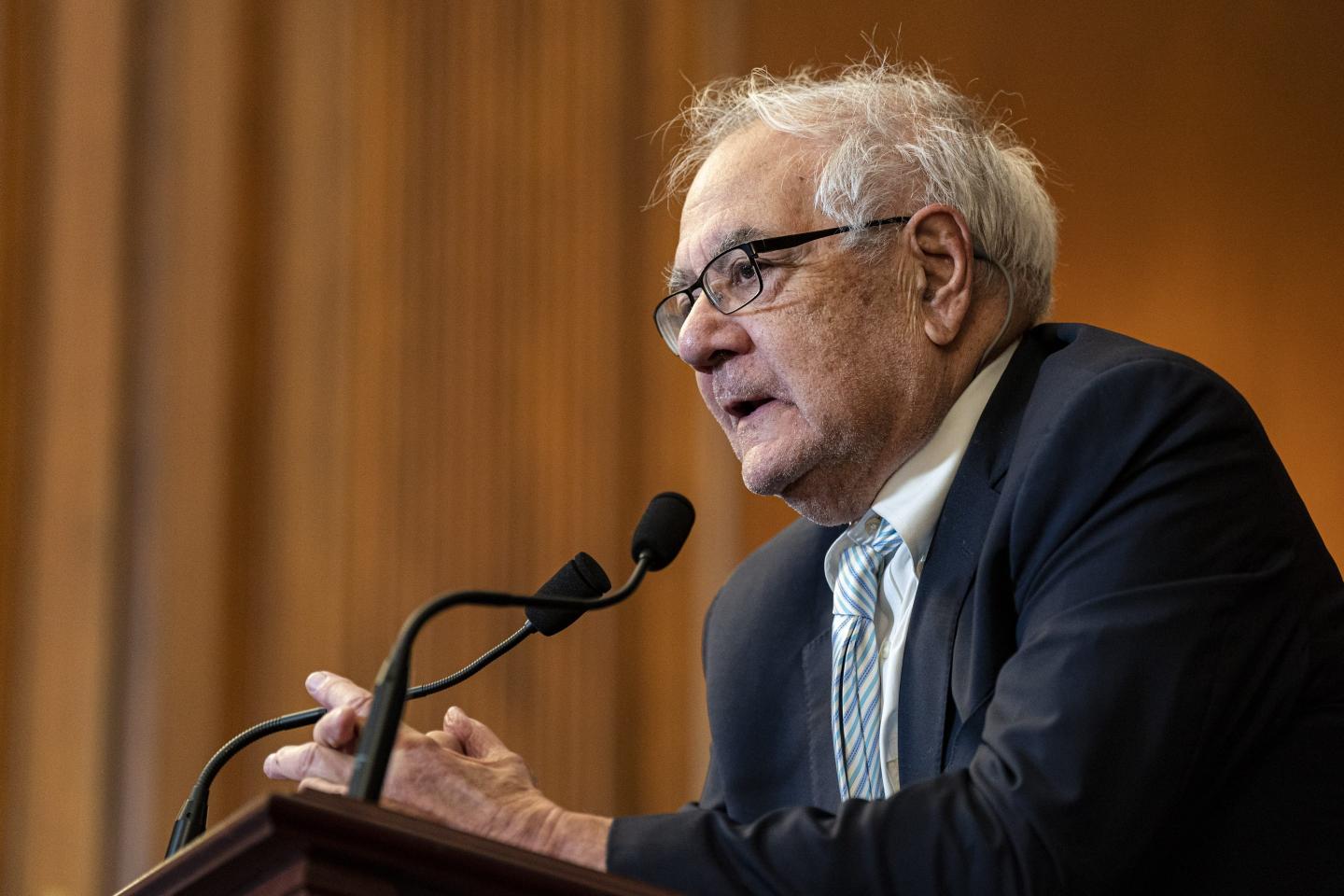
Representative Barney Frank, a Democrat from Massachusetts, speaks during a bill enrollment ceremony for H.R. 8408, the Respect for Marriage Act, at the US Capitol in Washington, DC, US, on Thursday, Dec. 8, 2022.Al Drago/Bloomberg via Getty Images
Add Fortune on Google for similar content.

The warning signs were all there. Silicon Valley Bank was expanding at a breakneck pace and pursuing wildly risky investments in the bond market. The vast majority of its deposits were uninsured by the federal government, leaving its customers exposed to a crisis.

None of this was a secret. Yet bank supervisors at the Federal Reserve Bank of San Francisco and the state of California did nothing as the bank rolled over the cliff.

“Their duty is to make sure that the bank is being run in a safe and sound manner and is not a threat,’’ said Dennis Kelleher, president of Better Markets, a nonprofit that advocates tougher financial regulations. “The great mystery here is why the supervision was AWOL at Silicon Valley Bank.’’

The search for causes and culprits — and solutions — is refocusing attention on a 2018 federal law that rolled back tough bank regulations put in place after the 2008-2009 financial crisis and, perhaps even more, on the way regulators wrote the rules that put that law in place.

The Silicon Valley Bank collapse — the second-biggest bank failure in U.S. history — is also raising difficult questions about whether the FDIC needs to offer more protection for deposits.

On Friday, regulators shuttered and seized the bank, based in Santa Clara, California. For months it had made a losing bet that interest rates would stay low. They rose instead — as the Federal Reserve repeatedly raised its benchmark rate to fight inflation — and the bank’s bond portfolio plunged in value. As its troubles became public, worried depositors started to withdraw their money in an old-fashioned bank run.

And over the weekend the federal government, determined to restore public confidence in the banking system, decided to protect all the bank’s deposits, even those that exceeded the FDIC’s $250,000 limit.

The demise of Silicon Valley Bank Friday and of New York-based Signature Bank two days later has revived bad memories of the financial crisis that plunged the United States into the Great Recession of 2007-2009.

In the wake of that cataclysm, set off by reckless lending in the U.S. housing market, Congress passed the so-called Dodd-Frank law in 2010, tightening financial regulation. Dodd-Frank focused especially on “systemically important’’ institutions with assets of $50 billion or more — so big and interconnected with other banks that their collapse could bring the whole system down.

Those institutions had to maintain a bigger capital buffer against losses, keep more cash or other liquid assets on hand to handle a bank run, undergo annual “stress tests’’ from the Federal Reserve and write a “living will’’ to arrange for their affairs to be settled in an orderly manner if they fail.

But as the crisis faded into the past, and more and more banks grumbled about the burden of complying with the new rules, Congress decided to provide relief from the Dodd-Frank legislation. Among other things, it ditched the $50 billion asset threshold for the most stringent oversight, pushing it up to $250 billion. Many large lenders, including Silicon Valley Bank, were thereby freed from the tightest regulatory scrutiny.

Critics like Democratic Sen. Elizabeth Warren of Massachusetts, a leading critic of the banking industry, denounced the bill at the time, saying it would encourage banks to take more risk.

The law gave Federal Reserve officials the authority to reimpose tougher regulations on banks with assets between $100 billion and $250 billion if they felt it necessary.

But they chose not to be tough on those banks. For example, they only required a stress test every two years, not annually. So Silicon Valley Bank didn’t have to undergo a stress test in 2022 and wasn’t due for one until later this year.

Todd Phillips, a fellow at the left-leaning Roosevelt Institute and a former FDIC lawyer, said Congress’ deregulatory push during the Trump years created a “vibe shift.”

“It basically gave regulators permission to take their eyes off″ lenders like Silicon Valley Bank, he said. ”The regulators ran with that.’’

Warren and other lawmakers on Tuesday introduced legislation to undo the 2018 law and restore the tougher Dodd-Frank regulations.

But Kelleher at Better Markets said that U.S. bank regulators “don’t have to wait for a divided Congress to act in the best interests of the American public.’’

They could rewrite 20 bank-friendly rules the Fed and other bank agencies put in place during the Trump years. For example, for banks with $100 billion or more in assets, Phillips wrote in a report Wednesday, regulators should reinstate annual stress tests and raise capital requirements, among other things.

“When we roll back regulations so that bank executives can use these banks to boost their profits, to boost their own salaries, to get big bonuses, they are doing it by taking on more risk,’’ Warren told reporters Wednesday. “Banking should be boring. And we have a chance here in Congress to make banking more boring again.’’

The sudden collapse of Silicon Valley Bank has also turned attention to federal deposit insurance.

The FDIC only covers up to $250,000. But Silicon Valley Bank, the go-to institution for tech entrepreneurs, held cash for many startups: 94% of its deposits — including money that companies need to meet their payrolls — were above the $250,000 threshold and vulnerable to losses when the bank failed.

The idea that so many depositors would lose their savings threatened to shake public faith in the banking system. So the Biden administration announced Sunday night that the FDIC would cover 100% of deposits at Silicon Valley Bank, and also at Signature Bank

Now some are calling for a permanent increase in the deposit insurance limit.

“I hope now going forward they’re not going to treat this increase in the guaranteed deposits as just a one-shot response … but make it ongoing,’’ said Barney Frank, former chair of the House Financial Services Committee and director of failed Signature Bank. He also suggested an increase for businesses so they can meet payrolls.

But the Roosevelt Institute’s Phillips said the issue is complicated. If you cover business’ payrolls, should you cover deposits they have earmarked to pay rent or suppliers? And unlimited deposit coverage would mean even the richest and most financially sophisticated people would have to take no responsibility for monitoring the financial health of their banks.

Covering all deposits would also require the FDIC to charge banks more for the extra insurance, a prospect that the industry has not been receptive to in the past. The industry unsuccessfully lobbied to reduce FDIC insurance assessments last year.

However, having full insurance might be a competitive advantage.

A group of small banks in Massachusetts created their own private deposit insurance fund in the 1990s, allowing depositors to be insured over the $250,000 limit through this state-based program. While it costs more for the small banks to participate than just being insured through the FDIC, Massachusetts bankers said they’ve been attracting customers since Silicon Valley Bank’s failure.

“Maybe our rates are not as competitive as the biggest banks, but customers like that we insure 100% of their funds,” said Catherine Dillon, chief operating officer of Bank Five in Fall River, Massachusetts.

___

Sweet reported from New York.

Subscribe to Well Adjusted, our newsletter full of simple strategies to work smarter and live better, from the Fortune Well team. Sign up today.
About the Authors
By Paul Wiseman
See full bioRight Arrow Button Icon
By Ken Sweet
See full bioRight Arrow Button Icon
By The Associated Press
See full bioRight Arrow Button Icon
Add Fortune on Google for similar content.

Latest in Finance

Finance
Lorem ipsum dolor sit amet, consectetur adipiscing elit, sed do eiusmod tempor incididunt ut labore et dolore magna aliqua. Ut enim ad minim veniam
By Fortune Editors
October 20, 2025
Finance
Lorem ipsum dolor sit amet, consectetur adipiscing elit, sed do eiusmod tempor incididunt ut labore et dolore magna aliqua. Ut enim ad minim veniam
By Fortune Editors
October 20, 2025
Finance
Lorem ipsum dolor sit amet, consectetur adipiscing elit, sed do eiusmod tempor incididunt ut labore et dolore magna aliqua. Ut enim ad minim veniam
By Fortune Editors
October 20, 2025
Finance
Lorem ipsum dolor sit amet, consectetur adipiscing elit, sed do eiusmod tempor incididunt ut labore et dolore magna aliqua. Ut enim ad minim veniam
By Fortune Editors
October 20, 2025
Finance
Lorem ipsum dolor sit amet, consectetur adipiscing elit, sed do eiusmod tempor incididunt ut labore et dolore magna aliqua. Ut enim ad minim veniam
By Fortune Editors
October 20, 2025
Finance
Lorem ipsum dolor sit amet, consectetur adipiscing elit, sed do eiusmod tempor incididunt ut labore et dolore magna aliqua. Ut enim ad minim veniam
By Fortune Editors
October 20, 2025

Most Popular

Finance
Lorem ipsum dolor sit amet, consectetur adipiscing elit, sed do eiusmod tempor incididunt ut labore et dolore magna aliqua. Ut enim ad minim veniam
By Fortune Editors
October 20, 2025
Finance
Lorem ipsum dolor sit amet, consectetur adipiscing elit, sed do eiusmod tempor incididunt ut labore et dolore magna aliqua. Ut enim ad minim veniam
By Fortune Editors
October 20, 2025
Finance
Lorem ipsum dolor sit amet, consectetur adipiscing elit, sed do eiusmod tempor incididunt ut labore et dolore magna aliqua. Ut enim ad minim veniam
By Fortune Editors
October 20, 2025
Finance
Lorem ipsum dolor sit amet, consectetur adipiscing elit, sed do eiusmod tempor incididunt ut labore et dolore magna aliqua. Ut enim ad minim veniam
By Fortune Editors
October 20, 2025
Finance
Lorem ipsum dolor sit amet, consectetur adipiscing elit, sed do eiusmod tempor incididunt ut labore et dolore magna aliqua. Ut enim ad minim veniam
By Fortune Editors
October 20, 2025
Finance
Lorem ipsum dolor sit amet, consectetur adipiscing elit, sed do eiusmod tempor incididunt ut labore et dolore magna aliqua. Ut enim ad minim veniam
By Fortune Editors
October 20, 2025
Fortune Secondary Logo
Rankings
  • 100 Best Companies
  • Fortune 500
  • Global 500
  • Fortune 500 Europe
  • Most Powerful Women
  • World's Most Admired Companies
  • See All Rankings
  • Lists Calendar
Sections
  • Finance
  • Fortune Crypto
  • Features
  • Leadership
  • Health
  • Commentary
  • Success
  • Retail
  • Mpw
  • Tech
  • Lifestyle
  • CEO Initiative
  • Asia
  • Politics
  • Conferences
  • Europe
  • Newsletters
  • Personal Finance
  • Environment
  • Magazine
  • Education
Customer Support
  • Frequently Asked Questions
  • Customer Service Portal
  • Privacy Policy
  • Terms Of Use
  • Single Issues For Purchase
  • International Print
Commercial Services
  • Advertising
  • Fortune Brand Studio
  • Fortune Analytics
  • Fortune Conferences
  • Business Development
  • Group Subscriptions
About Us
  • About Us
  • Press Center
  • Work At Fortune
  • Terms And Conditions
  • Site Map
  • About Us
  • Press Center
  • Work At Fortune
  • Terms And Conditions
  • Site Map
  • Facebook icon
  • Twitter icon
  • LinkedIn icon
  • Instagram icon
  • Pinterest icon

Latest in Finance

Young couple looking sad in front of a home with a for sale sign
Real EstateHousing
Gen Z and millennials aren’t convinced the American Dream exists anymore: Only 40% of them can afford to buy a home
By Tristan BoveJune 30, 2026
3 hours ago
Russian President Vladimir Putin
EconomyRussia
It started with one viral influencer complaining about Russia’s economy. Now a record 60% of Russians are pessimistic about their country’s outlook
By Tristan BoveJune 30, 2026
4 hours ago
Stripe CEO Patrick Collison gestures with his hands as he speaks into a microphone before a congressional committee hearing.
Cryptostablecoins
Stripe, Visa and over 140 other businesses to launch stablecoin to rival Tether and Circle
By Camila Grigera NaónJune 30, 2026
5 hours ago
A woman types into a kiosk at an airport.
Travel & LeisureAviation
‘You can expect prices to be high and stay high’: Domestic airfare is skyrocketing faster than international flight costs, despite using less jet fuel
By Sasha RogelbergJune 30, 2026
6 hours ago
Young worker at desk
SuccessGen Z
Remote-first fintech giant Revolut is making the office compulsory for new Gen Z grads—and they’ll earn flexibility like their peers after one year
By Emma BurleighJune 30, 2026
6 hours ago
mill
InvestingWealth
America added more than 1,200 millionaires per day in 2025, but the heyday of the ‘everyday millionaire’ is already over
By Nick LichtenbergJune 30, 2026
6 hours ago

Most Popular

Elon Musk on MacKenzie Scott giving away $26 billion of her fortune: 'Sadly,' it makes the world a worse place
Success
Elon Musk on MacKenzie Scott giving away $26 billion of her fortune: 'Sadly,' it makes the world a worse place
By Sydney LakeJune 29, 2026
1 day ago
MacKenzie Scott alone accounted for one-third of America's $19.2 billion in megagifts last year
Success
MacKenzie Scott alone accounted for one-third of America's $19.2 billion in megagifts last year
By Sydney LakeJune 25, 2026
6 days ago
Philanthropy leader at Warren Buffett and Bill Gates’ Giving Pledge says children of billionaires are pushing them to give their wealth away faster
Success
Philanthropy leader at Warren Buffett and Bill Gates’ Giving Pledge says children of billionaires are pushing them to give their wealth away faster
By Preston ForeJune 27, 2026
3 days ago
'Humanity has chosen to become idiots': This Brown professor switched to take-home exams after a mass shooting and discovered mass cheating
AI
'Humanity has chosen to become idiots': This Brown professor switched to take-home exams after a mass shooting and discovered mass cheating
By Catherina GioinoJune 29, 2026
24 hours ago
The retired college professor fighting a $313 trespassing ticket in Wisconsin thinks he's part of a national struggle
Environment
The retired college professor fighting a $313 trespassing ticket in Wisconsin thinks he's part of a national struggle
By Catherina GioinoJune 28, 2026
3 days ago
Current price of oil as of June 29, 2026
Personal Finance
Current price of oil as of June 29, 2026
By Joseph HostetlerJune 29, 2026
1 day ago

© 2026 Fortune Media IP Limited. All Rights Reserved. Use of this site constitutes acceptance of our Terms of Use and Privacy Policy | CA Notice at Collection and Privacy Notice | Do Not Sell/Share My Personal Information
FORTUNE is a trademark of Fortune Media IP Limited, registered in the U.S. and other countries. FORTUNE may receive compensation for some links to products and services on this website. Offers may be subject to change without notice.