• Home
  • News
  • Fortune 500
  • Tech
  • Finance
  • Leadership
  • Lifestyle
  • Rankings
  • Multimedia
TechSection 230

Supreme Court seems skeptical that social media giants aided a terror attack in a key case that tests the limits of online liability

By
Jessica Gresko
Jessica Gresko
,
Mark Sherman
Mark Sherman
and
The Associated Press
Down Arrow Button Icon
By
Jessica Gresko
Jessica Gresko
,
Mark Sherman
Mark Sherman
and
The Associated Press
Down Arrow Button Icon
February 22, 2023, 5:22 PM ET
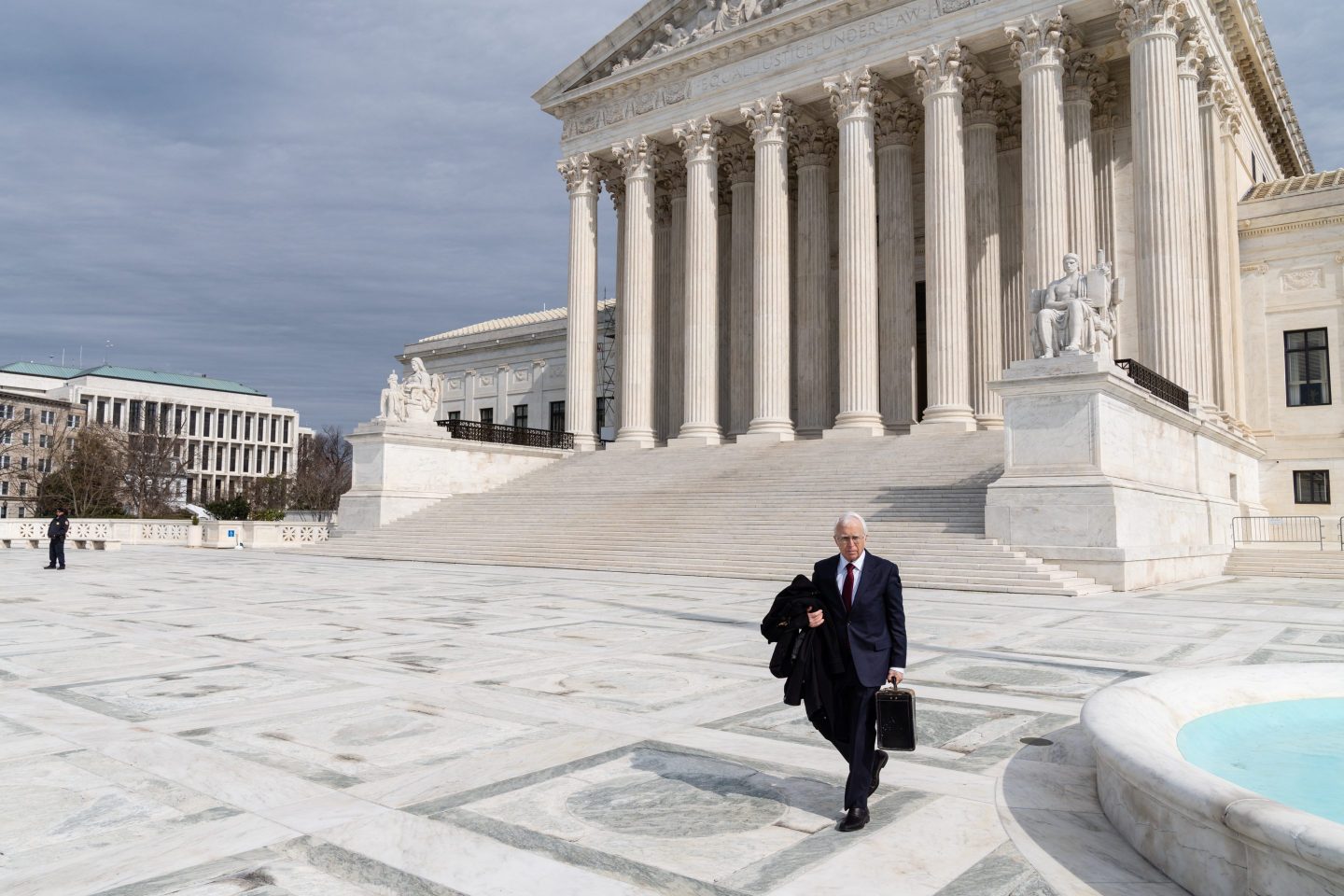
The Supreme Court heard arguments in a case that accuses social media companies of helping a terrorist group.
The Supreme Court heard arguments in a case that accuses social media companies of helping a terrorist group. Eric Lee/Bloomberg via Getty Images

The Supreme Court seemed skeptical Wednesday of a lawsuit trying to hold social media companies responsible for a terrorist attack at a Turkish nightclub that killed 39 people.

During arguments at the high court several justices underscored that there was no evidence linking Twitter, Facebook and Google directly to the 2017 attack on the Reina nightclub in Istanbul. The family of a man killed in the attack says the companies aided and abetted the attack because they assisted in the growth of the Islamic State group, which claimed responsibility for the attack . A lower court let the lawsuit go forward.

What the court does with Wednesday’s case and a related one it heard a day earlier is important, particularly because the companies have been shielded from liability on the internet, allowing them to grow into global giants.

If the court bars the lawsuit involving the attack in Turkey from going forward it could avoid a major ruling on the companies’ legal immunity. That outcome would leave the current system in place, but also leave open the possibility that the justices could take up the issue again in a later case.

Justice Amy Coney Barrett was among the members of the court who suggested that the suit against the companies lacks the kind of facts required under a federal anti-terrorism law to hold platforms responsible.

Barrett suggested that a lawsuit against a company such as Twitter would need to have more, such as direct messages, comment threads or other evidence that the platform was being used to coordinate activities for a terrorist attack, “not just general recruitment or radicalizing people.”

Justice Neil Gorsuch, participating remotely for a second straight day because of illness, said he was having difficulty with the argument of a lawyer for the family of Nawras Alassaf, who was killed in the nightclub attack. Gorsuch told lawyer Eric Schnapper that he was “struggling with how your complaint lines up with the three requirements of the statute” that the companies knowingly helped a person commit a terrorist act.

The justices seemed more willing to accept the arguments of a lawyer for Twitter, Facebook and Google, Seth Waxman. At one point during two and a half hours of arguments, Justice Sonia Sotomayor told Waxman to help her sketch out what an opinion would look like if the court ruled for his clients. “Write it for me,” she said.

Justice Brett Kavanaugh summarized Waxman’s argument this way: “When there’s a legitimate business that provides services on a widely available basis … it’s not going to be liable under this statute even if it knows bad people use its services for bad things.”

Seeming to agree with that idea, Justice Samuel Alito suggested that it would be outlandish if telephone companies were held responsible for criminal activity of people using their phones. What if, he said, the phone company “knows that a particular person is — has a criminal background and is probably engaging in criminal activity and is using the phone to communicate with other members of that person’s gang. Is that aiding and abetting the crimes that they commit?”

The law the case involves is the Justice Against Sponsors of Terrorism Act, which allows Americans injured by a terrorist attack abroad to sue for money damages in federal court.

A decision in the case — Twitter v. Taamneh, 21-1496 — is expected by the end of June before the court recesses for its summer break.

Learn how to navigate and strengthen trust in your business with The Trust Factor, a weekly newsletter examining what leaders need to succeed. Sign up here.
About the Authors
By Jessica Gresko
See full bioRight Arrow Button Icon
By Mark Sherman
See full bioRight Arrow Button Icon
By The Associated Press
See full bioRight Arrow Button Icon

Latest in Tech

Big TechStreaming
Trump warns Netflix-Warner deal may pose antitrust ‘problem’
By Hadriana Lowenkron, Se Young Lee and BloombergDecember 7, 2025
7 hours ago
Big TechOpenAI
OpenAI goes from stock market savior to burden as AI risks mount
By Ryan Vlastelica and BloombergDecember 7, 2025
7 hours ago
AIData centers
HP’s chief commercial officer predicts the future will include AI-powered PCs that don’t share data in the cloud
By Nicholas GordonDecember 7, 2025
9 hours ago
Future of WorkJamie Dimon
Jamie Dimon says even though AI will eliminate some jobs ‘maybe one day we’ll be working less hard but having wonderful lives’
By Jason MaDecember 7, 2025
13 hours ago
CryptoCryptocurrency
So much of crypto is not even real—but that’s starting to change
By Pete Najarian and Joe BruzzesiDecember 7, 2025
18 hours ago
Elon Musk
Big TechSpaceX
SpaceX to offer insider shares at record-setting $800 billion valuation
By Edward Ludlow, Loren Grush, Lizette Chapman, Eric Johnson and BloombergDecember 6, 2025
1 day ago

Most Popular

placeholder alt text
Real Estate
The 'Great Housing Reset' is coming: Income growth will outpace home-price growth in 2026, Redfin forecasts
By Nino PaoliDecember 6, 2025
2 days ago
placeholder alt text
AI
Nvidia CEO says data centers take about 3 years to construct in the U.S., while in China 'they can build a hospital in a weekend'
By Nino PaoliDecember 6, 2025
2 days ago
placeholder alt text
Economy
The most likely solution to the U.S. debt crisis is severe austerity triggered by a fiscal calamity, former White House economic adviser says
By Jason MaDecember 6, 2025
1 day ago
placeholder alt text
Economy
JPMorgan CEO Jamie Dimon says Europe has a 'real problem’
By Katherine Chiglinsky and BloombergDecember 6, 2025
1 day ago
placeholder alt text
Big Tech
Mark Zuckerberg rebranded Facebook for the metaverse. Four years and $70 billion in losses later, he’s moving on
By Eva RoytburgDecember 5, 2025
3 days ago
placeholder alt text
Politics
Supreme Court to reconsider a 90-year-old unanimous ruling that limits presidential power on removing heads of independent agencies
By Mark Sherman and The Associated PressDecember 7, 2025
16 hours ago
Rankings
  • 100 Best Companies
  • Fortune 500
  • Global 500
  • Fortune 500 Europe
  • Most Powerful Women
  • Future 50
  • World’s Most Admired Companies
  • See All Rankings
Sections
  • Finance
  • Leadership
  • Success
  • Tech
  • Asia
  • Europe
  • Environment
  • Fortune Crypto
  • Health
  • Retail
  • Lifestyle
  • Politics
  • Newsletters
  • Magazine
  • Features
  • Commentary
  • Mpw
  • CEO Initiative
  • Conferences
  • Personal Finance
  • Education
Customer Support
  • Frequently Asked Questions
  • Customer Service Portal
  • Privacy Policy
  • Terms Of Use
  • Single Issues For Purchase
  • International Print
Commercial Services
  • Advertising
  • Fortune Brand Studio
  • Fortune Analytics
  • Fortune Conferences
  • Business Development
About Us
  • About Us
  • Editorial Calendar
  • Press Center
  • Work At Fortune
  • Diversity And Inclusion
  • Terms And Conditions
  • Site Map

© 2025 Fortune Media IP Limited. All Rights Reserved. Use of this site constitutes acceptance of our Terms of Use and Privacy Policy | CA Notice at Collection and Privacy Notice | Do Not Sell/Share My Personal Information
FORTUNE is a trademark of Fortune Media IP Limited, registered in the U.S. and other countries. FORTUNE may receive compensation for some links to products and services on this website. Offers may be subject to change without notice.