Wade Shepard stumbled across his first Chinese “ghost city” in 2006 when he was a student at Zhejiang University. While visiting Tiantai, a town about two hours south of Hangzhou, he walked out of a bus station, took a wrong turn, and was gob-smacked to discover himself in an “utterly empty district” of newly erected structures.
“I remember gazing upon the freshly built, gray-tiled five-story buildings that surrounded me,” he recalled in a 2015 essay for The Diplomat. “Their windows and doors were dark, lifeless cavities, their interiors bare concrete shells, devoid of all signs of life. The street grid, buildings, and public squares were all created in a singular blast of construction. The design was cobbled together on computers, projected onto screens in boardrooms, and made into little plastic scale renders before being pasted upon the loamy river valley soil of Tiantai.”
Shepard, who later wrote a book on China’s ghost cities, was astonished to learn that such empty quarters were commonplace in China. There were scores of them scattered across the country. He visited many over the next two years. No one called them “ghost cities” in those days; what fascinated Shepard about these developments is that they weren’t old and abandoned but new and waiting to be occupied.
The global press discovered China’s “ghost cities” a few years later in the wake of the West’s own imploded property bubble. In 2009, Melissa Chan for Al Jazeera filed one of the earliest reports from Kangbashi New Area, a sprawling “city of the future” built near the old city of Ordos in the middle of the Mongolian desert. Kangbashi, she noted, had been created in just five years and was meant for a million people—”but no one has moved in.”
The following year, my old Fortune colleague Bill Powell, writing for Time, traveled to Kangbashi with ace Magnum photographer Michael Christopher Brown. Kangbashi, Bill declared, was “a public-works project worthy of Kublai Khan’s ‘stately pleasure-dome‘…filled with office towers, administrative centers, government buildings, museums, theaters, and sports fields—not to mention acre on acre of subdivisions overflowing with middle-class duplexes and bungalows.”
Alas, he noted, “hardly anyone lives there.”
New York Times correspondent David Barboza visited Kangbashi a few months later. He found it a “tomorrowland…built from scratch on a huge plot of empty land” but missing just one thing: people.
In March 2013, CBS 60 Minutes correspondent Lesley Stahl toured the new eastern district of Zhengzhou, in Henan province, with Hong Kong financial analyst Gillem Tulloch. She found a “‘ghost city’ of new towers with no residents, desolate condos, and vacant subdivisions uninhabited for miles, and miles, and miles, and miles of empty apartments.” China, Stahl worried, “may have created the largest housing bubble in human history.”
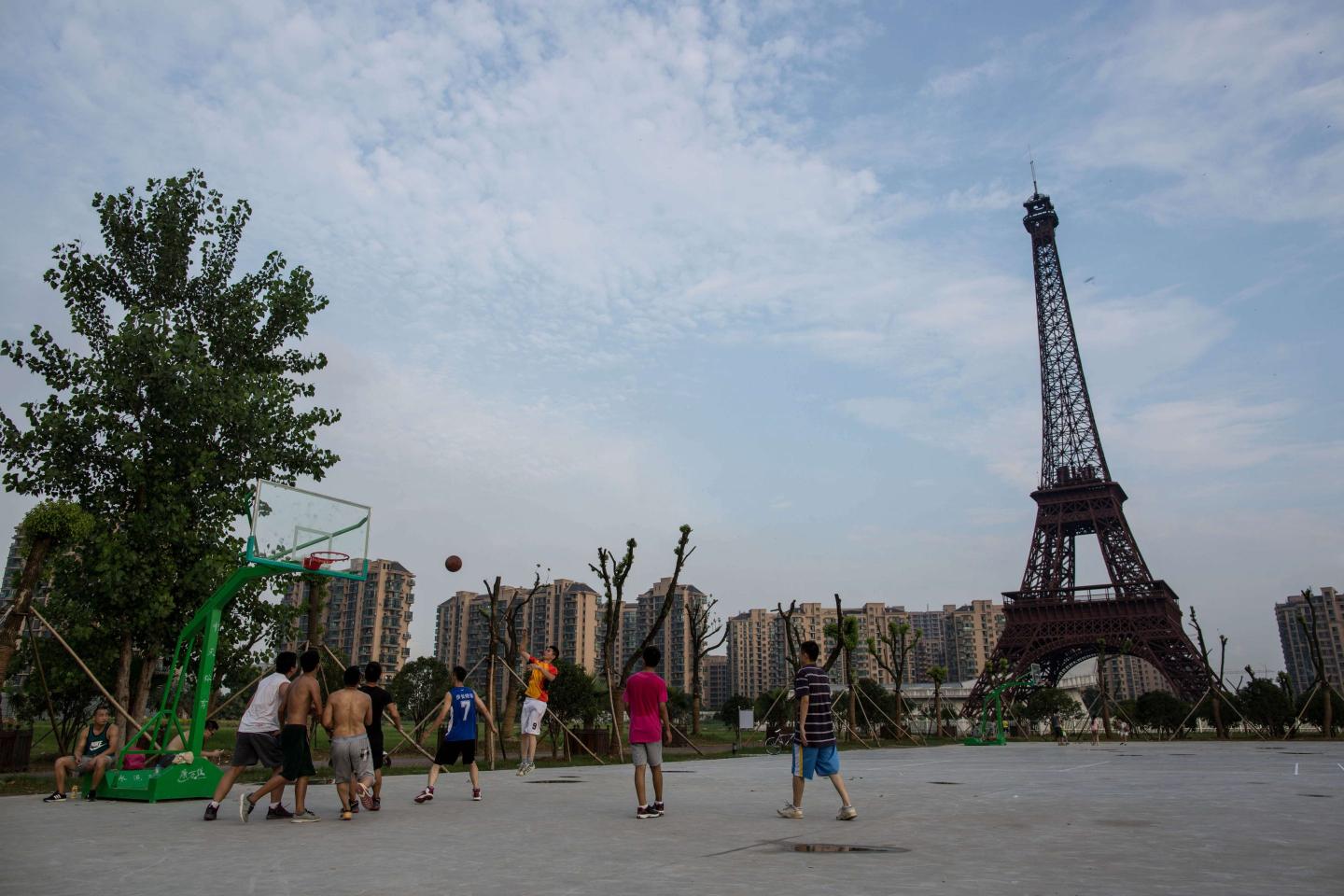
In the decade since those early dispatches, “China’s ghost cities” have become a familiar trope in Western media. Beyond Kangbashi, with its other-worldly stadiums and museums, there is Chengchong in southern Yunnan province; Binhai, outside the central city of Tianjin; and Tianducheng, in the Hangzhou suburbs, with its very own replica of the Eiffel Tower.
The topic is in the news again because of the financial travails of Evergrande Group, China’s second-largest property developer which, as Fortune‘s Eamon Barrett reported yesterday, is teetering on the brink of default with outstanding debts of more than $305 billion.
The Wall Street Journal yesterday published a riveting profile of one of Evergrande’s debt-fueled disasters in Lu’an, a city 350 miles west of Shanghai. “Rows of residential towers, some 26 stories high, stand unfinished…plastic tarps flagging in the wind,” the Journal reports. Nearby, “golden Pegasus statues guard an uncompleted $9 billion theme park that was supposed to be bigger than Disneyland” while a “$4 billion electric-vehicle plant, central to local leaders’ economic dreams, remains a steel frame with overgrown vegetation spilling into the road.”
It’s easy to see Evergrande as a metaphor for China itself: overly ambitious, hopelessly mired in debt, divorced from market realities, and hurtling towards collapse. But the real story of China’s ghost cities is complicated.
Bloomberg Businessweek last month revisited three of China’s most notorious ghost cities—Kangbashi, Binhai, and Zhengzhou—and found that they are gradually attracting residents. “It’s hard to say how China’s reputed ghost cities are faring collectively,” Bloomberg concluded. “Government data aren’t publicly available, and independent research is spotty. What is clear is that local governments can throw money at these projects for many years.”
True enough. There are many more profitable ventures at which local governments could “throw money.” But for now ghost cities are an investment target that does not frighten.
More Eastworld news below.
Clay Chandler
clay.chandler@fortune.com
This edition of Eastworld was curated and produced by Nicholas Gordon. Reach him at nicholas.gordon@fortune.com.
Eastworld news
Foreign interference
After ten hours of parliamentary debate, and three years after it was first proposed, Singapore has passed a law against “foreign interference.” The law allows Singapore’s government to demand user information from Internet and social media companies, block online content, and require “politically significant” individuals to declare links to foreign entities. Critics have flagged the law’s “extremely broad language,” such as its lack of specificity about what acts are proscribed. South China Morning Post
COVID zero
Zhong Nanshan—one of China’s leading epidemiologists—gave some of the first indications of when China might move away from its aggressive COVID-zero strategy. Zhong noted that the policy is unsustainable in the long-run, and suggested that an 80-85% full vaccination rate might be a safe threshold to consider a change in strategy. China is increasingly alone in its pursuit of COVID zero, with Singapore, Australia and New Zealand all announcing plans to begin to “live with the virus.” Fortune
U.S.-China trade war
In a speech to the Center for Strategic and International Studies, U.S. Trade Representative Katherine Tai offered one of the first looks at how the Biden administration will approach the U.S-China trade relationship. Ambassador Tai noted that the U.S. would continue to use trade barriers to counter Chinese trade practices in a seeming continuation of the approach of the previous administration, though it would allow companies to apply for tariff exemptions. The New York Times
India protests
Nine people were killed in an incident during a farmer protest in Uttar Pradesh. Protest leaders claim that a vehicle carrying the son of Ajay Mishra, India’s minister of state for home affairs, struck protestors; in contrast, Mishra claimed that the driver and other members of the BJP party were later beaten to death by protestors. The farmer protests have continued since last November after New Delhi passed laws intended to modernize the country’s agricultural system. Al Jazeera
Pandora Papers
The release of the Pandora Papers by the International Consortium of Investigative Journalists, which show how wealthy individuals hide their income and assets through offshore companies and trusts, is reverberating around Asia. The documents name two of Hong Kong’s former chief executives—Tung Chee-Hwa and C.Y. Leung—as well as Feng Qiya, a delegate to the National People’s Congress. Malaysia’s opposition leader, Anwar Ibrahim, has demanded a parliamentary debate on revelations that the country’s former and current Finance Ministers are named in the document. Associated Press
Markets and movers
Fantasia — Another Chinese property developer has defaulted on a bond, with Fantasia failing to repay $205 million of debt due Monday. The missed payment comes after the company claimed two weeks ago that it had no liquidity issues.
Oyo — The hotel startup, backed by SoftBank’s Vision Fund, is planning to raise $1.1 billion in a local IPO. India’s markets have attracted significant interest as investors look for alternatives to crackdown-plagued China.
HK anti-sanctions law — Hong Kong is shelving its proposed anti-sanctions law, which would have punished institutions that implemented U.S. sanctions. The business community had lobbied against the law, stating that it would have hurt the city as a financial center, especially compared to Hong Kong’s regional rival Singapore.
Japan markets — Japan’s stock markets are down 10% from their September high after Fumio Kishida was sworn in as the country’s 100th prime minister. Markets surged after the resignation of Yoshihide Suga as investors hoped for political change, but Kishida’s victory over more reformist rivals has hit those expectations.
Grab — The Singaporean superapp will buy a majority stake in Indonesian e-wallet startup OVO, increasing its share to 90%. Grab is purchasing the stake from Lippo and Tokopedia. The sale is expected to help clear the way for Tokopedia’s upcoming merger with GoJek; Indonesian rules only allow firms to have stakes in one e-wallet at a time, and so Tokopedia would not have been allowed to have stakes in both OVO and GoJek’s GoPay.
Final figure
Asia’s initial public offerings had their best third quarter on record, with first time share sales raising $56 billion in the three months through Sept. 30. Listings surged in South Korea, India and Indonesia; however, China’s crackdown has resulted in fewer listings in Hong Kong, normally one of the world’s busiest listing venues.
Subscribe to Fortune Daily to get essential business stories straight to your inbox each morning.