• Home
  • Latest
  • Fortune 500
  • Finance
  • Tech
  • Leadership
  • Lifestyle
  • Rankings
  • Multimedia

Trendingnow

1

'Dr. Doom' Nouriel Roubini says we're headed for universal basic income or 'some form of socialism' as AI revolutionizes work—He calls that optimistic

2

Power companies are using eminent domain to seize land for data centers as 70% of Americans say not in my backyard

3

Red Lobster’s 37-year-old CEO waited tables before joining the C-suite—he says it was a crash course in managing ‘difficult people and situations’

1

'Dr. Doom' Nouriel Roubini says we're headed for universal basic income or 'some form of socialism' as AI revolutionizes work—He calls that optimistic

2

Power companies are using eminent domain to seize land for data centers as 70% of Americans say not in my backyard

3

Red Lobster’s 37-year-old CEO waited tables before joining the C-suite—he says it was a crash course in managing ‘difficult people and situations’
Health

Colorado lawmakers wage multi-front assault on high drug costs

By
Markian Hawryluk
Markian Hawryluk
and
Kaiser Health News
Kaiser Health News
Down Arrow Button Icon
By
Markian Hawryluk
Markian Hawryluk
and
Kaiser Health News
Kaiser Health News
Down Arrow Button Icon
May 24, 2021, 7:15 AM ET
Add Fortune on Google for similar content.

Tired of waiting for federal action to reduce prescription drug costs, Colorado is acting on its own—even if it must do so with one arm tied behind its back. Unable to set prices or change patent protections, the state is exploring creative legislative and administrative approaches to lower out-of-pocket costs on medications.

While none of the efforts alone would result in broad-based, deep cuts, state officials estimate the combined impact of the various measures could save Coloradans between 20% to 40% in out-of-pocket costs.

“That’s why it’s so important to have a variety of levers,” said Kim Bimestefer, executive director of the Colorado Department of Health Care Policy & Financing. “You start stacking all these up, and it’s remarkable how much we can drive down the cost.”

Like many states, Colorado has been looking to lower drug prices for several years, issuing a report late in 2019 that explained why the state spent more than $1 billion annually on drug purchases. Although the pandemic derailed action last year, the state updated the report in January, and state agencies and the legislature are working to implement some of the proposals.

One bill would create a prescription drug affordability board, which could review prices of medications sold in the state to consumers and set payment limits. The legislation, backed by Democratic Gov. Jared Polis, has already passed the Colorado Senate and is making its way through the House. The board would be charged with ensuring those savings are passed on to consumers.

Drugs would qualify for an affordability review under various triggers, including when prices increase by more than 10% per year, or exceed either $30,000 a year for brand-name drugs or $100 per month for generics per person. Patients or consumer advocates could also nominate drugs for review.

State officials estimate those categories probably cover 100 to 125 medications, but the board would be permitted to set limits for only 12 drugs per year. The board could review affordability of more drugs and make recommendations for other types of administrative or legislative action to lower their costs.

“It is inherently limited,” said Isabel Cruz, a policy manager with the Colorado Consumer Health Initiative, a nonprofit that seeks to lower health costs for state residents. “That’s the political reality that we had to accept.”
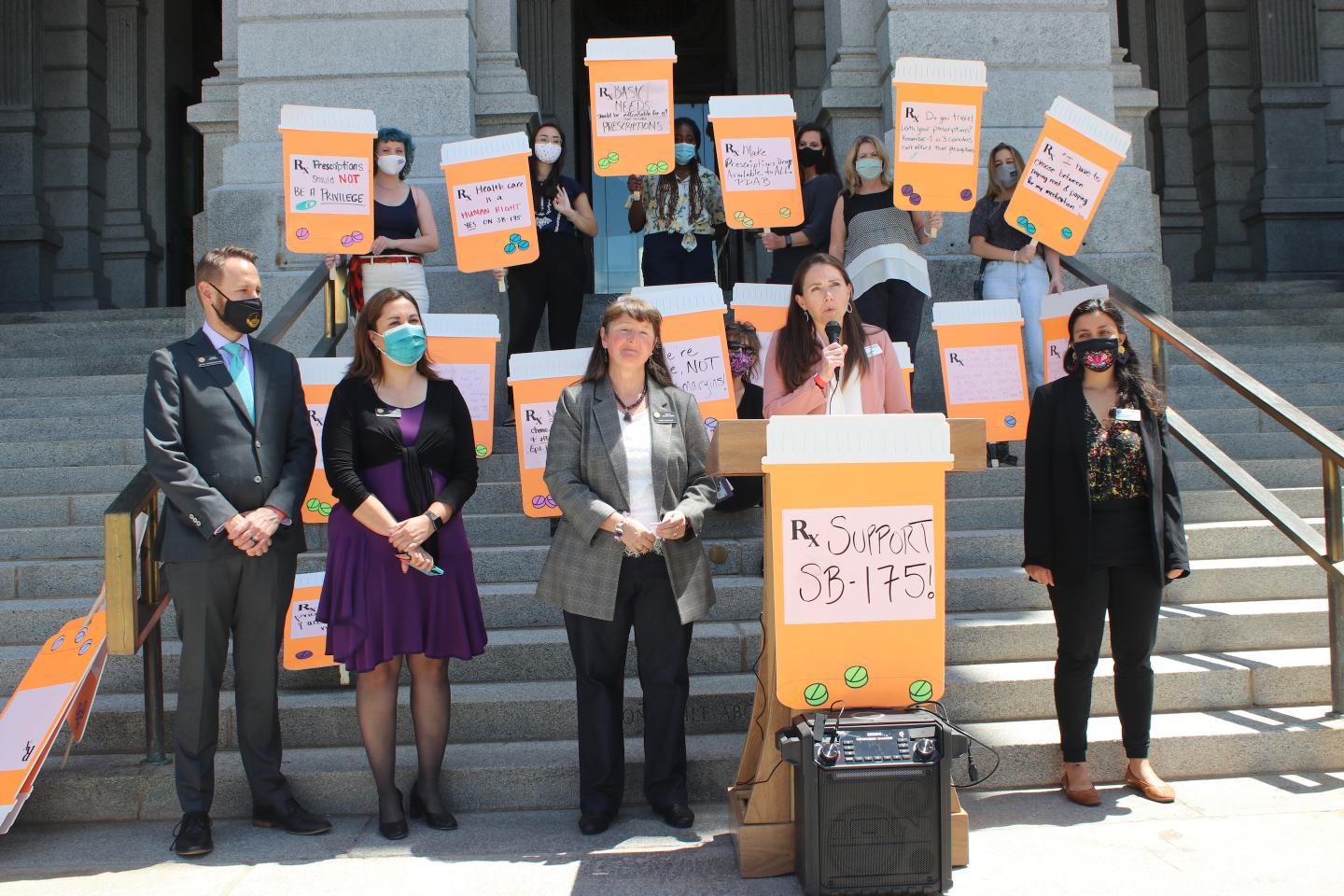
Adela Flores-Brennan, executive director of the Colorado Consumer Health Initiative, speaks at a rally on the steps of the Colorado Capitol in Denver on May 19, 2021, in support of a bill that would create a prescription drug affordability board to set payment limits on high-cost drugs.
Markian Hawryluk/KHN

The bill is intended to help patients like 18-year-old Koen Lichtenbelt, in Ridgeway, Colo., who was diagnosed with a rare autoinflammatory disease in kindergarten. The condition damaged his nerves and, in December, doctors prescribed the drug Hizentra, with an out-of-pocket cost of $10,000 per month. His parents footed the bill for three months before their insurance plan agreed to cover the drug.

His mother, Cat Lichtenbelt, said, that’s “$30,000, which is the price of a car, but, you know, this is our son’s life.”

Once on the medication, Koen, who had been missing half of his school days over the course of his education, was able to graduate this year. He’s been accepted to Colorado State University but is taking a gap year to work as a first responder at a local fire department. Had he not had access to the drug, Lichtenbelt said, her son would likely be reliant on state aid now.

“There is a need for pharmaceutical companies to continue to develop medications and drugs to improve people’s lives,” she said. “However, what is the price point at which there is access to actually being able to use those drugs?”

In addition to opposition from the state’s hospital and pharmacy groups, the pharmaceutical industry is throwing its weight against the bill, including threats not to sell in Colorado the drugs facing payment limits.

“Creating a board of unelected bureaucrats with the authority to arbitrarily decide what medicines are worth and what medicines patients can get would be a disaster for patients,” said Hannah Loiacono, a spokesperson for the national Pharmaceutical Research and Manufacturers of America industry group.

The Colorado BioScience Association warned that setting payment limits could reduce the funding available for new pharmaceutical discoveries.

“If passed, this bill will create unpredictability for the startups and development-stage companies in Colorado’s life sciences ecosystem, making it harder for them to raise funds,” said Jennifer Jones Paton, the group’s president and CEO. “Investors will look elsewhere for opportunities.”

Nonetheless, the bill is expected to pass. Proponents said it’s unlikely a manufacturer could carve out specific drugs or states from its supply chain and pointed out that drug companies already sell their highest-cost drugs at lower prices to Medicaid, community health clinics, and charity hospitals.

The governor’s office is also implementing changes on its own. On July 1, it is formally launching a tool embedded in electronic medical records allowing doctors and other prescribers to see what patients with public or private health plans would pay for a medication. Bimestefer said 80% of prescribers in the state have the tool enabled, and 37% are using it ahead of the official start date.

The state is also pursuing contracts with drug companies that would link prices to the effectiveness of the drugs, measured, for example, by whether they reduce hospitalizations or heart attacks.

The Colorado legislature had previously approved importing drugs from Canada for consumers to purchase at lower costs and, now with federal approval, the state is reviewing bids from contractors to make that happen. The state estimates Canadian imports would reduce costs for 50 common drugs by 63%. But the state found that importing drugs from Australia and France could save 78% to 84%. Colorado would need an adjustment to federal law to expand importation to those countries but could rely on the same infrastructure being built for Canadian imports.

“If we open up other countries, we could increase the supply of the drugs coming in,” Bimestefer said. “This will actually help us battle pharma if we can turn on the spigot full, full, full throttle.”

Colorado’s efforts are part of a national trend by states that started in earnest about five years ago, said Megan Olsen, a principal in the policy practice at Avalere, a health care consulting firm in Washington, D.C. The lack of federal action, as well as exploding Medicaid and state employee health plan budgets, encouraged states to tackle the issue.

“Early on the focus was on transparency,” she said. “Now what we’re seeing is sort of a progression from those transparency bills into more of trying to regulate prices or control prices in different ways.”

According to the National Academy for State Health Policy, which provides draft health policy legislation to states, nearly every single state and U.S. territory is considering some sort of prescription drug cost bill this year. There are 14 prescription drug affordability board bills, 24 foreign drug importation bills and 58 bills addressing prescription drug coupons or cost sharing. And, following a December U.S. Supreme Court ruling allowing states to regulate pharmacy benefit managers, the go-between companies that control the drug prices paid by insurance companies, states are considering 97 separate PBM measures. Colorado legislators, for example, are debating a bill that would force those companies to compete to service state health plans.

Trish Riley, executive director for the academy, said states serve as 50 health policy laboratories, experimenting with policies that can set precedent for other states, prove the viability of various approaches, and put pressure on the feds to act. Some national policies, such as the Children’s Health Insurance Program, started as state measures.

“We’re on the front lines,” Bimestefer said. “And we can see some of the solutions more readily.”

While a patchwork of state regulations can add administrative burdens for drug companies, Riley said it can also spur federal action.

“I would argue chaos theory,” Riley said. “The more differentiation between states, the more there’s pressure on the federal government to make a more consistent system.”

KHN (Kaiser Health News) is a national newsroom that produces in-depth journalism about health issues. Together with Policy Analysis and Polling, KHN is one of the three major operating programs at KFF (Kaiser Family Foundation). KFF is an endowed nonprofit organization providing information on health issues to the nation.

Our mission to make business better is fueled by readers like you. To enjoy unlimited access to our journalism, subscribe today.
About the Authors
By Markian Hawryluk
See full bioRight Arrow Button Icon
By Kaiser Health News
See full bioRight Arrow Button Icon
Add Fortune on Google for similar content.

Latest in Health

Finance
Lorem ipsum dolor sit amet, consectetur adipiscing elit, sed do eiusmod tempor incididunt ut labore et dolore magna aliqua. Ut enim ad minim veniam
By Fortune Editors
October 20, 2025
Finance
Lorem ipsum dolor sit amet, consectetur adipiscing elit, sed do eiusmod tempor incididunt ut labore et dolore magna aliqua. Ut enim ad minim veniam
By Fortune Editors
October 20, 2025
Finance
Lorem ipsum dolor sit amet, consectetur adipiscing elit, sed do eiusmod tempor incididunt ut labore et dolore magna aliqua. Ut enim ad minim veniam
By Fortune Editors
October 20, 2025
Finance
Lorem ipsum dolor sit amet, consectetur adipiscing elit, sed do eiusmod tempor incididunt ut labore et dolore magna aliqua. Ut enim ad minim veniam
By Fortune Editors
October 20, 2025
Finance
Lorem ipsum dolor sit amet, consectetur adipiscing elit, sed do eiusmod tempor incididunt ut labore et dolore magna aliqua. Ut enim ad minim veniam
By Fortune Editors
October 20, 2025
Finance
Lorem ipsum dolor sit amet, consectetur adipiscing elit, sed do eiusmod tempor incididunt ut labore et dolore magna aliqua. Ut enim ad minim veniam
By Fortune Editors
October 20, 2025

Most Popular

Finance
Lorem ipsum dolor sit amet, consectetur adipiscing elit, sed do eiusmod tempor incididunt ut labore et dolore magna aliqua. Ut enim ad minim veniam
By Fortune Editors
October 20, 2025
Finance
Lorem ipsum dolor sit amet, consectetur adipiscing elit, sed do eiusmod tempor incididunt ut labore et dolore magna aliqua. Ut enim ad minim veniam
By Fortune Editors
October 20, 2025
Finance
Lorem ipsum dolor sit amet, consectetur adipiscing elit, sed do eiusmod tempor incididunt ut labore et dolore magna aliqua. Ut enim ad minim veniam
By Fortune Editors
October 20, 2025
Finance
Lorem ipsum dolor sit amet, consectetur adipiscing elit, sed do eiusmod tempor incididunt ut labore et dolore magna aliqua. Ut enim ad minim veniam
By Fortune Editors
October 20, 2025
Finance
Lorem ipsum dolor sit amet, consectetur adipiscing elit, sed do eiusmod tempor incididunt ut labore et dolore magna aliqua. Ut enim ad minim veniam
By Fortune Editors
October 20, 2025
Finance
Lorem ipsum dolor sit amet, consectetur adipiscing elit, sed do eiusmod tempor incididunt ut labore et dolore magna aliqua. Ut enim ad minim veniam
By Fortune Editors
October 20, 2025
Fortune Secondary Logo
Rankings
  • 100 Best Companies
  • Fortune 500
  • Global 500
  • Fortune 500 Europe
  • Most Powerful Women
  • World's Most Admired Companies
  • See All Rankings
  • Lists Calendar
Sections
  • Finance
  • Fortune Crypto
  • Features
  • Leadership
  • Health
  • Commentary
  • Success
  • Retail
  • Mpw
  • Tech
  • Lifestyle
  • CEO Initiative
  • Asia
  • Politics
  • Conferences
  • Europe
  • Newsletters
  • Personal Finance
  • Environment
  • Magazine
  • Education
Customer Support
  • Frequently Asked Questions
  • Customer Service Portal
  • Privacy Policy
  • Terms Of Use
  • Single Issues For Purchase
  • International Print
Commercial Services
  • Advertising
  • Fortune Brand Studio
  • Fortune Analytics
  • Fortune Conferences
  • Business Development
  • Group Subscriptions
About Us
  • About Us
  • Press Center
  • Work At Fortune
  • Terms And Conditions
  • Site Map
  • About Us
  • Press Center
  • Work At Fortune
  • Terms And Conditions
  • Site Map
  • Facebook icon
  • Twitter icon
  • LinkedIn icon
  • Instagram icon
  • Pinterest icon

Latest in Health

FDA walks back positive lab test while lettuce recall continues
HealthFood and drink
FDA walks back positive lab test while lettuce recall continues
By Bloomberg, Kristina Peterson, Jessica Nix and Daniela SirtoriJuly 20, 2026
2 hours ago
Pharmacy technician Brandy Leroy fills a TPN bag using the ExactaMix Pro Automated Compounding System
Startups & VentureTerm Sheet
The FDA’s peptide vote could create telehealth’s next multibillion-dollar market
By Lily Mae LazarusJuly 20, 2026
4 hours ago
A decade after the ‘Godfather of AI’ said radiologists were obsolete, their salaries are up to $571K and demand is growing fast
AIthe future of work
A decade after the ‘Godfather of AI’ said radiologists were obsolete, their salaries are up to $571K and demand is growing fast
By Marco Quiroz-GutierrezJuly 19, 2026
1 day ago
How United’s ‘premiumization’ strategy got passengers to swallow higher airfares without a fight
HealthAirline industry
How United’s ‘premiumization’ strategy got passengers to swallow higher airfares without a fight
By Phil WahbaJuly 19, 2026
1 day ago
Diarrhea-causing lettuce may have spread as wide as 27 states, Taylor Farms recall suggests
HealthFood and drink
Diarrhea-causing lettuce may have spread as wide as 27 states, Taylor Farms recall suggests
By Savannah Peters and The Associated PressJuly 18, 2026
2 days ago
Walmart removes four Taylor Farms salads as recalls spread
RetailFood and drink
Walmart removes four Taylor Farms salads as recalls spread
By Jaewon Kang, Jessica Nix, Fabiola Zerpa and BloombergJuly 18, 2026
2 days ago

Most Popular

'Dr. Doom' Nouriel Roubini says we're headed for universal basic income or 'some form of socialism' as AI revolutionizes work—He calls that optimistic
AI
'Dr. Doom' Nouriel Roubini says we're headed for universal basic income or 'some form of socialism' as AI revolutionizes work—He calls that optimistic
By Jason MaJuly 18, 2026
2 days ago
Power companies are using eminent domain to seize land for data centers as 70% of Americans say not in my backyard
AI
Power companies are using eminent domain to seize land for data centers as 70% of Americans say not in my backyard
By Aaron Walayat and The ConversationJuly 19, 2026
1 day ago
Red Lobster’s 37-year-old CEO waited tables before joining the C-suite—he says it was a crash course in managing ‘difficult people and situations’
Success
Red Lobster’s 37-year-old CEO waited tables before joining the C-suite—he says it was a crash course in managing ‘difficult people and situations’
By Preston ForeJuly 19, 2026
1 day ago
Warren Buffett says his $147 billion investing career was an accident: ‘I may be one of the 10 luckiest in the world’
Future of Work
Warren Buffett says his $147 billion investing career was an accident: ‘I may be one of the 10 luckiest in the world’
By Sarah GlodekJuly 20, 2026
9 hours ago
A decade after the ‘Godfather of AI’ said radiologists were obsolete, their salaries are up to $571K and demand is growing fast
AI
A decade after the ‘Godfather of AI’ said radiologists were obsolete, their salaries are up to $571K and demand is growing fast
By Marco Quiroz-GutierrezJuly 19, 2026
1 day ago
Indeed chief economist: Aging Baby Boomers are America's real labor problem, not AI
Commentary
Indeed chief economist: Aging Baby Boomers are America's real labor problem, not AI
By Svenja GudellJuly 18, 2026
2 days ago

© 2026 Fortune Media IP Limited. All Rights Reserved. Use of this site constitutes acceptance of our Terms of Use and Privacy Policy | CA Notice at Collection and Privacy Notice | Do Not Sell/Share My Personal Information
FORTUNE is a trademark of Fortune Media IP Limited, registered in the U.S. and other countries. FORTUNE may receive compensation for some links to products and services on this website. Offers may be subject to change without notice.