• Home
  • Latest
  • Fortune 500
  • Finance
  • Tech
  • Leadership
  • Lifestyle
  • Rankings
  • Multimedia
Commentary

Why it would be a huge mistake to allow Big Tech firms to acquire banks

By
Art Wilmarth
Art Wilmarth
Down Arrow Button Icon
By
Art Wilmarth
Art Wilmarth
Down Arrow Button Icon
November 26, 2020, 9:00 AM ET
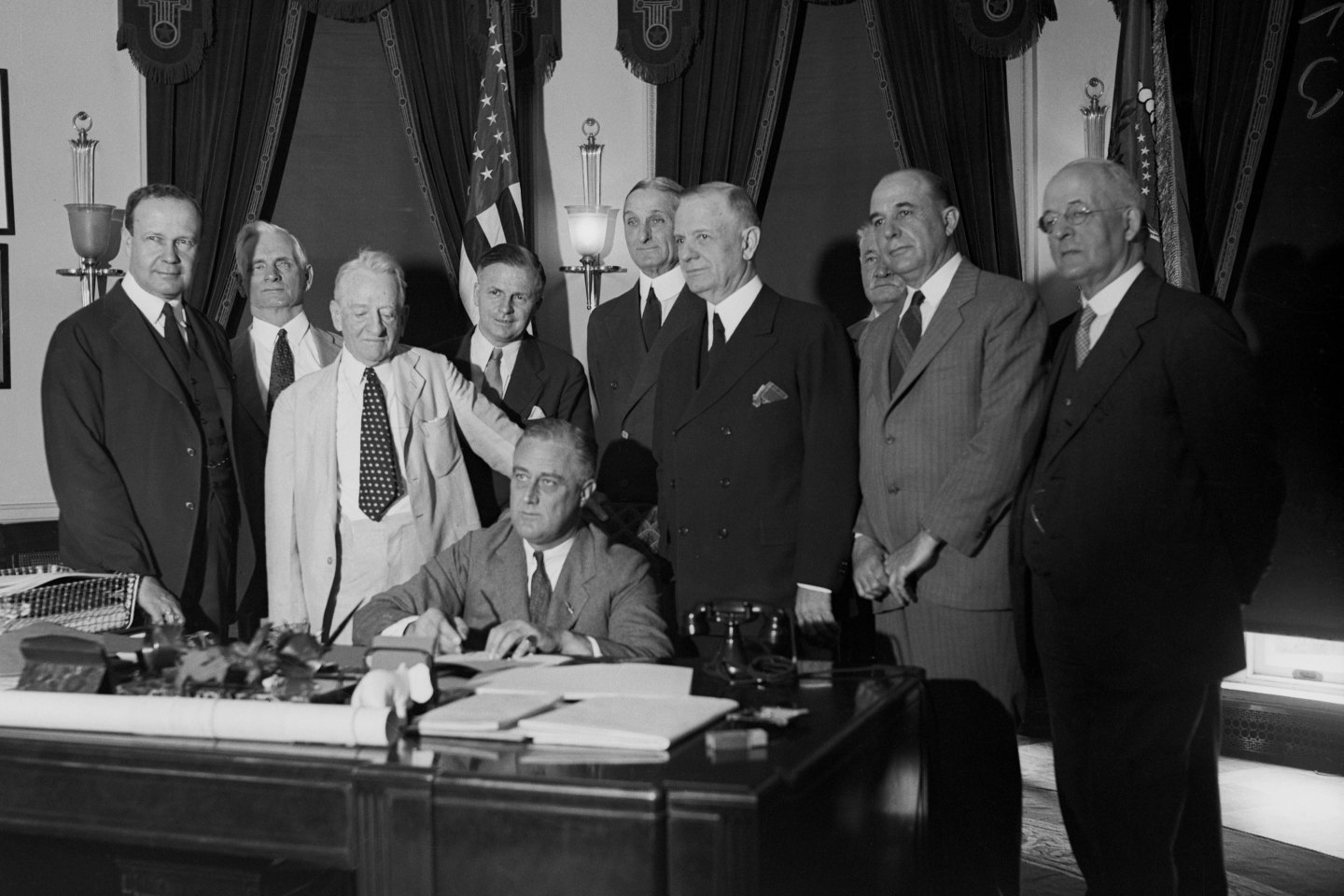
Commentary-Big Tech and Banks-Roosevelt Signing Glass-Steagall Act
President Franklin Roosevelt signs the Glass-Steagall bank reform legislation. Congress should pass a new Glass-Steagall Act to reinforce the separation between banking and commerce, writes Art Wilmarth.Bettmann—Getty Images

Prior to 1980, the Glass-Steagall Act of 1933 maintained a strict separation between our banking system and our capital markets. However, financial regulators opened loopholes in Glass-Steagall during the 1980s and 1990s, allowing banks to engage in securities activities and permitting nonbanks to offer bank-like products. 

“Universal banks” (banks engaged in securities activities) and “shadow banks” (nonbanks offering bank-like services) dominated our financial markets after Congress repealed Glass-Steagall in 1999. Universal banks and shadow banks played leading roles in the toxic subprime lending boom that led to the financial crisis of 2007–09.

In response to the financial crisis, the Treasury Department and the Federal Reserve bailed out big banks as well as large shadow banks (including AIG, Morgan Stanley, and Goldman Sachs). Federal agencies also protected short-term financial instruments that functioned as substitutes for bank deposits, such as money market mutual funds, commercial paper, and securities repurchase agreements (“repos”). 

The federal government’s response to the financial crisis went far beyond the traditional U.S. policy of protecting banks and bank depositors. Federal authorities effectively wrapped the federal “safety net” around our entire financial system. By doing so, they “bankified” our financial markets.

The Dodd-Frank Act’s regulatory reforms did not correct the deeply flawed structure of the financial system—including the dominance of universal banks and shadow banks—that caused the financial crisis of 2007–09. Consequently, federal agencies felt compelled to provide another series of bailouts when the COVID-19 pandemic triggered a new financial crisis. Federal authorities aggressively intervened in March to protect universal banks, shadow banks, and short-term financial markets from failure. In addition, federal agencies took the unprecedented step of backstopping the corporate bond market. 

That extraordinary measure was not coincidental. Universal banks and shadow banks promoted a massive expansion of corporate debt during the past decade. The debts of U.S. corporations reached a record level of $10.5 trillion in March 2020. Almost two-thirds of those debts were either rated as “junk” or received the lowest investment-grade rating (BBB). Corporate debt markets would have collapsed without the federal government’s backstop, with severe knock-on effects for our financial system and economy.

This year’s events have once again revealed the unhealthy bankification of our financial markets. Now federal regulators are trying to bankify the rest of the economy. The Office of the Comptroller of the Currency (OCC)—the regulator of national banks—wants to give national bank charters to fintechs that offer lending or payment services but do not accept deposits. The Federal Deposit Insurance Corporation (FDIC) is considering a rule that would allow all types of commercial firms to acquire FDIC-insured industrial banks (consumer banks chartered by Utah and several other states). 

The OCC’s and FDIC’s initiatives would allow technology firms and other commercial enterprises to obtain banking privileges and benefits—including access to the federal “safety net”—without complying with many of the prudential requirements governing FDIC-insured full-service banks. For example, commercial owners of fintech national banks and industrial banks would not have to comply with the Bank Holding Company (BHC) Act, which prohibits affiliations between FDIC-insured full-service banks and commercial firms. That prohibition is the cornerstone of our historic policy of separating banking and commerce.

The Glass-Steagall and BHC acts separated banking from commerce to prevent undue concentrations of financial and economic power and to minimize conflicts of interest in bank lending and investment advice. A bank that controls—or is controlled by—a commercial firm has powerful and dangerous incentives to use its lending and investment policies to support its commercial affiliate. Problems that arise in the commercial affiliate are likely to infect the bank, as shown by the recent collapse of Wirecard in Germany.

If the OCC’s and FDIC’s initiatives succeed, Congress will face intense pressure to repeal the separation of banking and commerce. Big Tech firms will lobby for permission to acquire full-service banks, and big banks will push for authority to acquire technology firms. If Congress gives in (as it did when it repealed Glass-Steagall), mergers between Big Tech companies and big banks are virtually certain to occur. 

The result will be a bankification of our economy. Giant banking-and-commercial conglomerates will spread across the nation. Commercial owners of banks will profit from the federal “safety net,” including the ability to offer FDIC-insured deposits—the cheapest and most stable source of funding available in the private market. Large commercial firms that own sizable banks will be considered “too big to fail” and will enjoy enormous advantages over smaller competitors that can’t afford to acquire banks. 

When the next crisis occurs, federal agencies will feel compelled to rescue not only our financial system but also our leading banking-and-commercial conglomerates. Market discipline, which has already been greatly weakened in our financial markets, will largely disappear from the rest of our economy.

Congress should adopt two crucial measures to reverse the bankification of our country. First, Congress should enact a new Glass-Steagall Act to reestablish a strict separation between our banking system and our capital markets. Congress should prohibit banks from underwriting and trading in securities and other capital market instruments, except for government bonds. 

Congress should also prohibit nonbanks from offering short-term financial instruments that function as deposit substitutes. Only banks should be allowed to issue money market mutual funds, commercial paper, and repos. Requiring nonbanks to fund their operations with longer-term securities would eliminate the shadow bank business model, restore market discipline, and improve the stability of our financial markets.

Second, Congress should reaffirm the separation of banking and commerce by overruling the OCC’s and FDIC’s initiatives. Both measures would return banks to their traditional roles as objective providers of deposit, credit, payment, and fiduciary services. The “too big to fail” problem would be greatly diminished with the elimination of universal banks and the likely disappearance of shadow banks. Banks and commercial firms would be prevented from exercising any type of control over each other. 

Banks and the capital markets would once again become independent sectors with strong incentives to serve the needs of consumers, communities, and Main Street businesses. Our financial system and our economy would become more stable, more competitive, and more productive. 

Art Wilmarth is a professor emeritus of law at George Washington University. This essay is based on his recently published book, Taming the Megabanks: Why We Need a New Glass-Steagall Act, and his testimony before the House Financial Services Committee’s Task Force on Financial Technology on Sept. 29, 2020. 

About the Author
By Art Wilmarth
See full bioRight Arrow Button Icon

Latest in Commentary

Finance
Lorem ipsum dolor sit amet, consectetur adipiscing elit, sed do eiusmod tempor incididunt ut labore et dolore magna aliqua. Ut enim ad minim veniam
By Fortune Editors
October 20, 2025
Finance
Lorem ipsum dolor sit amet, consectetur adipiscing elit, sed do eiusmod tempor incididunt ut labore et dolore magna aliqua. Ut enim ad minim veniam
By Fortune Editors
October 20, 2025
Finance
Lorem ipsum dolor sit amet, consectetur adipiscing elit, sed do eiusmod tempor incididunt ut labore et dolore magna aliqua. Ut enim ad minim veniam
By Fortune Editors
October 20, 2025
Finance
Lorem ipsum dolor sit amet, consectetur adipiscing elit, sed do eiusmod tempor incididunt ut labore et dolore magna aliqua. Ut enim ad minim veniam
By Fortune Editors
October 20, 2025
Finance
Lorem ipsum dolor sit amet, consectetur adipiscing elit, sed do eiusmod tempor incididunt ut labore et dolore magna aliqua. Ut enim ad minim veniam
By Fortune Editors
October 20, 2025
Finance
Lorem ipsum dolor sit amet, consectetur adipiscing elit, sed do eiusmod tempor incididunt ut labore et dolore magna aliqua. Ut enim ad minim veniam
By Fortune Editors
October 20, 2025

Most Popular

Finance
Lorem ipsum dolor sit amet, consectetur adipiscing elit, sed do eiusmod tempor incididunt ut labore et dolore magna aliqua. Ut enim ad minim veniam
By Fortune Editors
October 20, 2025
Finance
Lorem ipsum dolor sit amet, consectetur adipiscing elit, sed do eiusmod tempor incididunt ut labore et dolore magna aliqua. Ut enim ad minim veniam
By Fortune Editors
October 20, 2025
Finance
Lorem ipsum dolor sit amet, consectetur adipiscing elit, sed do eiusmod tempor incididunt ut labore et dolore magna aliqua. Ut enim ad minim veniam
By Fortune Editors
October 20, 2025
Finance
Lorem ipsum dolor sit amet, consectetur adipiscing elit, sed do eiusmod tempor incididunt ut labore et dolore magna aliqua. Ut enim ad minim veniam
By Fortune Editors
October 20, 2025
Finance
Lorem ipsum dolor sit amet, consectetur adipiscing elit, sed do eiusmod tempor incididunt ut labore et dolore magna aliqua. Ut enim ad minim veniam
By Fortune Editors
October 20, 2025
Finance
Lorem ipsum dolor sit amet, consectetur adipiscing elit, sed do eiusmod tempor incididunt ut labore et dolore magna aliqua. Ut enim ad minim veniam
By Fortune Editors
October 20, 2025
Fortune Secondary Logo
Rankings
  • 100 Best Companies
  • Fortune 500
  • Global 500
  • Fortune 500 Europe
  • Most Powerful Women
  • Future 50
  • World’s Most Admired Companies
  • See All Rankings
Sections
  • Finance
  • Fortune Crypto
  • Features
  • Leadership
  • Health
  • Commentary
  • Success
  • Retail
  • Mpw
  • Tech
  • Lifestyle
  • CEO Initiative
  • Asia
  • Politics
  • Conferences
  • Europe
  • Newsletters
  • Personal Finance
  • Environment
  • Magazine
  • Education
Customer Support
  • Frequently Asked Questions
  • Customer Service Portal
  • Privacy Policy
  • Terms Of Use
  • Single Issues For Purchase
  • International Print
Commercial Services
  • Advertising
  • Fortune Brand Studio
  • Fortune Analytics
  • Fortune Conferences
  • Business Development
  • Group Subscriptions
About Us
  • About Us
  • Editorial Calendar
  • Press Center
  • Work At Fortune
  • Diversity And Inclusion
  • Terms And Conditions
  • Site Map
  • About Us
  • Editorial Calendar
  • Press Center
  • Work At Fortune
  • Diversity And Inclusion
  • Terms And Conditions
  • Site Map
  • Facebook icon
  • Twitter icon
  • LinkedIn icon
  • Instagram icon
  • Pinterest icon

Latest in Commentary

vicente
CommentaryLeadership
Ingersoll Rand CEO: here’s how employee ownership helped drive more than 8x enterprise value growth
By Vicente ReynalApril 11, 2026
9 hours ago
hunt
CommentaryMedia
OpenAI’s TBPN deal shows how talent, media, and influence are collapsing into one
By Jonathan HuntApril 11, 2026
12 hours ago
pandu
CommentaryIndonesia
Danantara CIO: Indonesia can anchor the AI and energy economy—if governance keeps pace
By Pandu SjahrirApril 11, 2026
12 hours ago
assis
CommentaryIBM
The digital sovereignty dilemma is a false choice — here’s how enterprises can have both
By Ana Paula AssisApril 9, 2026
2 days ago
housing
CommentaryHousing
The housing market has been frozen for 3 years. Here’s why this spring could finally change that
By Jessica LautzApril 8, 2026
3 days ago
curtin
CommentaryInfrastructure
TE Connectivity CEO: the real promise of AI is long-term transformation, not short-term efficiency gains
By Terrence CurtinApril 7, 2026
4 days ago

Most Popular

Scottie Scheffler joined Tiger Woods and Rory McIlroy in golf's $100M club—and donated his entire Ryder Cup stipend to charity
Success
Scottie Scheffler joined Tiger Woods and Rory McIlroy in golf's $100M club—and donated his entire Ryder Cup stipend to charity
By Fortune EditorsApril 10, 2026
1 day ago
The Navy confirmed an ‘abundant amount’ of Uncrustables when the Artemis II crew lands. Smucker’s just offered them a lifetime supply
Politics
The Navy confirmed an ‘abundant amount’ of Uncrustables when the Artemis II crew lands. Smucker’s just offered them a lifetime supply
By Fortune EditorsApril 10, 2026
23 hours ago
The 'affordability economy' has created a housing market nobody predicted: Prices collapsing in the Sun Belt, soaring in the Rust Belt
Real Estate
The 'affordability economy' has created a housing market nobody predicted: Prices collapsing in the Sun Belt, soaring in the Rust Belt
By Fortune EditorsApril 11, 2026
13 hours ago
Mark Cuban admits he made a mistake letting go of the Mavericks: 'I don't regret selling. I regret who I sold to'
Investing
Mark Cuban admits he made a mistake letting go of the Mavericks: 'I don't regret selling. I regret who I sold to'
By Fortune EditorsApril 9, 2026
2 days ago
Schools across America are quietly admitting that screens in classrooms made students worse off and are reversing years of tech-first policies
Innovation
Schools across America are quietly admitting that screens in classrooms made students worse off and are reversing years of tech-first policies
By Fortune EditorsApril 10, 2026
2 days ago
Warren Buffett says 'accumulating great amounts of money' doesn’t achieve greatness—He still lives in a $31,500 Nebraska home and clipped coupons
Success
Warren Buffett says 'accumulating great amounts of money' doesn’t achieve greatness—He still lives in a $31,500 Nebraska home and clipped coupons
By Fortune EditorsApril 11, 2026
10 hours ago

© 2026 Fortune Media IP Limited. All Rights Reserved. Use of this site constitutes acceptance of our Terms of Use and Privacy Policy | CA Notice at Collection and Privacy Notice | Do Not Sell/Share My Personal Information
FORTUNE is a trademark of Fortune Media IP Limited, registered in the U.S. and other countries. FORTUNE may receive compensation for some links to products and services on this website. Offers may be subject to change without notice.










