
The Last Dance, ESPN’s weekly documentary series about Michael Jordan and a Chicago Bulls season that concluded 22 years ago, is the only appointment-viewing entertainment for American sports fans during professional leagues’ indefinite, pandemic-inflicted hiatus. In Asia, however, some teams are playing ball. In fact, on Tuesday, fans in South Korea can tune into five games that will mark the national baseball league’s opening day.
In early April, U.S. President Donald Trump told reporters that he wanted “fans back in [U.S. sports] arenas” as soon as possible. And without specifying a date, he said that it would likely be “sooner rather than later.” A month on, no major U.S. professional sports league has released a timetable for a return. League officials like National Basketball Association commissioner Adam Silver have said the NBA would only return if he was confident players and team staffs could do so under safe conditions, which would entail consistent and widespread testing of league personnel on a scale that isn’t yet available in the U.S.
Sports leagues in Europe appear slightly ahead of the curve, with the German Bundesliga soccer league proposing dates for restarting games and its Italian counterpart, the Serie A league, announcing the resumption of team training sessions. The Bundesliga last played a match on March 11, and Serie A was shut down after a game on March 10.
Yet these plans have run into snags.
In Germany, a proposed start date of May 9 will likely be pushed back a week or two after three staff members of a league team tested positive for the virus. In Italy, teams in the Serie A league were cleared to practice as of May 4, but the country’s sports minister is calling for a review of the decision, and there is little certainty the league will resume playing games again this season.
As sports leagues around the world contemplate a return to competition, Asia offers a blueprint for how to play professional sports amid a pandemic.
Basketball in Taiwan
Just as the NBA abruptly canceled games indefinitely on March 11, Taiwan’s Super Basketball League, a national organization, was resuming play after its own coronavirus-related delays.
The five-team league did not play any games between Jan. 18 and March 7, extending its usual one-month holiday for Chinese New Year over concerns related to the pandemic.
To resume play, officials created a “bubble” environment to ensure the health and safety of fans and athletes.
The approach to fans was straightforward enough: They were banned from attending games in-person for the remainder of the 2020 season. They’d have to resort to watching broadcasts of the games; all are televised.
For players, the process of returning to the court required more nuanced adjustments. All of the remaining 50 regular season games, plus playoff contests, were confined to a single arena to limit travel for players. Athletes also had their temperatures checked before entering the venue. Team coaches and trainers distributed squirts of hand sanitizer to players during timeouts and other pauses in play and were expected to urge players to wash their hands thoroughly at halftime.
After squeezing in all the games missed during the delay, the league finished its five-month season on schedule on April 30 after Taiwan Beer defeated the Yulon Luxgen Dinos in the league’s championship.
Baseball in Taiwan
When Taiwan’s Chinese Professional Baseball League began its regular season a month late on April 11, it adhered to public health measures piloted by its basketball counterpart like temperature checks and fan-less stadiums.
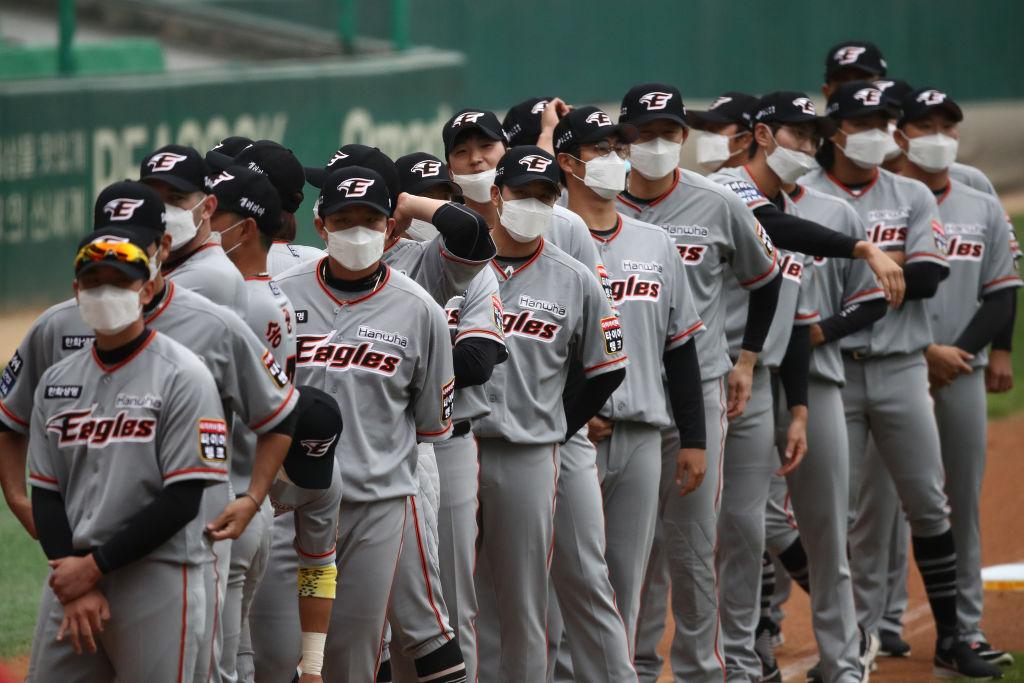
Baseball, however, is already showing some signs of relaxing the restrictions of its peer league; it’s playing games at five venues—as opposed to one—and is now considering whether to open its stadiums to 250 fans per game.
The baseball league banned common practices like high-fiving and spitting, but players are obeying the directives to varying degrees. For instance, all attempts at social distancing became moot during an April 19 game, when two teams engaged in a bench-clearing brawl.
Neither league has conducted universal coronavirus testing of staff or players, but both said they would postpone games if someone affiliated with the league fell ill and tested positive for the coronavirus.
The return of Taiwan’s professional sports was, in large part, the result of its effective handling of the pandemic. Thus far, the self-governed region has recorded 436 cases of coronavirus with six deaths and hasn’t had to shut down its economy.
Baseball and soccer in South Korea
In recent months, South Korea too has tamed its coronavirus outbreak; it even held a national election with record turnout on April 15.
Now, it appears, the country is ready for sports. On May 5 and May 8, the South Korean KBO baseball league and K-League soccer, respectively, will resume play after months of delays.
The sporting events will not have any fans in attendance and will require players to undergo daily temperature screenings. South Korean authorities have said that if any players show symptoms of the virus, they will be immediately tested and quarantined, and games will be postponed if a player or staff member tests positive.
If the leagues successfully resume play this week, they may be seen by more viewers than ever before. ESPN on Monday struck a deal with South Korea’s baseball league for English-language rights to games and highlights for the 2020 season. Starting with opening day on Tuesday, ESPN will air six games per week live, with the first pitch between 1 a.m. and 5:30 a.m. ET. The deal seems to leave leeway for ESPN to return to its typical slate of live sports, should U.S. leagues make a comeback. Its announcement noted that the telecast schedule for Korean baseball is subject to change “pending future live event considerations.”
South Korea’s soccer league has already struck a deal with 10 overseas markets for rights to air its games, though the U.S. wasn’t part of the agreement.
Basketball in China
The fate of China’s basketball league, however, has provided a cautionary tale for league officials elsewhere about the tricky nature of adapting to the risks of a virus that’s not well understood.
China, which has reported dwindling numbers of coronavirus patients since early March, still doesn’t have a firm start date for its basketball league, the Chinese Basketball Association (CBA). The league initially planned to return to play on April 15, after it suspended games for months during the country’s outbreak. Like their counterparts in Taiwan, officials had been aiming to create a bubble atmosphere for the games, limiting the 20 teams to playing at two sites without fans. However, owing to government orders, league officials are now instead targeting a July start date.
In its statement on March 31, China’s official sports body said that sports leagues, including the CBA, would be indefinitely suspended as a means to enhance China’s “epidemic prevention and control efforts.” But sources told ESPN that Chinese sports officials who made the decision were concerned about the potential for asymptomatic carriers to spread the virus if the league was allowed to resume play.
The danger of asymptomatic carriers is causing a similar holdup in the NBA’s plan to restart games. The league does not believe monitoring symptoms and temperatures will be enough to ensure the health and safety of its players and personnel, since some carriers show neither, according to ESPN. The NBA forecasts it will need roughly 15,000 coronavirus tests to conduct regular testing before its season can resume. Right now, it’s not purchasing any tests, and it won’t do so until the larger health system has enough capacity to address the needs of the general public.
More coronavirus coverage from Fortune:
—The Rebuild Program: A project to help small businesses reopen amid a pandemic
—Saving lives vs. saving the economy is a false tradeoff, economists say
—When government fails businesses, communities can step up to help them thrive
—Unemployment claims are taking some states weeks to process. What to know
—Inside China’s reopening: 7 personal stories of life after lockdown
—Gilead’s remdesivir won’t be a COVID-19 miracle cure, but it’s an important first step
—Work from home, online grocery shopping, cord cutting: Which coronavirus trends will stick
—PODCAST: How 2 CEOs outside health care decided to pivot to fight COVID-19
—WATCH: Fortune’s top 10 heroes of the coronavirus pandemic
Subscribe to How To Reopen, Fortune’s weekly newsletter on what it takes to reboot business in the midst of a pandemic