• Home
  • Latest
  • Fortune 500
  • Finance
  • Tech
  • Leadership
  • Lifestyle
  • Rankings
  • Multimedia
Commentary

Immigrant Farm Workers Endure Inhumane Conditions. Here’s What We Can Do

By
Gene Baur
Gene Baur
and
Bethany Cianciolo
Bethany Cianciolo
Down Arrow Button Icon
By
Gene Baur
Gene Baur
and
Bethany Cianciolo
Bethany Cianciolo
Down Arrow Button Icon
June 8, 2018, 11:26 AM ET
Operations During An Asparagus Harvest And Packing Facility As Export Value Increases
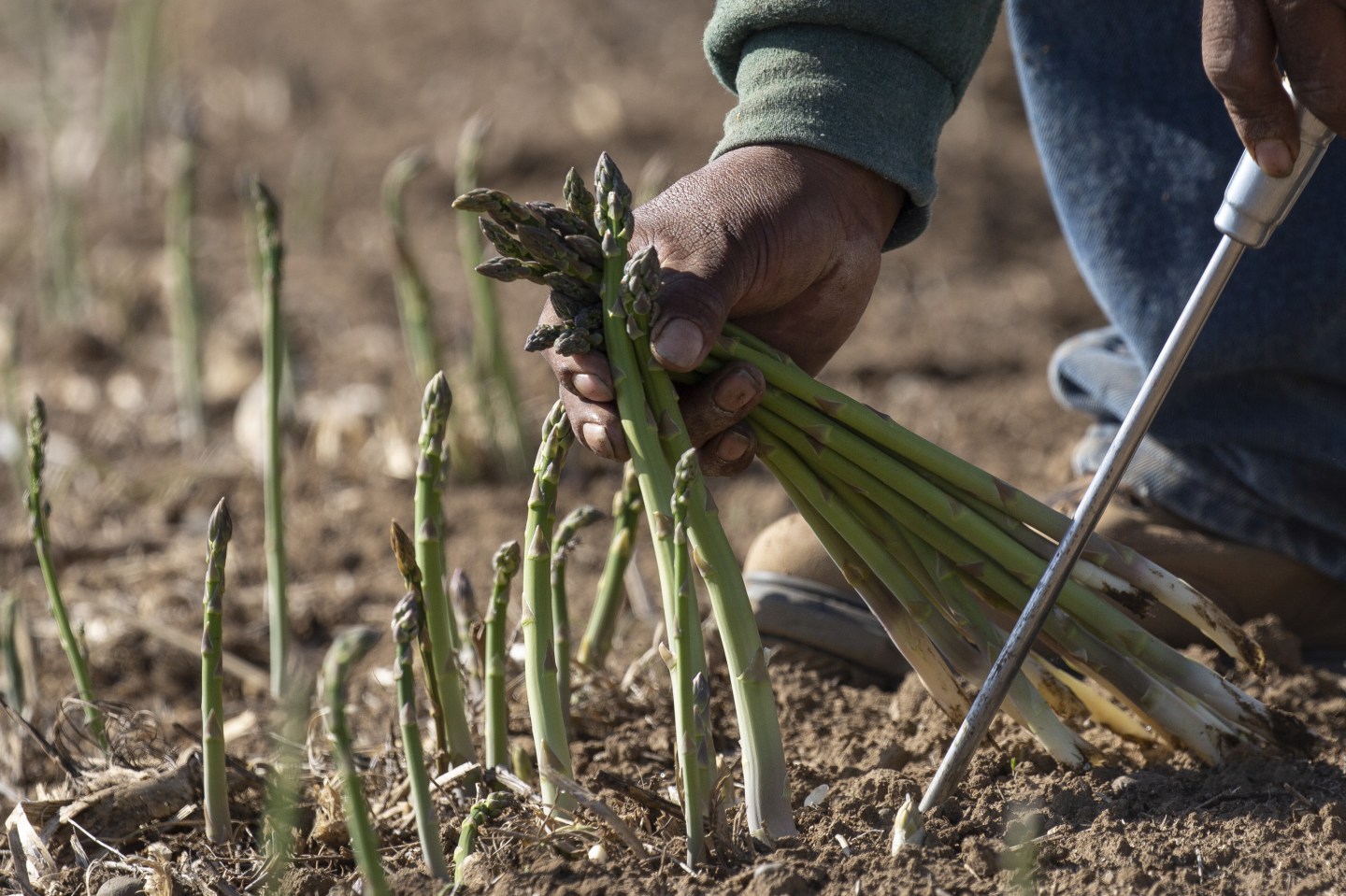
A worker picks asparagus at the Imperial's Garden farm in Wapato, Washington, U.S., on Thursday, April 26, 2018. Washington is second only to California in asparagus production. Nearly 5000 acres of asparagus are grown in the state. Photographer: David Ryder/Bloomberg via Getty ImagesDavid Ryder—Bloomberg via Getty Images

Industrialized agriculture depends on a ready source of cheap labor, and factory farms across the United States have a long history of exploiting immigrants to provide this need. The U.S. government has enacted many measures to support agribusiness, including programs to supply manual labor from other countries. In the 1940s, the Bracero Program, translated in Spanish as “one who works with their arms,” was created to supply foreign workers to U.S. farms. In the 1960s, it became the H-2A visa program, which remains in place today, amid contentious debates now taking place in Washington, D.C.

U.S. immigration policy and its connection to our industrialized food system is an evolving and unresolved topic, and was a key reason for the demise of the massive Farm Bill in the U.S. House of Representatives earlier this year as legislators pressed for votes on immigration policy. The Farm Bill comes up every five years and governs U.S. agriculture policy, directing billions of dollars in subsidies that have shaped our industrialized food system. While the Farm Bill doesn’t explicitly address immigration, it supports an agribusiness model that depends on cheap foreign labor. The president says he wants to reform the agricultural immigrant worker program, while members of Congress are weighing many divergent interests, including those of families who have been torn apart.

Agribusiness wants easy access to inexpensive foreign labor, while human rights and justice advocates are concerned about dangerous and abusive conditions that immigrants endure. Undercurrents of racism and systemic injustice permeate the field, although these biases usually exist subconsciously. On occasion, Donald Trump has made impudent remarks, which rather than raising awareness or opening a dialogue, have tended to affirm unconscious biases.

Whether legally sanctioned or not, inhumane labor practices are woven into the fabric of American agriculture, and represent a fundamental element of our mass-produced, cheap food system. Farm and slaughterhouse workers don’t have adequate legal protections, and they also experience illegal abuses that the media is starting to address.

In April, PBS’ Frontline aired a troubling story, “Trafficked in America,” exposing an underground operation to supply workers from Latin America to factory egg farms in the Midwest. People went into debt so family members, often teenagers, could travel to the U.S., believing they’d have a good job and opportunities. Instead, these immigrants were deceived, overworked and unable to escape their hardship, essentially held as indentured servants. This callous system wants to extract as much profit as possible, and it shows little or no regard for the dignity and welfare of exploited individuals. It lacks empathy for human and nonhuman animals alike.

Last year, The New Yorker published an expose about labor abuses in the chicken industry and explained how a poultry company “built its business by recruiting some of the world’s most vulnerable immigrants, who endure harsh and at times illegal conditions that few Americans would put up with.” It’s an apt description and a common strategy. Disempowered workers with limited access to resources are especially susceptible to exploitation, and profit-driven corporations are quick to take advantage. Economic priorities tend to trump ethical offenses. In recent months, there have been news reports about big rigs smuggling immigrants into the U.S., including a case in Texas involving dozens of people, 10 who died, being transported as cargo in a semi-trailer.

Besides enduring treacherous journeys to America’s farms and slaughterhouses, foreign workers are also subjected to atrocious working conditions, suffering in secret. After investigating conditions for agricultural workers, Oxfam America released a report that describes how poultry slaughterhouse workers were denied adequate bathroom breaks, stating: “Workers struggle to cope with this denial of a basic human need. They urinate and defecate while standing on the line; they wear diapers to work; they restrict intake of liquids and fluids to dangerous degrees; they endure pain and discomfort while they worry about their health and job security. And it’s not just their dignity that suffers: they are in danger of serious health problems.”


The way we produce food in the U.S. today, driven by the goal of maximizing profit, has led to numerous affronts to basic human decently, and these have tragically become the norm. The greed of intensive industrial agriculture bears most of the responsibility, but we are each involved as citizens and as consumers. Our elected officials should be challenged if they continue passing legislation that enables factory farms to operate so irresponsibility. We need to show up and vote in elections. We also need to consider how we vote with our dollars. Purchasing food from abusive businesses supports and enables them to continue with their despicable cruelties.

Each of us, every day, can make a difference by eschewing industrialized agriculture, and instead, purchasing food from more transparent and responsible businesses, such as those that operate at farmers’ markets and through community supported agriculture programs (CSAs). It might even be possible to grow some of our own food through community or urban gardens, or in yards or containers. Whatever the case, we should recognize and take responsibility for the impacts of our daily food choices, and try to live by the adage, “Think globally, act locally.”

Gene Baur is president and co-founder of Farm Sanctuary and a faculty member at the Johns Hopkins Bloomberg School of Public Health.


About the Authors
By Gene Baur
See full bioRight Arrow Button Icon
By Bethany Cianciolo
See full bioRight Arrow Button Icon

Latest in Commentary

Finance
Lorem ipsum dolor sit amet, consectetur adipiscing elit, sed do eiusmod tempor incididunt ut labore et dolore magna aliqua. Ut enim ad minim veniam
By Fortune Editors
October 20, 2025
Finance
Lorem ipsum dolor sit amet, consectetur adipiscing elit, sed do eiusmod tempor incididunt ut labore et dolore magna aliqua. Ut enim ad minim veniam
By Fortune Editors
October 20, 2025
Finance
Lorem ipsum dolor sit amet, consectetur adipiscing elit, sed do eiusmod tempor incididunt ut labore et dolore magna aliqua. Ut enim ad minim veniam
By Fortune Editors
October 20, 2025
Finance
Lorem ipsum dolor sit amet, consectetur adipiscing elit, sed do eiusmod tempor incididunt ut labore et dolore magna aliqua. Ut enim ad minim veniam
By Fortune Editors
October 20, 2025
Finance
Lorem ipsum dolor sit amet, consectetur adipiscing elit, sed do eiusmod tempor incididunt ut labore et dolore magna aliqua. Ut enim ad minim veniam
By Fortune Editors
October 20, 2025
Finance
Lorem ipsum dolor sit amet, consectetur adipiscing elit, sed do eiusmod tempor incididunt ut labore et dolore magna aliqua. Ut enim ad minim veniam
By Fortune Editors
October 20, 2025

Most Popular

Finance
Lorem ipsum dolor sit amet, consectetur adipiscing elit, sed do eiusmod tempor incididunt ut labore et dolore magna aliqua. Ut enim ad minim veniam
By Fortune Editors
October 20, 2025
Finance
Lorem ipsum dolor sit amet, consectetur adipiscing elit, sed do eiusmod tempor incididunt ut labore et dolore magna aliqua. Ut enim ad minim veniam
By Fortune Editors
October 20, 2025
Finance
Lorem ipsum dolor sit amet, consectetur adipiscing elit, sed do eiusmod tempor incididunt ut labore et dolore magna aliqua. Ut enim ad minim veniam
By Fortune Editors
October 20, 2025
Finance
Lorem ipsum dolor sit amet, consectetur adipiscing elit, sed do eiusmod tempor incididunt ut labore et dolore magna aliqua. Ut enim ad minim veniam
By Fortune Editors
October 20, 2025
Finance
Lorem ipsum dolor sit amet, consectetur adipiscing elit, sed do eiusmod tempor incididunt ut labore et dolore magna aliqua. Ut enim ad minim veniam
By Fortune Editors
October 20, 2025
Finance
Lorem ipsum dolor sit amet, consectetur adipiscing elit, sed do eiusmod tempor incididunt ut labore et dolore magna aliqua. Ut enim ad minim veniam
By Fortune Editors
October 20, 2025
Fortune Secondary Logo
Rankings
  • 100 Best Companies
  • Fortune 500
  • Global 500
  • Fortune 500 Europe
  • Most Powerful Women
  • Future 50
  • World’s Most Admired Companies
  • See All Rankings
Sections
  • Finance
  • Fortune Crypto
  • Features
  • Leadership
  • Health
  • Commentary
  • Success
  • Retail
  • Mpw
  • Tech
  • Lifestyle
  • CEO Initiative
  • Asia
  • Politics
  • Conferences
  • Europe
  • Newsletters
  • Personal Finance
  • Environment
  • Magazine
  • Education
Customer Support
  • Frequently Asked Questions
  • Customer Service Portal
  • Privacy Policy
  • Terms Of Use
  • Single Issues For Purchase
  • International Print
Commercial Services
  • Advertising
  • Fortune Brand Studio
  • Fortune Analytics
  • Fortune Conferences
  • Business Development
About Us
  • About Us
  • Editorial Calendar
  • Press Center
  • Work At Fortune
  • Diversity And Inclusion
  • Terms And Conditions
  • Site Map
Fortune Secondary Logo
  • About Us
  • Editorial Calendar
  • Press Center
  • Work At Fortune
  • Diversity And Inclusion
  • Terms And Conditions
  • Site Map
  • Facebook icon
  • Twitter icon
  • LinkedIn icon
  • Instagram icon
  • Pinterest icon

Latest in Commentary

putin
CommentaryRussia
Exclusive analysis: we looked at the 400 western firms still in Russia. Their paltry size strips Putin’s bluff bare naked
By Jeffrey Sonnenfeld, Stephen Henriques, Jake Waldinger and Giuseppe ScottoFebruary 27, 2026
3 hours ago
roth
CommentaryLeadership
The AI resource reallocation challenge: How can companies capture the value of time?
By Erik RothFebruary 27, 2026
5 hours ago
will
CommentaryAdvertising
I’m one of America’s top pollsters and I’ve got a warning for the AI companies: customers aren’t sold on ads
By Will JohnsonFebruary 27, 2026
8 hours ago
the pitt
CommentaryDEI
‘The Pitt’: a masterclass display of DEI in action 
By Robert RabenFebruary 26, 2026
1 day ago
david booth
CommentaryMarkets
3 lessons from investing’s ‘moneyball’ moment
By David BoothFebruary 25, 2026
2 days ago
CommentaryCulture
Gen Z’s enthusiasm for all things touchable is resurrecting the analog economy—and costing parents
By Luba KassovaFebruary 24, 2026
3 days ago

Most Popular

placeholder alt text
Innovation
An MIT roboticist who cofounded bankrupt robot vacuum maker iRobot says Elon Musk’s vision of humanoid robot assistants is ‘pure fantasy thinking’
By Marco Quiroz-GutierrezFebruary 25, 2026
2 days ago
placeholder alt text
Success
Jeff Bezos says being lazy, not working hard, is the root of anxiety: ‘The stress goes away the second I take that first step’
By Sydney LakeFebruary 25, 2026
2 days ago
placeholder alt text
Economy
Trump claims America is ‘winning so much.’ The IMF agrees, adding that Trump’s trade policies are the only thing holding it back from even more
By Tristan BoveFebruary 26, 2026
21 hours ago
placeholder alt text
Success
Gen Z Olympic champion Eileen Gu says she rewires her brain daily to be more successful—and multimillionaire founder Arianna Huffington says it really does work
By Orianna Rosa RoyleFebruary 25, 2026
2 days ago
placeholder alt text
AI
Jamie Dimon says society should start preparing for AI job displacement: ‘Now’s the time to start thinking about’ it
By Marco Quiroz-GutierrezFebruary 25, 2026
2 days ago
placeholder alt text
Success
Ex–presidential candidate Andrew Yang warns that millions of white-collar workers will lose their jobs within 18 months: ‘The AI jobpocalypse is here’
By Preston ForeFebruary 25, 2026
2 days ago

© 2026 Fortune Media IP Limited. All Rights Reserved. Use of this site constitutes acceptance of our Terms of Use and Privacy Policy | CA Notice at Collection and Privacy Notice | Do Not Sell/Share My Personal Information
FORTUNE is a trademark of Fortune Media IP Limited, registered in the U.S. and other countries. FORTUNE may receive compensation for some links to products and services on this website. Offers may be subject to change without notice.