• Home
  • Latest
  • Fortune 500
  • Finance
  • Tech
  • Leadership
  • Lifestyle
  • Rankings
  • Multimedia

Trendingnow

1

MacKenzie Scott alone accounted for one-third of America's $19.2 billion in megagifts last year

2

As Big Tech showers employees with perks to win the talent war, Nvidia built a nearly $5 trillion company by making people pay for their own lunch

3

Philanthropy leader at Warren Buffett and Bill Gates’ Giving Pledge says children of billionaires are pushing them to give their wealth away faster

1

MacKenzie Scott alone accounted for one-third of America's $19.2 billion in megagifts last year

2

As Big Tech showers employees with perks to win the talent war, Nvidia built a nearly $5 trillion company by making people pay for their own lunch

3

Philanthropy leader at Warren Buffett and Bill Gates’ Giving Pledge says children of billionaires are pushing them to give their wealth away faster
Commentaryquantum computing

Commentary: These Next-Generation Supercomputers Are So Hot They Need to Run in a Freezer

By
Vivek Wadhwa
Vivek Wadhwa
,
Alex Salkever
Alex Salkever
, and
Bethany Cianciolo
Bethany Cianciolo
Down Arrow Button Icon
By
Vivek Wadhwa
Vivek Wadhwa
,
Alex Salkever
Alex Salkever
, and
Bethany Cianciolo
Bethany Cianciolo
Down Arrow Button Icon
January 17, 2018, 3:58 PM ET
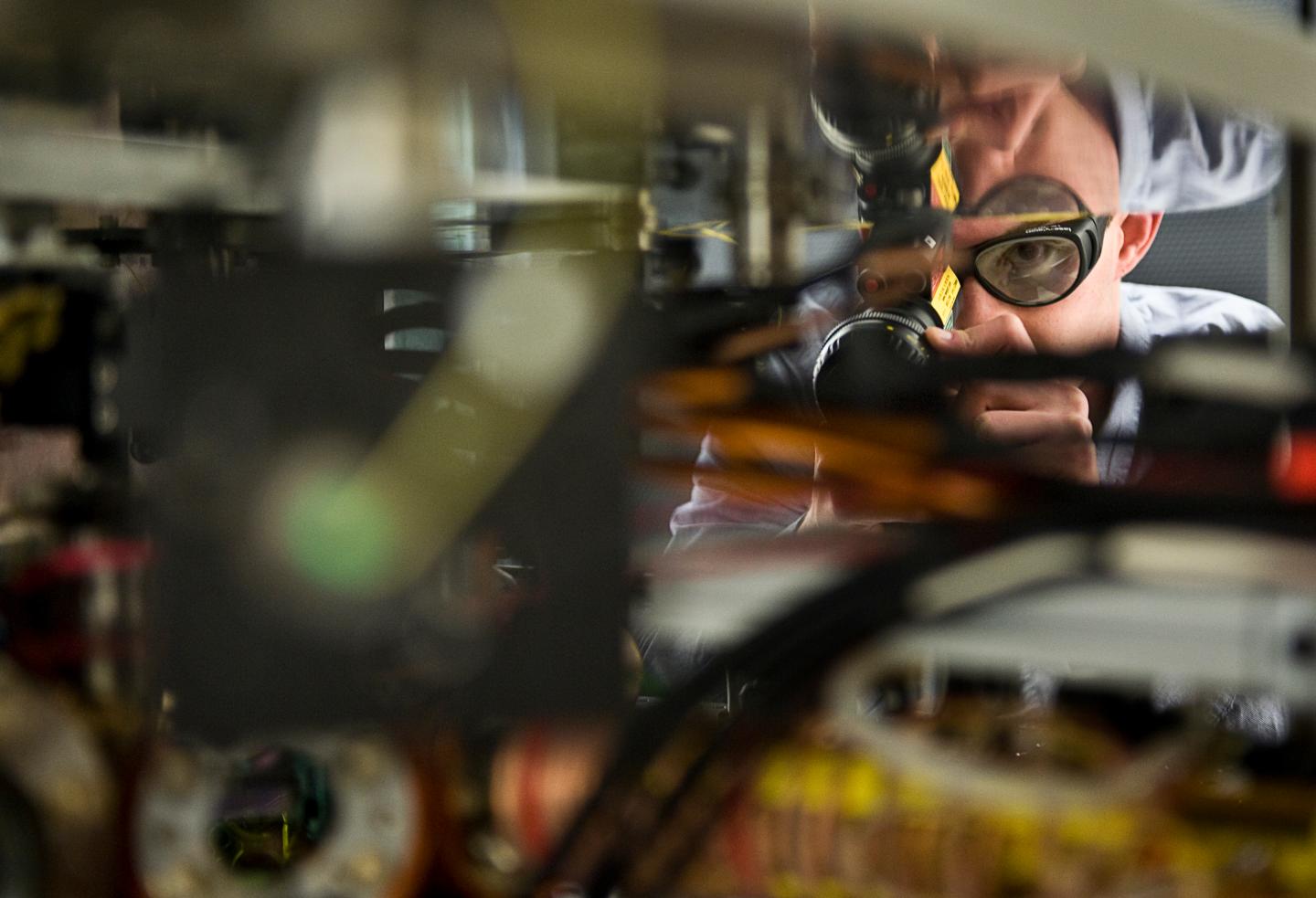
Ari Dyckovsky is a finalist in the Intel Science Talent search
GAITHERSBURG,MD - March, 5:Ari Dyckovsky, 17, works on quantum physics experiments in the Physical Measurement Lab that deals with quantum computing and simulation Monday March 5, 2012 in Gaithersburg, MD at NIST, National Institute of Standards and Technology. Ari Dyckovsky is a finalist in the Intel Science Talent search.(Photo by Katherine Frey/The Washington Post via Getty Images)Katherine Frey—The Washington Post/Getty Images
Add Fortune on Google for similar content.

While much of the media attention has been focused on the race among nations to develop the most powerful artificial intelligence systems, an equally crucial race has been heating up: the race to build the first working quantum computers.

As progress in the field accelerates at an exponential rate, 2018 should see an avalanche of breakthroughs. It is a race for so-called “quantum supremacy,” when a quantum computer demonstrably and markedly outperforms a classical supercomputer for any class of problems.

Booth Google (GOOG) and IBM (IBM), two leaders in quantum computing, have laid out plans to achieve this goal. Intel (INTC) also has a horse in the race, announcing a new 49 qubit neuromorphic chip designed for quantum computing research at the annual Consumer Electronics Show in Las Vegas last week.

The stakes are enormous. Quantum computers promise to set a new paradigm for solving some of the hardest math and computing problems today—problems such as analyzing the interactions of multiple genes in health outcomes, modeling the energy states of chemicals, and predicting the behavior of atomic particles. They also might make the Internet inherently insecure by quickly cracking modern cryptography used to lock our IT infrastructure and the web.

One thing is for sure: The era of quantum computing is coming on soon, and the world will never be the same.

Put simply, quantum computers use a unit of computing called a qubit. While regular semiconductors represent information as a series of 1s and 0s, qubits exhibit quantum properties and can compute as both a 1 and a 0 simultaneously. That means two qubits could represent the sequence 1-0, 1-1, 0-1, 0-0 at the same moment in time. This compute power increases exponentially with each qubit. A quantum computer with as few as 50 qubits could, in theory, pack more computing power than the most powerful supercomputers on earth today.

This comes at a timely juncture. Moore’s Law dictated that computing power per unit would double every 18 months while the price per computing unit would drop by half. While Moore’s Law has largely held true, the amount of money required to squeeze out these improvements is now significantly greater than it was in the past. In other words, semiconductor companies and researchers must spend more and more money in R&D to achieve each jump in speed. Quantum computing, on the other hand, is in rapid ascent.

One company, D-Wave Systems, is selling a quantum computer that it says has 2,000 qubits. However, D-Wave computers are controversial. While some researchers have found good uses for D-Wave machines, these quantum computers have not beaten classical computers and are only useful for certain classes of problems—optimization problems. Optimization problems involve finding the best possible solution from all feasible solutions. So, for example, complex simulation problems with multiple viable outcomes may not be as easily addressable with a D-Wave machine. The way D-Wave performs quantum computing, as well, is not considered to be the most promising for building a true supercomputer-killer.

Google, IBM, and a number of startups are working on quantum computers that promise to be more flexible and likely more powerful because they will work on a wider variety of problems. A few years ago, these flexible machines of two or four qubits were the norm. During the past year, company after company has announced more powerful quantum computers. In November 2017, IBM announced that it has built such a quantum machine that uses 50 qubits, breaking the critical barrier beyond which scientists believe quantum computers will shoot past traditional supercomputers.

The downside? The IBM machine can only maintain a quantum computing state for 90 microseconds at a time. This instability, in fact, is the general bane of quantum computing. The machines must be super-cooled to work, and a separate set of calculations must be run to correct for errors in calculations due to the general instability of these early systems. That said, scientists are making rapid improvements to the instability problem and hope to have a working quantum computer running at room temperature within five years.

And here’s where the confluence of quantum computing and AI looks so promising. As we are seeing the first major impacts of wide-scale artificial intelligence, we are also realizing that classic semiconductor-based computing limits our ability to solve the biggest problems that we had hoped artificial intelligence could tackle. They expect quantum computers to start performing very useful calculations well before they’re ready to leave the freezer.


Quantum computing promises to step into that breach and provide the rocket fuel needed to solve these grand challenges. Precisely targeted medical treatments, radically cheaper energy production, and new types of super-strong materials are all breakthroughs that quantum computing could make possible by performing billions and billions of calculations simultaneously in a relatively small package. Google researchers demonstrated the promise when they used quantum computing to simulate the electron structure of a hydrogen molecule, a key step toward moving chemical design from empirical measurement and educated guesses to more proper engineering and simulation. (This will also work for drug discovery.)

The perils of quantum computing are also real. Quantum computers will be able to easily crack most forms of encryption in use today (although security experts are already at work on creating codes that are not crackable by qubit attack). Should Russia or China, for example, gain quantum computing dominance—which is entirely possible—they could use their advantage for even more sophisticated hacking and decrypting of encoded communications.

Between governments, big companies, startups, and university labs, some of the brightest engineering minds are rushing toward quantum supremacy. This literally could shift the global balance of power.

Vivek Wadhwa is a distinguished fellow at Carnegie Mellon University’s College of Engineering and Alex Salkever is an author, public speaker, and former vice president of marketing at Mozilla. Together they authored The Driver in the Driverless Car: How Our Technology Choices Will Create the Future.

About the Authors
By Vivek Wadhwa
See full bioRight Arrow Button Icon
By Alex Salkever
See full bioRight Arrow Button Icon
By Bethany Cianciolo
See full bioRight Arrow Button Icon
Add Fortune on Google for similar content.

Latest in Commentary

Finance
Lorem ipsum dolor sit amet, consectetur adipiscing elit, sed do eiusmod tempor incididunt ut labore et dolore magna aliqua. Ut enim ad minim veniam
By Fortune Editors
October 20, 2025
Finance
Lorem ipsum dolor sit amet, consectetur adipiscing elit, sed do eiusmod tempor incididunt ut labore et dolore magna aliqua. Ut enim ad minim veniam
By Fortune Editors
October 20, 2025
Finance
Lorem ipsum dolor sit amet, consectetur adipiscing elit, sed do eiusmod tempor incididunt ut labore et dolore magna aliqua. Ut enim ad minim veniam
By Fortune Editors
October 20, 2025
Finance
Lorem ipsum dolor sit amet, consectetur adipiscing elit, sed do eiusmod tempor incididunt ut labore et dolore magna aliqua. Ut enim ad minim veniam
By Fortune Editors
October 20, 2025
Finance
Lorem ipsum dolor sit amet, consectetur adipiscing elit, sed do eiusmod tempor incididunt ut labore et dolore magna aliqua. Ut enim ad minim veniam
By Fortune Editors
October 20, 2025
Finance
Lorem ipsum dolor sit amet, consectetur adipiscing elit, sed do eiusmod tempor incididunt ut labore et dolore magna aliqua. Ut enim ad minim veniam
By Fortune Editors
October 20, 2025

Most Popular

Finance
Lorem ipsum dolor sit amet, consectetur adipiscing elit, sed do eiusmod tempor incididunt ut labore et dolore magna aliqua. Ut enim ad minim veniam
By Fortune Editors
October 20, 2025
Finance
Lorem ipsum dolor sit amet, consectetur adipiscing elit, sed do eiusmod tempor incididunt ut labore et dolore magna aliqua. Ut enim ad minim veniam
By Fortune Editors
October 20, 2025
Finance
Lorem ipsum dolor sit amet, consectetur adipiscing elit, sed do eiusmod tempor incididunt ut labore et dolore magna aliqua. Ut enim ad minim veniam
By Fortune Editors
October 20, 2025
Finance
Lorem ipsum dolor sit amet, consectetur adipiscing elit, sed do eiusmod tempor incididunt ut labore et dolore magna aliqua. Ut enim ad minim veniam
By Fortune Editors
October 20, 2025
Finance
Lorem ipsum dolor sit amet, consectetur adipiscing elit, sed do eiusmod tempor incididunt ut labore et dolore magna aliqua. Ut enim ad minim veniam
By Fortune Editors
October 20, 2025
Finance
Lorem ipsum dolor sit amet, consectetur adipiscing elit, sed do eiusmod tempor incididunt ut labore et dolore magna aliqua. Ut enim ad minim veniam
By Fortune Editors
October 20, 2025
Fortune Secondary Logo
Rankings
  • 100 Best Companies
  • Fortune 500
  • Global 500
  • Fortune 500 Europe
  • Most Powerful Women
  • World's Most Admired Companies
  • See All Rankings
  • Lists Calendar
Sections
  • Finance
  • Fortune Crypto
  • Features
  • Leadership
  • Health
  • Commentary
  • Success
  • Retail
  • Mpw
  • Tech
  • Lifestyle
  • CEO Initiative
  • Asia
  • Politics
  • Conferences
  • Europe
  • Newsletters
  • Personal Finance
  • Environment
  • Magazine
  • Education
Customer Support
  • Frequently Asked Questions
  • Customer Service Portal
  • Privacy Policy
  • Terms Of Use
  • Single Issues For Purchase
  • International Print
Commercial Services
  • Advertising
  • Fortune Brand Studio
  • Fortune Analytics
  • Fortune Conferences
  • Business Development
  • Group Subscriptions
About Us
  • About Us
  • Press Center
  • Work At Fortune
  • Terms And Conditions
  • Site Map
  • About Us
  • Press Center
  • Work At Fortune
  • Terms And Conditions
  • Site Map
  • Facebook icon
  • Twitter icon
  • LinkedIn icon
  • Instagram icon
  • Pinterest icon

Latest in Commentary

senate
CommentaryCongress
One rare bipartisan AI bill is moving through Congress. Here’s why it deserves to pass
By Neil Björkman and Betsy BrewerJuly 1, 2026
12 hours ago
I know how Gen Z can survive the ‘jobpocalypse’ because I built an AI company — in 2015
CommentaryCareers
I know how Gen Z can survive the ‘jobpocalypse’ because I built an AI company — in 2015
By Jeremy FainJuly 1, 2026
13 hours ago
mr
Commentary250 Years of Innovation
America needs 3.8 million manufacturing workers. This CEO has a blueprint to find them
By Mark RayfieldJuly 1, 2026
13 hours ago
usa
Commentary250 Years of Innovation
America at 250: why the Constitution was built to restrain government, not celebrate majority rule
By Steve H. HankeJuly 1, 2026
13 hours ago
t
CommentaryMedia
Netflix could turn NBC into its biggest bet yet — and this time, the math actually works
By Jeffrey Sonnenfeld and Steven TianJune 30, 2026
1 day ago
wb
CommentaryLeadership
I grew BDO from $600 million to $3.4 billion. Here’s the 3-part formula that made it possible
By Wayne BersonJune 30, 2026
1 day ago

Most Popular

MacKenzie Scott alone accounted for one-third of America's $19.2 billion in megagifts last year
Success
MacKenzie Scott alone accounted for one-third of America's $19.2 billion in megagifts last year
By Sydney LakeJune 25, 2026
7 days ago
As Big Tech showers employees with perks to win the talent war, Nvidia built a nearly $5 trillion company by making people pay for their own lunch
Big Tech
As Big Tech showers employees with perks to win the talent war, Nvidia built a nearly $5 trillion company by making people pay for their own lunch
By Marco Quiroz-GutierrezJuly 1, 2026
16 hours ago
Philanthropy leader at Warren Buffett and Bill Gates’ Giving Pledge says children of billionaires are pushing them to give their wealth away faster
Success
Philanthropy leader at Warren Buffett and Bill Gates’ Giving Pledge says children of billionaires are pushing them to give their wealth away faster
By Preston ForeJune 27, 2026
5 days ago
The Supreme Court's birthright citizenship ruling hands the U.S. economy a $7.7 trillion win
Newsletters
The Supreme Court's birthright citizenship ruling hands the U.S. economy a $7.7 trillion win
By Diane BradyJuly 1, 2026
14 hours ago
Elon Musk on MacKenzie Scott giving away $26 billion of her fortune: 'Sadly,' it makes the world a worse place
Success
Elon Musk on MacKenzie Scott giving away $26 billion of her fortune: 'Sadly,' it makes the world a worse place
By Sydney LakeJune 29, 2026
2 days ago
The U.S. Army is opening military bases to private billions — here's why that changes everything for the next 250 years
Commentary
The U.S. Army is opening military bases to private billions — here's why that changes everything for the next 250 years
By Marc AndersenJune 30, 2026
1 day ago

© 2026 Fortune Media IP Limited. All Rights Reserved. Use of this site constitutes acceptance of our Terms of Use and Privacy Policy | CA Notice at Collection and Privacy Notice | Do Not Sell/Share My Personal Information
FORTUNE is a trademark of Fortune Media IP Limited, registered in the U.S. and other countries. FORTUNE may receive compensation for some links to products and services on this website. Offers may be subject to change without notice.